
Memory Devices Market Outlook: Size, Share, Trends, Growth Analysis, Competitive Landscape & Forecast, 2026-2033

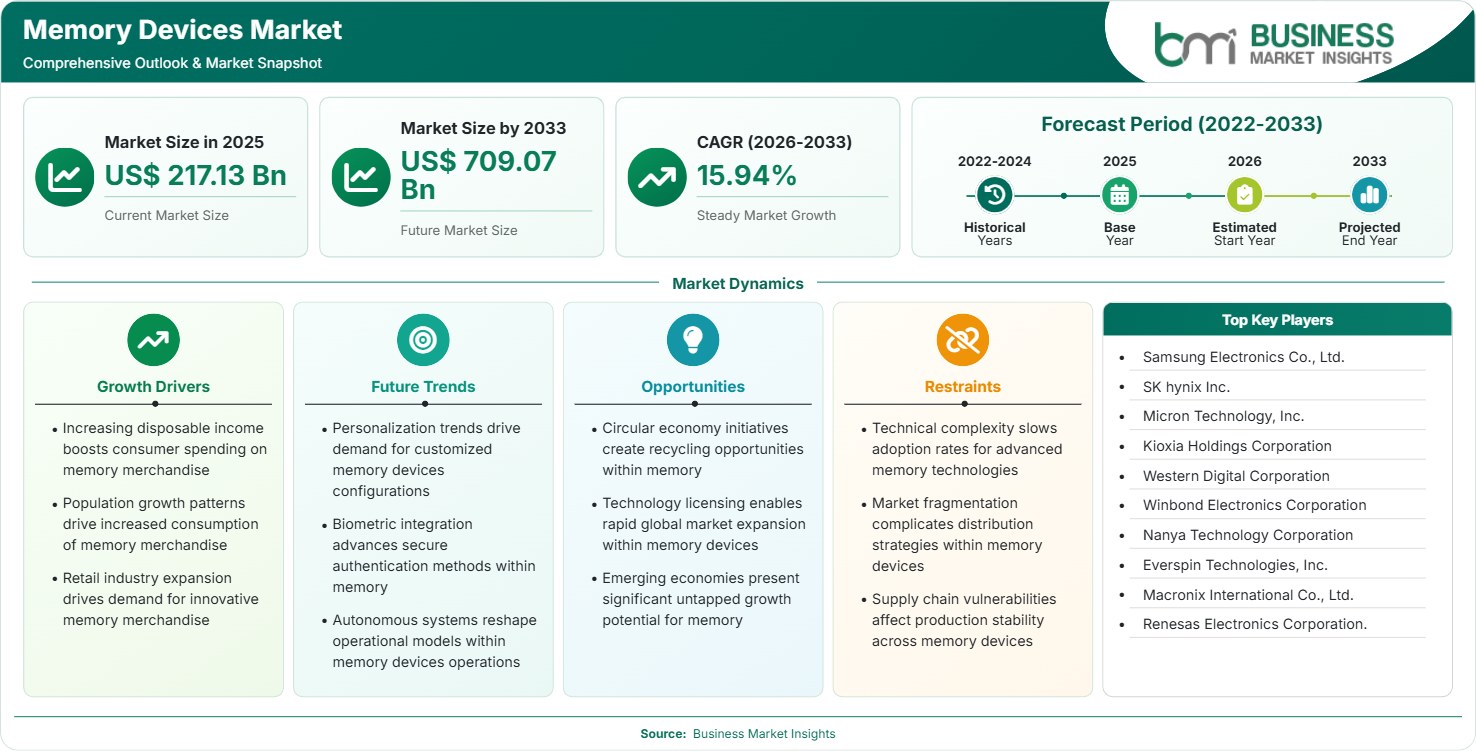
The Memory Devices Market size was valued at US$ 217.13 Billion in 2025 and is projected to reach US$ 709.07 Billion by 2033, growing at a CAGR of 15.94% during 2026–2033. Rising AI server deployments, expanding cloud infrastructure, automotive electronics growth, and next generation non-volatile memory innovation continue creating long-term commercialization and investment opportunities globally.

Report Coverage
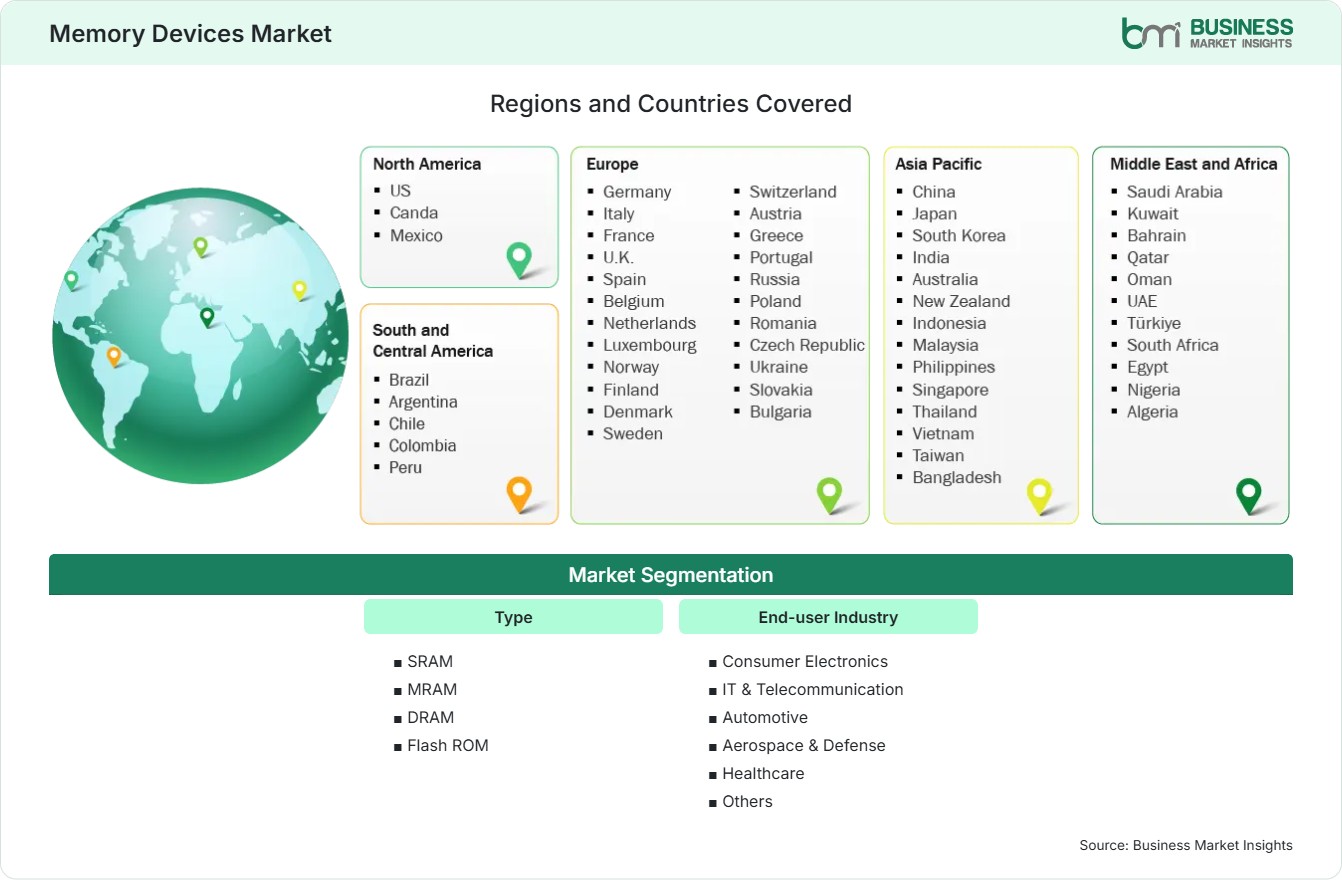
  • Type: SRAM, MRAM, DRAM, Flash ROM
  • End-user Industry: Consumer Electronics, IT & Telecommunication, Automotive, Aerospace & Defense, Healthcare, Others
US$ 217.13 Bn Market size in 2025
US$ 709.07 Bn Market Size by 2033
15.94% CAGR, 2026 - 2033
2026-2033 Forecast Period

AI Overview

Memory Devices Market Summary

  • North America Region: North America holds market share of 34%–37% in 2025, growing with a CAGR of 14.8%–16.2% during 2026–2033. Key drivers include AI datacenters, enterprise storage modernization, and advanced semiconductor investments. Opportunities emerge from edge computing expansion and high-bandwidth memory adoption across hyperscale infrastructure worldwide. The U.S. represents 76%–80% of regional demand and advances at 15.0%–16.5% CAGR through sustained AI infrastructure spending.
  • Fastest Growing Region: Asia Pacific holds market share of 29%–32% in 2025 and expands at a CAGR of 17.5%–19.0% during 2026–2033. Semiconductor manufacturing concentration, consumer electronics production, AI hardware investments, and vehicle electrification support demand while government incentives encourage fabrication capacity expansion and technology localization.
  • Leading Segment: DRAM accounts for 39%–43% market share in 2025 and grows at 15.5%–16.8% CAGR. Increasing requirements for AI accelerators, smartphones, servers, gaming systems, and high-performance computing workloads sustain volume demand and technology migrations toward higher-density memory architectures globally.
  • High Growth Segment: Automotive holds 12%–15% market share in 2025 and advances at 18.5%–20.0% CAGR. Autonomous driving systems, electrified vehicles, infotainment upgrades, sensor integration, and safety architectures require increasing memory capacity, reliability, and endurance across electronic platforms.
  • Key Market Opportunity: AI training clusters, edge inference systems, and advanced automotive computing demand larger memory footprints, creating opportunities for high-bandwidth, low-latency, energy-efficient architectures supporting next-generation digital workloads worldwide.
  • Major Market Players: Samsung Electronics Co., Ltd.; SK hynix Inc.; Micron Technology, Inc.; Kioxia Holdings Corporation; Western Digital Corporation; Winbond Electronics Corporation; Nanya Technology Corporation; Everspin Technologies, Inc.; Macronix International Co., Ltd.; Renesas Electronics Corporation.
Strategic Insights

Memory Devices Market: Strategic Insights

Memory Devices Market Strategic Framework
FREE PDF
Request your free sample
Request free sample
Stakeholder View

Key Takeaways

  • The industry value chain is increasingly integrated around wafer fabrication, advanced packaging, controller technologies, and software optimization, creating competitive advantages for vertically integrated semiconductor suppliers.
  • Automotive electronics and AI server applications offer the strongest medium-term upside as memory content per device rises substantially compared with conventional computing environments.
  • Innovation activity is moving toward MRAM, high-bandwidth memory, embedded memory architectures, and low-power designs that support performance-intensive workloads and energy-efficient computing.
  • Asia Pacific presents a compelling investment case due to large-scale semiconductor manufacturing ecosystems, government incentives, electronics production clusters, and rising domestic technology consumption.
  • Strategic investments, joint ventures, and fabrication capacity expansions remain common as manufacturers secure supply, improve technology leadership, and address long-term demand visibility.
  • Reliability-certified memory products for healthcare, aerospace, industrial automation, and mission-critical systems are creating attractive premium-margin opportunities for specialized vendors.
Geographic Outlook

Memory Devices Market Regional Highlights

North America Memory Devices Market

North America accounted for 34%–37% of global demand in 2025 and is projected to expand at a CAGR of 14.8%–16.2% through 2033. Strong cloud infrastructure, AI accelerator deployment, and semiconductor investment programs support adoption. The region benefits from advanced data center concentration and enterprise digital transformation initiatives. The Memory Devices Market share remains highest in this region due to technology leadership, substantial R&D expenditure, and strong presence of hyperscale operators. Demand increasingly centers on high-bandwidth memory, enterprise SSD infrastructure, and low-latency computing systems.

  • AI datacenter expansion continues driving demand for advanced DRAM and flash technologies, particularly across cloud, machine learning, and high-performance computing environments.
  • Semiconductor incentive programs support fabrication investments, helping improve supply security and encourage domestic production capability development.
  • Enterprise modernization initiatives accelerate adoption of next-generation storage and memory architectures across financial services, healthcare, and industrial sectors.
  • Demand for edge computing infrastructure supports deployment of energy-efficient memory devices optimized for real-time processing requirements.

US Memory Devices Market

The U.S. represents 76%–80% of North American Memory Devices Market consumption and advances at a CAGR of 15.0%–16.5% during the forecast period. Strong investments from hyperscale cloud providers, AI developers, and semiconductor manufacturers create sustained demand. Research leadership, semiconductor design expertise, and large-scale data infrastructure support innovation. Adoption is particularly strong across enterprise computing, defense electronics, and advanced automotive technologies, reinforcing the country's strategic role within global memory ecosystems.

  • AI model training clusters require significantly larger memory capacities and higher bandwidth performance, stimulating premium product demand.
  • Advanced defense and aerospace programs emphasize ruggedized and high-reliability memory technologies for mission-critical applications.
  • Automotive software-defined vehicle platforms increasingly integrate memory-intensive architectures for autonomous functionality and real-time analytics.
  • Semiconductor manufacturing investments enhance domestic capacity and supply-chain resilience across critical technology sectors.

Europe Memory Devices Market

Europe held approximately 22%–25% Memory Devices Market share in 2025 and is projected to register a CAGR of 14.0%–15.5% through 2033. Automotive electrification, industrial automation, and semiconductor policy initiatives support demand growth. Germany leads regional consumption, while Eastern European technology hubs and Ireland demonstrate stronger expansion rates. Investments in automotive electronics, Industry 4.0 deployment, and data sovereignty initiatives contribute to adoption. Regional suppliers increasingly prioritize energy-efficient memory solutions aligned with sustainability objectives and advanced manufacturing requirements.

  • Germany remains the largest national market supported by automotive electronics and industrial automation applications.
  • Ireland and several Central European economies exhibit faster adoption driven by technology investments and expanding semiconductor ecosystems.
  • Data localization requirements encourage deployment of regional cloud infrastructure and associated memory-intensive systems.
  • Electrification and connected mobility trends continue increasing memory content within vehicle architectures.
  • Advanced manufacturing digitization creates demand for reliable industrial-grade memory technologies supporting predictive maintenance and automation.

Asia Pacific Memory Devices Market

Asia Pacific accounted for 29%–32% of global Memory Devices Market demand in 2025 and is forecast to grow at the fastest CAGR of 17.5%–19.0% through 2033. The region hosts major semiconductor fabrication facilities, electronics manufacturing centers, and rapidly expanding digital economies. China, South Korea, Japan, and Taiwan dominate production and consumption. Growing smartphone manufacturing, AI infrastructure deployment, and electric vehicle adoption stimulate sustained demand. Regional governments continue supporting semiconductor self-sufficiency programs, strengthening long-term competitive positioning and capacity expansion.

  • China remains the largest consumption market due to electronics manufacturing scale and cloud infrastructure expansion.
  • India demonstrates one of the fastest growth trajectories supported by digitalization, data centers, and semiconductor initiatives.
  • South Korea and Taiwan maintain leadership in advanced memory production technologies and export-oriented manufacturing chains.
  • AI servers, consumer electronics, and industrial automation collectively create broad-based demand momentum.
  • Government-backed semiconductor investment programs accelerate technology development and localized supply ecosystems.

Rest of World Memory Devices Market

Rest of World represents approximately 10%–13% of global demand in 2025 and is expected to expand at a CAGR of 13.0%–14.5% through 2033. South and Central America benefit from growing digital infrastructure and electronics consumption. Meanwhile, Middle East and Africa markets gain momentum from smart city projects, telecommunications expansion, and cloud investments. Brazil is the leading market in Latin America, while the UAE and Saudi Arabia demonstrate stronger growth rates through technology modernization and data center development programs.

  • Smart city projects increase deployment of connected systems requiring reliable storage and memory technologies.
  • Telecommunications modernization and 5G rollout generate demand for networking infrastructure with higher memory requirements.
  • Brazil remains the foremost regional market supported by enterprise and consumer technology adoption.
  • Gulf economies continue investing in digital services, AI initiatives, and cloud infrastructure development.
  • Industrial diversification strategies improve opportunities for semiconductor and electronics ecosystem participants.
Global Market Geography
FREE PDF
Request your free sample
Request free sample
Segment Analysis

Memory Devices Market Segmentation

Type

Type segment accounted for all industry revenues, with DRAM emerging as the dominant category at 39%–43% share in 2025 and projected CAGR of 15.5%–16.8%. The Memory Devices Market scope continues expanding through diversified memory architectures optimized for performance, endurance, and energy efficiency. AI computing, edge processing, connected devices, and advanced storage applications support demand across volatile and non-volatile technologies.

  • SRAM: Utilized extensively in processors and cache applications where ultra-fast access speeds are required. Demand benefits from AI processing, advanced CPUs, and high-performance computing environments requiring low latency.
  • MRAM: Gains traction through non-volatility, endurance advantages, and industrial applications. Adoption rises across embedded systems, automotive electronics, and mission-critical devices requiring persistent data retention.
  • DRAM: Maintains leadership due to widespread deployment across servers, PCs, smartphones, graphics systems, and AI accelerators demanding high-capacity working memory.
  • Flash ROM: Supports extensive storage applications including SSDs, mobile devices, industrial systems, and consumer electronics where persistent memory remains essential.

End-user Industry

End-user demand is diversified, with Consumer Electronics leading at 31%–35% share during 2025, while Automotive records the fastest CAGR of 18.5%–20.0%. The Memory Devices Market trends reflect increasing memory content per device, expanding digital functionality, and rising data generation across industries requiring high reliability and performance.

  • Consumer Electronics: Smartphones, tablets, wearables, gaming devices, and smart appliances continue increasing memory requirements through richer applications and higher processing capabilities.
  • IT & Telecommunication: Cloud infrastructure, networking equipment, enterprise servers, and edge computing systems drive substantial deployments of advanced memory technologies.
  • Automotive: Electrification, autonomous driving, connected services, and advanced infotainment systems significantly increase memory intensity within vehicle electronic architectures.
  • Aerospace & Defense: High-reliability memory products support avionics, communications, surveillance systems, and mission-critical platforms operating under demanding conditions.
  • Healthcare: Medical imaging, diagnostics, monitoring equipment, and connected healthcare platforms require secure and dependable memory solutions supporting digital workflows.
Market Forces

Memory Devices Market Dynamics

Key Market Drivers

AI Infrastructure Scaling and High-Bandwidth Memory Adoption

Artificial intelligence infrastructure expansion is significantly increasing memory requirements across training and inference workloads. Sources in the industry suggest that hyperscale expenditure on infrastructure in AI is expected to grow at an even faster pace and high bandwidth memory could be an important enabling technology for future accelerators. The memory requirement in AI servers is significantly higher than the enterprise servers and provides high value product mix for vendors. Generative AI applications, analytics, and machine learning platforms have added fuel to the demand fire. In light of the rising importance of memory bandwidth for computational performance, vendors are making investments in advanced packaging and stack density, among others.

Growth in Connected Automotive Electronics

Modern vehicles integrate advanced driver assistance systems, infotainment platforms, connectivity modules, and battery management technologies requiring substantial memory resources. The semiconductor component usage in automotive systems is constantly rising owing to the increase in market penetration of electric and software-defined vehicles. Memory vendors are also getting an advantage out of the need for highly reliable memory parts that have to work under the most rigorous conditions. Autonomous cars generate significant amounts of data coming from sensors, which creates further memory needs. Thus, vendors develop their automotive memory families. This strategy allows for maintaining steady purchasing cycles and diversifying outside of mobile devices and PCs.

Cloud Data Center Expansion and Enterprise Digitization

Organizations continue migrating workloads toward cloud environments, increasing demand for advanced memory and storage technologies. Enterprises’ modernization efforts, cyber security spend, and real-time analytics applications require faster access and processing of data. Cloud-based companies create memory intensive systems to enable virtualization services, AI-based applications, and distributed computing. The edge computing framework provides additional scope by demanding local processing along with good memory performance. Such factors result in the use of next generation DRAM, flash memory, and other non-volatile memories. Enterprise IT spend and digital transformation initiatives make sure that there is an enduring basis of demand in the industry.

Key Market Opportunities

Emergence of Advanced Non-Volatile Memory Architectures

MRAM, along with other emerging memory technologies, offers significant prospects for commercialization. The combination of persistence, endurance, and high performance is achieved with such technologies, overcoming the weaknesses inherent in standard memory. In industries including industrial automation, aerospace, healthcare, and automotive, the importance of reliability and fast start-up capabilities is growing. Improvements in fabrication costs can further expand the applicability of the technology to embedded systems and edge computing platforms. Long-term Memory Devices Market Forecasts remain increasingly influenced by specialized memory products capable of delivering differentiated performance characteristics beyond traditional DRAM and NAND solutions.

Expansion of Edge AI and Industrial Computing

Edge AI platforms require localized processing capability to minimize latency and support real-time decision making. The change creates room for memory vendors to deliver high-performing, energy-efficient products suited to the constrained environment. The industrial automation sector, robots, smart infrastructures, and intelligent logistics solutions continue to offer growth prospects for embedded memory solutions. As companies look for ways to increase their efficiency through predictive analytics, hardware installations continue to move closer to the data source. Such trends create addressable market prospects outside the cloud environment and favor the development of memory architecture for particular applications.

Regional Semiconductor Self-Sufficiency Programs

Governments across North America, Europe, and Asia are supporting domestic semiconductor ecosystems through incentives, infrastructure development, and strategic partnerships. These efforts promote growth in manufacturing capability and research investments. Regional manufacturing creates a buffer against the risks associated with the supply chain, as well as serving the goals of technology sovereignty. Memory manufacturers will be able to benefit from favorable financing opportunities, tax breaks, and innovation partnerships. Greater regional manufacturing capability is an enabler of advanced packaging ecosystems and workforce skills development. As geopolitics increasingly drives technology strategy, suppliers in multiple ecosystems have a competitive advantage.

Market Restraints and Challenges

Cyclical Pricing Volatility and Margin Instability

Factor: Memory products remain exposed to cyclical supply-demand imbalances that can result in significant price fluctuations. Factor: rapid capacity additions or sudden demand slowdowns frequently pressure pricing across key product categories.

Impact: Low profits could hinder plans for capital investments, research expenditure, and technology transition times. Even though the AI demand can sustain some high-end products at the moment, market factors may generate instability within normal memory products. As such, companies need to be very cautious with their inventories and market diversification. This problem becomes even more important for small producers who lack economies of scale that large integrated players have.

High Fabrication Costs and Entry Barriers

Factor: State-of-the-art memory fabrication is capital intensive in terms of fabrication plants, process technology, tools acquisition, and yield enhancement. Reason: Increased complexity of leading-edge nodes and advanced packaging makes the capital expenditure higher.

Impact: There are numerous challenges associated with new entrants, making competitive diversification difficult. Technology changes are associated with long qualification times and other risks. These factors may result in delays in introducing innovations and in the flexibility in meeting unexpected increases in demand. Businesses should have healthy balance sheets and strategic alliances to finance their expansion programs.

Company Analysis

Competitive Landscape

The Memory Devices Market analysis indicates a highly concentrated competitive environment dominated by vertically integrated memory manufacturers and specialized technology providers.

Company Name

Overview

Products and Services relevant to this market

Samsung Electronics Co., Ltd.

Global semiconductor leader with extensive DRAM, NAND, and advanced memory manufacturing capabilities serving enterprise and consumer markets.

DRAM, NAND flash, HBM, SSDs, mobile memory, enterprise storage solutions, advanced memory packaging technologies.

SK hynix Inc.

Major memory supplier recognized for leadership in advanced DRAM and high-bandwidth memory technologies.

DRAM, NAND flash, HBM, enterprise memory products, storage solutions, AI-focused memory platforms.

Micron Technology, Inc.

Leading U.S.-based memory manufacturer addressing datacenter, mobile, automotive, and industrial applications.

DRAM, NAND, SSDs, automotive memory, embedded memory solutions, AI infrastructure products.

Kioxia Holdings Corporation

Prominent flash memory specialist with strong presence in storage and enterprise applications.

NAND flash, SSDs, storage memory solutions, industrial memory products, enterprise storage systems.

Western Digital Corporation

Storage technology provider with extensive flash-based offerings and enterprise infrastructure presence.

NAND solutions, SSDs, storage platforms, enterprise storage products, data infrastructure technologies.

Winbond Electronics Corporation

Specialist supplier focused on embedded and specialty memory products.

NOR flash, specialty DRAM, embedded memory technologies, industrial memory solutions.

Nanya Technology Corporation

Taiwan-based DRAM manufacturer serving computing and industrial sectors.

DRAM products, specialty memory components, industrial and enterprise memory solutions.

Everspin Technologies, Inc.

Pioneer in MRAM technology supporting industrial and mission-critical environments.

MRAM products, persistent memory solutions, industrial-grade memory technologies.

Macronix International Co., Ltd.

Key provider of non-volatile memory technologies for embedded applications.

NOR flash, NAND solutions, ROM products, embedded memory technologies.

Renesas Electronics Corporation

Semiconductor supplier integrating embedded memory capabilities within diverse electronics platforms.

Embedded memory devices, automotive semiconductor solutions, industrial electronics technologies.

Trust & Transparency

Research Methodology

The market analysis combines proprietary research with secondary data from government agencies, company disclosures, regulatory filings, industry databases and expert interviews. Market estimates are validated through data triangulation, cross-market benchmarking and analyst review.

View Full Research Methodology

Questions Answered

Frequently Asked Questions

What does the Memory Devices Market Report indicate about long-term industry direction?

The Memory Devices Market Report highlights stronger adoption of AI-oriented memory, automotive electronics, edge intelligence, and next-generation non-volatile technologies as key future growth avenues.

What factors determine supplier competitiveness?

Technology leadership, fabrication scale, yield efficiency, advanced packaging capabilities, customer relationships, and diversified end-market exposure strongly influence competitive positions.

How does AI influence industry revenue opportunities?

AI infrastructure requires higher bandwidth, larger memory footprints, and advanced packaging technologies, creating premium pricing opportunities for suppliers delivering performance-oriented products.

Why is automotive demand increasing faster than several traditional sectors?

Vehicle electrification, software-defined architectures, connectivity features, autonomous functions, and advanced driver assistance systems all require growing memory capacity and reliability.

Which memory technology currently generates the largest revenue contribution?

DRAM remains the leading revenue-generating category because servers, AI systems, personal computers, smartphones, and graphics processors depend heavily on high-capacity working memory.

Access the Full Memory Devices Market Report

Get segment-level forecasts, regional estimates, competitive benchmarking, company profiles and downloadable Excel datasets.

Access the full Memory Devices Market Report
350 pages PDF & Excel | 2026-08-31
Similar Research

Related Market Reports