
Microwave Devices Market Outlook: Size, Share, Trends, Growth Analysis, Competitive Landscape & Forecast, 2026-2033

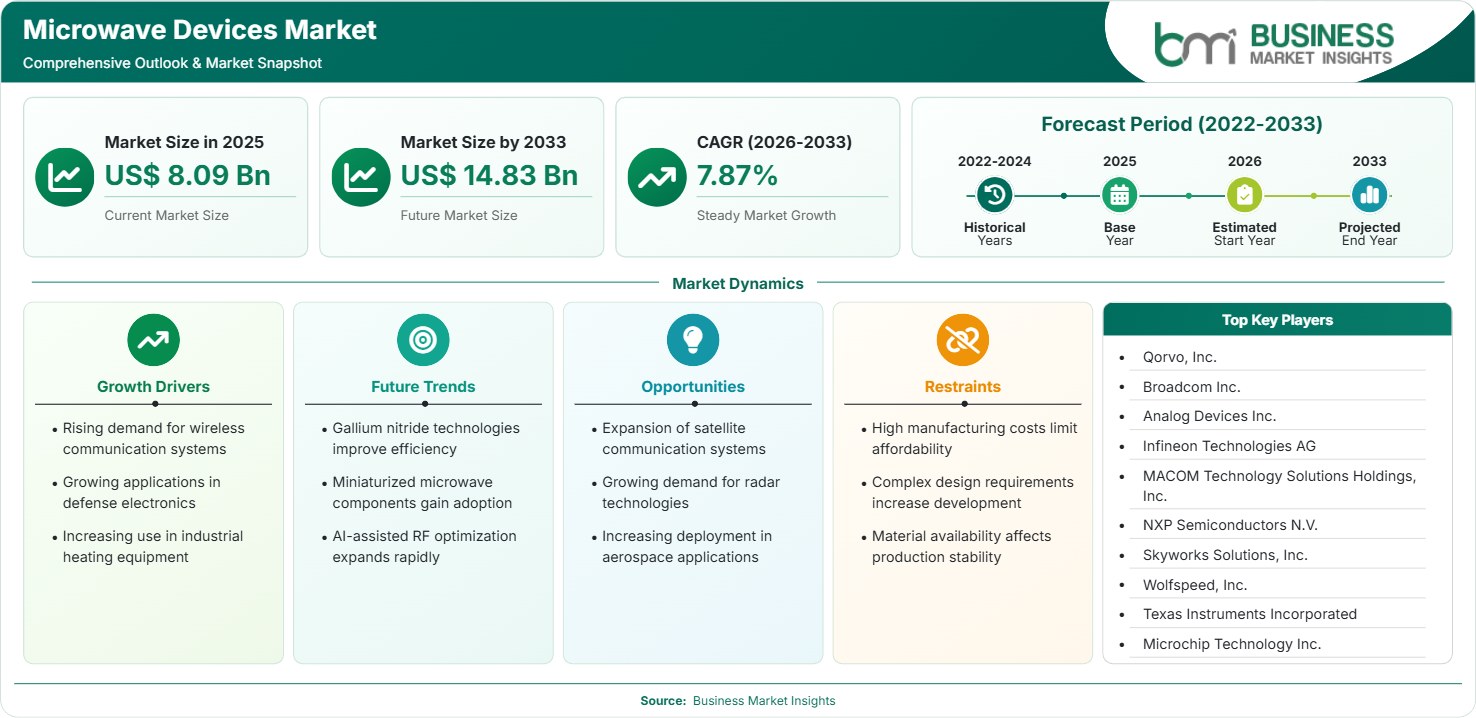
The Microwave Devices Market size was valued at US$ 8.09 billion in 2025 and is projected to reach US$ 14.83 billion by 2033, growing at a CAGR of 7.87% during 2026–2033. Rising demand for wireless communication systems, growing applications in defense electronics, and increasing use in industrial heating equipment continue driving market expansion, while satellite communications, radar technologies, and aerospace applications create significant future opportunities.

Report Coverage
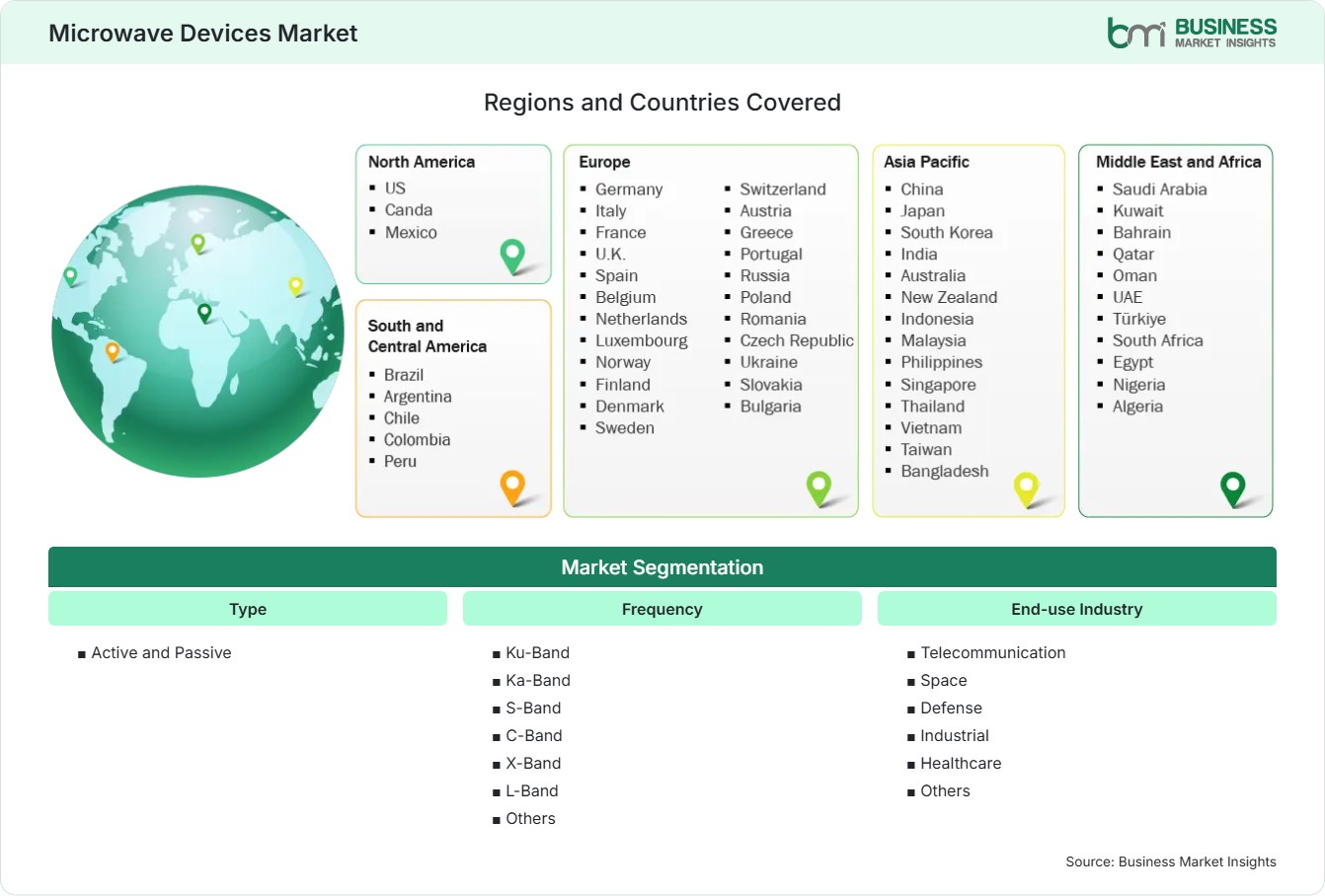
  • Type: Active and Passive
  • Frequency: Ku-Band, Ka-Band, S-Band, C-Band, X-Band, L-Band, Others
  • End-use Industry: Telecommunication, Space, Defense, Industrial, Healthcare, Others
US$ 8.09 Bn Market size in 2025
US$ 14.83 Bn Market Size by 2033
7.87% CAGR, 2026 - 2033
2026-2033 Forecast Period

01 AI Overview

Microwave Devices Market Summary

  • North America Region: North America accounts for 35%–38% market share in 2025 and is projected to expand at a CAGR of 7.4%–8.0% during 2026–2033. Strong investments in defense modernization, satellite communications, aerospace innovation, and advanced semiconductor technologies continue supporting regional demand. The U.S. dominates the regional market through robust defense spending, expanding space programs, and advanced telecommunications infrastructure, growing at an estimated CAGR of 7.6%–8.2% during 2026–2033.
  • Fastest Growing Region: Asia Pacific represents 29%–32% market share in 2025 and is expected to register a CAGR of 8.6%–9.2% during 2026–2033. Expanding 5G deployment, semiconductor manufacturing, industrial automation, and aerospace investments continue accelerating regional market growth.
  • Leading Segment: Active devices account for 58%–61% market share in 2025 and are projected to expand at a CAGR of 7.9%–8.4% through 2033 owing to increasing demand for amplifiers, oscillators, and microwave transistors in communication and defense systems.
  • High Growth Segment: Telecommunication represents 31%–34% market share in 2025 and is anticipated to register a CAGR of 8.5%–9.1% during 2026–2033 as global deployment of 5G and next-generation wireless communication infrastructure accelerates.
  • Key Market Opportunity: Expansion of satellite communication systems, growing adoption of advanced radar technologies, and increasing aerospace investments are creating long-term opportunities for microwave device manufacturers and component suppliers.
  • Major Market Players: Qorvo, Inc., Broadcom Inc., Analog Devices Inc., Infineon Technologies AG, MACOM Technology Solutions Holdings, Inc., NXP Semiconductors N.V., Skyworks Solutions, Inc., Wolfspeed, Inc., Texas Instruments Incorporated, and Microchip Technology Inc.
02 Strategic Insights

Microwave Devices Market: Strategic Insights

Microwave Devices Market Strategic Framework
FREE PDF
Request your free sample
Request free sample
03 Stakeholder View

Key Takeaways

  • Expanding semiconductor manufacturing, component integration, and advanced radio frequency technologies are strengthening the market value chain across telecommunications, aerospace, industrial automation, and defense applications.
  • Telecommunication and satellite communication infrastructure present the strongest commercial opportunities as operators continue investing in high-capacity wireless networks and next-generation connectivity solutions.
  • Continuous innovation in gallium nitride, silicon carbide, and microwave integrated circuit technologies is improving device efficiency, power density, and operational reliability across high-frequency applications.
  • Asia Pacific offers the most attractive long-term investment opportunity owing to expanding semiconductor fabrication, 5G deployment, aerospace manufacturing, and government-backed technology initiatives.
  • Strategic partnerships among semiconductor manufacturers, defense contractors, communication equipment providers, and research organizations continue accelerating product innovation, capacity expansion, and commercialization of advanced microwave technologies.
04 Geographic Outlook

Microwave Devices Market Regional Highlights

North America Microwave Devices Market

North America accounted for 35%–38% of the Microwave Devices Market Share in 2025 and is projected to expand at a CAGR of 7.4%–8.0% during 2026–2033. Strong investments in defense electronics, satellite communications, advanced semiconductor manufacturing, and next-generation wireless infrastructure continue supporting regional market expansion. Ongoing modernization of military communication systems and increasing deployment of high-frequency networking technologies further strengthen long-term demand.

  • Rising defense modernization programs continue increasing demand for microwave amplifiers, filters, and high-frequency communication components.
  • Expansion of satellite communication infrastructure supports growing adoption of microwave devices across commercial and government applications.
  • Continuous investment in 5G infrastructure accelerates deployment of advanced RF and microwave semiconductor technologies.
  • Strong research capabilities and established semiconductor manufacturing ecosystems encourage continuous product innovation.

US Microwave Devices Market

The U.S. represented 76%–79% of the North American market in 2025 and is expected to grow at a CAGR of 7.6%–8.2% through 2033. Expanding aerospace programs, robust defense investments, and increasing deployment of advanced communication technologies continue driving nationwide market development.

  • Government investments in advanced radar and electronic warfare systems strengthen microwave component demand.
  • Expanding commercial space activities create opportunities for satellite communication equipment manufacturers.
  • Increasing deployment of private 5G networks supports growth in high-frequency semiconductor applications.
  • Continuous innovation in compound semiconductor technologies improves device efficiency and performance.

Europe Microwave Devices Market

Europe held 24%–27% market share in 2025 and is forecast to expand at a CAGR of 7.2%–7.8% during 2026–2033. Germany leads regional demand, while the United Kingdom records the fastest growth owing to increasing aerospace investments, defense modernization, and expanding satellite communication capabilities.

  • Defense modernization initiatives continue increasing procurement of advanced microwave communication equipment.
  • Aerospace manufacturing supports growing utilization of microwave components across avionics and satellite platforms.
  • Semiconductor research programs encourage innovation in high-frequency electronic devices.
  • Increasing industrial automation expands deployment of microwave-based sensing and heating technologies.

Asia Pacific Microwave Devices Market

Asia Pacific accounted for 29%–32% market share in 2025 and is projected to register the strongest Microwave Devices Market Forecasts, expanding at a CAGR of 8.6%–9.2% during 2026–2033. China leads regional revenue, while India demonstrates the fastest growth because of expanding telecommunications infrastructure, semiconductor investments, and defense manufacturing.

  • Large-scale 5G deployment significantly increases demand for advanced microwave communication devices.
  • Semiconductor manufacturing expansion strengthens regional production capacity for microwave components.
  • Aerospace and defense investments continue supporting adoption of high-frequency electronic systems.
  • Industrial digitalization encourages wider implementation of microwave sensing and communication technologies.
  • Government-backed electronics manufacturing initiatives strengthen long-term market competitiveness.

Rest of World Microwave Devices Market

The Rest of World region represented 9%–12% market share in 2025 and is anticipated to grow at a CAGR of 7.5%–8.1% through 2033. Brazil leads adoption across South America, while the United Arab Emirates records the fastest growth because of increasing investments in defense technologies, satellite communications, and advanced industrial infrastructure.

  • Growing investments in satellite connectivity support wider deployment of microwave communication equipment.
  • Defense procurement programs increase demand for radar and electronic communication systems.
  • Industrial modernization initiatives encourage adoption of microwave heating and sensing technologies.
  • Expanding aviation and aerospace projects strengthen opportunities for high-frequency electronic components.
Global Market Geography
FREE PDF
Request your free sample
Request free sample
05 Segment Analysis

Microwave Devices Market Segmentation

Type

The Type segment represents the largest, with Active devices accounting for 58%–61% market share in 2025 and expanding at a CAGR of 7.9%–8.4%. The Microwave Devices Market Trends indicate increasing adoption of active microwave components because of their critical role in signal amplification, frequency generation, and communication system performance.

  • Active: Widely utilized in wireless communication infrastructure, radar systems, satellite communications, and defense electronics requiring signal amplification and high-frequency processing.
  • Passive: Increasingly adopted in filters, couplers, waveguides, and resonators supporting efficient signal transmission with low insertion loss across communication and industrial systems.

Frequency

The Frequency segment continues expanding as different microwave frequency bands support diverse communication, defense, industrial, and aerospace applications. Demand is increasing for higher-frequency bands capable of delivering enhanced bandwidth, improved data transmission, and advanced radar capabilities.

  • Ku-Band: Extensively deployed in satellite broadcasting, broadband communication, and commercial satellite connectivity applications.
  • Ka-Band: Experiencing strong demand because of high-capacity satellite communications and next-generation broadband services.
  • S-Band: Commonly utilized in weather radar, maritime communications, and aerospace telemetry applications.
  • C-Band: Supports satellite television broadcasting, wireless backhaul, and reliable long-distance communication systems.
  • X-Band: Widely adopted across military radar, defense surveillance, and satellite communication applications requiring high-frequency performance.
  • L-Band: Utilized in navigation systems, aviation communications, GPS technologies, and mobile satellite services.

End-use Industry

The End-use Industry segment continues expanding as microwave technologies become increasingly important across communication, aerospace, defense, healthcare, and industrial applications. Telecommunications remain the dominant application area owing to rapid global deployment of advanced wireless infrastructure.

  • Telecommunication: Increasing investments in 5G networks, wireless backhaul, and mobile communication infrastructure continue driving strong demand for microwave devices.
  • Space: Satellite communication, deep-space missions, and earth observation programs support increasing deployment of high-frequency microwave technologies.
  • Defense: Radar systems, electronic warfare, secure military communications, and surveillance platforms remain major application areas.
  • Industrial: Microwave heating, material processing, sensing technologies, and industrial automation continue expanding commercial utilization.
  • Healthcare: Medical imaging, therapeutic equipment, diagnostic systems, and minimally invasive treatment technologies increasingly utilize microwave devices.
06 Market Forces

Microwave Devices Market Dynamics

Key Market Drivers

Rising Demand for Wireless Communication Systems

The increasing deployment of advanced wireless communication infrastructure is a major factor driving the Market Growth. Rapid expansion of 5G networks, fixed wireless access, satellite broadband, and high-capacity backhaul systems continues increasing demand for high-frequency microwave components. Microwave components are highly efficient when it comes to transmitting signals and have low latency and high bandwidth. Telecom operators are deploying denser networks with optimized spectrum for increased mobile data usage and connected devices. Future development in radio frequency technology and wireless standards will ensure that the need for microwave components remains robust in years to come.

Growing Applications in Defense Electronics

Defense organizations worldwide continue investing in advanced electronic warfare systems, radar technologies, secure communication equipment, and surveillance platforms that rely extensively on microwave devices. These components provide reliable high-frequency performance required for target detection, navigation, missile guidance, and tactical communication. Geopolitical tension and military modernization drive governments to improve their defense systems through electronic devices. Microwave amplifiers, filters, oscillators, and transceivers still form an integral part of such systems. The continued procurement of advanced defense systems is still presenting steady business opportunities to companies manufacturing efficient microwave components for defense firms and governments.

Increasing Use in Industrial Heating Equipment

Industrial microwave technology is gaining wider adoption because of its ability to provide rapid, energy-efficient, and uniform heating across manufacturing processes. Industries including food processing, chemicals, pharmaceuticals, ceramics, and advanced materials increasingly utilize microwave equipment for drying, curing, sterilization, and material processing applications. Microwave devices improve production efficiency, reduce energy consumption, and enhance product quality compared with conventional heating methods. Growing emphasis on industrial automation and sustainable manufacturing further supports market expansion. Continuous development of high-power microwave generators and advanced control systems is expected to strengthen commercial adoption across multiple industrial sectors during the forecast period.

Key Market Opportunities

Expansion of Satellite Communication Systems

Rapid expansion of commercial satellite networks, low Earth orbit constellations, and broadband connectivity projects presents significant growth opportunities for microwave device manufacturers. The Microwave Devices Market Forecasts indicate increasing demand for high-frequency components capable of supporting reliable satellite communication, earth observation, and navigation systems. Governments and private space companies continue investing in satellite infrastructure to improve global connectivity and digital communication services. Microwave devices play an essential role in satellite payloads, ground stations, and communication terminals. Growing investments in space exploration and satellite broadband services are expected to create substantial long-term commercial opportunities for industry participants.

Growing Demand for Radar Technologies

The increasing adoption of advanced radar systems across defense, aviation, maritime, automotive, and weather monitoring applications is creating attractive opportunities for microwave device manufacturers. Modern radar platforms require highly reliable microwave amplifiers, oscillators, mixers, and filters capable of operating at high frequencies with exceptional precision. Growing investments in air traffic management, autonomous transportation, border surveillance, and military modernization continue strengthening demand. Continuous innovation in phased-array radar and electronically scanned antenna technologies is expected to further expand application areas and support long-term market development.

Increasing Deployment in Aerospace Applications

Expanding aerospace activities, including commercial aviation, satellite launches, unmanned aerial vehicles, and deep-space exploration, are increasing demand for advanced microwave technologies. High-frequency microwave components are widely utilized in aircraft communication systems, satellite payloads, telemetry equipment, navigation systems, and onboard radar applications. Governments and private aerospace organizations continue investing in next-generation aircraft and space technologies requiring reliable electronic components capable of operating under demanding environmental conditions. These developments create significant opportunities for manufacturers offering high-performance microwave devices with improved efficiency, durability, and operational reliability.

Market Restraints and Challenges

High Manufacturing Costs Limit Affordability

Manufacturing advanced microwave devices requires sophisticated semiconductor fabrication technologies, precision engineering, specialized materials, and stringent quality control processes, resulting in comparatively high production costs.

Factor: High manufacturing and material costs.

Impact: Elevated production expenses increase product prices, limiting adoption among cost-sensitive industries and smaller equipment manufacturers. Companies must continuously invest in advanced fabrication facilities and testing technologies, increasing capital requirements while affecting profitability and slowing broader commercial deployment in price-sensitive application areas.

Complex Design Requirements Increase Development

Microwave devices require highly specialized engineering expertise to achieve optimal performance across demanding high-frequency applications while maintaining reliability and electromagnetic compatibility.

Factor: Complex high-frequency design and integration requirements.

Impact: Lengthy design cycles, extensive product validation, and advanced simulation requirements increase development costs and delay product commercialization. Manufacturers must continuously invest in research, engineering talent, and sophisticated testing capabilities to meet evolving performance standards, creating barriers for new entrants and extending time-to-market for innovative microwave technologies.

07 Company Analysis

Competitive Landscape

The competitive landscape of the Market is characterized by intense innovation in radio frequency (RF) technologies, compound semiconductor materials, and high-frequency integrated circuits. The Microwave Devices Market Analysis indicates that leading companies are strengthening their competitive positions through product innovation, strategic acquisitions, expanded semiconductor manufacturing capacity, and investments in gallium nitride (GaN) and silicon carbide (SiC) technologies. Market participants are also collaborating with telecommunications providers, aerospace companies, and defense organizations to develop high-performance microwave components supporting next-generation wireless communication, radar systems, satellite networks, and industrial automation applications.

Company Name

Overview

Products and Services Relevant to this Market

Qorvo, Inc.

Leading semiconductor company specializing in RF solutions serving mobile, defense, aerospace, and infrastructure markets globally.

RF amplifiers, microwave integrated circuits, filters, power amplifiers, GaN solutions, radar components, and wireless communication technologies.

Broadcom Inc.

Global technology company developing semiconductor and infrastructure software solutions for communication and industrial applications.

RF front-end modules, microwave components, networking semiconductors, wireless communication chipsets, and broadband connectivity solutions.

Analog Devices Inc.

Global semiconductor manufacturer focused on high-performance analog, mixed-signal, and RF technologies.

Microwave amplifiers, RF transceivers, data converters, signal processing solutions, and aerospace-grade communication components.

Infineon Technologies AG

International semiconductor company providing power electronics, RF technologies, and secure connectivity solutions.

Microwave power devices, RF transistors, radar chipsets, communication semiconductors, and industrial electronic components.

MACOM Technology Solutions Holdings, Inc.

Semiconductor company developing high-performance analog and microwave products for communications, aerospace, and defense industries.

Microwave amplifiers, RF devices, optical networking components, radar technologies, and satellite communication solutions.

NXP Semiconductors N.V.

Global semiconductor supplier delivering secure connectivity, RF technologies, and automotive electronics.

RF power amplifiers, microwave transistors, communication processors, industrial connectivity solutions, and wireless infrastructure devices.

Skyworks Solutions, Inc.

Semiconductor manufacturer supplying wireless connectivity technologies for mobile, networking, and industrial applications.

RF front-end modules, microwave filters, amplifiers, wireless communication semiconductors, and connectivity solutions.

Wolfspeed, Inc.

Technology company specializing in silicon carbide and gallium nitride semiconductor solutions for high-frequency applications.

GaN RF devices, microwave semiconductors, power electronics, aerospace communication technologies, and defense-grade components.

Texas Instruments Incorporated

Global semiconductor company offering analog and embedded processing technologies across diverse industrial sectors.

High-frequency analog devices, RF components, signal processing technologies, industrial communication solutions, and embedded semiconductors.

Microchip Technology Inc.

Semiconductor manufacturer delivering embedded control, connectivity, and analog technologies for industrial and communication markets.

RF controllers, microwave timing devices, communication processors, embedded solutions, and aerospace electronic components.

10 Trust & Transparency

Research Methodology

The market analysis combines proprietary research with secondary data from government agencies, company disclosures, regulatory filings, industry databases and expert interviews. Market estimates are validated through data triangulation, cross-market benchmarking and analyst review.

View Full Research Methodology

11 Questions Answered

Frequently Asked Questions

What does the Microwave Devices Market Report include?

The Market Report provides comprehensive insights into market size, competitive landscape, segmentation analysis, technology developments, regional outlook, growth drivers, opportunities, restraints, company profiles, recent developments, and long-term industry forecasts.

Which opportunities are expected to shape future market expansion?

Major opportunities include expansion of satellite communication systems, increasing deployment of advanced radar technologies, growing aerospace investments, next-generation wireless infrastructure, and rising adoption of high-frequency communication devices across commercial and defense sectors.

Why are active microwave devices dominating the market?

Active microwave devices dominate because they provide essential functions including signal amplification, oscillation, frequency conversion, and power generation required in wireless communication, radar, aerospace, and satellite applications.

Which end-use industry holds the largest market share?

The telecommunication industry represents the leading end-use segment because of rapid deployment of 5G infrastructure, wireless backhaul networks, satellite broadband systems, and increasing global demand for high-speed data connectivity.

What is driving the growth of the Microwave Devices Market?

The market is driven by expanding wireless communication infrastructure, increasing defense modernization programs, rising satellite communication deployments, growing industrial automation, and continuous advancements in high-frequency semiconductor technologies including gallium nitride and silicon carbide devices.

Access the Full Microwave Devices Market Report

Get segment-level forecasts, regional estimates, competitive benchmarking, company profiles and downloadable Excel datasets.

Access the full Microwave Devices Market Report
350 pages PDF & Excel | 2026-08-05