Market Summary
Executive Summary and Global Market Analysis
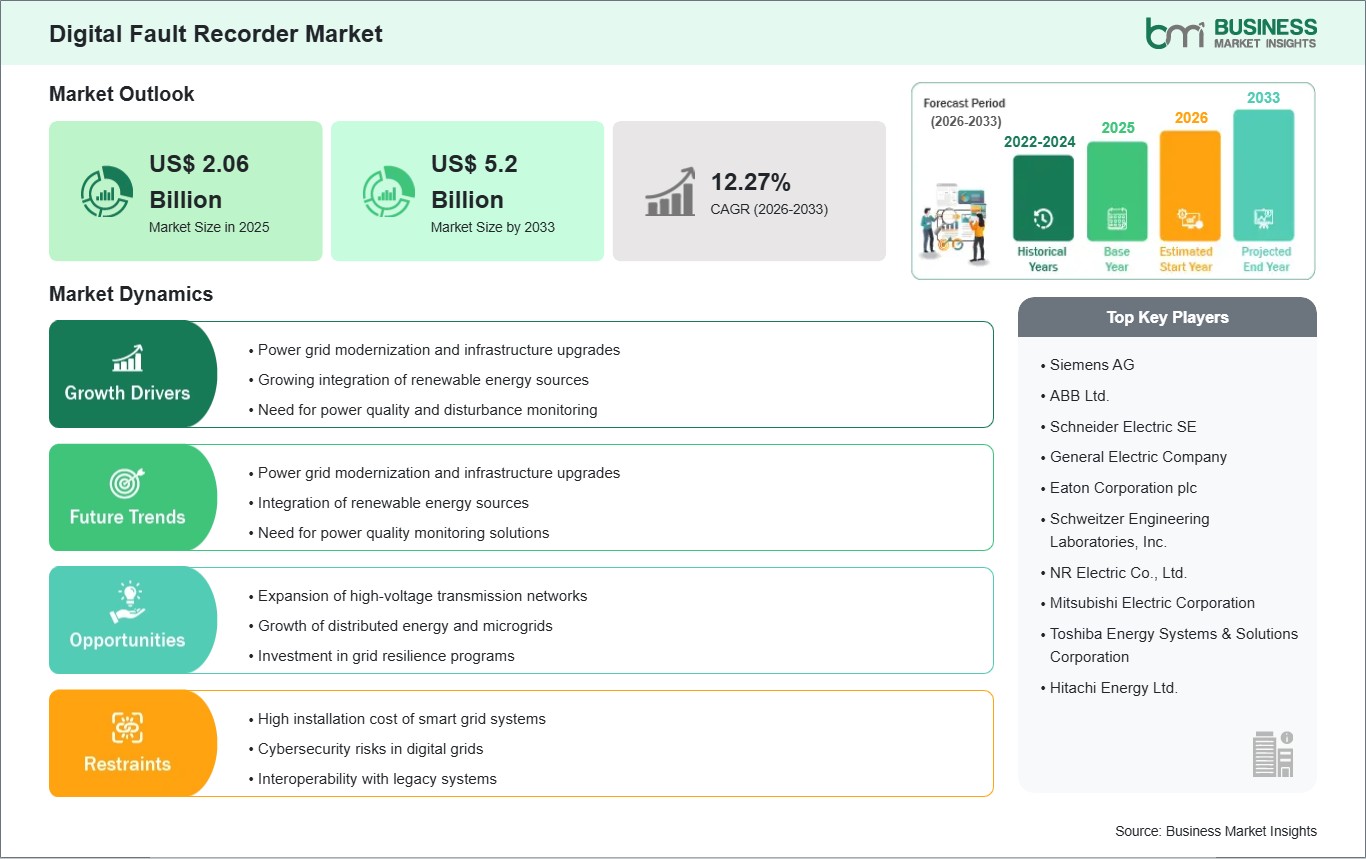
The Digital Fault Recorder market plays a critical role in enhancing the reliability, stability, and operational transparency of modern power systems. Digital fault recorders are advanced monitoring devices used to capture and analyze electrical disturbances, transient events, and fault conditions across generation, transmission, and distribution networks. These systems provide high-resolution waveform data that enables utilities and grid operators to diagnose faults, prevent cascading failures, and improve overall grid resilience.
With increasing grid complexity driven by renewable energy integration, distributed generation, and cross-border interconnections, real-time disturbance monitoring has become essential. DFR systems support post-event analysis, regulatory compliance, asset protection, and system performance optimization. Integration with SCADA systems, substation automation platforms, and synchrophasor networks enhances situational awareness and supports faster fault isolation and restoration.
Market growth is fueled by rising investments in grid modernization, expansion of high-voltage transmission networks, and increasing emphasis on power quality management. The transition toward smart grids and digital substations is further accelerating adoption of multifunctional fault recording systems capable of event logging, disturbance analysis, and power quality monitoring within a unified platform.
However, high installation and integration costs, cybersecurity concerns, and interoperability challenges with legacy systems remain key constraints. Despite these challenges, ongoing advancements in digital monitoring technologies and regulatory mandates for grid reliability are expected to sustain steady market expansion.
Segment Analysis
Digital Fault Recorder Market Segmentation
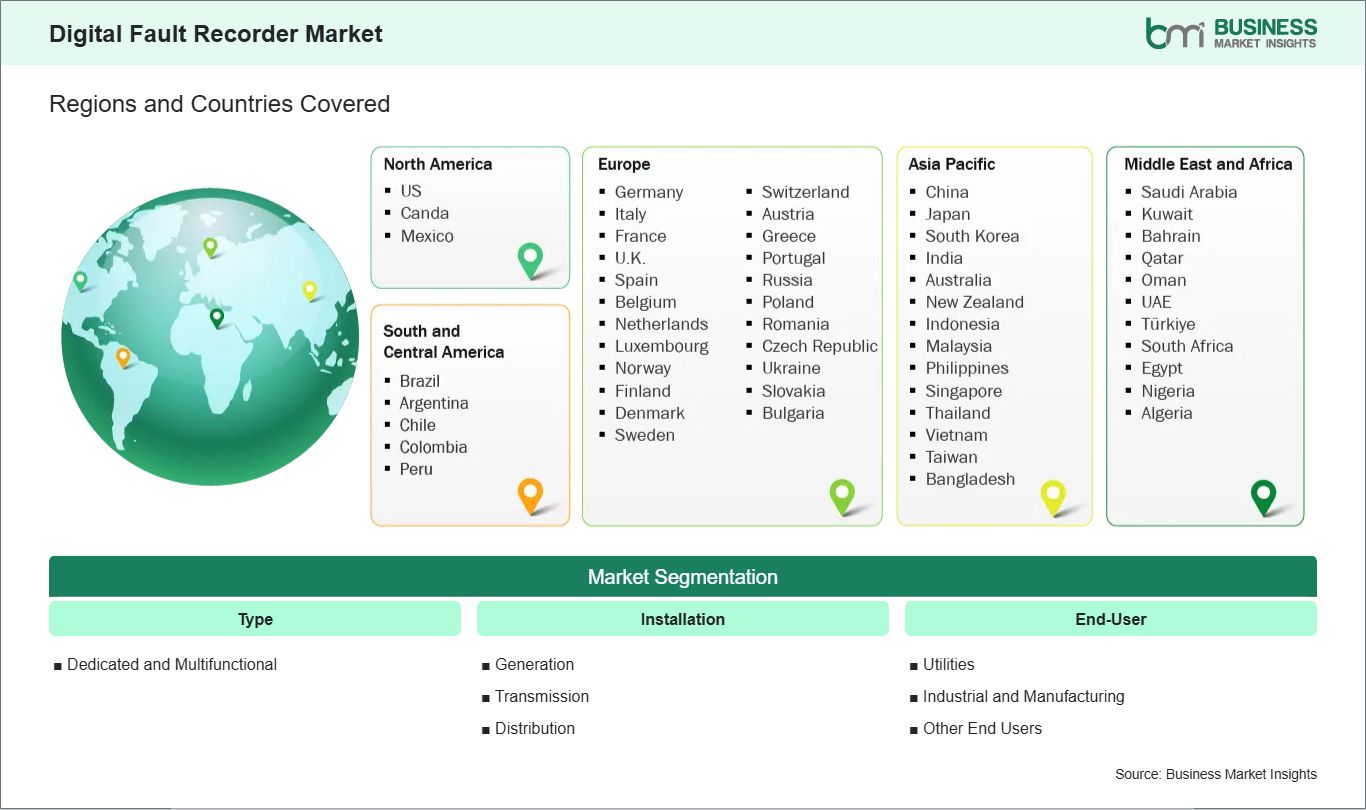
Key segments contributing to the derivation of the Digital Fault Recorder market analysis include type, installation, and end user.
- By type, the market is divided into Dedicated and Multifunctional systems. The Multifunctional segment dominated in 2025 due to its ability to integrate disturbance recording, event logging, and power quality monitoring in a single device.
- By installation, the market is segmented into Generation, Transmission, and Distribution. The Transmission segment held the largest share in 2025, supported by extensive deployment across high-voltage substations and interconnection networks.
- By end user, the market includes Utilities, Industrial & Manufacturing, and Others. The Utilities segment accounted for the largest market share in 2025 owing to mandatory grid monitoring requirements and large-scale infrastructure investments.
Market Forces
Digital Fault Recorder Market Drivers and Opportunities
Grid Modernization and Rising Power System Complexity
Aging grid infrastructure and increasing power demand are compelling utilities to modernize transmission and distribution networks. The integration of renewable energy sources, energy storage systems, and distributed generation has introduced bidirectional power flows and dynamic load variations, increasing the risk of disturbances and transient faults.
Digital fault recorders provide precise event capture and waveform analysis, enabling utilities to quickly identify fault origins, evaluate protection system performance, and implement corrective measures. Regulatory bodies are mandating enhanced grid monitoring and reliability standards, driving widespread adoption of advanced disturbance recording systems. As utilities pursue automation and digital substation initiatives, DFR deployment is becoming a core component of grid resilience strategies.
Expansion of Renewable Energy and Smart Grid Infrastructure
The global shift toward renewable energy generation and smart grid development is generating significant growth opportunities for the Digital Fault Recorder market. Wind farms, solar plants, and hybrid energy systems introduce variability and intermittency that require advanced monitoring to maintain grid stability.
DFR systems support integration of renewable assets by capturing voltage fluctuations, frequency deviations, and transient events in real time. Increasing deployment of smart substations equipped with IEC 61850-based communication systems is further accelerating demand for digital recording and disturbance analysis solutions. Additionally, industrial facilities and large commercial operations are adopting on-site generation and microgrid systems, increasing the need for precise power quality monitoring. As electrification expands across transportation and industrial sectors, the demand for reliable fault recording and system diagnostics is expected to grow steadily through 2033.
Size and Share Analysis
Digital Fault Recorder Market Size and Share Analysis
By type, the Digital Fault Recorder market is segmented into Dedicated and Multifunctional systems. The Multifunctional segment dominated in 2025, driven by its integrated capabilities and cost efficiency in modern digital substations.
By installation, the market is categorized into Generation, Transmission, and Distribution. The Transmission segment held the largest share in 2025, supported by increased monitoring requirements across high-voltage grid infrastructure.
By end user, the market is divided into Utilities, Industrial & Manufacturing, and Others. The Utilities segment accounted for the largest share in 2025, reflecting strong regulatory mandates, infrastructure upgrades, and investments in grid reliability and automation.
Report Coverage
Digital Fault Recorder Market Report Coverage and Deliverables
The "Digital Fault Recorder Market Size and Forecast (2022 - 2033)" report provides a detailed analysis of the market covering below areas:
- Digital Fault Recorder market size and forecast at global, regional, and country levels for all the key market segments covered under the scope
- Digital Fault Recorder market trends, as well as market dynamics such as drivers, restraints, and key opportunities
- Digital Fault Recorder market analysis covering key market trends, global and regional framework, major players, regulations, and recent market developments
- Industry landscape and competition analysis covering market concentration, heat map analysis, prominent players, and recent developments for the Digital Fault Recorder market
- Detailed company profiles, including SWOT analysis
Geographic Insights
Digital Fault Recorder Market Geographic Insights
Geographically, the Digital Fault Recorder market is segmented into North America, Europe, Asia Pacific, Middle East & Africa, and South & Central America, with each region demonstrating distinct adoption dynamics influenced by grid maturity, regulatory standards, and infrastructure investment levels.
Asia Pacific is expected to register the fastest growth and maintain a dominant position throughout the forecast period. Rapid urbanization, expanding high-voltage transmission networks, and large-scale renewable energy integration across China, India, Japan, and South Korea are driving demand for advanced grid monitoring solutions. Government-led smart grid initiatives and investments in digital substations are further accelerating market expansion.
North America and Europe represent mature markets supported by stringent grid reliability standards and early adoption of digital substation technologies. Ongoing refurbishment of aging infrastructure, renewable integration, and deployment of synchrophasor networks are sustaining steady demand for digital fault recording systems. Meanwhile, Middle East & Africa and South & Central America are experiencing gradual growth, driven by power infrastructure expansion, industrialization, and increasing focus on grid stability and operational efficiency.
Industry Activity
Recent Developments
The Digital Fault Recorder market is evaluated by gathering qualitative and quantitative data post primary and secondary research, which includes important corporate publications, association data, and databases. A few of the key developments in the Digital Fault Recorder market are:
- In April 2025, Elspec India installed 55 units of G5 Multi-Functional Digital Fault Recorder at a major wind power generating company in India.
- In April 2024, Siemens inaugurated the first building complex of the Siemens Technology Center (STC) at the Garching Research Campus near Munich, Germany, where it will bundle all its corporate research activities in Germany. Collaborating with the Technical University of Munich and other institutions, the STC aims to accelerate innovation by combining academic and industrial expertise, with plans to expand by 2027 to become the largest of Siemens' research hubs worldwide.
Trust & Transparency
Research Methodology
The market analysis combines proprietary research with secondary data from government agencies, company disclosures, regulatory filings, industry databases and expert interviews. Market estimates are validated through data triangulation, cross-market benchmarking and analyst
review.
View Full Research Methodology
Key Sources Referred:
International Energy Agency (IEA)Institute of Electrical and Electronics Engineers (IEEE)Company websiteCompany annual reportsCompany investor presentations