Digital Asset Management Market Outlook (2022–2033)

Historic Data: 2022-2024   |   Base Year: 2025   |   Forecast Period: 2026-2033
Report Content: Market Scope, Market Segmentation, Market Dynamics, and Competitive Analysis

Report Coverage:
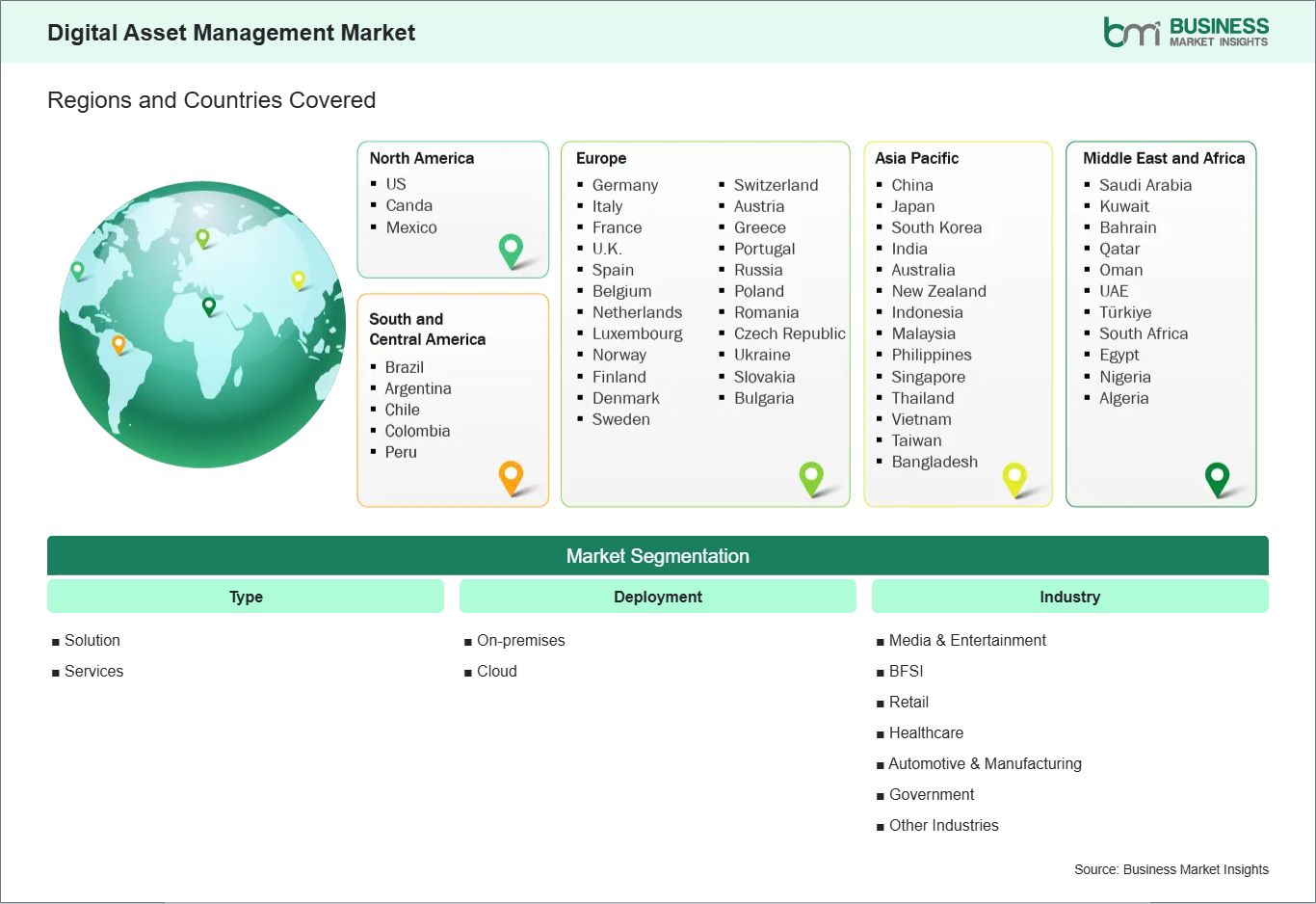
  • Type (Solution, Services)
  • Deployment (On-premises, Cloud)
  • Industry (Media & Entertainment, BFSI, Retail, Healthcare, Automotive & Manufacturing, Government, Other Industries)

No. of Pages: 400
Report Code: BMIPUB00033592
Category: Electronics and Semiconductor
Digital Asset Management Market

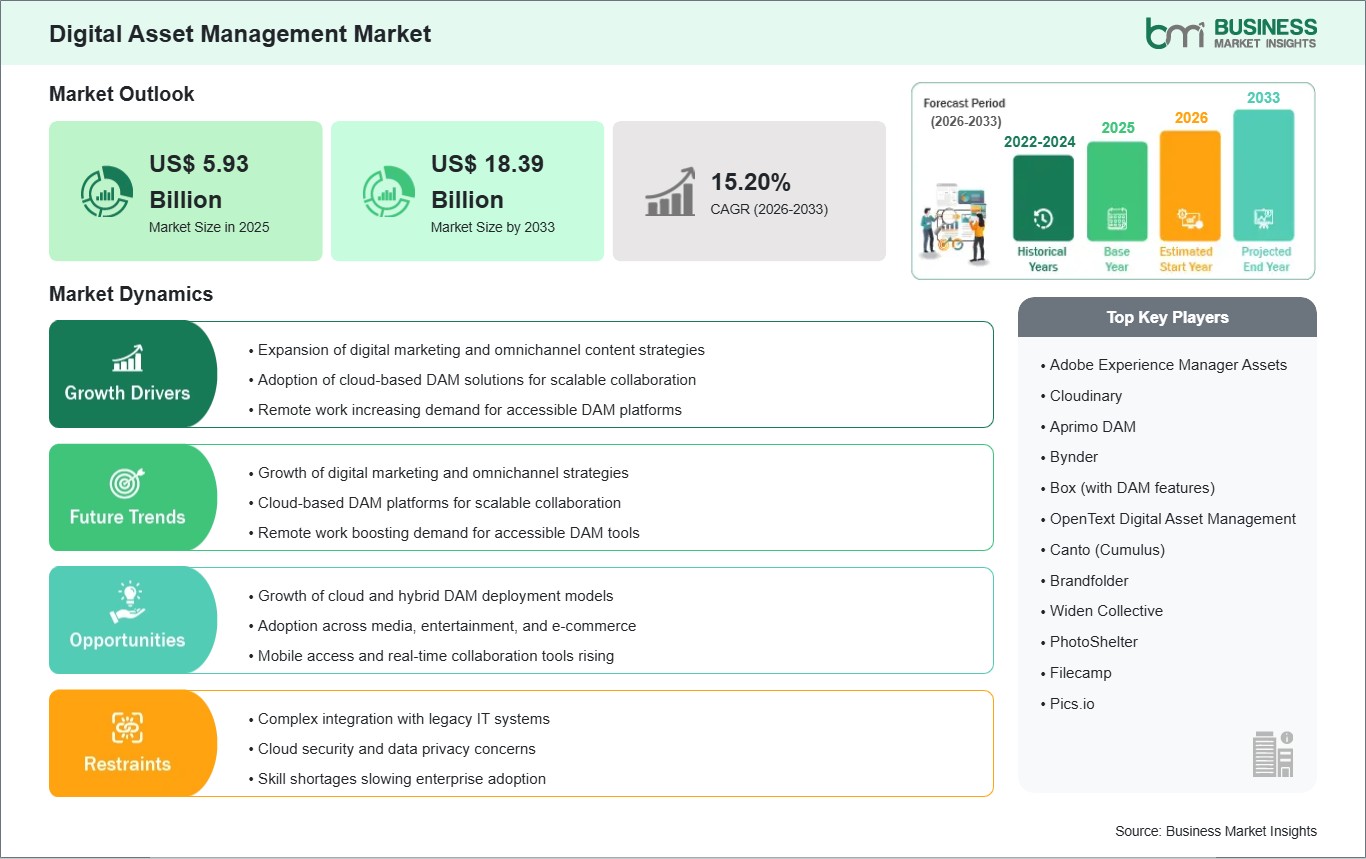
The Digital Asset Management size is expected to reach US$ 18.39 billion by 2033 from US$ 5.93 billion in 2025. The market is estimated to record a CAGR of 15.20% from 2026 to 2033.      

Executive Summary and Global Market Analysis:

The DAM market is essentially a digital content management solution in the form of a software and service package, which helps enterprises store, sort, manage, retrieve, and share digital content efficiently. Digital asset management covers everything from images, videos, and audio files to creative designs, product details, marketing materials, documents, and other rich media typically used in various digital channels. Besides being a place for storing and archiving a company's digital assets, the DAM platform automatically streamlines workflow, helps in brand consistency, meets regulatory requirements, and even facilitates teamwork in a smooth manner.

A good number of these DAM systems are being used in sectors like media & entertainment, retail & e, commerce, healthcare, banking & financial services, education, manufacturing, and government, where large, scale digital content management is a key factor for operational and marketing success. Organizations today are creating a lot more digital content than they did in the past, which is one of the main reasons why the Digital Asset Management Market is growing rapidly and continuously. Thanks to the widespread use of omnichannel marketing strategies, companies have not only taken over the websites but also the mobile apps, social media platforms, and e, commerce marketplaces. In such cases, the requirement for a single, central command and control over the contents has become a necessity.

Digital Asset Management Market - Strategic Insights:

global-market-strategic-framework
Get more information on this report

Digital Asset Management Market Segmentation Analysis:

Key segments that contributed to the derivation of the Digital Asset Management analysis are technology, wafer size, and application.

  • By Type, the Digital Asset Management market is segmented into solutions and services. The solution segment held the largest share of the market in 2025.
  • By Deployment, the Digital Asset Management market is segmented into on-premises, cloud. The on-premise segment held the largest share of the market in 2025.
  • By Application, the Digital Asset Management market is segmented into media & entertainment, BFSI, retail, healthcare, automotive and manufacturing, government, others. The media & entertainment segment held the largest share of the market in 2025.

Digital Asset Management Market Drivers and Opportunities:

Explosion of Digital Content and Need for Centralized Management

A major factor pushing the Digital Asset Management market is the tremendous increase in digital content generation within enterprises. As companies are creating more and more product images, videos, marketing materials, and branded content to support e, commerce platforms, omnichannel campaigns, and social media outreach, traditional file, based storage systems have become insufficient. Enterprises face various issues such as chaotic repositories, slow and inefficient retrieval processes, and inconsistent branding across their different channels. Digital Asset Management systems help businesses by centralizing storage, organizing with metadata tagging, and providing fast and easy access to the assets, thus encouraging teams to work more efficiently, find, reuse and distribute the assets that are consistent with the brand. Besides, the deployment of DAM platforms facilitates the interaction of creative, marketing, and sales teams, thereby minimizing the time required to market the product and operational bottlenecks. The continuous growth of digital content remains a strong force driving the demand for DAM solutions worldwide as enterprises concentrate on providing consistent customer engagement and efficient workflows.

AI-Driven Capabilities and Intelligent Automation

Integrating artificial intelligence (AI) and machine learning (ML) with digital asset management (DAM) platforms is one of the biggest opportunities for the DAM market. AI, powered features like automated metadata tagging, smart content classification, enhanced search, predictive recommendations, and analytics are changing the way we think about asset libraries. Instead of being mere repositories, they become efficient, interactive systems capable of learning and adapting. To illustrate, AI has the ability to automatically detect items in pictures or words spoken in videos, create relevant tags, and based on previous behavior, suggest the most suitable assets to the users. Thus, there will be a significant decrease in manual labor, a rise in asset visibility, and faster workflows, all these resulting in lower costs and greater reuse of existing materials. Besides that, AI, enabled analytics within DAM tools can reveal content success, popular user habits, and ways to improve. With the help of smart, scalable digital infrastructures for personalized customer experiences and data, driven decision, making, businesses probably see AI integration as an exciting growth path for both, DAM vendors and the users thereof.

Digital Asset Management Market Size and Share Analysis:

By Type, the Digital Asset Management market is segmented into solution and services. The Solutions category is the largest maker of the market presently as it is a fact that enterprises concentrate more and more on single platforms where they can easily manage, organize and share the just growing volume of digital content. With a Security, privacy, and compliance focus, Digital Asset Management (DAM) solutions provide core functionalities such as asset storage, metadata management, advanced search and retrieval, workflow automation, version control, rights management, analytics, and seamless integration with enterprise systems like content management systems (CMS), customer relationship management (CRM) platforms, and marketing automation tools. As the use of digital marketing, e-commerce and omnichannel content strategies spread very fast, enterprises aspire cloud, based and scalable brand content management systems that allow increasing the level of collaboration, ensuring brand consistency and supporting global content distribution. Thanks to artificial intelligence (AI) features such as auto, tagging, facial recognition, content classification, and predictive search, the value of DAM solutions has been considerably increased allowing them to extend their market penetration in media and entertainment, retail, healthcare, BFSI, and manufacturing industries.

By Deployment, the Digital Asset Management market is segmented as on-premises, cloud.  On-premises DAM systems dominated the market since they offer better control, data security, and customization. Large companies, especially those in regulated sectors like banking, government, healthcare, media, and defense, use premise deployment to meet the requirements of very strict data residency and privacy laws. When a company puts a DAM system on its own local IT infrastructure, it retains complete control over sensitive digital assets, copyrights, and proprietary information.

By Application, the Digital Asset Management market is segmented as media & entertainment, BFSI, retail, healthcare, automotive & manufacturing, government, others. Media & Entertainment remains one of the dominant sectors in the market as it heavily depends on large volumes of rich media content including videos, images, audio files, and digital graphics. Production houses, broadcasters, streaming platforms, and advertising agencies are just some of the entities that rely on DAM (Digital Asset Management) systems for managing content libraries, streamlining post, production workflows, facilitating global distribution, and ensuring rights management. The escalating demand for high, resolution video content, OTT platforms, and real, time digital publishing are the factors that have made the implementation of these systems very popular in this segment. Retail sector is also one of the major drivers of market growth. It is very much linked to the rise of e, commerce and the adoption of omnichannel marketing strategies. Retailers are increasingly turning to DAM (Digital Asset Management) platforms to handle the management of images of the products, promotional materials, brand assets, and campaign content across multiple channels such as websites, marketplaces, mobile apps, and social media platforms.

Digital Asset Management Market Report Highlights:

Report Attribute Details
Market size in 2025 US$ 5.93 Billion
Market Size by 2033 US$ 18.39 Billion
Global CAGR (2026 - 2033)15.20%
Historical Data 2022-2024
Forecast period 2026-2033
Segments Covered By Type
  • Solution
  • Services
By Deployment
  • On-premises
  • Cloud
By Industry
  • Media & Entertainment
  • BFSI
  • Retail
  • Healthcare
  • Automotive & Manufacturing
  • Government
  • Other Industries
Regions and Countries Covered
North America US, Canada, Mexico
Europe Belgium, Austria, Finland, Denmark, Greece, Poland, Romania, Russia, Ukraine, Czech Republic, Slovakia, Bulgaria, Italy, Luxembourg, Germany, Switzerland, France, Netherlands, Norway, Portugal, Spain, Sweden, United Kingdom
Asia-Pacific Australia, China, India, Japan, South Korea, Indonesia, Malaysia, Philippines, Singapore, Thailand, Vietnam, Bangladesh, New Zealand, Taiwan
South and Central America Brazil, Argentina, Peru, Chile, Colombia
Middle East and Africa Bahrain, Kuwait, Oman, Qatar, Saudi Arabia, United Arab Emirates, Turkiye, South Africa, Egypt, Algeria, Nigeria
Market leaders and key company profiles
  • Adobe Experience Manager Assets
  • Cloudinary
  • Aprimo DAM
  • Bynder
  • Box (with DAM features)
  • OpenText Digital Asset Management
  • Canto (Cumulus)
  • Brandfolder
  • Widen Collective
  • PhotoShelter
Get more information on this report

Digital Asset Management Market Report Coverage and Deliverables:

The "Digital Asset Management Size and Forecast (2022 - 2033)" report provides a detailed analysis of the market covering below areas:

  • Digital Asset Management size and forecast at global, regional, and country levels for all the key market segments covered under the scope
  • Digital Asset Management trends, as well as market dynamics such as drivers, restraints, and key opportunities
  • Digital Asset Management analysis covering key market trends, global and regional framework, major players, regulations, and recent market developments
  • Industry landscape and competition analysis covering market concentration, heat map analysis, prominent players, and recent developments for the Digital Asset Management
  • Detailed company profiles, including SWOT analysis

Digital Asset Management Market Geographic Insights:

The geographical scope of the Digital Asset Management report is divided into five regions: North America, Asia Pacific, Europe, the Middle East & Africa, and South & Central America.

The Asia Pacific region is expected to be the fastest, growing market while holding a large share of the world's demand for goods. This rapid growth is mainly attributed to the high, speed digital transformation, the growth of the e-commerce ecosystem, and the extensive utilization of the cloud in such countries as China, India, Japan, South Korea, and Australia. The boom of smartphones, social media platforms, online retail channels, and digital payment systems has substantially increased the amount of digital content generated by businesses, thus requiring centralized asset management solutions. Besides that, the upsurge of local media production, gaming industries, and digital advertising investments has further fueled the demand for scalable, AI, enabled DAM platforms. Moreover, government initiatives that encourage digital economies, smart cities, and data localization policies also facilitate the implementation of secure and compliant DAM systems in both the public and private sectors.

global-market-geography
Get more information on this report

Digital Asset Management Market Research Report Guidance:

  • The report includes qualitative and quantitative data in the Digital Asset Management across technology, wafer size, application and geography.
  • The report starts with the key takeaways (chapter 2), highlighting the key trends and outlook of the Digital Asset Management.
  • Chapter 3 includes the research methodology of the study.
  • Chapter 4 further includes ecosystem analysis.
  • Chapter 5 highlights the major industry dynamics in the Digital Asset Management, including factors that are driving the market, prevailing deterrents, potential opportunities, as well as future trends. Impact analysis of these drivers and restraints is also covered in this section.
  • Chapter 6 discusses the Digital Asset Management scenario, in terms of historical market revenues, and forecast till the year 2031.
  • Chapters 7 to 10 cover Digital Asset Management segments by type, deployment, industry and geography across North America, Europe, Asia Pacific, Middle East and Africa, and South and Central America. They cover the market volume revenue forecast and factors driving the market.
  • Chapter 11 describes the competitive analysis along with the heat map analysis for the key players operating in the market.
  • Chapter 12 describes the industry landscape analysis. It provides detailed descriptions of business activities such as market initiatives, new developments, mergers, and joint ventures globally, along with a competitive landscape.
  • Chapter 13 provides detailed profiles of the major companies operating in the Digital Asset Management. Companies have been profiled on the basis of their key facts, business descriptions, products and services, financial overview, SWOT analysis, and key developments.
  • Chapter 14, i.e., the appendix is inclusive of a brief overview of the company, list of abbreviations, and disclaimer.

Digital Asset Management Market News and Key Development:

The Digital Asset Management is evaluated by gathering qualitative and quantitative data post primary and secondary research, which includes important corporate publications, association data, and databases. A few of the key developments in the Digital Asset Management are:

  • In October 2025, IBM announced the launch of IBM Digital Asset Haven, a comprehensive platform for financial institutions, governments, and corporations to securely manage and scale their digital asset operations. Banks and governments now have a single solution to manage their digital asset lifecycle from custody to transactions to settlement that helps them meet compliance obligations while being integration ready.
  • In July 2024, European Aquatics announced an expansion to its commercial partnership with EPAM, a global leader in digital engineering, cloud and AI-enabled transformation services. European Aquatics has adopted EPAM’s modern digital asset management (DAM) platform, transforming the way media is handled across the organization and its affiliated national federations. This is a key milestone in the Digital Transformation of European Aquatics, as laid out in the 2024-2030 Strategic Plan.

Key Sources Referred:

  • DAMA International
  • DAM Federation
  • Visual Resources Association (VRA)
  • Association for Information and Image Management (AIIM)
  • Metaverse Standards Forum - Digital Asset Management Working Group
  • World Wide Web Consortium (W3C)
  • ISACA (Information Systems Audit and Control Association)
  • Global Digital Finance (GDF)
  • Global Digital Commodity Association (Global DCA)
  • Company Annual Reports
  • Company Investor Presentations
The List of Companies - Digital Asset Management Market
  • <p>Adobe Experience Manager Assets
  • Cloudinary
  • Aprimo DAM
  • Bynder
  • Box (with DAM features)
  • OpenText Digital Asset Management
  • Canto (Cumulus)
  • Brandfolder
  • Widen Collective
  • PhotoShelter
  • Filecamp
  • Pics.io
  • ImageKit
  • MerlinOne
  • QBank
  • Digizuite
  • Sitecore Content Hub
  • Celum DAM
  • Nuxeo Platform
  • ResourceSpace (Open Source)
  • UnaPim DAM (Open Source)
  • Pimcore DAM (Open Source)
  • EnterMedia (Open Source)
  • Razuna (Open/Cloud)
  • AIRegistry
  • Credencys (DAM implementation services)</p>
Frequently Asked Questions
How big is the Digital Asset Management Market?

The Digital Asset Management Market is valued at US$ 5.93 Billion in 2025, it is projected to reach US$ 18.39 Billion by 2033.

What is the CAGR for Digital Asset Management Market by (2026 - 2033)?

As per our report Digital Asset Management Market, the market size is valued at US$ 5.93 Billion in 2025, projecting it to reach US$ 18.39 Billion by 2033. This translates to a CAGR of approximately 15.20% during the forecast period.

What segments are covered in this report?

The Digital Asset Management Market report typically cover these key segments-

  • Type (Solution, Services)
  • Deployment (On-premises, Cloud)
  • Industry (Media & Entertainment, BFSI, Retail, Healthcare, Automotive & Manufacturing, Government, Other Industries)

What is the historic period, base year, and forecast period taken for Digital Asset Management Market?

The historic period, base year, and forecast period can vary slightly depending on the specific market research report. However, for the Digital Asset Management Market report:

  • Historic Period : 2022-2024
  • Base Year : 2025
  • Forecast Period : 2026-2033
  • Who are the major players in Digital Asset Management Market?

    The Digital Asset Management Market is populated by several key players, each contributing to its growth and innovation. Some of the major players include:

  • Adobe Experience Manager Assets
  • Cloudinary
  • Aprimo DAM
  • Bynder
  • Box (with DAM features)
  • OpenText Digital Asset Management
  • Canto (Cumulus)
  • Brandfolder
  • Widen Collective
  • PhotoShelter
  • Filecamp
  • Pics.io
  • ImageKit
  • MerlinOne
  • QBank
  • Digizuite
  • Sitecore Content Hub
  • Celum DAM
  • Nuxeo Platform
  • ResourceSpace (Open Source)
  • UnaPim DAM (Open Source)
  • Pimcore DAM (Open Source)
  • EnterMedia (Open Source)
  • Razuna (Open/Cloud)
  • AIRegistry
  • Credencys (DAM implementation services)
  • Who should buy this report?

    The Digital Asset Management Market report is valuable for diverse stakeholders, including:

    • Investors: Provides insights for investment decisions pertaining to market growth, companies, or industry insights. Helps assess market attractiveness and potential returns.
    • Industry Players: Offers competitive intelligence, market sizing, and trend analysis to inform strategic planning, product development, and sales strategies.
    • Suppliers and Manufacturers: Helps understand market demand for components, materials, and services related to concerned industry.
    • Researchers and Consultants: Provides data and analysis for academic research, consulting projects, and market studies.
    • Financial Institutions: Helps assess risks and opportunities associated with financing or investing in the concerned market.

    Essentially, anyone involved in or considering involvement in the Digital Asset Management Market value chain can benefit from the information contained in a comprehensive market report.

    Available Report Formats

    pdf-format excel-format pptx-format
    Buy Now
    Sales Assistance
    +1 646 791 7070 (US & UK)
    Customization Form

    Please tell us your area of interest
    (Market Segments/ Regions and Countries/ Companies)