Market Summary
Executive Summary and Global Market Analysis
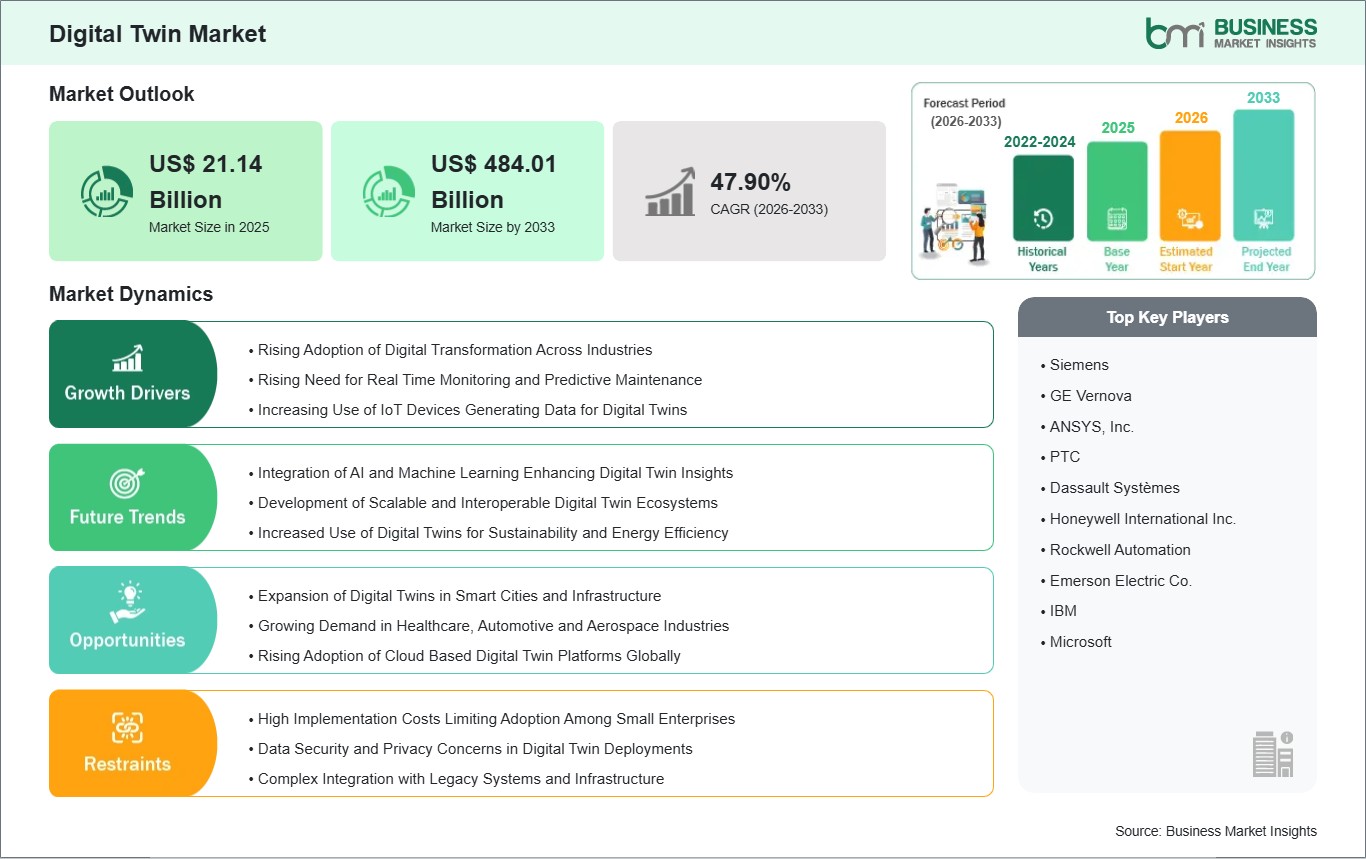
The global digital twin market is experiencing a boost in momentum as more and more organizations are adopting digital twin technology for the betterment of their operations. Digital twins are digital models of a physical asset, process, or environment created by integrating data from connected sensors and enterprise systems. Digital twin technology allows organizations to visualize the performance of assets, simulate different operating scenarios, and predict potential problems before they occur. Digital twin technology is becoming an integral part of many industries, from manufacturing, automotive, energy, healthcare, construction, and smart infrastructure, as more and more industries are focusing on digital transformation. One of the key drivers of the growth of the digital twin market is the increasing adoption of advanced technologies, including Industrial Internet of Things, cloud, and artificial intelligence. These technologies enable the constant exchange of data between physical systems and their digital equivalents. This way, organizations are able to improve the predictive maintenance of physical systems, make the processes more efficient, and optimize the product development processes. Moreover, the development and implementation of smart factories, smart supply chains, and smart cities are also helping the growth of the global digital twin market. Nevertheless, there are some factors that are limiting the growth of the global digital twin market. The initial investment needed to set up digital twin ecosystems, such as sensors, data integration platforms, and simulation tools, may be high, especially for smaller enterprises. Furthermore, issues such as cybersecurity, data management, and integration with older infrastructure have remained major challenges for enterprises to overcome while adopting digital twin solutions. Nevertheless, technological developments and increasing use cases are expected to boost the global market of digital twin solutions.
Segment Analysis
Digital Twin Market Segmentation
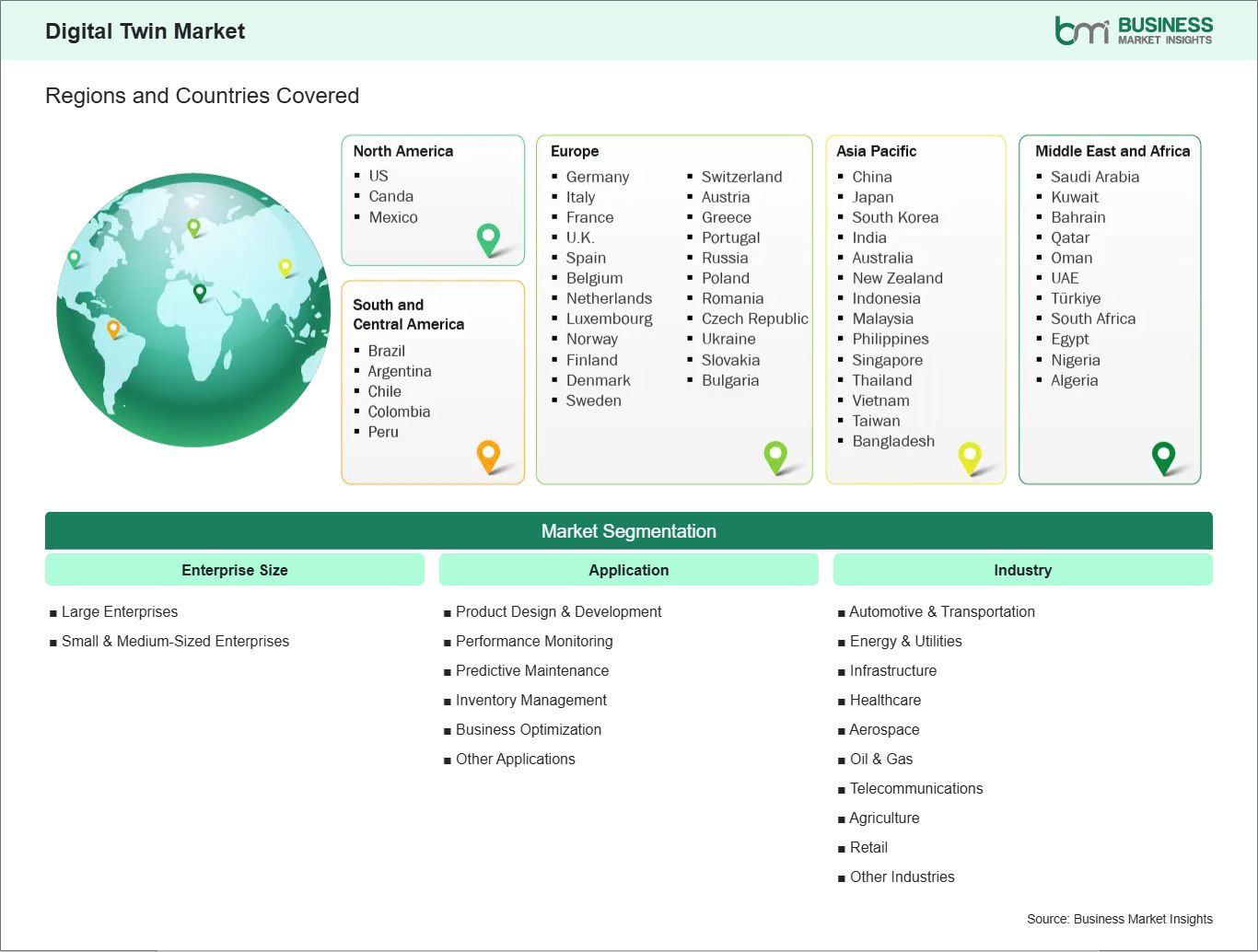
Key segments that contributed to the derivation of the digital twin market analysis are enterprise size, application and industry.
- By enterprise size, the digital twin market is segmented into large enterprises and small & medium-sized enterprises. The large enterprises segment dominated the market in 2025.
- Based on application, the digital twin market is categorized into product design & development, performance monitoring, predictive maintenance, inventory management, business optimization, and other applications. The predictive maintenance segment dominated the market in 2025.
- In terms of industry, the digital twin market is categorized into automotive & transportation, energy & utilities, infrastructure, healthcare, aerospace, oil & gas, telecommunications, agriculture, retail, and other industries. The healthcare segment dominated the market in 2025.
Market Forces
Digital Twin Market Drivers and Opportunities
Rising Adoption of Digital Transformation Across Industries
The increased emphasis on digital transformation in industries across the globe is also an important factor that is contributing to the growth of the digital twin market. Organizations are using advanced digital technologies to increase the visibility and efficiency of their operations. Digital twins help organizations create virtual models of their physical assets and operations using real-time data received through digital platforms and devices. This enables organizations to analyze their operations and simulate various possible operations to identify any potential problems before they occur in the real world. Organizations across industries such as manufacturing, energy, aerospace, and logistics are actively using digital twins in their operations. Organizations in the manufacturing sector are using digital twins to simulate improvements in their workflow and minimize equipment downtime. Similarly, organizations in the energy sector are using digital twins to monitor their power infrastructure and develop effective maintenance strategies. As organizations across the globe continue to adopt digital technologies such as IoT, cloud computing, and advanced data analysis, digital twins have become an essential technology for them to increase their digital transformation initiatives.
Expansion of Digital Twins in Smart Cities and Infrastructure
The increasing trend towards smart cities and smart infrastructure is also providing an impetus for the growth of digital twin technology across the world. Governments and city planners are using digital twin platforms to develop digital models of cities that integrate real-time data from transportation networks, utilities, and environmental monitoring networks. This digital environment is helping governments evaluate the performance of city infrastructure and simulate city planning initiatives. Digital twin technology is already being used in several smart city initiatives across the world to develop smart city planning and infrastructure management solutions. This technology is helping city planners analyze city infrastructure and develop effective city planning initiatives through digital twins. City planning is not the only area where digital twins are finding applications. This technology is also helping governments monitor large-scale infrastructure across the world. The increasing trend towards smart infrastructure and smart city planning is likely to boost the growth of digital twins across the world in the coming years.
Size and Share Analysis
Digital Twin Market Size and Share Analysis
The digital twin market demonstrates steady growth, with size and share analysis highlighting evolving trends and competitive dynamics among key players. The report examines subsegments categorized within enterprise size, application and industry, offering insights into their contribution to overall market performance.
By enterprise size, the large enterprises subsegment dominated the market in 2025, driven by their higher financial capacity and strong investments in advanced digital technologies to optimize operations and asset management.
Based on application, the predictive maintenance subsegment dominated the market in 2025, driven by the growing need to reduce equipment downtime, improve operational efficiency, and enable real-time monitoring of assets.
On the basis of industry, the healthcare subsegment dominated the market in 2025, driven by increasing adoption of digital twins for patient monitoring, medical device optimization, and improving healthcare infrastructure management.
Report Coverage
Digital Twin Market Report Coverage and Deliverables
The "Digital Twin Market Size and Forecast (2022 - 2033)" report provides a detailed analysis of the market covering below areas:
- Digital Twin Market size and forecast at global, regional, and country levels for all the key market segments covered under the scope
- Digital Twin Market trends, as well as drivers, restraints, and opportunities
- Digital Twin Market analysis covering key trends, global and regional framework, major players, regulations, and recent developments
- Industry landscape and competition analysis covering market concentration, heat map analysis, prominent players, and recent developments for the Digital Twin Market
- Detailed company profiles, including SWOT analysis
Geographic Insights
Digital Twin Market Geographic Insights
The geographical scope of the Digital Twin Market report is divided into North America, Asia Pacific, Europe, Middle East & Africa, and South & Central America. North America held the largest share in 2025.
The North American region is currently the leading market for the use of digital twin technology. This is because the countries in this region were the first to adopt the latest industrial automation technologies, IoT solutions, and AI-based technologies. Major countries in this region include the United States and Canada. Both countries have the major technology companies and the required infrastructure for research and development. In addition, the government initiatives in this region are also supporting the adoption of digital twin technology. In the Asia Pacific region, the countries are rapidly industrializing. The governments are also implementing smart city initiatives. In this region, countries such as China, Japan, Korea, and India are rapidly adopting the latest industrial technologies such as Industry 4.0. Organizations are using the digital twin platform for efficient operations and for the development of infrastructure. Europe is a mature market with substantial investments in smart manufacturing, renewable energy, and transportation infrastructure. Countries like Germany, France, and the UK are leveraging digital twins for better production workflows, cost savings in maintenance, and supporting their sustainability efforts. For the Middle East & Africa, the adoption of digital twins is growing steadily, with a focus on large-scale infrastructure, oil and gas, and urban development. Governments in Gulf Cooperation Council (GCC) countries are currently employing digital twin technology to monitor utilities, optimize construction projects, and enhance resource management, while Africa is witnessing pilot projects in mining and energy industries. South & Central America represents an emerging market, where Brazil, Mexico, and Chile are at the forefront of employing digital twin technology in manufacturing, energy, and transportation industries. Organizations in this region are beginning to explore digital twin technology to optimize their business, but adoption is limited due to budgetary constraints and technology availability. Overall, it can be determined that North America represents a global leader in employing digital twin technology due to technological maturity, while Asia Pacific represents a growing market, and Europe, Middle East, Africa, and South & Central America represent emerging markets due to growing potential as digital transformation initiatives gain traction.
Industry Activity
Recent Developments
The Digital Twin Market is evaluated by gathering qualitative and quantitative data post primary and secondary research, which includes important corporate publications, association data, and databases. A few of the key developments in the digital twin market are:
- In February 2025, HEALWELL AI Inc. announced that its subsidiary VeroSource Solutions introduced new digital twin technology on its VS Data‑as‑a‑Service platform. This solution delivers real‑time intelligence for healthcare operations by creating a virtual model of health facilities to support data integration, dynamic simulation, and optimized decision‑making for better operational efficiency and patient care.
- In April 2025, the Digital Twin Consortium revealed a global digital twin‑enabled microfactory showcase led by NTT Data, demonstrating composable digital twins for smart manufacturing. This initiative highlights how digital twin platforms integrate real‑time IoT data, AI insights, and 3D visualization to improve process optimization, predictive maintenance, and remote monitoring across industrial environments.
Trust & Transparency
Research Methodology
The market analysis combines proprietary research with secondary data from government agencies, company disclosures, regulatory filings, industry databases and expert interviews. Market estimates are validated through data triangulation, cross-market benchmarking and analyst
review.
View Full Research Methodology
Key Sources Referred:
World Health Organization (WHO)Organisation for Economic Cooperation and Development (OECD)The World Bank GroupWorldometerThe LancetInternational Bar AssociationInternational Trade Administration