Market Summary
Executive Summary and Global Market Analysis
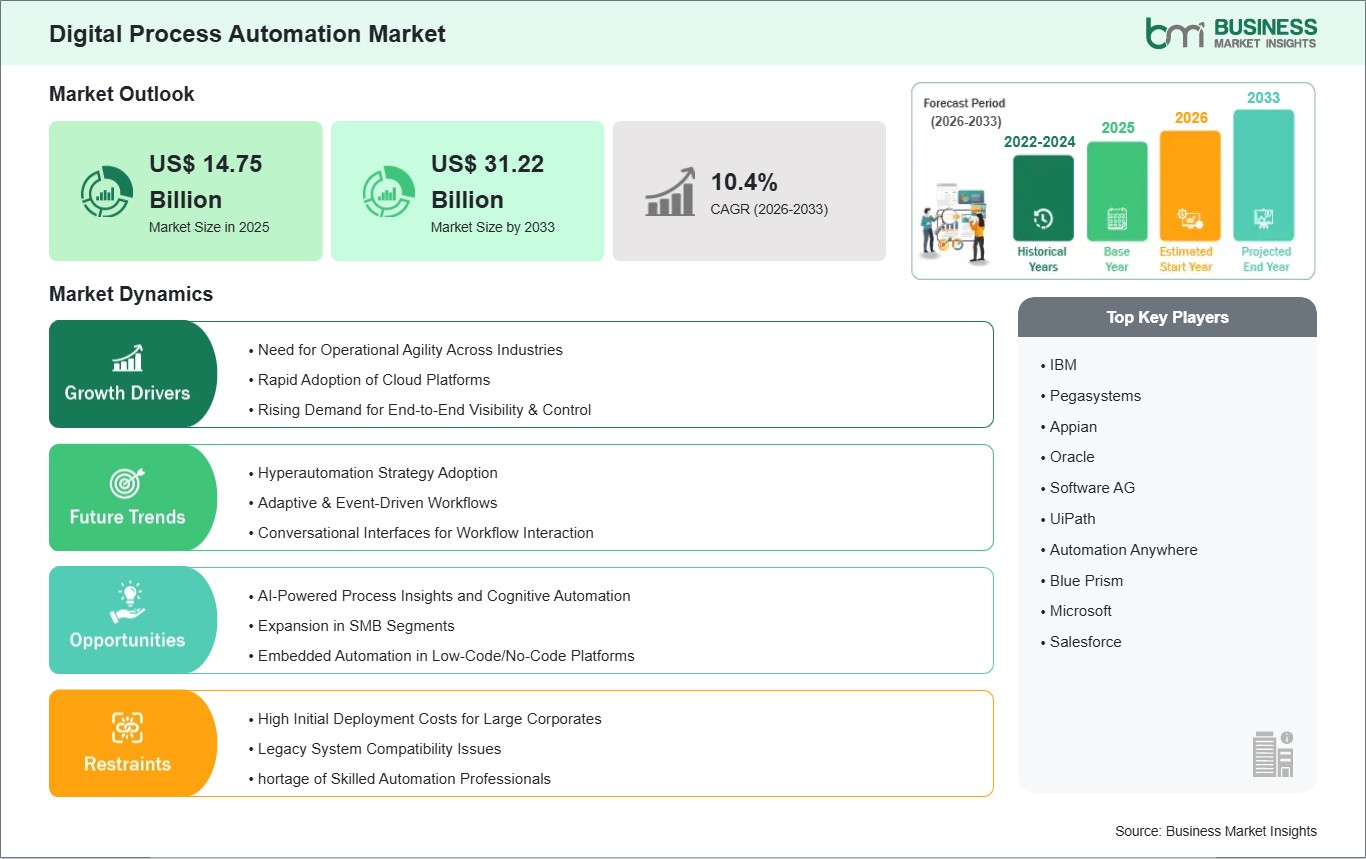
The global digital process automation (DPA) market is a critical enabler of business transformation, empowering organizations to streamline, optimize, and automate complex, rule-based workflows by integrating digital technologies. DPA extends beyond basic task automation (Robotic Process Automation) to encompass the orchestration of end-to-end business processes, human tasks, decisions, and data across disparate systems. It is a cornerstone of the modern intelligent enterprise. Market growth is driven by the urgent need for operational agility and efficiency, the acceleration of digital transformation initiatives post-pandemic, and the rising adoption of cloud-native architectures. Organizations across sectors are leveraging DPA to reduce manual errors, improve compliance, enhance customer and employee experience, and gain real-time process visibility. Furthermore, the convergence of DPA with artificial intelligence (AI), machine learning (ML), and low-code development platforms is creating more intelligent and accessible automation capabilities.
Despite strong growth, the market faces challenges including the high complexity of integrating DPA solutions with legacy IT ecosystems, skill shortages in process design and automation governance, and concerns over data security and privacy, especially in regulated industries. However, substantial opportunities are emerging from the demand for industry-specific automation solutions, the rise of hyperautomation strategies that combine multiple automation tools, and the growing need for DPA in small and medium-sized enterprises (SMEs) seeking to compete through digital efficiency.
Segment Analysis
Digital Process Automation Market Segmentation
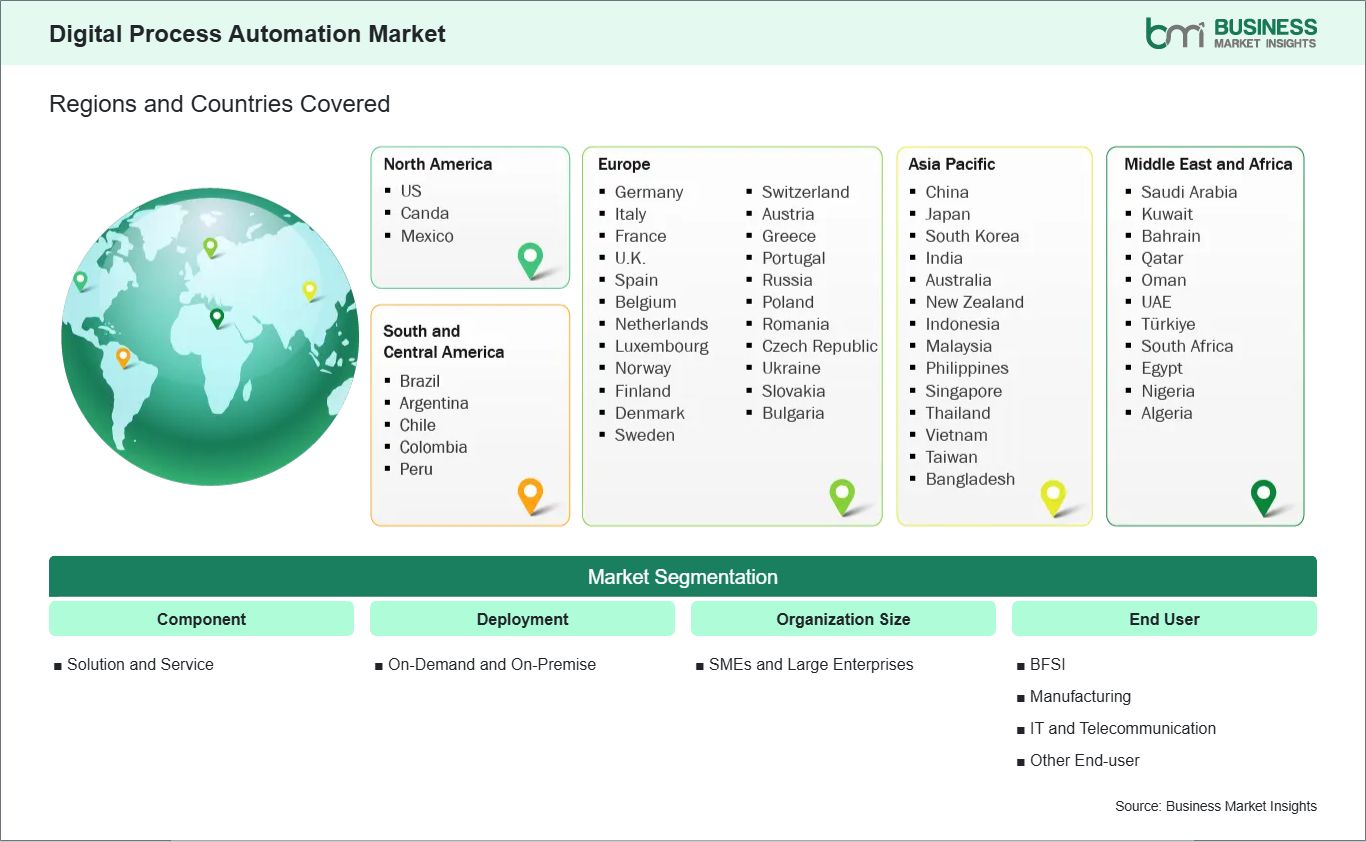
Key segments that contributed to the derivation of the digital process automation market analysis are component, deployment, organization size, and end-user.
- By component, the market is segmented into solution (software/platform) and service. The solution segment dominated the market in 2025, as the core automation platform constitutes the primary investment. However, the services segment (consulting, implementation, support) is a significant and growing part of the total cost of ownership.
- By deployment, the market is categorized into on-demand (cloud/SaaS) and on-premise. The on-demand segment held the largest and fastest-growing share in 2025, driven by its scalability, lower upfront costs, and ease of updates.
- By organization size, the market is segmented into SMEs and large enterprises. Large enterprises accounted for the largest share in 2025 due to their complex processes, larger IT budgets, and early adoption of enterprise-scale automation. The SMEs segment is growing rapidly as cloud-based DPA becomes more affordable and accessible.
- By end-user, the market is segmented into BFSI, manufacturing, IT and telecommunication, and other end-users (including healthcare, retail, government). The BFSI sector held the leading share in 2025, driven by its document-intensive, compliance-critical processes and need for customer onboarding automation.
Market Forces
Digital Process Automation Market Drivers and Opportunities
The Imperative for Operational Excellence and Customer-Centricity
The primary driver for DPA adoption is the relentless corporate pursuit of operational excellence. In a competitive global landscape, organizations must eliminate process inefficiencies, reduce cycle times, and lower operational costs. DPA provides the tools to model, execute, monitor, and optimize business processes systematically. Concurrently, the drive to become customer-centric is paramount. DPA enables the creation of seamless, automated customer journeys—from loan origination in banking to order fulfillment in retail—thereby improving satisfaction and loyalty. This dual focus on internal efficiency and external experience creates a powerful, sustained demand for DPA solutions across all industries.
Convergence with AI and the Rise of Hyperautomation
A major growth opportunity lies in the integration of DPA with advanced technologies like Artificial Intelligence (AI), Machine Learning (ML), and Process Mining. This convergence enables "intelligent automation," where processes can not only be automated but also optimized and adapted dynamically based on data insights. AI can handle unstructured data (like emails or documents), make predictive decisions, and manage exceptions, taking automation to a new level. This trend is encapsulated in the concept of hyperautomation, a strategic approach that combines DPA, RPA, AI, and other tools to automate everything that can be automated within an organization. This creates a expansive and evolving market for integrated platform vendors and service providers.
Size and Share Analysis
Digital Process Automation Market Size and Share Analysis
By component, the solution segment leads in revenue as it includes the licensing or subscription fees for the core DPA platform, which often includes process modeling, workflow engine, business rules management, and analytics modules. The services segment is essential for successful deployment and is growing as a percentage of spend, reflecting the complexity of transformation projects.
By deployment, the cloud-based (on-demand) model is decisively leading the market due to its operational and financial benefits. It allows for rapid deployment, easier scaling, and reduces the burden on internal IT teams. The on-premise segment retains a share in highly regulated industries (e.g., defense, certain BFSI sub-sectors) with stringent data sovereignty requirements.
By organization size, large enterprises are the early and deep adopters, often running enterprise-wide DPA programs. The SME segment represents the high-growth frontier, as cloud delivery and low-code platforms lower the barriers to entry, allowing smaller firms to automate key processes without massive IT departments.
By end-user, BFSI is the traditional leader, automating processes like claims, underwriting, and KYC. Manufacturing is a major adopter for supply chain and order management automation. The IT & telecom sector uses DPA for network provisioning and customer service management. "Other end-users," especially healthcare and government, are rapidly growing segments.
Report Coverage
Digital Process Automation Market Report Coverage and Deliverables
The "Digital Process Automation Market Size and Forecast (2022-2033)" report provides a detailed analysis of the market covering below areas:
- Digital Process Automation Market size and forecast at global, regional, and country levels for all the key market segments covered under the scope
- Digital Process Automation Market trends, as well as market dynamics such as drivers, restraints, and key opportunities
- Digital Process Automation Market analysis covering key market trends, global and regional framework, major players, regulations, and recent market developments
- Industry landscape and competition analysis covering market concentration, heat map analysis, prominent players, and recent developments for the digital process automation market
- Detailed company profiles, including SWOT analysis
Geographic Insights
Digital Process Automation Market Geographic Insights
The geographical scope of the DPA market report is divided into five regions: North America, Asia Pacific, Europe, Middle East & Africa, and South & Central America. North America holds the largest market share, while Asia Pacific is projected to exhibit the highest growth rate during the forecast period.
North America, led by the United States, is the most mature DPA market. This is due to the early and widespread adoption of digital technologies, the presence of a large number of leading DPA software vendors (e.g., IBM, Appian, Pega), and intense competition across sectors like BFSI and technology, which drives continuous investment in process optimization.
Asia Pacific is the fastest-growing region, fueled by rapid digitalization, economic growth, and increasing investments in cloud infrastructure across China, India, Japan, and Southeast Asia. Governments in the region are promoting digital transformation (e.g., India's Digital India), and both local enterprises and multinational subsidiaries are aggressively adopting DPA to improve efficiency and scale operations.
Europe is a significant and steady market, characterized by strong data protection regulations (GDPR) that influence deployment choices and a robust industrial and financial services base actively modernizing operations. Countries like the UK, Germany, and France are key contributors.
Industry Activity
Recent Developments
The digital process automation market is evaluated by gathering qualitative and quantitative data post primary and secondary research, which includes important corporate publications, association data, and databases. A few of the key developments in the digital process automation market are:
- In January 2026, Alpha Omega, a leading provider of AI-driven modernization and digital transformation solutions to the federal government, announced the launch of Continuum Automation Framework, a unified ecosystem of automation accelerators designed for federal agencies to modernize faster, operate more efficiently, and deliver mission impact at scale. The launch comes at a critical time, enabling agencies to efficiently comply with Executive Orders to reduce costs, improve resilience, and speed to delivery through modern acquisition pathways..
- In October 2025, Ricoh Company, Ltd. announced the creation of an artificial intelligence (AI)-powered global Software as a Service (SaaS) platform called RICOH Intelligent Automation. This Platform will help customers improve their operational efficiency and productivity by automating a series of tasks like extracting and reading information from various business documents, linking together mission-critical systems, storing and utilizing data. Ricoh will pilot the platform in selected markets to demonstrate its ability to drive measurable business outcomes, setting the stage for a phased global rollout. This marks a significant step in Ricoh's strategy to become a global leader in Process Automation (PA), helping organizations transition toward autonomous operations.
- In October 2025, Appian (NASDAQ: APPN) the leading platform for AI process automation, announced that it is named a Leader in the The Forrester Wave: Digital Process Automation Software, Q3 2025. The report states that Appian best suits organizations pursuing complex, scaled digital process automation deployments. "Customers praise Appian's rapid prototyping and flexible UI development tools that streamline application changes, alongside its data fabric and orchestration capabilities that help with integration challenges like extracting data from SAP."
Trust & Transparency
Research Methodology
The market analysis combines proprietary research with secondary data from government agencies, company disclosures, regulatory filings, industry databases and expert interviews. Market estimates are validated through data triangulation, cross-market benchmarking and analyst
review.
View Full Research Methodology
Key Sources Referred:
World Bank - Global Trade Indicators World Trade Organization (WTO) International Monetary Fund (IMF) International Trade Administration (ITA) Company website Company annual reports Company investor presentations