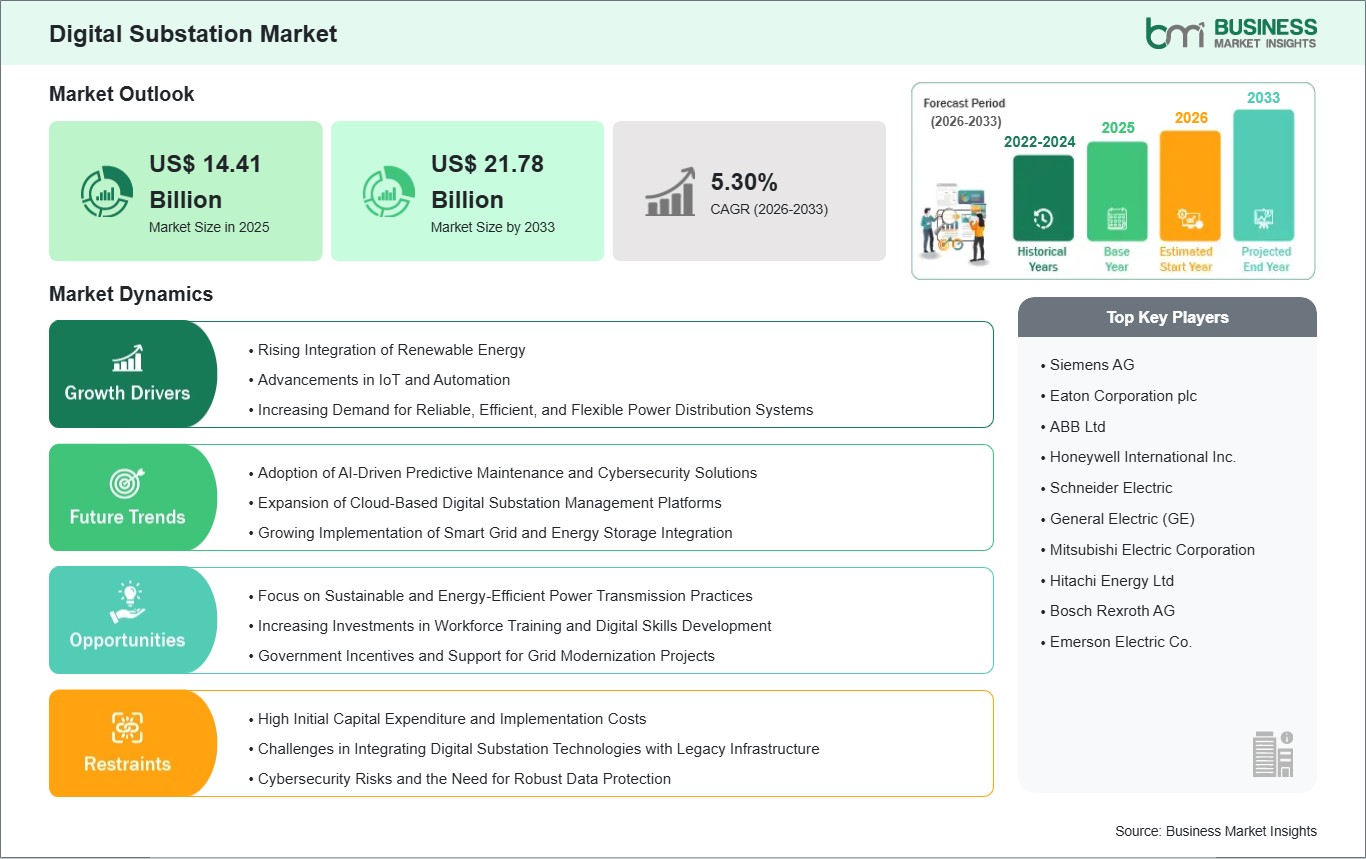
The Digital Substation Market size is expected to reach US$ 21.78 Billion by 2033 from US$ 14.41 Billion in 2025. The market is estimated to record a CAGR of 5.30% from 2026 to 2033.
The Digital Substation market is a key enabler of the transformation of power transmission and distribution to a more sustainable and efficient system. The real-time monitoring, automation, and data-driven control made possible by the digital substation are at the core of the grid modernization of the utilities, renewable energy, and industrial sectors. By using IoT, AI, and digital communication protocols, the grids become more operationally efficient, less prone to faults, and have faster response times. Digital substations are at the heart of the transition to a most stable grid, the one that can take in the highest amount of renewables and manage the complexity of the load patterns, while being more reliable, flexible, and intelligent power management is supported.
Some of the main factors driving the expansion of this market are the worldwide move towards smart grids, the imposition of grid modernizing regulations, and the urge for more resilient systems. Besides, the trend of distributed power generation and the popularity of microgrids make the need for digital substations also a matter of easy interoperable and remote control functionalities. Also, advancements in areas such as condition-based monitoring, predictive maintenance, and cybersecurity solutions have become a major factor in a quicker adoption since these are the ways to reduce downtime and secure the infrastructure of a critical nature. Yet, the market situation does not lack hurdles in the form of a high entry capital cost, the difficult task of a retrofit being your current infrastructure, and also concerns about cybersecurity threats. The insufficient number of skilled professionals familiar with digital substation technologies, as well as a fragmented regulatory landscape, constitute obstacles that slow down the pace of deployment. Besides, difficulties in standardization and interoperability between legacy systems and new digital solutions make the implementation process more complicated.

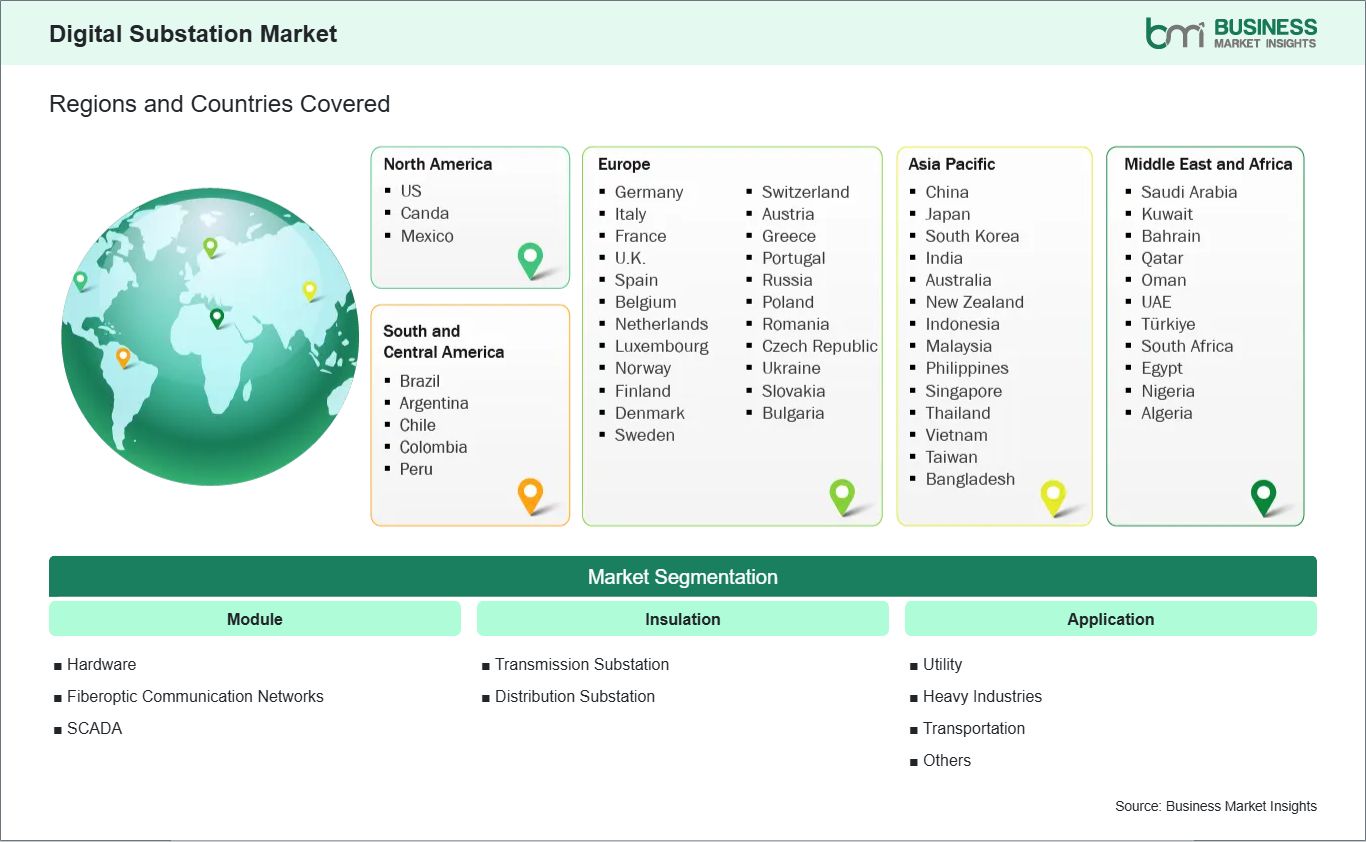
Key segments that contributed to the derivation of the Digital Substation market analysis are module, insulation, and application.
One of the main reasons for the expansion of the Digital Substation market is the rising integration of renewable energy sources. With the worldwide transition to cleaner energy sources such as solar, wind, and hydroelectric power, the power grid becomes more complicated because these sources are intermittent and variable by nature. In contrast to traditional power plants that can ensure a stable output, the production of renewable energy depends on weather conditions, time of day, and seasonal variations, hence, it becomes difficult to maintain grid stability and reliability.
Digital substations are capable of handling such situations by providing live monitoring, sophisticated automation, and smarts control of power distribution throughout the grid. They use intelligent electronic devices (IEDs), IoT-enabled sensors, and communication networks to allow utilities to manage energy generation and distribution in real-time. This not only guarantees a proper equilibrium between supply and demand but also lessens the chances of power outages and improves system reliability even when the renewable generation is highly variable. On top of that, digital substations make it possible for utilities to efficiently link up decentralized renewable sources by facilitating the integration of DERs and microgrids. Besides that, several features including predictive maintenance, fault detection, and remote diagnostics work together to raise the operational efficiency level and shorten the downtime period thus, giving the consumers the opportunity of experiencing uninterrupted power supply..
Advancements in IoT and automation technologies are fundamental to the expansion of the Digital Substation market. Digital substations are progressively adopting IoT-enabled sensors, AI algorithms, and automated control systems to not only improve operational efficiency but also to increase the reliability and safety of power transmission and distribution networks. IoT sensors deliver uninterrupted and real-time information about the performance of the equipment, the environmental conditions, and the overall health of the system, thus allowing utilities to keep an eye on the substations from a distance and take action in a timely manner if any irregularities occur.
In addition, AI-powered analytics extensively enhance this potential by substantially increasing the amount of data processed, thus providing results at a much faster rate as well as more reliable than the human ones. This way, it becomes easier to see trends, locate weak spots in the system, determine the time to carry out preventive maintenance, and regulate the power grid. Predictive maintenance is one of the major benefits of such technologies, which enable utilities to fix and replace equipment only at times when necessary, take short breaks off the grid, and save on operating costs while at the same time enhance the life span of the most valuable assets. Automation devices make it easier to perform both the usual and the difficult tasks involved in the operations by solar power plants, which can be of the nature of switching, voltage regulation, and fault isolation, thus furthering the safe use of the capacities and eradicating the risk of human errors. In extending the use of the automated control systems with the latest communication protocols, digital substations make a primary step towards saving time and effort in decision-making as well as being precise in load management and consequently enhancing grid stability..
By module, the digital substation market is bifurcated into Hardware, Fiber-optic Communication Networks, and SCADA. The hardware segment dominated the market in 2024. Fiber-optic communication networks are gaining momentum due to their high-speed, secure data transmission capabilities critical for substation automation. SCADA modules remain essential for centralized monitoring and control.
By insulation, the market is bifurcated into transmission substation, and distribution substation Transmission substations held the larger share in 2024. Distribution substations are also increasingly adopting digital technologies to support decentralized energy resources and improve fault detection.
By application, the market is segmented into Utility, Heavy Industries, Transportation, and Others. Utilities represent the primary application segment, driven by widespread digital transformation initiatives across power generation, transmission, and distribution networks. Heavy industries and transportation sectors are adopting digital substations to optimize energy usage, enhance operational safety, and support sustainability goals.
| Report Attribute | Details |
|---|---|
| Market size in 2025 | US$ 14.41 Billion |
| Market Size by 2033 | US$ 21.78 Billion |
| Global CAGR (2026 - 2033) | 5.30% |
| Historical Data | 2022-2024 |
| Forecast period | 2026-2033 |
| Segments Covered | By Module
|
|
Regions and Countries Covered
| |
| North America | US, Canada, Mexico |
| Europe | Belgium, Austria, Finland, Denmark, Greece, Poland, Romania, Russia, Ukraine, Czech Republic, Slovakia, Bulgaria, Italy, Luxembourg, Germany, Switzerland, France, Netherlands, Norway, Portugal, Spain, Sweden, United Kingdom |
| Asia-Pacific | Australia, China, India, Japan, South Korea, Indonesia, Malaysia, Philippines, Singapore, Thailand, Vietnam, Bangladesh, New Zealand, Taiwan |
| South and Central America | Brazil, Argentina, Peru, Chile, Colombia |
| Middle East and Africa | Bahrain, Kuwait, Oman, Qatar, Saudi Arabia, United Arab Emirates, Turkiye, South Africa, Egypt, Algeria, Nigeria |
| Market leaders and key company profiles |
|
The Digital Substation Market Size and Forecast (2022–2033) report provides a detailed analysis of the market covering below areas:
The geographical scope of the Digital Substation market report is divided into five regions: North America, Asia Pacific, Europe, Middle East &; Africa, and South & Central America. The Digital Substation market in Asia Pacific is expected to grow significantly during the forecast period.
The Digital Substation market in the Asia-Pacific is segmented into China, Japan, South Korea, India, Australia, New Zealand, Indonesia, Malaysia, the Philippines, Singapore, Thailand, Vietnam, Taiwan, Bangladesh, and the Rest of Asia. The region's growth is supported by a combination of high industrial output, considerable investments in Industry 4.0 technologies, and various government initiatives focused on automating, digitizing, and deploying smart factories. As a result, four major economies including China, Japan, South Korea, and India are not only leading the way in Digital Substation solution implementations but also using AI, IoT, robotics, and digital twins to improve operational efficiency, productivity, and quality control.
On top of that, the demand for Digital Substation from the core industries of the region, such as the automobile sector, the electronics industry, pharmaceuticals, the food & beverage sector, and consumer goods, has become the main driver for the market. More importantly, the investments made in high-tech manufacturing plants, predictive maintenance systems, and data-driven production platforms all contribute largely to the industry's development. Besides the public-private investment model, other government-led collaboration programs including skills training and smart factory ecosystems are also on the rise in the region to support these transformations.

The Digital Substation market is evaluated by gathering qualitative and quantitative data post primary and secondary research, which includes important corporate publications, association data, and databases. A few of the key developments in the Digital Substation market are:
The Digital Substation Market is valued at US$ 14.41 Billion in 2025, it is projected to reach US$ 21.78 Billion by 2033.
As per our report Digital Substation Market, the market size is valued at US$ 14.41 Billion in 2025, projecting it to reach US$ 21.78 Billion by 2033. This translates to a CAGR of approximately 5.30% during the forecast period.
The Digital Substation Market report typically cover these key segments-
The historic period, base year, and forecast period can vary slightly depending on the specific market research report. However, for the Digital Substation Market report:
The Digital Substation Market is populated by several key players, each contributing to its growth and innovation. Some of the major players include:
The Digital Substation Market report is valuable for diverse stakeholders, including:
Essentially, anyone involved in or considering involvement in the Digital Substation Market value chain can benefit from the information contained in a comprehensive market report.
Please tell us your area of interest
(Market Segments/ Regions and Countries/ Companies)