Market Summary
Executive Summary and Global Market Analysis
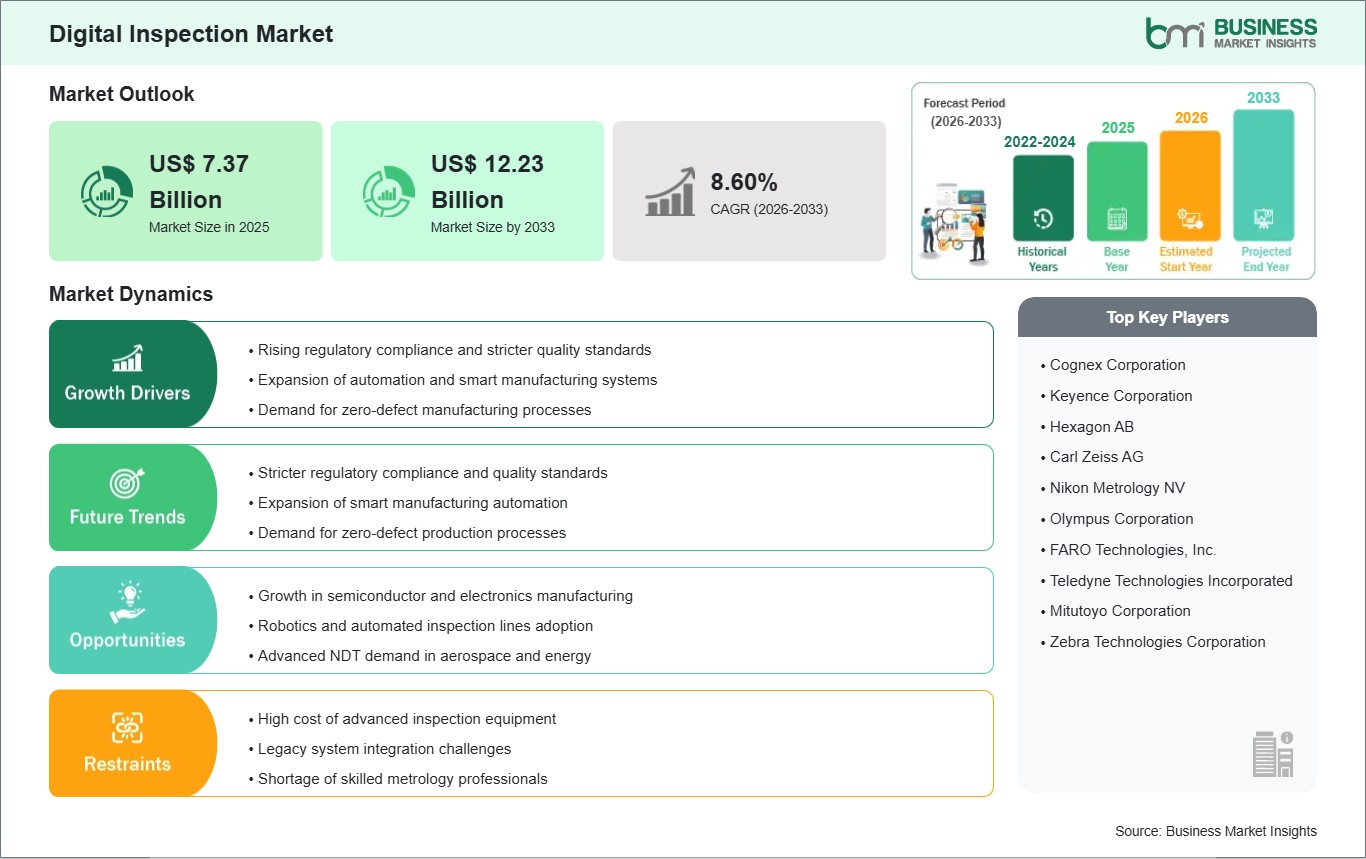
The Digital Inspection market plays a pivotal role in enhancing product quality, operational efficiency, and regulatory compliance across a wide range of industrial sectors. Digital inspection solutions leverage advanced imaging systems, automated metrology tools, non-destructive testing (NDT) technologies, robotics, and AI-driven analytics to detect defects, validate tolerances, and ensure process accuracy in real time. As manufacturing environments become increasingly automated and precision-driven, digital inspection has emerged as a core component of smart production ecosystems.
Organizations are integrating digital inspection systems into production lines to enable continuous quality monitoring, reduce human error, and minimize material waste. These solutions support applications such as surface defect detection, dimensional measurement, structural integrity testing, and assembly verification. Integration with industrial IoT platforms and manufacturing execution systems (MES) enhances traceability, data transparency, and performance optimization.
Market growth is fueled by stringent quality standards, increasing product complexity, and rising adoption of Industry 4.0 technologies. The shift toward zero-defect manufacturing, lean production models, and predictive quality control strategies is further accelerating adoption. Although high initial investment and integration complexity remain challenges, advancements in AI, machine vision, and cloud-based analytics are improving scalability, cost efficiency, and return on investment.
Segment Analysis
Digital Inspection Market Segmentation
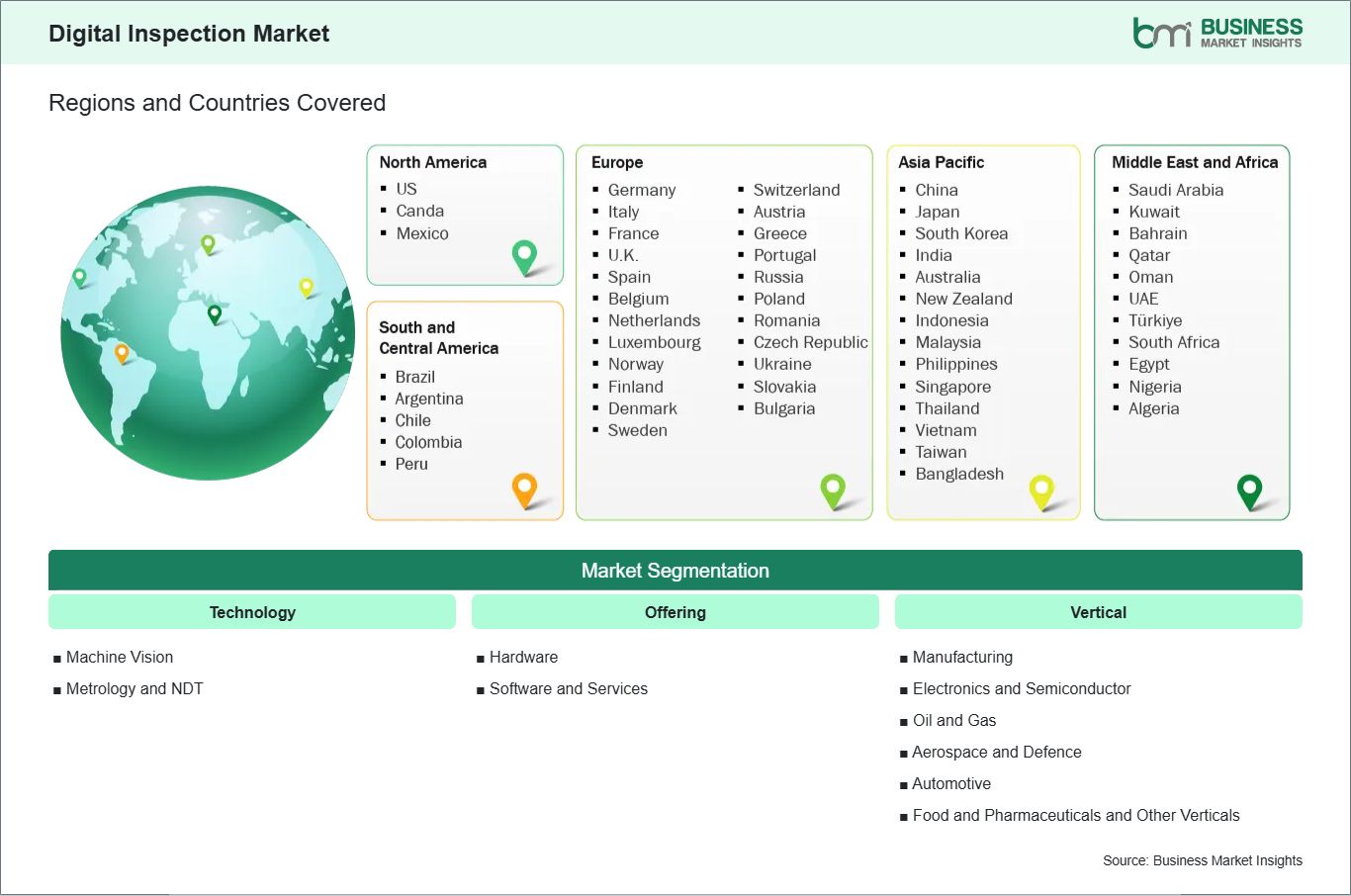
Key segments contributing to the derivation of the Digital Inspection market analysis include technology, offering, and vertical.
- By technology, the market is divided into Machine Vision, Metrology, and NDT. The Machine Vision segment held the largest share in 2025 due to its widespread adoption in automated production lines for real-time defect detection and quality assurance.
- By offering, the market is segmented into Hardware, Software, and Services. The Hardware segment dominated in 2025, supported by strong demand for cameras, sensors, scanners, and inspection systems integrated within manufacturing facilities.
- By vertical, the market includes Manufacturing, Electronics & Semiconductor, Oil & Gas, Aerospace & Defence, Automotive, Food & Pharmaceuticals, and Others. The Manufacturing segment accounted for the largest market share in 2025, driven by large-scale automation and quality optimization initiatives.
Market Forces
Digital Inspection Market Drivers and Opportunities
Increasing Emphasis on Quality Assurance and Regulatory Compliance
Rising enforcement of international quality and safety standards is a primary driver of the Digital Inspection market. Industries such as aerospace, automotive, electronics, and pharmaceuticals operate under strict regulatory frameworks that require precise inspection, documentation, and traceability. Even minor defects can lead to product recalls, financial penalties, or reputational damage.
Digital inspection systems enable automated, repeatable, and data-driven quality control processes that minimize variability and ensure compliance. Real-time monitoring and digital documentation enhance audit readiness and reduce dependency on manual inspection methods. As supply chains become increasingly globalized, manufacturers are investing in standardized inspection technologies to maintain consistent quality across geographically dispersed production facilities, sustaining long-term demand.
Growth of Automation and Smart Manufacturing Ecosystems
The rapid expansion of automation and smart factory initiatives is creating significant growth opportunities for digital inspection solutions. Modern production environments rely on robotics, CNC machinery, additive manufacturing, and high-precision assembly systems that demand continuous monitoring and accuracy validation. Integration of AI-powered image analysis, 3D metrology systems, and automated NDT technologies enables faster defect identification and predictive quality management. Digital inspection supports closed-loop manufacturing by feeding real-time data back into control systems to correct deviations and optimize performance.
Additionally, the adoption of digital twins, edge computing, and cloud-based analytics is enhancing scalability and remote monitoring capabilities. As industries transition toward data-driven production models and zero-defect strategies, digital inspection technologies are becoming indispensable to achieving operational excellence and competitive advantage.
Size and Share Analysis
Digital Inspection Market Size and Share Analysis
By technology, Machine Vision represents the largest revenue-generating segment, driven by its extensive deployment in automated production environments and real-time quality monitoring applications. Metrology and NDT segments are expected to witness steady growth due to increasing demand for high-precision dimensional measurement and structural integrity testing.
By offering, Hardware accounts for the largest market share, supported by strong investments in imaging systems, sensors, and automated inspection equipment. Software is anticipated to experience accelerated growth due to rising adoption of AI-based analytics and cloud-integrated quality management platforms.
By vertical, Manufacturing dominates the market, followed by Electronics & Semiconductor and Automotive sectors, where precision requirements, production scale, and compliance standards are particularly stringent.
Report Coverage
Digital Inspection Market Report Coverage and Deliverables
The "Digital Inspection Market Size and Forecast (2022 - 2033)" report provides a detailed analysis of the market covering below areas:
- Digital Inspection market size and forecast at global, regional, and country levels for all the key market segments covered under the scope
- Digital Inspection market trends, as well as market dynamics such as drivers, restraints, and key opportunities
- Digital Inspection market analysis covering key market trends, global and regional framework, major players, regulations, and recent market developments
- Industry landscape and competition analysis covering market concentration, heat map analysis, prominent players, and recent developments for the Digital Inspection market
- Detailed company profiles, including SWOT analysis
Geographic Insights
Digital Inspection Market Geographic Insights
The Digital Inspection market is geographically segmented into North America, Asia Pacific, Europe, the Middle East & Africa, and South & Central America, with each region demonstrating distinct growth patterns influenced by industrial development, regulatory enforcement, and automation maturity.
Asia Pacific is projected to witness the fastest growth and maintain a leading market position throughout the forecast period. Rapid industrialization, expansion of electronics and semiconductor manufacturing hubs, and increasing investments in automation across China, India, Japan, South Korea, and Southeast Asia are driving strong demand for advanced inspection systems. Growing export-oriented manufacturing and rising adoption of global quality standards further support regional expansion.
North America and Europe represent mature markets characterized by advanced manufacturing ecosystems, strict regulatory oversight, and early adoption of smart factory technologies. Continuous investments in aerospace, automotive, and high-tech manufacturing sectors sustain steady demand for digital inspection solutions. Meanwhile, the Middle East & Africa and South & Central America are experiencing gradual growth, supported by infrastructure modernization, industrial diversification, and increasing focus on product quality and operational reliability across emerging economies.
Industry Activity
Recent Developments
The Digital Inspection market is evaluated by gathering qualitative and quantitative data post primary and secondary research, which includes important corporate publications, association data, and databases. A few of the key developments in the Digital Inspection market are:
- In May 2024, GE Vernova (NYSE: GEV) a global leader in electrification, decarbonization, and energy solutions announced the launch of Autonomous Inspection, a cloud-based computer vision software solution designed to automate the manual inspection and monitoring of industrial assets by utilizing image capture devices and artificial intelligence/machine learning (AI/ML) algorithms. This new software integrates with select applications within GE Vernova’s Asset Performance Management (APM), a suite of software and services designed to help asset performance and operations and maintenance (O&M) efficiency across equipment, plant, and an entire fleet.
- In May 2022, Hitachi, Ltd. (TSE:6501) announced the launch of Lumada Inspection Insights, its end-to-end portfolio of digital solutions for the inspection, monitoring, and optimization of critical assets. Pioneered by Hitachi Energy and Hitachi Vantara, Lumada Inspection Insights enables customers to automate asset inspection, support sustainability goals, improve physical security, and reduce risks and impacts related to storms or fires by using powerful artificial intelligence (AI) to analyze photographs and video, including LiDAR, thermal and satellite imagery.
Trust & Transparency
Research Methodology
The market analysis combines proprietary research with secondary data from government agencies, company disclosures, regulatory filings, industry databases and expert interviews. Market estimates are validated through data triangulation, cross-market benchmarking and analyst
review.
View Full Research Methodology
Key Sources Referred:
International Data Corporation (IDC)Institute of Electrical and Electronics Engineers (IEEE)Company websiteCompany annual reportsCompany investor presentations