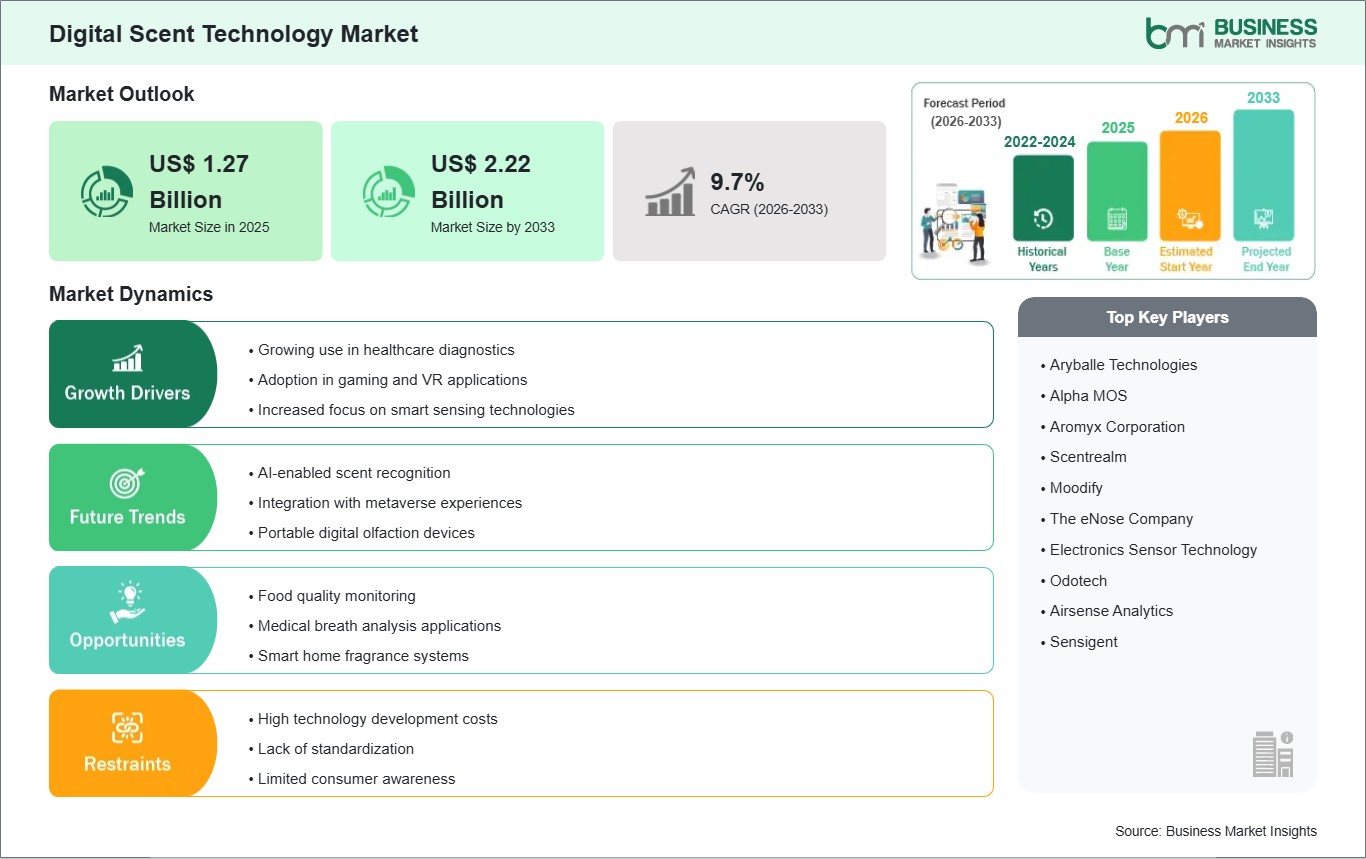
The Digital Scent Technology market size is expected to reach US$ 2.22 billion by 2033 from US$ 1.27 billion in 2025. The market is estimated to record a CAGR of 9.7% from 2026 to 2033.
Digital scent technology refers to the integrated application of olfactory systems engineered to detect, transmit, and reproduce aromas within a digital environment. By utilizing specialized hardware, primarily electronic noses (e-noses) for scent capture and scent synthesizers for emission, these systems convert complex chemical signatures into digital data for sensory replication. This technology is fundamental to the operational architecture of non-invasive medical diagnostics, high-fidelity virtual reality (VR) simulations, and industrial quality control for food and beverage safety. Market expansion is being propelled by the rapid integration of olfactory sensors into smartphones, the rising institutional requirement for breath-based disease screening, and the global rollout of multisensory metaverse platforms that prioritize deep emotional immersion.
However, several factors may restrain market progression. The high capital intensity associated with high-precision multi-sensor e-noses, which require frequent recalibration and expensive replacement of consumable scent cartridges, remains a primary hurdle for widespread consumer adoption. The industry also faces persistent technical challenges regarding scent persistence and clearing, as the inability to rapidly neutralize a fragrance before the next emission can lead to olfactory overlap and reduced realism. Additionally, the lack of unified global standardization for digital scent protocols has intensified concerns regarding cross-platform interoperability, potentially fragmenting the developer ecosystem. These hurdles, compounded by the strategic risks of stringent EU regulations on volatile organic compound (VOC) emissions and a scarcity of large annotated olfactory datasets for AI training, increase the total cost of ownership and may lengthen the validation cycles for mission-critical healthcare applications.
Despite these hurdles, the market outlook remains highly favorable as the sector transitions toward intelligent and miniaturized sensory interfaces. Opportunities are emerging through the adoption of Olfactory Intelligence (OI); the market is witnessing a surge in AI-driven platforms that use graph neural networks to autonomously blend custom fragrances in real-time based on a user's biometric state or digital context. The medical diagnostic segment is gaining significant traction, with a rising requirement for e-noses capable of detecting lung cancer and other metabolic disorders through 30-second breath analysis. Furthermore, the growth of Emotionally Adaptive Smart Homes, where scent is synchronized with lighting and audio to enhance wellness, aligns with global goals for personalized and responsive living environments. Collectively, these innovations position the digital scent technology industry for sustained long-term development as a cornerstone of the modern, multisensory, and data-enriched global digital landscape.

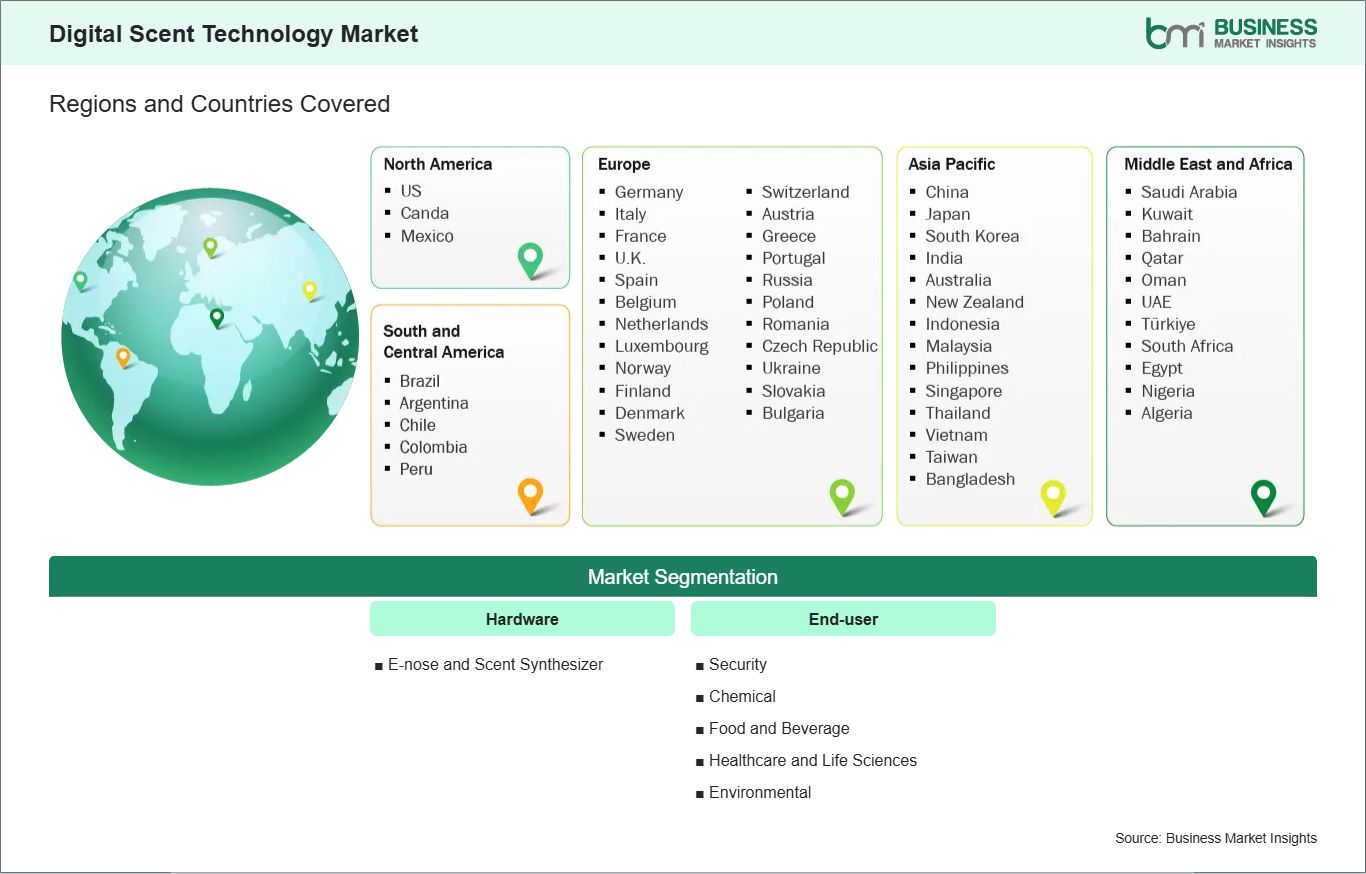
Key segments that contributed to the derivation of the Digital Scent Technology market analysis are hardware and end user.
The digital scent technology market is being driven by the growing need for immersive experiences, healthcare innovation, and food safety across industries such as entertainment, consumer electronics, healthcare, and food & beverage. Digital scent devices simulate and transmit smells electronically, enhancing user engagement in virtual reality, gaming, and multimedia applications. Rising demand for multisensory experiences is amplifying adoption, as consumers seek deeper immersion in AR/VR environments. Healthcare is reinforcing growth, with digital scent technologies being explored for diagnostic tools, therapeutic applications, and patient rehabilitation. Food and beverage industries are leveraging scent technology for quality control, freshness detection, and enhanced consumer experiences. Additionally, rising awareness of hygiene and safety is propelling investment in digital scent solutions that can detect hazardous odors or contamination. The expansion of e‑commerce and online retail is also driving demand, as digital scent technology offers potential for virtual product sampling. Collectively, immersive experience priorities, healthcare applications, and food safety requirements are fueling sustained growth in the global digital scent technology market.
Opportunities in the digital scent technology market are expanding through the integration of artificial intelligence, IoT ecosystems, and emerging cross‑industry applications. AI‑enabled scent platforms are opening lucrative opportunities by delivering adaptive scent generation, predictive analytics, and personalized olfactory experiences. IoT‑driven devices are gaining traction, enabling digital scent systems to connect seamlessly with smart homes, wearables, and entertainment platforms. The growing emphasis on multisensory digital transformation is fueling demand for interoperable scent solutions that enhance virtual reality, online shopping, and remote communication. Emerging applications in healthcare are driving innovation, as digital scent technology supports early disease detection, therapeutic interventions, and patient monitoring. Food and beverage industries are reinforcing opportunities, where scent devices ensure quality assurance and enable interactive consumer engagement. Additionally, sustainability trends are encouraging deployment of eco‑friendly, energy‑efficient scent technologies that align with global environmental goals. The expansion of smart marketing, personalized advertising, and immersive entertainment is creating new pathways for adoption. Vendors who focus on AI‑driven, IoT‑ready, and industry‑specific scent solutions are well‑positioned to capture growth. The convergence of AI, IoT, and multisensory innovation underscores a transformative trajectory for the global digital scent technology market.

The Digital Scent Technology market demonstrates steady growth, with size and share analysis revealing evolving trends and competitive positioning among key players. The report examines subsegments categorized within hardware and end user, offering insights into their contribution to overall market performance.
Based on Hardware, the E‑nose subsegment holds a strong presence, as electronic noses are indispensable for detecting, identifying, and analyzing odors across industries. They are widely used in security for explosives detection, in healthcare for disease diagnosis, and in food & beverage for quality control. E‑noses leverage sensor arrays and pattern recognition algorithms to provide accurate odor profiling, making them critical for applications requiring precision and reliability. The Scent Synthesizer subsegment is essential for recreating and delivering specific scents in entertainment, marketing, and consumer experiences. Scent synthesizers anchor demand in immersive technologies such as VR/AR, gaming, and digital advertising, where sensory engagement enhances user experience. Together, these hardware categories highlight the dual role of digital scent technology in both detection and sensory simulation.
| Report Attribute | Details |
|---|---|
| Market size in 2025 | US$ 1.27 Billion |
| Market Size by 2033 | US$ 2.22 Billion |
| Global CAGR (2026 - 2033) | 9.7% |
| Historical Data | 2022-2024 |
| Forecast period | 2026-2033 |
| Segments Covered | By Hardware
|
|
Regions and Countries Covered
| |
| North America | US, Canada, Mexico |
| Europe | Belgium, Austria, Finland, Denmark, Greece, Poland, Romania, Russia, Ukraine, Czech Republic, Slovakia, Bulgaria, Italy, Luxembourg, Germany, Switzerland, France, Netherlands, Norway, Portugal, Spain, Sweden, United Kingdom |
| Asia-Pacific | Australia, China, India, Japan, South Korea, Indonesia, Malaysia, Philippines, Singapore, Thailand, Vietnam, Bangladesh, New Zealand, Taiwan |
| South and Central America | Brazil, Argentina, Peru, Chile, Colombia |
| Middle East and Africa | Bahrain, Kuwait, Oman, Qatar, Saudi Arabia, United Arab Emirates, Turkiye, South Africa, Egypt, Algeria, Nigeria |
| Market leaders and key company profiles |
|
The Digital Scent Technology Market Size and Forecast (2022&2033)& report provides a detailed analysis of the market covering below areas:
The geographical scope of the Digital Scent Technology market report is divided into five regions: North America, Asia Pacific, Europe, Middle East & Africa, and South & Central America.
North America maintains a preeminent position within the global industry, a status reinforced by the region's advanced research ecosystem and the rapid commercialization of digital olfaction across high-impact sectors. The regional landscape is characterized by significant investments in the United States and Canada, where North America accounts for a leading portion of the global market share. This market leadership is supported by a robust presence of technology pioneers, including Sensigent LLC, Smiths Detection, and ScentSational Technologies, who drive the development of electronic noses and scent synthesizers for industrial and clinical applications.
Industrial and enterprise trends in the region reflect a decisive shift toward Non-Invasive Healthcare Diagnostics and Immersive Media. Medical institutions are increasingly piloting electronic sensing systems for breath analysis to detect volatile organic compounds associated with respiratory illnesses and metabolic disorders. Furthermore, the region is witnessing an escalating demand for Scent-Enabled Virtual Reality and Gaming. This focus on Multisensory Immersion allows developers to integrate olfactory layers into digital content, enhancing emotional engagement and memory retention for training simulations, entertainment, and experiential retail.

The Digital Scent Technology market is evaluated by gathering qualitative and quantitative data post primary and secondary research, which includes important corporate publications, association data, and databases. A few of the key developments in the Digital Scent Technology market are:
The Digital Scent Technology Market is valued at US$ 1.27 Billion in 2025, it is projected to reach US$ 2.22 Billion by 2033.
As per our report Digital Scent Technology Market, the market size is valued at US$ 1.27 Billion in 2025, projecting it to reach US$ 2.22 Billion by 2033. This translates to a CAGR of approximately 9.7% during the forecast period.
The Digital Scent Technology Market report typically cover these key segments-
The historic period, base year, and forecast period can vary slightly depending on the specific market research report. However, for the Digital Scent Technology Market report:
The Digital Scent Technology Market is populated by several key players, each contributing to its growth and innovation. Some of the major players include:
The Digital Scent Technology Market report is valuable for diverse stakeholders, including:
Essentially, anyone involved in or considering involvement in the Digital Scent Technology Market value chain can benefit from the information contained in a comprehensive market report.
Please tell us your area of interest
(Market Segments/ Regions and Countries/ Companies)