Digital Aviation Market Regional Highlights
North America Digital Aviation Market
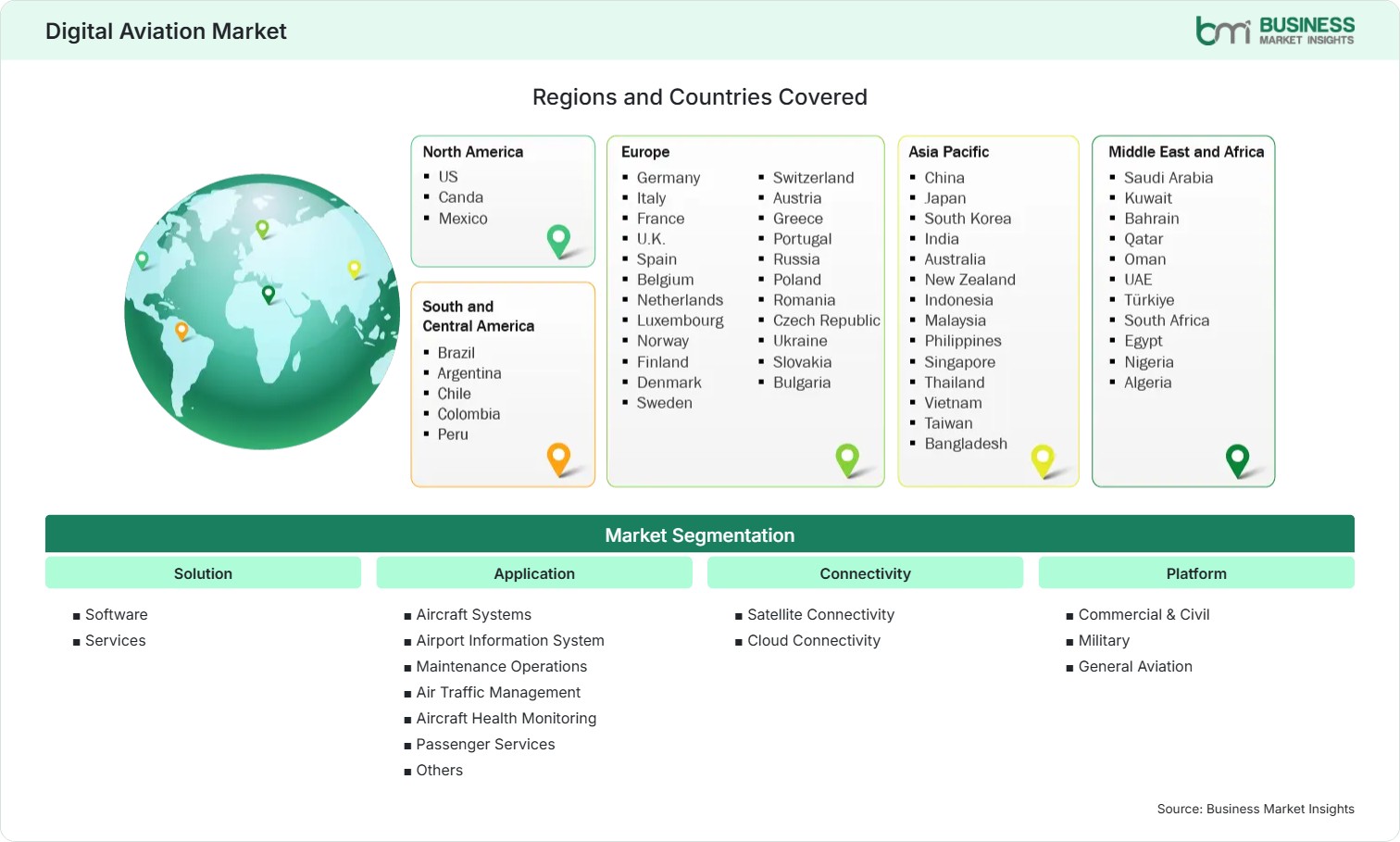
North America represents a 32%–35% share in 2025 and records a 8.2%–9.0% CAGR through 2033. The region benefits from mature airline IT infrastructure, large commercial fleets, advanced MRO capabilities, and substantial cybersecurity spending. The Digital Aviation Market share remains supported by high software penetration and established cloud ecosystems. The Market growth is reinforced by AI-based operations, predictive maintenance, connected aircraft, and airport automation. The US remains the principal regional technology buyer, while Canada supports specialized aviation software and aerospace analytics demand.
- The modernization of airlines is focusing on integrated operational platforms, and AI is becoming more embedded in disruption management, scheduling, aircraft assignment, and crew decision support.
- As the pressure from capacity limitations grows, airport operators are placing greater emphasis on biometrics, automated passenger processing, cybersecurity, and having real-time operational visibility.
- MRO providers are using predictive analytics and connected-engineering systems to enhance their maintenance planning, visibility of parts, aircraft availability, and the productivity of technicians.
- The process of migrating to the cloud is helping to reduce infrastructure complexity and, at the same time, allowing for centralized analytics to be carried out across the airline and airport operations that are distributed.
US Digital Aviation Market
The US accounts for approximately 75%–80% of the North American Digital Aviation Market demand and expands at a 8.3%–9.1% CAGR. Its position reflects a large airline fleet, advanced airports, extensive MRO networks, and strong aerospace software capabilities. Operators increasingly integrate aircraft, passenger, crew, and maintenance data.
- The major airlines are putting an upgrade on their flight operations, data platforms, AI applications, and passenger systems to handle crowded schedules and the risk of disruptions.
- Aerospace manufacturers are incorporating analytics into their maintenance and fleet services, which is leading to new and ongoing sources of digital revenue in addition to sales of the original equipment.
- Cybersecurity investment is still of strategic importance since the interconnected nature of airline, airport, aircraft, and third-party systems leads to greater operational exposure.
Europe Digital Aviation Market
Europe holds a 27%–30% Digital Aviation Market share in 2025 and expands at a 8.0%–8.8% CAGR. The market benefits from mature aviation infrastructure, sustainability requirements, cross-border operations, and strong digital identity initiatives. Germany, France, and the UK remain leading technology markets, while Spain and Italy provide additional airport modernization demand.
- In 2025, Airbus was increasing its digital integration via Skywise, the system having supported more than 11,900 commercial aircraft and about 55,000 users.
- European airports are increasingly combining biometric processing, passenger analytics, automated baggage systems, and cybersecurity capabilities.
- There is a growing demand for operational data platforms as a result of sustainability reporting, particularly since these platforms need to measure emissions, fuel performance, and ground operations.
- In multinational airlines and maintenance networks with operating bases in different locations, collaboration based on the cloud is becoming more important.
Asia Pacific Digital Aviation Market
Asia Pacific represents 24%–27% of 2025 demand and achieves the fastest regional expansion at 10.0%–11.2% CAGR. The Digital Aviation Market is supported by rapid passenger growth, fleet expansion, airport construction, and technology modernization. China, Japan, India, Singapore, and Australia are leading markets, while India and Southeast Asia offer particularly strong growth opportunities.
- New airports offer the chance to introduce cloud-native passenger processing, digital identity, automated baggage handling, and an integrated command system.
- Airlines are using analytics to optimize their fleet utilization, turnaround times, crew allocation, fuel consumption, and their ability to recover from disruptions.
- Singapore continues to function as a technological hub for the region since its advanced airport facilities generate a demand for high-value automation and connected operational systems.
- The greater the growth in aviation connectivity, the more likely it is that investment will be made in satellite and cloud communication infrastructure in emerging markets.
Rest of World Digital Aviation Market
Rest of World accounts for 10%–13% in 2025 and grows at 8.8%–10.0% CAGR. South and Central America benefit from airport modernization and airline fleet renewal, while the Middle East and Africa gain from hub expansion and digital infrastructure investment. The Digital Aviation Market share is strongest in Gulf aviation centers, while the market growth is faster in developing aviation systems.
- The Gulf countries are putting their money into advanced airports, biometric processing, digital identity, the use of artificial intelligence in operations, and in creating connected passenger journeys to strengthen the competitiveness of their hubs.
- Brazil and Mexico offer opportunities in the areas of airline software, MRO analytics, airport systems, and cloud-based operational platforms.
- African aviation operators are increasingly calling for solutions that are scalable and will allow them to modernise their operations without having to make substantial investments in existing infrastructure.
- Satellite connectivity provides a vital means of carrying out remote operations, enabling communication for aircraft, offering passenger services, and allowing for the exchange of operational data in real time.