
Aviation Test Equipment Market Outlook: Size, Share, Trends, Growth Analysis, Competitive Landscape & Forecast, 2026-2033

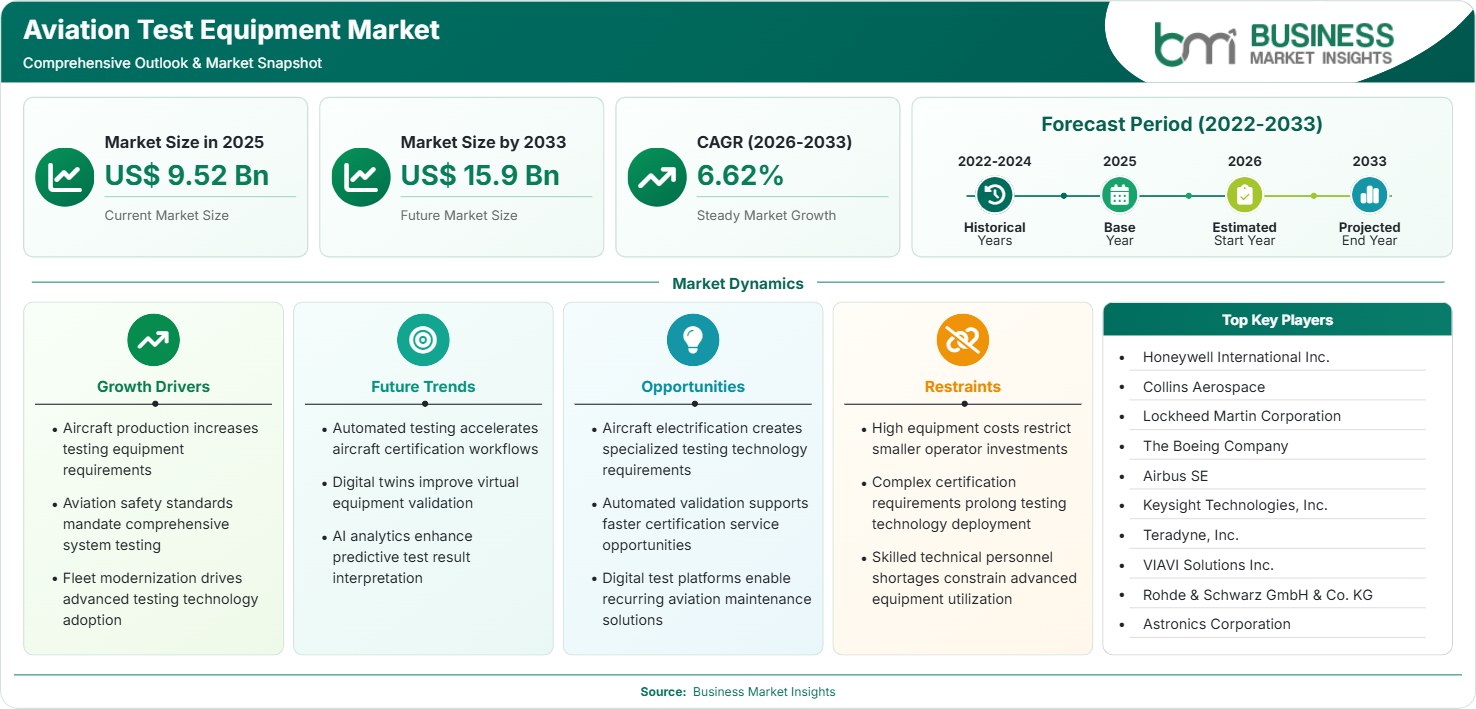
The Aviation Test Equipment Market size was valued at US$ 9.52 Billion in 2025 and is projected to reach US$ 15.9 Billion by 2033, growing at a CAGR of 6.62% during 2026–2033, driven by fleet expansion, avionics complexity, MRO digitization, certification requirements, automation, electrification, and defense modernization.

Report Coverage
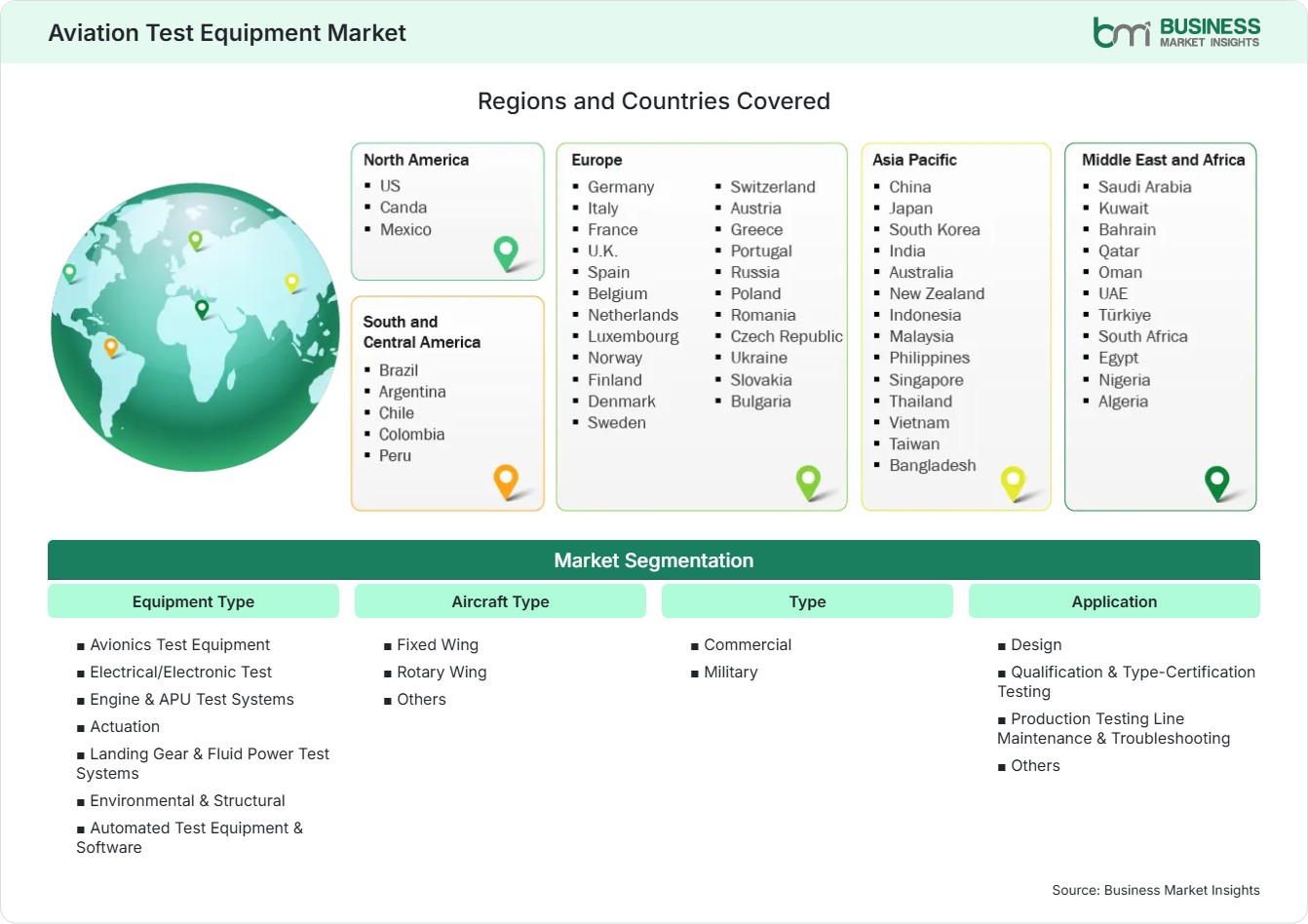
  • Equipment Type: Avionics Test Equipment, Electrical/Electronic Test, Engine & APU Test Systems, Actuation, Landing Gear & Fluid Power Test Systems, Environmental & Structural, Automated Test Equipment & Software
  • Aircraft Type: Fixed Wing, Rotary Wing, Others
  • Type: Commercial, Military
  • Application: Design, Qualification & Type-Certification Testing, Production Testing Line Maintenance & Troubleshooting, Others
US$ 9.52 Bn Market size in 2025
US$ 15.9 Bn Market Size by 2033
6.62% CAGR, 2026 - 2033
2026-2033 Forecast Period

AI Overview

Aviation Test Equipment Market Summary

  • North America Region: North America holds Aviation Test Equipment Market share of 39%–43% in 2025, growing with a CAGR of 5.4%–6.1%, influenced by defense modernization, mature MRO infrastructure, avionics upgrades, fleet renewal, automated diagnostics, and aerospace manufacturing investment.
  • Fastest Growing Region: Asia Pacific holds a market share of 20%–24% in 2025, expanding at a CAGR of 7.8%–8.6%, supported by fleet additions, rising passenger traffic, expanding MRO capacity, localization initiatives, defense procurement, and advanced avionics manufacturing investments.
  • Leading Segment: Avionics Test Equipment holds a market share of 30%–34% in 2025, expanding at a CAGR of 6.5%–7.1%, supported by connected aircraft architectures, navigation upgrades, communications testing, cybersecurity validation, and increasingly software-defined avionics.
  • High Growth Segment: Automated Test Equipment (ATE) & Software holds a market share of 10%–14% in 2025, expanding at a CAGR of 8.2%–9.0%, driven by automated diagnostics, reusable test programs, digital interfaces, data analytics, and reduced maintenance turnaround times.
  • Key Market Opportunity: Investment is shifting toward modular test platforms, software-defined instrumentation, digital twins, wireless acquisition, predictive diagnostics, and localized certification capabilities that reduce testing cycle times while improving aircraft availability globally.
  • Major Market Players: Honeywell International Inc.; Collins Aerospace; Lockheed Martin Corporation; The Boeing Company; Airbus SE; Keysight Technologies, Inc.; Teradyne, Inc.; VIAVI Solutions Inc.; Rohde & Schwarz GmbH & Co. KG; Astronics Corporation.
Strategic Insights

Aviation Test Equipment Market: Strategic Insights

Aviation Test Equipment Market Strategic Framework
FREE PDF
Request your free sample
Request free sample
Stakeholder View

Key Takeaways

  • The value chain increasingly links precision instrumentation, test software, fixtures, calibration, engineering services, maintenance databases, and lifecycle support rather than relying on individual instruments.
  • Automated diagnostics and software-defined platforms offer strong upside because operators can reuse test programs across aircraft configurations while reducing technician intervention and troubleshooting time.
  • Wireless data acquisition, digital twins, high-speed connectivity validation, AI-assisted diagnostics, and modular instrumentation are reshaping equipment design and test workflow integration.
  • India and wider Asia Pacific provide a compelling investment case because fleet expansion, engineering localization, defense procurement, aircraft manufacturing, and MRO development are occurring concurrently.
  • Consolidation among aerospace technology suppliers is increasing the strategic value of proprietary testing, instrumentation, software, calibration, and engineering capabilities.
  • Suppliers that combine equipment sales with software updates, calibration, technical training, obsolescence management, and long-term support can strengthen recurring revenue and customer retention.
Geographic Outlook

Aviation Test Equipment Market Regional Highlights

North America Aviation Test Equipment Market

North America Aviation Test Equipment Market holds a 39%–43% share in 2025 and records a 5.4%–6.1% CAGR through 2033. The region benefits from extensive commercial fleets, defense programs, mature MRO networks, aerospace OEM concentration, and strong demand for avionics validation. The United States accounts for most regional demand because military sustainment, aircraft modernization, and advanced production programs require sophisticated automated testing. Canada contributes through aircraft manufacturing, component development, simulation, specialized maintenance, and defense aviation programs requiring precision measurement and certification capabilities.

  • Defense sustainment supports recurring demand for ruggedized automated systems, particularly where legacy platforms require continued diagnostics despite component obsolescence.
  • Commercial MRO operators are upgrading portable avionics testers, communications analyzers, and digital inspection systems to shorten aircraft ground time.
  • Aerospace production investment is encouraging integrated testing earlier in manufacturing, increasing demand for programmable instruments and software-controlled validation.
  • Certification-intensive development programs favor high-accuracy equipment with traceability, calibration management, environmental testing, and automated documentation capabilities.

US Aviation Test Equipment Market

The U.S. Aviation Test Equipment Market accounts for 82%–86% of North American demand and records a 5.5%–6.2% CAGR through 2033. Its leadership reflects the concentration of aircraft OEMs, defense primes, engine manufacturers, airlines, MRO providers, and test-system specialists. Government modernization programs reinforce demand for automated avionics testing and sustainment equipment, while commercial operators prioritize diagnostics supporting higher aircraft utilization. The breadth of military aircraft platforms also sustains replacement demand for specialized legacy test equipment and advanced electronic verification systems across multiple aircraft generations.

  • Military modernization sustains demand for automated systems supporting avionics, radar, communications, electronic warfare, navigation, and mission electronics across multiple aircraft generations.
  • Commercial operators increasingly deploy portable and software-enabled equipment for rapid troubleshooting, reducing dependence on centralized depot testing for selected line-maintenance tasks.
  • Domestic aerospace manufacturing supports production testing, environmental validation, structural testing, electrical verification, and acceptance testing across complex supply chains.

Europe Aviation Test Equipment Market

Europe Aviation Test Equipment Market represents a 23%–27% share in 2025 and is projected to expand at a 5.8%–6.5% CAGR. Germany, France, the United Kingdom, Italy, and Spain form the principal aerospace manufacturing and testing base, while France and Germany remain particularly important for sophisticated avionics and certification applications. Germany records approximately 6.1%–6.8% growth and France approximately 6.0%–6.7%, supported by commercial aerospace programs, defense modernization, sustainable aviation development, engine testing, advanced electronics, and component qualification requirements.

  • European aerospace programs increasingly require environmental, electromagnetic compatibility, structural, and propulsion testing to support certification of next-generation aircraft architectures.
  • Germany combines industrial automation expertise with aerospace manufacturing, creating demand for digitally integrated test systems and high-throughput production validation.
  • France benefits from major aircraft, engine, avionics, and defense ecosystems, supporting recurring investment in development, qualification, production, and maintenance testing.
  • The United Kingdom remains important for engine testing, military aviation, avionics engineering, and specialized aerospace measurement applications.

Asia Pacific Aviation Test Equipment Market

Asia Pacific Aviation Test Equipment Market commands a 20%–24% share in 2025 and records the fastest regional CAGR of 7.8%–8.6%. China, India, Japan, South Korea, Singapore, and Australia are strengthening aircraft manufacturing, MRO, defense, and aviation infrastructure. India is among the fastest individual markets, with modeled growth of 8.3%–9.1%, supported by fleet expansion, engineering localization, and MRO investment. China provides substantial demand through domestic aircraft development, defense aviation, electronics manufacturing, certification infrastructure, and expanding commercial fleet requirements.

  • India is developing integrated aerospace engineering, manufacturing, and testing ecosystems, creating demand for avionics, electrical, environmental, structural, and production test capabilities.
  • China’s domestic aircraft programs and expanding commercial fleet support requirements for indigenous testing, certification infrastructure, component validation, and lifecycle diagnostics.
  • Japan and South Korea provide mature electronics and defense ecosystems where high-precision measurement, semiconductor-related testing, and avionics validation intersect.
  • Southeast Asian MRO hubs are adopting portable diagnostic and automated systems as airlines seek shorter turnaround times and stronger maintenance independence.

Rest of World Aviation Test Equipment Market

South and Central America Aviation Test Equipment Market represents a smaller but developing demand base supported by fleet modernization, regional aircraft utilization, aerospace manufacturing, and MRO investment. Brazil remains the principal market, while Mexico benefits from aerospace manufacturing and cross-border supply-chain integration. The combined subregion records modeled growth of 6.5%–8.0%. Middle East and Africa benefit from fleet expansion, defense procurement, major airline hubs, and MRO investments, with Gulf states leading specialized testing adoption. The broader RoW region records a 6.4%–7.2% CAGR through 2033.

  • Brazil combines aircraft manufacturing, airline operations, defense aviation, and MRO capabilities, creating diversified demand for electrical, avionics, structural, and propulsion testing.
  • Mexico benefits from aerospace component manufacturing and proximity to North American production networks, increasing demand for production and quality-control test systems.
  • The United Arab Emirates and Saudi Arabia are strengthening aviation infrastructure, creating opportunities for advanced MRO diagnostics, automated test equipment, and localized support services.
  • South Africa remains a specialized African testing center, while Gulf aviation ecosystems create higher-value demand for certification and fleet-support technologies.
Global Market Geography
FREE PDF
Request your free sample
Request free sample
Segment Analysis

Aviation Test Equipment Market Segmentation

Equipment Type

Equipment Type represents the broadest technology grouping, with Avionics Test Equipment accounting for 30%–34% share in 2025 and expanding at 6.5%–7.1% CAGR. Adoption is supported by aircraft connectivity, electronic integration, certification requirements, maintenance diagnostics, and increasingly software-defined architectures across commercial and military platforms. The Aviation Test Equipment Market scope increasingly favors integrated systems supporting multiple electronic domains.

  • Avionics Test Equipment: Supports navigation, communication, radar, transponders, sensors, and integrated avionics validation, with demand driven by connectivity upgrades, certification requirements, and increasingly complex aircraft electronic architectures.
  • Electrical / Electronic Test: Covers power systems, wiring, electronic assemblies, and signal integrity, benefiting from electrification, higher onboard power demand, electronic integration, and stricter production quality requirements.
  • Engine & APU Test Systems: Enable propulsion and auxiliary power validation across development, production, overhaul, and maintenance, with demand tied to engine reliability, efficiency programs, and growing installed fleets.
  • Actuation, Landing Gear & Fluid Power Test Systems: Validate hydraulic, pneumatic, actuation, and landing systems under controlled conditions, supporting safety-critical maintenance, component overhaul, certification, and aircraft availability.
  • Environmental & Structural: Covers vibration, thermal, pressure, humidity, acoustic, fatigue, and structural validation, gaining importance as manufacturers introduce lighter materials and more integrated aircraft architectures.
  • Automated Test Equipment (ATE) & Software: Combines programmable hardware, test interfaces, software, diagnostics, and data management, with adoption accelerated by automation, repeatability, labor constraints, and reusable test programs.

Aircraft Type

Aircraft Type demand is shaped by installed fleet size, utilization intensity, maintenance complexity, and electronics content. Fixed Wing remains the dominant category, while Rotary Wing and Others provide specialized opportunities. The segment benefits from increasing aircraft utilization, longer operating lives, new propulsion concepts, unmanned platforms, and broader electronic integration. Aviation Test Equipment requirements increasingly span design, certification, production, maintenance, and lifecycle sustainment across civil and defense fleets.

  • Fixed Wing: Dominates testing demand because commercial, business, cargo, and military aircraft require extensive avionics, propulsion, structural, electrical, and environmental validation across long operational lifecycles.
  • Rotary Wing: Requires specialized propulsion, vibration, actuation, flight-control, and avionics testing, supported by military modernization, emergency services, offshore operations, and helicopter MRO.
  • Others: Includes emerging unmanned, advanced air mobility, and specialized aircraft platforms, creating demand for compact instrumentation, wireless acquisition, autonomous diagnostics, and flexible development testing.

Type

Commercial and Military Aviation Test Equipment applications represent distinct purchasing environments. Commercial demand emphasizes uptime, certification, standardization, and lifecycle economics, while military procurement emphasizes ruggedization, interoperability, mission readiness, security, and support for legacy platforms. Both categories benefit from increasing electronics content and automated diagnostic requirements. Equipment suppliers increasingly develop configurable platforms that can serve multiple aircraft programs, allowing customers to reduce duplicated infrastructure and standardize testing workflows across distributed engineering, manufacturing, maintenance, and defense facilities.

  • Commercial: Airlines, OEMs, and MRO providers prioritize rapid troubleshooting, repeatable certification, production quality, and portable testing to improve aircraft utilization and maintenance turnaround performance.
  • Military: Defense organizations require rugged, deployable, software integration. Increasing aircraft complexity also encourages test-data continuity between development and service environments, enabling manufacturers and operators to reuse validated procedures and improve troubleshooting consistency throughout an aircraft's operating life. Secure, long-supported testing systems are capable of supporting diverse aircraft fleets, electronic warfare systems, avionics, communications, and aging platforms.

Application

Application demand spans design through operational maintenance, making test equipment a lifecycle investment rather than a single procurement event. Design and certification require high-precision laboratory systems, while production and maintenance emphasize throughput, portability, repeatability, diagnostics, and software integration. Increasing aircraft complexity also encourages test-data continuity between development and service environments, enabling manufacturers and operators to reuse validated procedures and improve troubleshooting consistency throughout an aircraft's operating lifecycle.

  • Design, Qualification & Type-Certification Testing: Requires high-accuracy environmental, structural, avionics, propulsion, and electromagnetic testing to demonstrate safety, performance, interoperability, and regulatory compliance before entry into service.
  • Production Testing: Focuses on throughput, repeatability, automated inspection, functional validation, and traceability, helping manufacturers control quality while reducing manual intervention across complex aerospace production environments.
  • Line Maintenance & Troubleshooting: Prioritizes portable, fast-deployment equipment for fault isolation, return-to-service activities, avionics diagnostics, and component verification where aircraft downtime directly affects operating economics.
Market Forces

Aviation Test Equipment Market Dynamics

Key Market Drivers

Rising Aircraft Utilization and Fleet Complexity

Higher aircraft utilization increases the economic value of rapid fault detection, accurate maintenance decisions, and shorter return-to-service cycles. Global passenger demand growth of approximately 5% during 2025 reinforced pressure on operators to maximize aircraft availability. The Aviation Test Equipment Market growth therefore increasingly reflects maintenance intensity alongside aircraft deliveries. Modern aircraft combine interconnected avionics, sensors, communications, electrical systems, and software, requiring more comprehensive testing than legacy platforms. Operators also retain older aircraft when delivery schedules change, extending demand for specialized diagnostic equipment. Higher utilization means equipment downtime can create operational disruption, increasing the value of portable testers, automated troubleshooting, and integrated maintenance data.

Increasing Avionics and Connectivity Complexity

Aviation electronics have become more integrated, connected, and software-dependent, leading to a greater number of interfaces that must be validated during design and operation. Modern test systems should assess radio-frequency parameters, navigation performance, data link speed, sensor integration, EMC issues, and interoperability among systems. The Aviation Test Equipment market trends include the growing popularity of test instruments offering measurement, simulation, automation, and software-based test analysis features. Aircraft that use connected architectures will require more thorough testing due to the propagation of faults across electronic domains. Suppliers who provide solutions integrating all these features in a single platform can meet this demand.

Defense Modernization and Sustainment Requirements

The demand generated by defense aviation is considered highly resilient, as aircraft programs typically last for decades and thus require testing even as electronics and components evolve over time. Automation of the testing process will help defense depots and field organizations test assemblies, preserve legacy test programs, and reduce manual troubleshooting. There are also modernization efforts underway, which generate new testing needs for radar, communications, electronic warfare, navigation, and mission computing. This ensures a regular need for replacements and upgrades. Defense sustainment therefore provides a structural contributor to the Aviation Test Equipment Market forecast rather than representing only a short-term procurement cycle.

Key Market Opportunities

Software-Defined and AI-Assisted Testing

Software-based testing provides suppliers with an opportunity to earn recurring revenue not only from hardware sales but also from software updates, test program sets, analytics, and configuration management. AI technologies can be used for problem prioritization, signature matching, and reducing a technician's time spent on the decision-making process, without replacing an official procedure. The commercial attractiveness of such solutions will be greatest when the operator operates multiple aircraft types and needs a common infrastructure for each. Companies that can integrate hardware, software, cybersecurity, calibration, and lifecycle services are likely to create higher switching costs and stronger partnerships.

Localization of Aerospace Testing Infrastructure

Localization creates an opportunity for suppliers to establish engineering, calibration, manufacturing, and certification capabilities near fast-growing aerospace clusters. India is particularly attractive because aerospace engineering, manufacturing, MRO, and defense activities are expanding simultaneously. Local testing facilities may reduce the time required for equipment delivery, enhance technical support, and strengthen customer relations. The local engineering departments can even modify the global platform to align with regional aircraft development and certification programs. Suppliers with manufacturing and service facilities in the developing aerospace centers will have the opportunity to be involved in program development early on, moving into testing roles through production and maintenance.

Testing for Electric, Hybrid and Advanced Aircraft

Emerging aircraft architectures create new test requirements across batteries, high-voltage power electronics, electric motors, thermal management, advanced sensors, autonomous systems, and digital communications. These applications require equipment capable of handling faster switching, higher data rates, new safety conditions, and tightly integrated control systems. Advanced aircraft developers also need flexible test systems because program architectures can change rapidly during development. Aviation Test Equipment Providers that modify existing instrumentation to work as modular systems will be able to serve both existing aviation projects and new aircraft development programs. The greatest opportunities for investment lie in equipment that integrates electrical characterization, RF testing, data acquisition, software control, and reporting.

Market Restraints and Challenges

High Capital Cost and Long Qualification Cycles

Factor: Aerospace testing equipment requires state-of-the-art instrumentation, fixtures, software interface, calibration capabilities, engineering services, and validation for certification. Impact: The high costs of procurement and integration may be a barrier to procurement for smaller maintenance shops, OEMs, and regional carriers, particularly when such equipment is not in constant use. Procurement specialists have begun considering the total cost of ownership, as this equipment needs to be calibrated, maintained, patched, and ultimately replaced. The lengthy qualification process may delay the implementation of new system architectures, especially when operators need to prove the equivalence of new methods to old ones. Manufacturers are thus under pressure to offer systems that are modular, have upgradable software, and offer a variety of business models.

Legacy Systems, Skills Gaps and Technology Obsolescence

Factor: Airlines have an aviation fleet that utilizes state-of-the-art digital test platforms with traditional avionics, unique interfaces, obsolete hardware, and outdated software for test programs. Impact: Airlines may experience compatibility issues, skill gaps, and increased support costs due to the obsolescence of previously used equipment. Replacing the test system may necessitate developing fixturing, adaptors, databases, and certification processes. A lack of skills contributes to the problem, as new test systems will require engineers with expertise in radio-frequency measurements, software, electronics, aircraft systems, and automated testing.

Company Analysis

Competitive Landscape

The Aviation Test Equipment Market analysis indicates a moderately fragmented competitive environment spanning diversified aerospace groups, electronic measurement specialists, automated test suppliers, and dedicated aviation technology companies. Competition increasingly centers on integrated hardware-software architectures, platform flexibility, lifecycle support, calibration, cybersecurity, and the ability to support both current and legacy aircraft programs.

Company Name

Overview

Products and Services relevant to this market

Honeywell International Inc.

Diversified aerospace technology provider with extensive avionics, propulsion, aircraft systems, and maintenance technology exposure across commercial and defense aviation.

Avionics systems, aircraft diagnostics, propulsion technologies, maintenance solutions, electronic testing support, and integrated aerospace systems.

Collins Aerospace

Major aerospace systems supplier with broad commercial and military capabilities and extensive engineering, laboratory, production, and testing infrastructure.

Avionics, power and controls, structural testing, environmental testing, qualification services, component testing, and engineering development capabilities.

Lockheed Martin Corporation

Major defense aerospace manufacturer with extensive aircraft development, mission systems, sustainment, and advanced electronic integration requirements.

Aircraft systems testing, avionics validation, mission electronics testing, systems integration, verification, and defense sustainment capabilities.

The Boeing Company

Global aircraft manufacturer with substantial design, production, certification, flight-test, and maintenance engineering requirements.

Aircraft systems validation, production testing, flight testing, structural testing, avionics integration, certification support, and maintenance technologies.

Airbus SE

Global commercial aircraft manufacturer with extensive aircraft development, certification, production, and lifecycle service activities.

Aircraft testing, avionics validation, structural and environmental testing, production qualification, maintenance diagnostics, and digital lifecycle solutions.

Keysight Technologies, Inc.

Precision electronic measurement specialist serving aerospace and defense applications requiring high-frequency, high-speed, and signal-integrity validation.

RF measurement, signal analysis, network analysis, wireless testing, simulation, electronic design validation, and automated measurement platforms.

Teradyne, Inc.

Automated test specialist with aerospace and defense applications spanning factory, depot, field, and electronic maintenance environments.

Automated test equipment, avionics test systems, instrumentation, diagnostics, test software, and military aircraft maintenance testing.

VIAVI Solutions Inc.

Test and measurement specialist supporting commercial and military avionics, communications, navigation, and field maintenance requirements.

Avionics test sets, navigation testing, RF automated test equipment, communication testing, transponder testing, and aircraft maintenance instruments.

Rohde & Schwarz GmbH & Co. KG

Independent test and measurement company with aviation capabilities across RF, communications, navigation, connectivity, and advanced aircraft testing.

Avionics testing, RF and microwave measurement, GNSS testing, communications validation, electromagnetic testing, and advanced aircraft test solutions.

Astronics Corporation

Aerospace technology provider with extensive automated test expertise serving commercial, military, and mission-critical electronic systems.

Automated test equipment, PXI and VXI instrumentation, test interfaces, software, maintenance trainers, test-program development, and lifecycle support.

Trust & Transparency

Research Methodology

The market analysis combines proprietary research with secondary data from government agencies, company disclosures, regulatory filings, industry databases and expert interviews. Market estimates are validated through data triangulation, cross-market benchmarking and analyst review.

View Full Research Methodology

Questions Answered

Frequently Asked Questions

How should buyers evaluate the Aviation Test Equipment Market Report?

Buyers should prioritize segmentation depth, aircraft-platform coverage, application-level demand, regional investment patterns, technology roadmaps, supplier capabilities, lifecycle economics, interoperability, and aftermarket support rather than relying only on aggregate revenue projections.

Why is Asia-Pacific attracting testing investment?

Fleet expansion, MRO localization, defense procurement, aircraft manufacturing, and engineering-center development are occurring simultaneously. India and Southeast Asia are particularly attractive because suppliers can serve domestic growth while integrating into international aerospace production and maintenance networks.

What role will wireless instrumentation play?

Wireless systems can reduce installation time, wiring complexity, and temporary instrumentation constraints during flight testing and specialized maintenance. Their strongest applications are environments where physical access, aircraft weight, power availability, or rapid deployment creates barriers for conventional wired acquisition systems.

How is software changing aerospace testing?

Software is moving test systems toward reusable test programs, automated sequencing, centralized results management, remote diagnostics, digital configuration control, and analytics. This increases equipment utilization and allows common platforms to support multiple aircraft programs with fewer hardware changes.

What factors are influencing equipment purchasing decisions beyond price?

Purchasers increasingly evaluate measurement accuracy, calibration traceability, software compatibility, cybersecurity, lifecycle support, interoperability with existing fixtures, training requirements, upgradeability, and equipment obsolescence. Suppliers that provide complete lifecycle support can offer greater operational value than vendors competing primarily on initial equipment price.

Access the Full Aviation Test Equipment Market Report

Get segment-level forecasts, regional estimates, competitive benchmarking, company profiles and downloadable Excel datasets.

Access the full Aviation Test Equipment Market Report
350 pages PDF & Excel | 2026-09-28
Similar Research

Related Market Reports