Market Summary
Executive Summary and Global Market Analysis
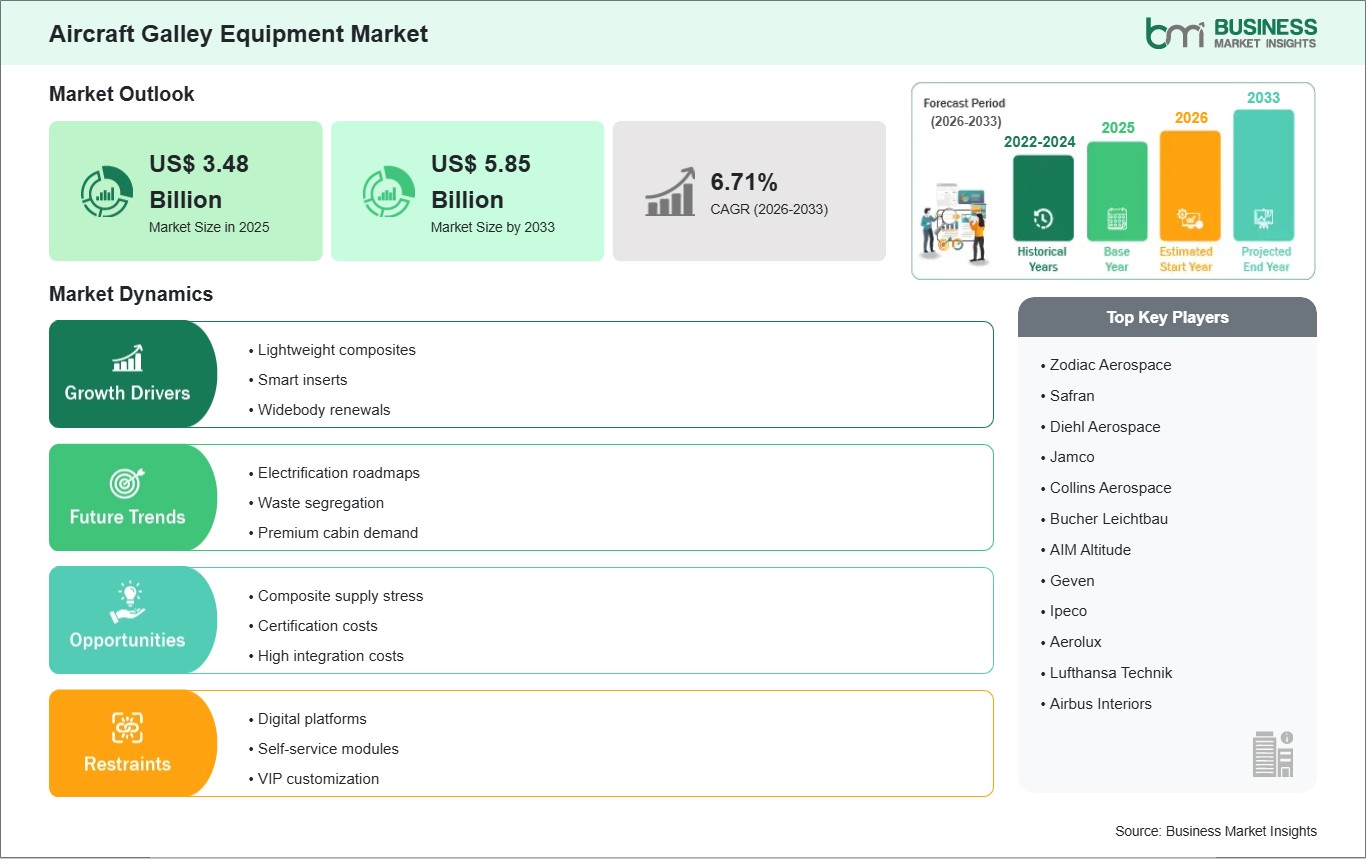
Aircraft galley equipment includes onboard kitchen systems and related components that support food preparation, storage, heating, cooling, and service operations during flights. These systems consist of galley inserts, ovens, beverage makers, storage units, trolleys, and waste management equipment that help airlines deliver passenger services efficiently. The Aircraft Galley Equipment market is expanding as airlines continue to improve passenger experience, increase long-haul connectivity, and modernize cabin interiors. Demand for lightweight galley systems is increasing because airlines aim to reduce aircraft weight and improve fuel efficiency. Manufacturers are also focusing on modular and space-saving galley designs that allow airlines to optimize cabin layouts without affecting operational performance. Growing aircraft deliveries and fleet expansion programs are supporting demand for new galley installations, while retrofit activities are creating opportunities for upgraded equipment across existing fleets.
Several factors present challenges for the market. Aircraft manufacturers and airlines must balance passenger seating capacity with available galley space, especially in narrow-body aircraft. Certification requirements and strict aviation safety standards can extend product development timelines and increase compliance costs. Supply chain disruptions for specialized aerospace materials and components may also affect production schedules. In addition, airlines often seek customized galley configurations, creating engineering and integration complexities during installation and maintenance activities.
Despite these challenges, the market continues to benefit from innovations in cabin interior technologies and passenger service solutions. Electric galley inserts, smart storage systems, and lightweight composite materials are gaining attention as airlines focus on operational efficiency and sustainability. Single-aisle aircraft remain important due to their extensive use across regional and medium-haul routes, while twin-aisle aircraft support demand for larger and more advanced galley configurations. Retrofit programs are expanding as airlines upgrade cabin environments to improve passenger comfort and maintain competitive service standards. Competition remains characterized by continuous product development, cabin customization capabilities, and long-term partnerships across aircraft manufacturing and airline sectors.
Segment Analysis
Aircraft Galley Equipment Market Segmentation
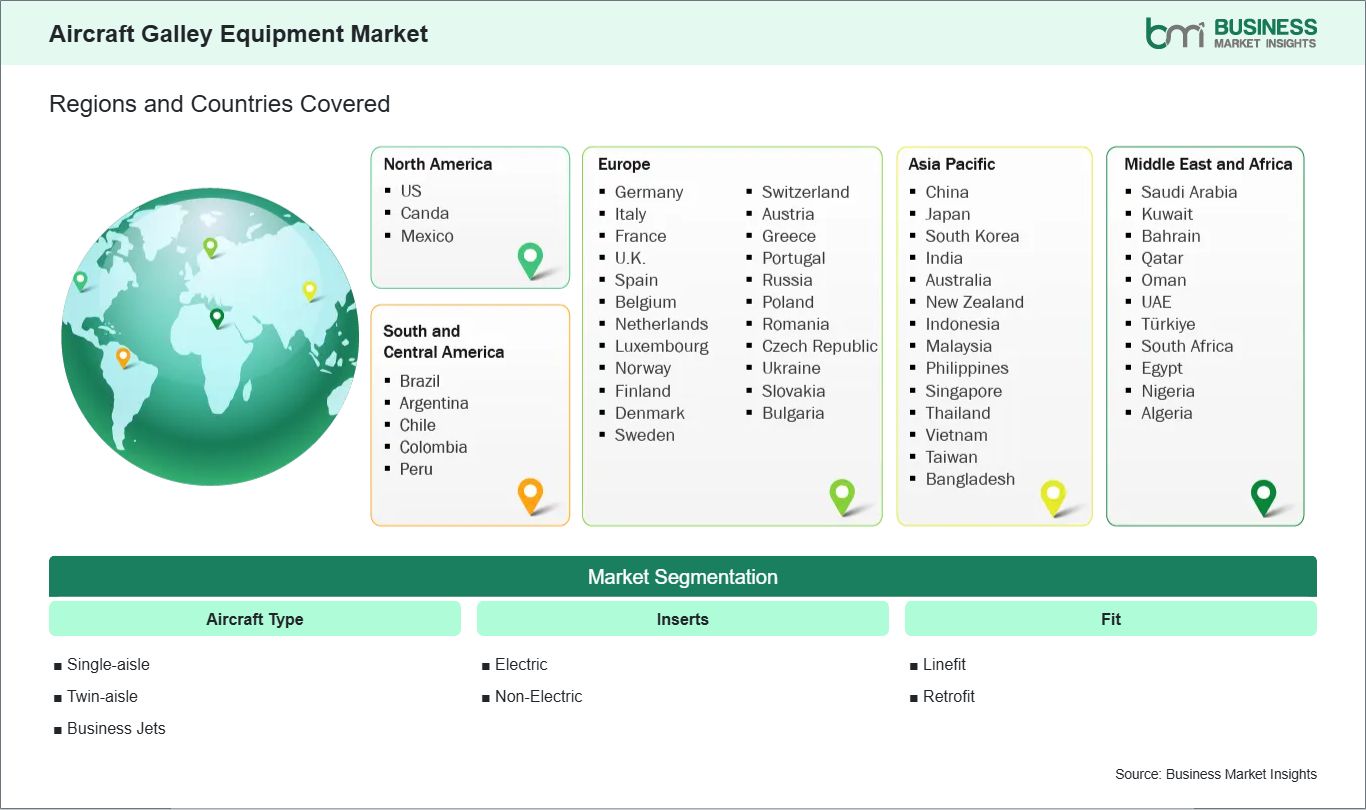
The Aircraft Galley Equipment market is segmented based on aircraft type, inserts, and fit, reflecting evolving airline service requirements and cabin design strategies.
By Aircraft Type
- Single-aisle: Dominates demand due to extensive deployment across short- and medium-haul routes
- Twin-aisle: Supports advanced galley configurations for long-haul passenger services
- Business Jets: Focuses on premium cabin experiences with customized galley solutions
By Inserts
- Electric: Increasingly adopted for efficient food preparation and enhanced onboard services
- Non-Electric: Preferred in applications requiring simple operation and lower power consumption
By Fit
- Linefit: Driven by new aircraft deliveries and integration of modern cabin systems
- Retrofit: Expanding due to fleet modernization and passenger experience enhancement programs
Market Forces
Aircraft Galley Equipment Market Drivers and Opportunities
Growing Airline Fleet Expansion and Cabin Modernization Programs
The growth of global airline fleets and increasing investment in cabin modernization are major factors supporting the Aircraft Galley Equipment market. Airlines continue to expand operations by introducing new aircraft to accommodate rising passenger traffic and route networks. Each new aircraft requires integrated galley systems that support food storage, preparation, and service functions while meeting aviation safety standards. As airlines focus on improving operational efficiency, demand is increasing for lightweight galley equipment that helps reduce aircraft weight and fuel consumption.
Cabin refurbishment programs are also contributing to market growth. Many airlines are upgrading existing fleets with modern galley systems to improve passenger satisfaction and streamline crew operations. Regulatory requirements related to aircraft safety and equipment performance encourage the adoption of certified and technologically advanced galley solutions. Manufacturers are responding by developing modular equipment that can be customized according to airline requirements. The combination of aircraft production growth, fleet renewal initiatives, and rising expectations for onboard services continues to create favorable conditions for the Aircraft Galley Equipment market.
Lightweight and Smart Galley Technologies Creating Future Opportunities
The increasing focus on lightweight materials and smart cabin technologies is creating new opportunities in the Aircraft Galley Equipment market. Airlines are seeking equipment that supports sustainability goals while improving operational efficiency. Advanced composite materials and lightweight structural designs are being integrated into galley systems to reduce aircraft weight and lower fuel consumption. These developments align with broader aviation industry efforts to improve environmental performance and reduce operating costs.
Digitalization is also influencing future market opportunities. Smart galley solutions equipped with connected monitoring systems can help airlines track equipment performance, manage inventory, and improve maintenance planning. Electric galley inserts with energy-efficient designs are becoming more attractive as airlines seek modern cabin solutions. Growing demand for premium passenger experiences is encouraging the development of customized galley layouts, enhanced storage capabilities, and multifunctional service equipment. Emerging aircraft platforms and next-generation cabin concepts are expected to support additional innovation across the market. As airlines prioritize passenger comfort, efficiency, and sustainability, manufacturers have opportunities to introduce advanced galley technologies that address evolving operational and service requirements.
Size and Share Analysis
Aircraft Galley Equipment Market Size and Share Analysis
The Aircraft Galley Equipment Market is projected to grow from US$ 3.48 Billion in 2025 to US$ 5.85 Billion by 2033 , registering a CAGR of 6.71% from 2026 to 2033.
By aircraft type, single-aisle aircraft account for a significant share due to their extensive use across regional and medium-haul routes. Twin-aisle aircraft continue to generate strong demand for larger and more advanced galley systems that support long-haul passenger services, while business jets increasingly adopt customized galley equipment designed for premium travel experiences.
By inserts, electric inserts are gaining importance because of their ability to support efficient food preparation, beverage service, and improved onboard operations. Non-electric inserts remain relevant in applications that require simple functionality and reduced power consumption. By fit, linefit installations represent a major share due to growing aircraft deliveries, while retrofit demand continues to expand as airlines modernize cabin interiors and upgrade passenger service capabilities.
Report Coverage
Aircraft Galley Equipment Market Report Coverage and Deliverables
The "Aircraft Galley Equipment Size and Forecast (2022-2033)" report provides a detailed analysis of the market covering below areas:
- Aircraft Galley Equipment Market size and forecast at global, regional, and country levels for all the key market segments covered under the scope
- Aircraft Galley Equipment Market trends, as well as market dynamics such as drivers, restraints, and key opportunities
- Aircraft Galley Equipment Market analysis covering key market trends, global and regional framework, major players, regulations, and recent market developments
- Industry landscape and competition analysis covering market concentration, heat map analysis, prominent players, and recent developments for the market
- Detailed company profiles, including SWOT analysis
Geographic Insights
Aircraft Galley Equipment Market Geographic Insights
The Aircraft Galley Equipment Market shows diverse regional adoption patterns influenced by airline fleet expansion, cabin modernization programs, passenger service expectations, and aircraft manufacturing activities.
North America maintains a mature market supported by established airline networks, extensive retrofit programs, and strong aviation infrastructure. Airlines in the United States continue to invest in cabin upgrades and lightweight galley systems to improve operational efficiency and passenger comfort. Canada also contributes through aircraft maintenance, repair, and overhaul activities that support retrofit demand. The presence of major aircraft interior suppliers and engineering capabilities encourages continuous product innovation and integration of advanced galley technologies.
Europe remains a significant market due to its strong aerospace manufacturing ecosystem and focus on sustainable aviation solutions. Countries such as France, Germany, and the United Kingdom support demand through aircraft production, cabin interior development, and airline modernization initiatives. Airlines across the region increasingly adopt lightweight and modular galley equipment to optimize cabin layouts and reduce operational costs. Retrofit activities remain active as carriers seek to enhance onboard services and passenger experiences. Regulatory emphasis on safety, efficiency, and environmental performance further supports the adoption of advanced galley technologies. Collaboration among aircraft manufacturers, interior suppliers, and airline operators continues to strengthen market maturity and encourage the development of innovative cabin solutions.
Industry Activity
Recent Developments
The Aircraft Galley Equipment Market is analyzed using a mix of primary and secondary research sources, including corporate publications, industry associations, and verified databases. This approach ensures accurate tracking of innovation trends and strategic developments influencing the market.
- In April 2026, Safran Cabin signed an agreement with flyadeal to supply customized galleys and stowage solutions for the airline's Airbus A330neo fleet. The project focuses on galley standardization, operational efficiency, and improved cabin crew workspace. The agreement reflects ongoing demand for advanced galley systems in expanding widebody fleets.
- In May 2025, J&C Aero received EASA Supplemental Type Certification for a cabin enhancement solution that increases catering and storage capacity in Airbus A320 family aircraft. The development addresses space limitations in high-density cabin layouts and supports more efficient galley operations. The certification highlights growing focus on retrofit solutions for aircraft interiors.
Trust & Transparency
Research Methodology
The market analysis combines proprietary research with secondary data from government agencies, company disclosures, regulatory filings, industry databases and expert interviews. Market estimates are validated through data triangulation, cross-market benchmarking and analyst
review.
View Full Research Methodology
Key Sources Referred:
World Bank - Global Trade Indicators
World Trade Organization (WTO)
International Monetary Fund (IMF)
International Trade Administration (ITA)
Company Websites
Company Annual Reports
Company Investor Presentations