Market Summary
Executive Summary and Global Market Analysis
Aircraft survivability equipment consists of systems and technologies designed to protect military and special mission aircraft from threats such as radar detection, missile attacks, electronic warfare, and hostile targeting systems. These solutions include electronic support measures, electronic attack systems, countermeasure dispensers, warning receivers, and non-combat safety systems. They are widely used across combat aircraft, combat helicopters, special mission aircraft, and unmanned aerial vehicles to improve mission effectiveness and enhance crew and platform protection. The market is expanding as defense organizations continue to modernize airborne fleets, strengthen electronic warfare capabilities, and address evolving threat environments.
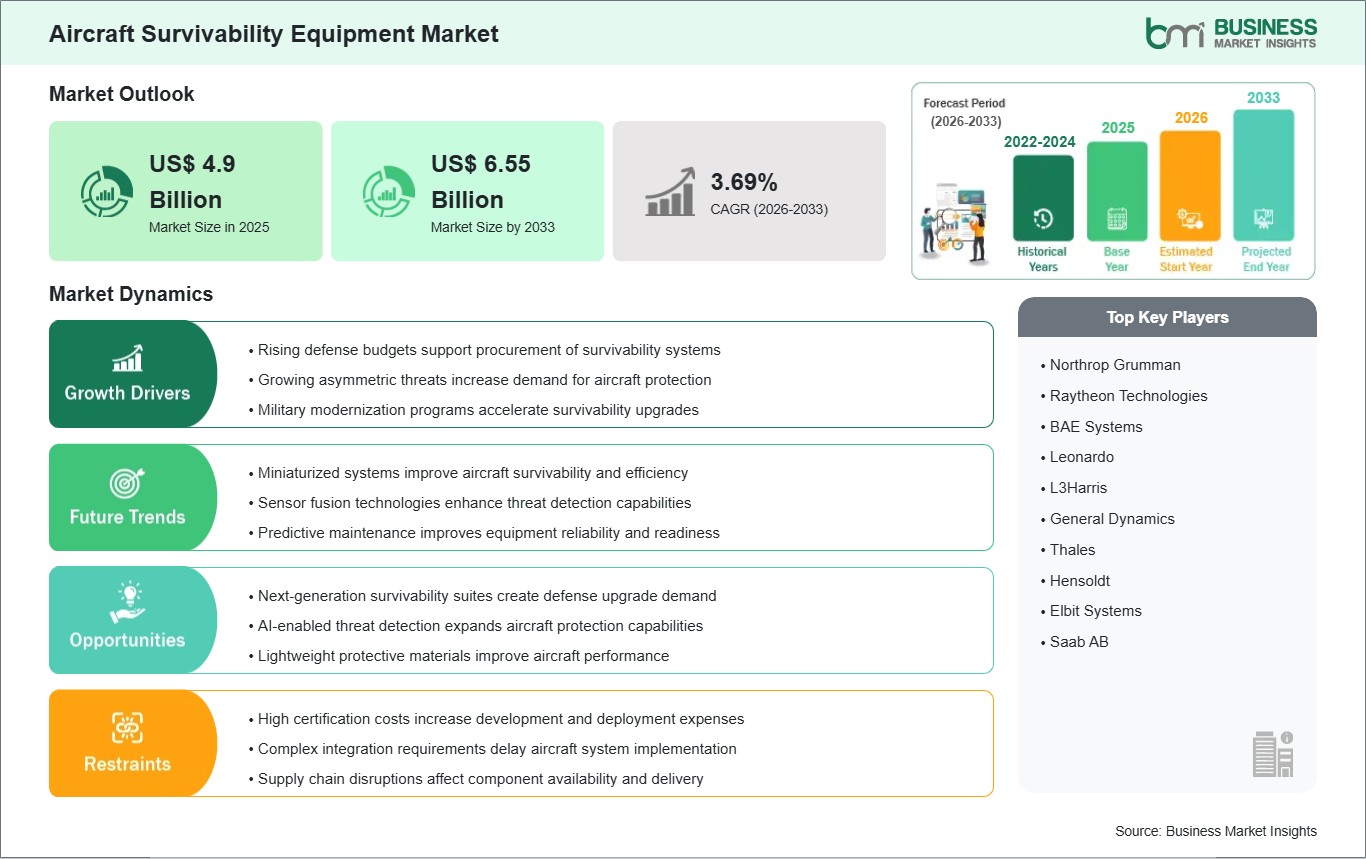
There are several factors that may restrain market expansion. The development and integration of advanced survivability systems involve significant costs and require extensive testing and certification procedures. Compatibility issues may emerge during the process of fitting modern electronic warfare systems into older planes. The quick advances in enemy technologies add more strain on companies producing systems and countries that need to upgrade their current systems continually. Furthermore, difficult purchasing procedures and financial constraints may slow the rate of adoption in certain areas.
Despite these challenges, the market is expected to benefit from advancements in electronic warfare technologies, artificial intelligence-enabled threat detection, and next-generation countermeasure systems. Increased investments in unmanned combat platforms, advances in sensor fusion technology, and increased aircraft survivability technologies have created new areas of opportunity. The competitive dynamic involves innovation, system integration, increased reliability, and the design of survivability systems in response to more advanced aerial threats.
Segment Analysis
Aircraft Survivability Equipment Market Segmentation
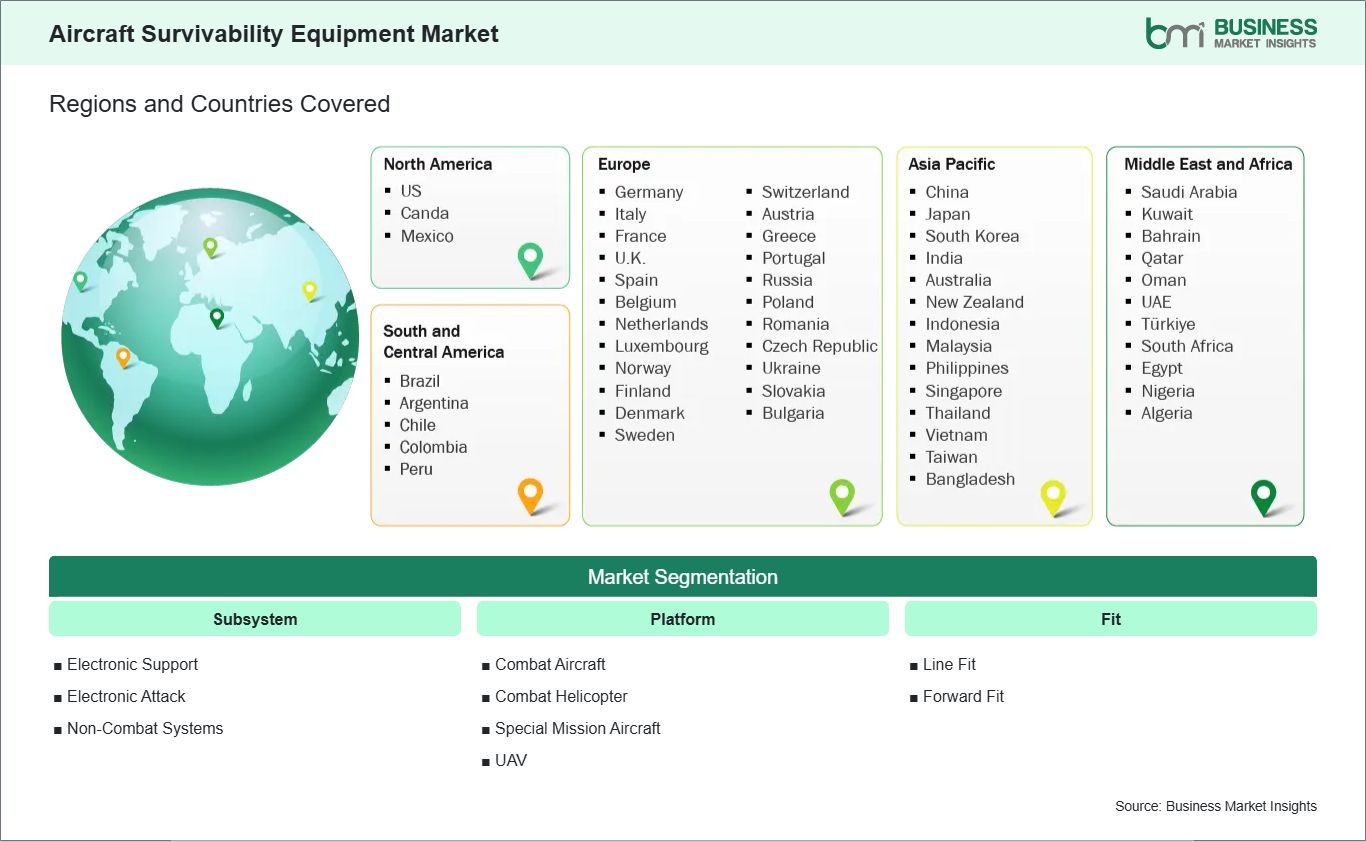
The Aircraft Survivability Equipment market is segmented based on subsystem, platform, and fit, reflecting the diverse operational requirements of military and special mission aviation.
By Subsystem
- Electronic Support: Provides threat detection, identification, and situational awareness capabilities
- Electronic Attack: Disrupts or degrades hostile radar and communication systems
- Non-Combat Systems: Enhances aircraft safety, mission support, and operational protection
By Platform
- Combat Aircraft: Represents significant demand due to frontline defense operations
- Combat Helicopter: Uses survivability systems for low-altitude and tactical missions
- Special Mission Aircraft: Requires advanced protection systems for surveillance and intelligence roles
- UAV: Increasing adoption driven by expanding unmanned defense operations
By Fit
- Line Fit: Installed during aircraft manufacturing and procurement stages
- Forward Fit: Integrated into existing aircraft through modernization and upgrade programs
Market Forces
Aircraft Survivability Equipment Market Drivers and Opportunities
Rising Defense Modernization and Electronic Warfare Requirements
Growing investments in military modernization programs are significantly supporting the Aircraft Survivability Equipment market. Defense organizations are increasingly focused on enhancing aircraft protection capabilities as modern battlefields become more complex and electronically contested. Advanced radar systems, precision-guided weapons, and integrated air defense networks are creating a greater need for sophisticated survivability technologies. Electronic support and electronic attack systems are becoming critical components of modern military aircraft because they help detect, identify, and counter emerging threats in real time. Governments are also prioritizing the development of next-generation combat aircraft and special mission platforms equipped with integrated electronic warfare capabilities. Regulatory requirements related to operational readiness and mission effectiveness further encourage investment in advanced protection technologies.
The increasing use of unmanned aerial systems in defense operations is also contributing to market growth. These platforms require reliable survivability solutions to operate effectively in contested environments. As military organizations seek to improve operational flexibility and aircraft protection, demand for advanced survivability equipment is expected to remain strong across multiple defense aviation segments.
AI-Enabled Threat Detection and Autonomous Defense Systems
The future of the Aircraft Survivability Equipment market is closely linked to advancements in artificial intelligence, sensor fusion, and autonomous defense technologies. Modern aircraft are generating large volumes of operational data that can be used to improve threat identification, decision-making, and response times. AI-enabled systems can help crews and autonomous platforms detect and classify threats more efficiently while reducing response delays. Growing interest in autonomous military operations is creating opportunities for survivability equipment designed specifically for unmanned aerial vehicles and next-generation aircraft. Advanced countermeasure systems, integrated warning receivers, and intelligent electronic warfare platforms are expected to gain wider adoption as defense organizations seek more adaptive protection capabilities.
Another important opportunity lies in the modernization of legacy military fleets. Many operators are investing in upgrade programs to extend aircraft service life while improving survivability performance. Emerging technologies such as cognitive electronic warfare, directed energy countermeasures, and advanced sensor networks are also opening new growth avenues. As military aviation continues to evolve, innovative survivability solutions that combine automation, connectivity, and real-time threat analysis are expected to play an increasingly important role in future defense strategies.
Size and Share Analysis
Aircraft Survivability Equipment Market Size and Share Analysis
The Aircraft Survivability Equipment Market size is expected to reach US$ 6.55 billion by 2033 from US$ 4.9 billion in 2025. The market is estimated to record a CAGR of 3.69% from 2026 to 2033.
By subsystem, electronic support accounts for a significant share due to its critical role in threat detection, situational awareness, and mission planning. Electronic attack systems continue to gain importance as military operators focus on disrupting hostile radar and communication networks. Non-combat systems also maintain steady demand by supporting aircraft protection and operational reliability.
By platform, combat aircraft dominate the market owing to ongoing fleet modernization programs and increasing defense investments. Combat helicopters remain important for tactical and battlefield missions requiring advanced protection technologies. Special mission aircraft are witnessing growing adoption of survivability equipment due to intelligence and surveillance requirements, while UAVs are emerging as a key growth segment with expanding military applications and autonomous operations.
Report Coverage
Aircraft Survivability Equipment Market Report Coverage and Deliverables
The "Aircraft Survivability Equipment Market Size and Forecast (2022-2033)" report provides a detailed analysis of the market covering below areas:
- Market size and forecast at global, regional, and country levels for all the key market segments covered under the scope
- Market trends, as well as market dynamics such as drivers, restraints, and key opportunities
- Market analysis covering key market trends, global and regional framework, major players, regulations, and recent market developments
- Industry landscape and competition analysis covering market concentration, heat map analysis, prominent players, and recent developments for the market
- Detailed company profiles, including SWOT analysis
Geographic Insights
Aircraft Survivability Equipment Market Geographic Insights
The Aircraft Survivability Equipment Market shows diverse regional adoption patterns influenced by defense modernization programs, evolving security requirements, and investments in advanced military aviation technologies.
North America, being a developed region, has a well-established defense aerospace sector and extensive deployment of advanced survivability technologies. The region comprises the United States and Canada, where defense agencies continue to invest in next-generation combat aircraft, electronic warfare systems, and unmanned platforms. The region focuses on enhancing mission effectiveness, aircraft protection, and operational readiness. Strong research capabilities, advanced manufacturing infrastructure, and continuous modernization initiatives support the adoption of aircraft survivability equipment across multiple military aviation programs.
Asia Pacific is growing significantly, driven by increasing defense spending and the modernization of military aviation fleets. The region comprises countries such as China, India, Japan, South Korea, and Australia, where governments are investing in advanced combat aircraft, surveillance platforms, and unmanned systems. The region focuses on strengthening national defense capabilities and improving operational resilience against emerging threats. Expanding aerospace manufacturing activities and growing investments in indigenous defense programs are further supporting the adoption of advanced survivability technologies.
Both regions are contributing significantly to the growth of the Aircraft Survivability Equipment Market, focusing on defense modernization, technological advancement, and the deployment of advanced airborne protection systems to address evolving security challenges.
Industry Activity
Recent Developments
The Aircraft Survivability Equipment Market is analyzed using a mix of primary and secondary research sources, including corporate publications, industry associations, and verified databases. This approach ensures accurate tracking of innovation trends and strategic developments influencing the market.
- In February 2026, BAE Systems secured multiple Foreign Military Sales contracts valued at $137 million from the U.S. Army to distribute its combat-proven AN/AAR-57 Common Missile Warning Systems (CMWS). The agreement facilitates the deployment of specialized aircraft survivability equipment to protect the fixed-wing and rotary-wing fleets of partner nations. These systems utilize advanced electro-optical sensors and automated countermeasure triggers to shield warfighters against emerging multi-spectral guided missile threats.
- In May 2026, the U.S. Army awarded Northrop Grumman a contract for the Phase II development of its Improved Threat Detection System (ITDS), featuring the Advanced Tactical Hostile Engagement Awareness (ATHENA) sensor to enhance aircraft survivability. The multi-spectral, 360-degree open architecture system utilizes a Modular Open Systems Approach (MOSA) to detect and counter threats like UAS and anti-tank missiles.
Trust & Transparency
Research Methodology
The market analysis combines proprietary research with secondary data from government agencies, company disclosures, regulatory filings, industry databases and expert interviews. Market estimates are validated through data triangulation, cross-market benchmarking and analyst
review.
View Full Research Methodology
Key Sources Referred:
World Bank - Global Trade IndicatorsWorld Trade Organization (WTO)International Monetary Fund (IMF)International Trade Administration (ITA)Company WebsitesCompany Annual ReportsCompany Investor Presentations