
Defense Cyber Security Market Outlook: Size, Share, Trends, Growth Analysis, Competitive Landscape & Forecast, 2026-2033

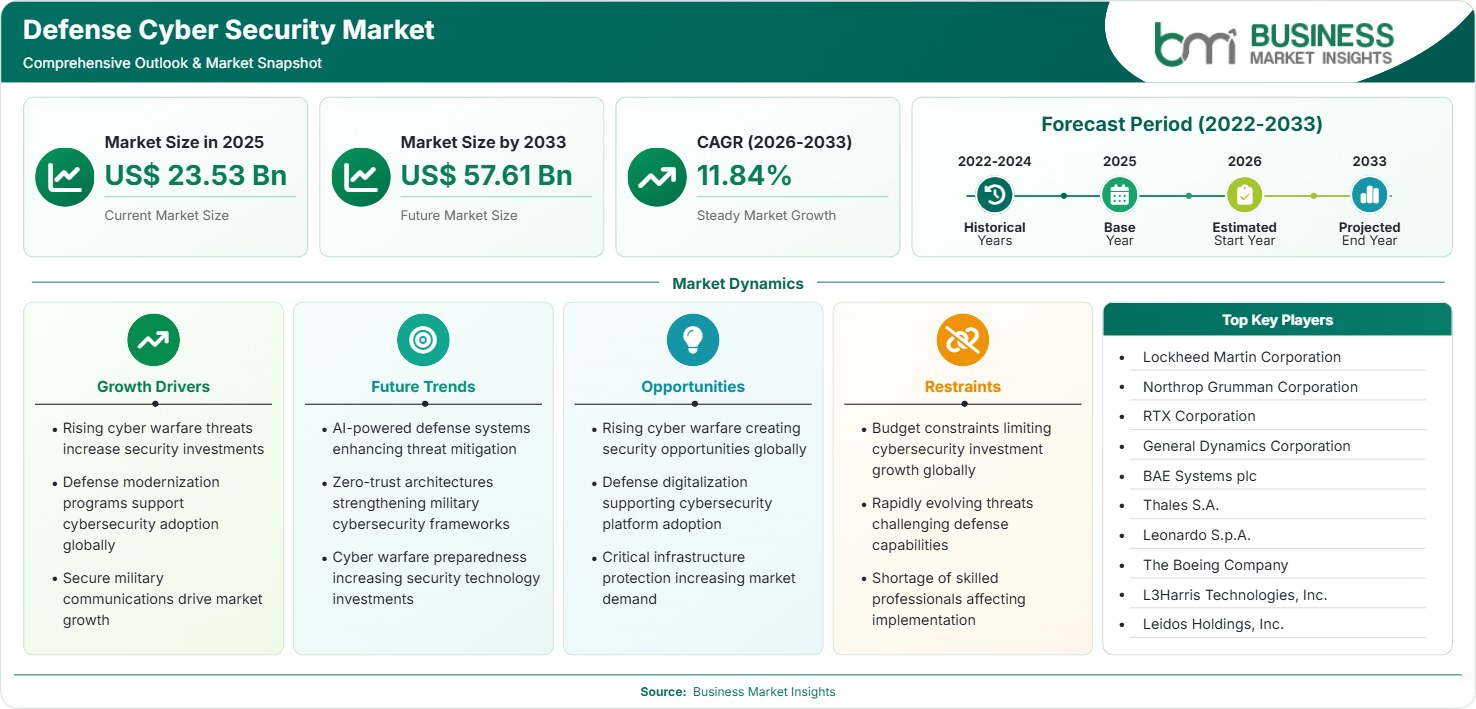
The Defense Cyber Security Market size was valued at US$ 23.53 Billion in 2025 and is projected to reach US$ 57.61 Billion by 2033, growing at a CAGR of 11.84% during 2026–2033, driven by zero-trust adoption, AI-enabled threats, military digitization, cloud migration, resilient communications, and rising cyber warfare investment.

Report Coverage
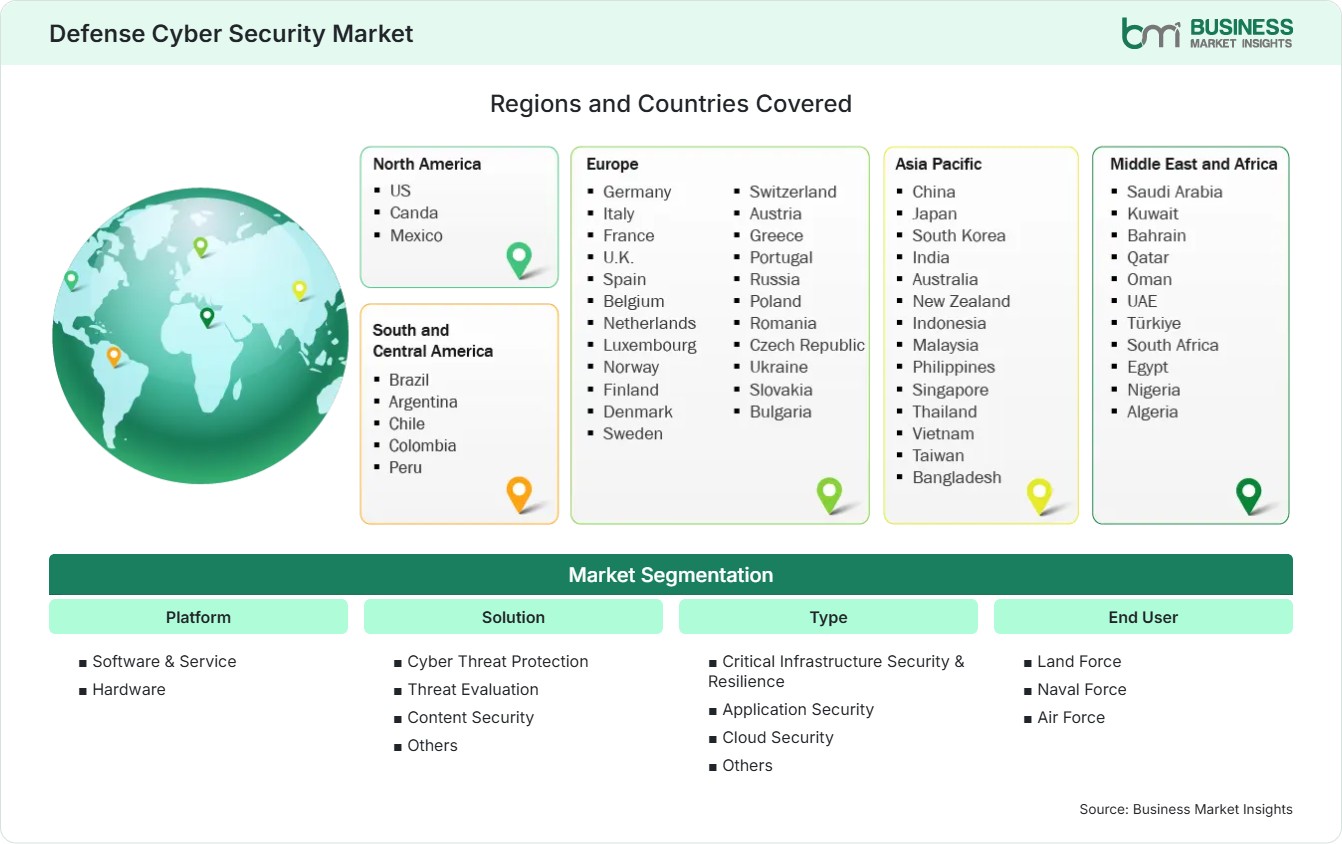
  • Platform: Software & Service, Hardware
  • Solution: Cyber Threat Protection, Threat Evaluation, Content Security, Others
  • Type: Critical Infrastructure Security & Resilience, Application Security, Cloud Security, Others
  • End User: Land Force, Naval Force, Air Force
US$ 23.53 Bn Market size in 2025
US$ 57.61 Bn Market Size by 2033
11.84% CAGR, 2026 - 2033
2026-2033 Forecast Period

AI Overview

Defense Cyber Security Market Summary

  • North America Region: North America holds a market share of 35%–38% in 2025, growing with a CAGR of 10.8%–11.5%, influenced by defense modernization, zero-trust mandates, cloud migration, and persistent state-sponsored threats, while expanding opportunities emerge across mission networks and autonomous systems. The US market is estimated to grow at 10.9%–11.6% CAGR through 2033, supported by federal modernization, CMMC compliance, cyber operations, and resilient military communications.
  • Fastest Growing Region: Asia Pacific holds market share of 24%–27% in 2025, expanding at a CAGR of 13.2%–14.0%, supported by military digitization, indigenous cyber capabilities, satellite communications, regional tensions, and modernization programs across India, Japan, South Korea, and Australia.
  • Leading Segment: Software & Service holds market share of 52%–56% in 2025, expanding at a CAGR of 12.0%–12.8%, driven by managed detection, threat intelligence, zero-trust architectures, cloud security, continuous monitoring, and scalable cyber defense platforms.
  • High Growth Segment: Cloud Security accounts for a market share of 21%–24% in 2025, advancing at a CAGR of 14.5%–15.5%, supported by distributed command systems, hybrid architectures, secure data sharing, remote operations, and modernization of military applications.
  • Key Market Opportunity: The strongest opportunity lies in integrated cyber defense combining AI-assisted detection, zero-trust controls, secure cloud infrastructure, mission analytics, and automated response across interconnected military platforms.
  • Major Market Players: Lockheed Martin Corporation, Northrop Grumman Corporation, RTX Corporation, General Dynamics Corporation, BAE Systems plc, Thales S.A., Leonardo S.p.A., The Boeing Company, L3Harris Technologies, Inc., and Leidos Holdings, Inc.
Strategic Insights

Defense Cyber Security Market: Strategic Insights

Defense Cyber Security Market Strategic Framework
FREE PDF
Request your free sample
Request free sample
Stakeholder View

Key Takeaways

  • Defense cyber value chains are changing from a focus on perimeter protection to one of continuous mission assurance by integrating identity, applications, communications, sensors, command systems, and operational technology into unified security architectures.
  • The Cloud Security and Software & Service options offer the greatest potential since defense organizations are increasingly needing scalable protection for distributed workloads, remote users, multi-domain operations, and applications that are rapidly updated.
  • AI is now acting as an operational multiplier in the areas of anomaly detection, vulnerability prioritization, threat hunting, automated remediation, and adversarial simulation, even though human supervision is still necessary for critical mission decisions.
  • There are good reasons to regard the Asia Pacific as an attractive investment destination since Japan, India, Australia, and South Korea are enhancing their military cyber capabilities and, at the same time, expanding their digital command, communications, aerospace, and maritime infrastructure.
  • Rather than just expanding their traditional information-security portfolios, investment and M&A activity is now concentrating on obtaining capabilities in specialized AI, cyber operations, vulnerability research, secure software, and mission analytics.
Geographic Outlook

Defense Cyber Security Market Regional Highlights

North America Defense Cyber Security Market

North America represented 35%–38% share in 2025 and is projected to expand at a 10.8%–11.5% CAGR through 2033. The region benefits from large defense budgets, mature cyber suppliers, zero-trust adoption, and continuous modernization of command networks. The Defense Cyber Security Market growth increasingly emphasizes mission resilience, cloud security, cyber operations, and software assurance across defense programs.

  • The zero-trust implementation and cyber modernization efforts of US defense agencies are leading to a continuous need for identity security, endpoint protection, network monitoring, and secure cloud environments in relation to systems that handle classified and controlled information.
  • Cybersecurity requirements are being more and more incorporated into procurement and supplier assurance, which creates greater opportunities for contractors to provide support in the areas of compliance, secure software development, vulnerability management, continuous monitoring, and the protection of defense industrial networks.
  • The use of autonomous platforms, satellites, tactical communication systems, and sensor networks is expanding the areas that can be attacked, which in turn is leading to greater spending on embedded security, cryptography, secure processing, threat intelligence, and real-time anomaly detection.
  • Increasingly, suppliers in North America are combining defense engineering with cybersecurity, which allows for integrated contracts that cover mission systems, digital infrastructure, cloud environments, cyber operations, and lifecycle support.

US Defense Cyber Security Market

The US accounted for approximately 82%–86% of North American demand in 2025 and is projected to grow at 10.9%–11.6% CAGR through 2033. Federal modernization, defense industrial cybersecurity, zero-trust requirements, and cyber warfare preparedness sustain demand. The Defense Cyber Security Market in the US is also supported by specialized procurement for cryptographic systems, secure communications, vulnerability research, and operational cyber services.

  • The requirements under CMMC result in increased spending on cybersecurity among contractors who handle Federal Contract Information and Controlled Unclassified Information, extending demand from the main defense companies to the subcontractor networks.
  • As military networks need to detect and respond more quickly to adversaries carrying out ever more automated attacks, operations enabled by AI are becoming strategically important.
  • It is still essential to have secure methods of communication and data processing for weapons systems, aircraft, ships, and forces that are deployed under contested electromagnetic and cyber conditions.

Europe Defense Cyber Security Market

Europe held 25%–28% share in 2025 and is projected to expand at 11.4%–12.1% CAGR through 2033. The region benefits from NATO interoperability, national cyber strategies, digital defense investment, and regulatory requirements affecting critical infrastructure. The Defense Cyber Security Market share is supported by Germany, the UK, France, Italy, and the Nordic countries.

  • ENISA has stated that DDoS attacks accounted for 77 percent of the incidents in its threat landscape in 2025, although ransomware was still the most damaging threat, thus underlining the need for resilient public and defense infrastructure.
  • The European defense programs are now placing greater emphasis on interoperable and secure communications, the exchange of data across borders, cyber resilience, and the protection of digitally connected weapons and command systems.
  • Regulations are helping to improve cybersecurity governance among essential and important organizations, and are prompting operators of defense-related infrastructure to enhance their security measures and get better prepared for incidents.
  • France and Italy are currently enhancing their cyber-defense capabilities and, at the same time, expanding their domestic technology ecosystems in order to promote opportunities in the fields of sovereign platforms, managed services, secure software, and cyber training.

Asia Pacific Defense Cyber Security Market

Asia Pacific represented 24%–27% share in 2025 and is projected to grow at 13.2%–14.0% CAGR through 2033, making it the fastest-growing regional market. The Defense Cyber Security Market share reflects accelerating military digitization, geopolitical tensions, satellite deployment, naval modernization, and domestic cybersecurity investment.

  • Japan is enhancing its cyber capabilities, including the implementation of active cyber defense and the carrying out of continuous risk management for key systems, by increasing the number of specialist personnel and obtaining more external expertise.
  • The defense strategy of Australia places a strong emphasis on cyber resilience, on having secure and survivable information and communication technology, on possessing a skilled workforce, and on building partnerships with the government, industry, academia, and allies.
  • India is currently increasing its own defense technology and cyber capabilities as its military communications, aerospace platforms, command networks, and digital intelligence systems become more interconnected.
  • South Korea is still making investments in advanced military communications, aerospace systems, and network protection, which in turn creates a demand for application security, threat intelligence, and secure infrastructure.

Rest of World Defense Cyber Security Market

The rest of the world accounted for 10%–13% Defense Cyber Security Market share in 2025 and is projected to expand at 9.2%–10.0% CAGR through 2033. South and Central America are prioritizing secure government networks, critical infrastructure, and military communications, with Brazil and Chile representing leading demand centers.

  • The Gulf countries are boosting their investments in sovereign digital infrastructure, which in turn is leading to greater demand for secure cloud services, threat intelligence, identity management, and the protection of critical infrastructure.
  • Brazil is enhancing the digital security capabilities of its public institutions and strategic infrastructure, thus creating opportunities for integrated cyber defense and managed security services.
  • Israel is still a major technology ecosystem when it comes to advanced cyber capabilities, providing specialized knowledge in the areas of threat detection, intelligence, vulnerability research, and cyber operations.
  • The modernization of the defense forces in Latin America and in some African countries leads to a gradual need for secure means of communication, protection for end points, and a robust command infrastructure.
Global Market Geography
FREE PDF
Request your free sample
Request free sample
Segment Analysis

Defense Cyber Security Market Segmentation

Platform

Platform solutions represented the largest structural category, with Software & Service holding 52%–56% Defense Cyber Security Market share in 2025 and growing at a 12.0%–12.8% CAGR through 2034. Adoption is supported by recurring monitoring, scalable architecture, threat intelligence, and managed defense requirements. Hardware remains essential where specialized cryptography, embedded protection, secure processing, and resilient communications are required.

  • Software & Service: Software and service offerings integrate monitoring, threat intelligence, managed detection, vulnerability assessment, identity controls, and incident response, supporting scalable protection across dispersed military networks and mission environments.
  • Hardware: Secure hardware includes cryptographic processors, hardened network equipment, security modules, embedded protection, and trusted computing components, providing foundational safeguards for weapons, communications, sensors, and command systems.

Solution

Solution demand is being shaped by increasingly complex attack surfaces spanning endpoints, applications, communications, cloud environments, and operational technology. Cyber Threat Protection remains central to procurement, while threat evaluation and content security support proactive risk management.

  • Cyber Threat Protection: This solution area protects networks, endpoints, communications, and mission systems from malware, intrusion, ransomware, and advanced persistent threats through layered detection and response capabilities.
  • Threat Evaluation: Threat evaluation combines intelligence, vulnerability assessment, behavioral analytics, and risk prioritization to identify adversary activity and help commanders and security teams allocate defensive resources.
  • Content Security: Content security protects sensitive documents, communications, operational data, and information flows against unauthorized access, manipulation, leakage, and malicious content within military environments.
  • Others: Other solutions include specialized security analytics, identity controls, cryptographic services, cyber training, security orchestration, and mission-specific capabilities supporting comprehensive defense architectures.

Type

Type segmentation reflects the expanding convergence between cyber protection and operational resilience. Critical Infrastructure Security & Resilience remains strategically important because military bases, energy systems, communications, and logistics depend on connected infrastructure.

  • Critical Infrastructure Security & Resilience: These capabilities protect bases, energy networks, communications infrastructure, logistics systems, and essential facilities against disruption, intrusion, physical-cyber convergence, and cascading operational failures.
  • Application Security: Application security embeds vulnerability management, secure development, testing, identity controls, and runtime protection into military software, reducing exploitable weaknesses across mission-critical digital applications.
  • Cloud Security: Cloud security protects distributed workloads, data, identities, interfaces, and hybrid environments, enabling defense organizations to gain scalability while maintaining controlled access and mission assurance.

End User

End-user demand is distributed across Land Force, Naval Force, and Air Force environments, each facing distinct cyber exposure from command systems, sensors, weapons, platforms, and communications. Land Force represents broad network demand, while Naval Force and Air Force programs require specialized protection for highly connected platforms and mission systems. Interoperability increasingly links all three environments.

  • Land Force: Land forces require secure tactical networks, command systems, vehicles, sensors, communications, and deployed infrastructure, increasing demand for resilient connectivity, endpoint protection, identity controls, and mobile cyber defense.
  • Naval Force: Naval cybersecurity protects ships, maritime command systems, navigation technologies, weapons interfaces, communications, and connected sensors, with resilience required during contested and bandwidth-constrained operations.
  • Air Force: Air forces require secure aircraft systems, mission computers, ground infrastructure, satellite links, communications, and autonomous platforms, making application security, embedded protection, and threat intelligence increasingly important.
Market Forces

Defense Cyber Security Market Dynamics

Key Market Drivers

Expansion of Zero-Trust Defense Architectures

Zero-trust adoption is changing procurement from network-centric security toward continuous identity, device, application, and transaction verification. Defense agencies increasingly require security controls that remain effective when personnel, platforms, and systems operate across distributed environments. CMMC requirements further strengthen supplier cybersecurity obligations in the US defense ecosystem. This shift supports recurring demand for identity management, privileged access controls, endpoint monitoring, secure application development, and automated policy enforcement. The Defense Cyber Security Market growth is consequently tied to architecture modernization rather than standalone cybersecurity appliances.

AI-Enabled Threat Detection and Response

Artificial intelligence is becoming important because adversaries can automate reconnaissance, phishing, malware development, vulnerability discovery, and information manipulation. ENISA’s 2026 threat landscape identifies increasing use of emerging AI models in malicious operations, while its 2025 assessment highlights convergence, automation, and industrialization of cyber threats. Defense organizations, therefore, require faster analytics capable of processing large volumes of network, endpoint, sensor, and intelligence data. These Defense Cyber Security Market trends favor vendors combining artificial intelligence with secure data environments, cyber ranges, threat intelligence, and operational expertise.

Digitization of Military Platforms and Networks

Modern military systems are becoming more reliant on interconnected software, sensors, communication facilities, cloud services, and data links, as a result of which aircraft, naval ships, land vehicles, satellites, and command systems now have bigger digital attack surfaces than older types of platforms. Security needs to be built into all stages of development, testing, deployment, maintenance, and modernization rather than being introduced following installation; this need has led to a demand for engineering based on secure design, testing of applications, embedded security, cryptography, vulnerability research, and continuous monitoring. For instance, Japan's defense planning places a strong emphasis on the continuous management of risk for key systems and on greatly improving its cyber workforce and capabilities.

Key Market Opportunities

Secure Cloud and Hybrid Mission Environments

The use of cloud and hybrid computing systems has grown among military organizations to enable better data availability, collaboration, analysis, and software deployments. This presents an opportunity for customized controls of identity, workload protection, data classification, application interfaces, encryption, and continuous monitoring. The benefit of cloud computing systems can be realized quickly when it comes to software deployment and distributed operations; however, this is based on proper authorization and robustness of the architecture. Defense Cyber Security Market Forecasts are therefore increasingly connected to the modernization of digital command environments.

AI-Based Cyber Operations and Automated Resilience

AI creates an investment Defense Cyber Security Market opportunity across threat hunting, vulnerability discovery, adversarial simulation, incident triage, and automated defensive actions. Machine learning can be used by defense agencies to measure normal operations against anomalous activity, saving time in detecting sophisticated attacks. Leidos purchased Kudu Dynamics in May 2025 to speed up the development of AI-driven cyber capabilities related to defense, intelligence, vulnerability assessment, and spectrum operations. These kinds of deals show increasing importance being placed on AI and cyber capabilities.

Cybersecurity for Autonomous and Multi-Domain Systems

Autonomous vehicles, unmanned systems, satellites, sensors, and distributed command networks create new security requirements because compromised data or control signals can affect physical missions. Protection must encompass communications, software, positioning, sensor integrity, authentication, and command authorization. The Defense Cyber Security Market opportunity is greater for companies designing security systems that have to work without continuous connections and with limited computing capabilities. Embedded crypto, trusted computing, behavior analysis, and secure updating could be areas that distinguish companies from one another. Multi-domain operations have increased the value of interoperability across land, sea, air, space, and cyber domains.

Market Restraints and Challenges

Legacy Systems and Integration Complexity

The fact is that defense organizations use long-standing platforms that include outdated software, proprietary interfaces, old hardware, and systems that were never designed for continuous cybersecurity monitoring. As a result, when it comes to incorporating modern security measures without affecting the availability of the mission, it often involves a great deal of engineering, testing, certification, and ongoing lifecycle support. Replacement procedures are generally slower than those in the commercial IT sector since military systems have to meet safety, interoperability, security, and operational requirements at the same time. It is for this reason that outdated technology can lead to higher implementation costs and longer procurement times.

Specialized Cybersecurity Skills and Procurement Constraints

The need for advanced cyber defense is based on the requirement for personnel who have expertise in cybersecurity, software engineering, intelligence, electronic warfare, cloud infrastructure, cryptography, and military operations. The shortage of specialists with the appropriate clearances can limit the ability to deploy forces and cause project schedules to be extended. Since defense procurement includes lengthy qualification, security accreditation, testing, and contracting processes, this can delay the commercialization of new technologies. It is necessary for organizations to stay operationally ready when introducing new and unfamiliar tools, which in turn increases the demand for training and integration.

Company Analysis

Competitive Landscape

The competitive environment is characterized by large defense contractors, cybersecurity specialists, systems integrators, and technology providers competing through mission integration, secure communications, cyber operations, cloud modernization, AI, and threat intelligence. Competitive differentiation increasingly depends on combining cyber capabilities with defense engineering and classified mission expertise. Recent Defense Cyber Security Market analysis also indicates increasing emphasis on acquisitions, strategic partnerships, secure software, and automated cyber operations.

Company Name

Overview

Products and Services relevant to this market

Lockheed Martin Corporation

Major US defense contractor with extensive expertise across aerospace, defense, intelligence, cyber, and mission systems.

Cyber resilience, zero-trust support, secure mission systems, threat intelligence, network protection, cyber engineering, and defense modernization.

Northrop Grumman Corporation

Global defense technology company serving aerospace, intelligence, autonomous systems, and national security customers.

Cyber operations, secure communications, mission systems, cyber engineering, threat protection, and resilient command infrastructure.

RTX Corporation

Diversified aerospace and defense company with capabilities spanning sensors, communications, missiles, avionics, and digital systems.

Secure communications, cyber-enabled defense systems, mission networks, threat protection, avionics security, and resilient digital infrastructure.

General Dynamics Corporation

Large defense and information-technology provider supporting military, government, maritime, land, and digital missions.

Cybersecurity services, zero-trust architecture, cloud security, vulnerability management, security operations, and mission IT modernization.

BAE Systems plc

International defense company with strong cyber, intelligence, electronic warfare, and secure systems capabilities.

Cybersecurity, threat intelligence, secure software, cyber operations, mission protection, and resilient defense infrastructure.

Thales S.A.

European technology and defense group serving aerospace, defense, security, digital identity, and critical infrastructure markets.

Cyber defense, encryption, secure communications, identity security, critical infrastructure protection, and mission cybersecurity.

Leonardo S.p.A.

Italian defense and aerospace group with capabilities across electronics, aircraft, helicopters, space, and cyber domains.

Cyber defense, secure communications, mission protection, cyber intelligence, digital security, and resilient operational systems.

The Boeing Company

Major aerospace and defense company developing connected aircraft, defense platforms, communications, and mission technologies.

Platform cybersecurity, secure avionics, mission systems, network protection, data security, and cyber-resilient aerospace technologies.

L3Harris Technologies, Inc.

Defense technology provider specializing in communications, electronic systems, space, intelligence, and mission-critical technologies.

Secure communications, security processors, cyber protection, resilient networks, mission systems, and cryptographic technologies.

Leidos Holdings, Inc.

Technology and engineering company providing digital modernization, defense IT, cyber operations, and intelligence capabilities.

Defensive cyber, zero trust, AI-enabled cyber operations, cryptographic key management, cloud security, and cyber resilience.

Trust & Transparency

Research Methodology

The market analysis combines proprietary research with secondary data from government agencies, company disclosures, regulatory filings, industry databases and expert interviews. Market estimates are validated through data triangulation, cross-market benchmarking and analyst review.

View Full Research Methodology

Questions Answered

Frequently Asked Questions

What factors could limit cybersecurity deployment in defense programs?

Legacy platforms, interoperability requirements, security accreditation, specialized workforce shortages, lengthy procurement cycles, and the need to maintain mission availability can slow deployment. Successful providers increasingly combine cybersecurity products with engineering, integration, training, managed services, and lifecycle support.

Which military branch requires specialized cybersecurity capabilities?

All three major end-user groups require specialized protection. Land forces emphasize tactical networks and deployed infrastructure, naval forces protect maritime platforms and communications, while air forces require security for aircraft systems, mission computers, satellite links, and connected ground infrastructure.

How is artificial intelligence changing defense cyber operations?

Artificial intelligence can automate alert prioritization, behavioral analysis, vulnerability discovery, threat correlation, and response recommendations. Its primary value is reducing analyst workload and response time while enabling security teams to process larger volumes of operational data.

Why is cloud security becoming important for military users?

Cloud environments allow defense organizations to scale computing, analytics, collaboration, and software deployment across geographically dispersed operations. Security requirements, therefore, extend to identity, data protection, workload isolation, interfaces, encryption, monitoring, and resilient access under contested operating conditions.

What is driving demand for cybersecurity across defense organizations?

The Defense Cyber Security Market Report highlights that Demand is being driven by military digitization, connected weapons platforms, cloud migration, zero-trust adoption, AI-enabled threats, and the increasing dependence of command and communications systems on software and data. Defense organizations are also strengthening resilience against cyber-enabled disruption and state-sponsored intrusion.

Access the Full Defense Cyber Security Market Report

Get segment-level forecasts, regional estimates, competitive benchmarking, company profiles and downloadable Excel datasets.

Access the full Defense Cyber Security Market Report
350 pages PDF & Excel | 2026-10-22
Similar Research

Related Market Reports