
Commercial Satellite Launch Service Market Outlook: Size, Share, Trends, Growth Analysis, Competitive Landscape & Forecast, 2026-2033

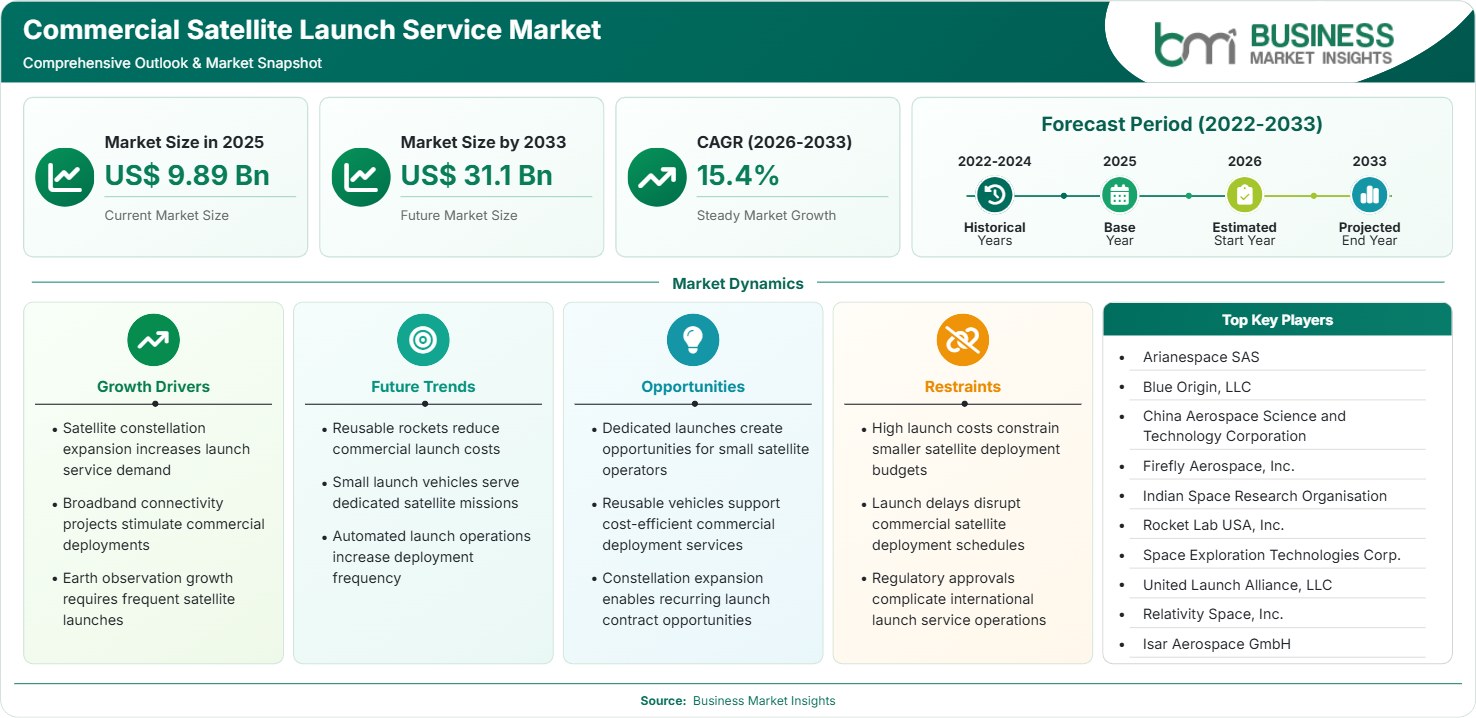
The Commercial Satellite Launch Service Market size was valued at US$ 9.89 Billion in 2025 and is projected to reach US$ 31.1 Billion by 2033, growing at a CAGR of 15.40% during 2026–2033, driven by constellation deployment, reusable launch systems, defense demand, responsive missions, and sovereign space programs.

Report Coverage
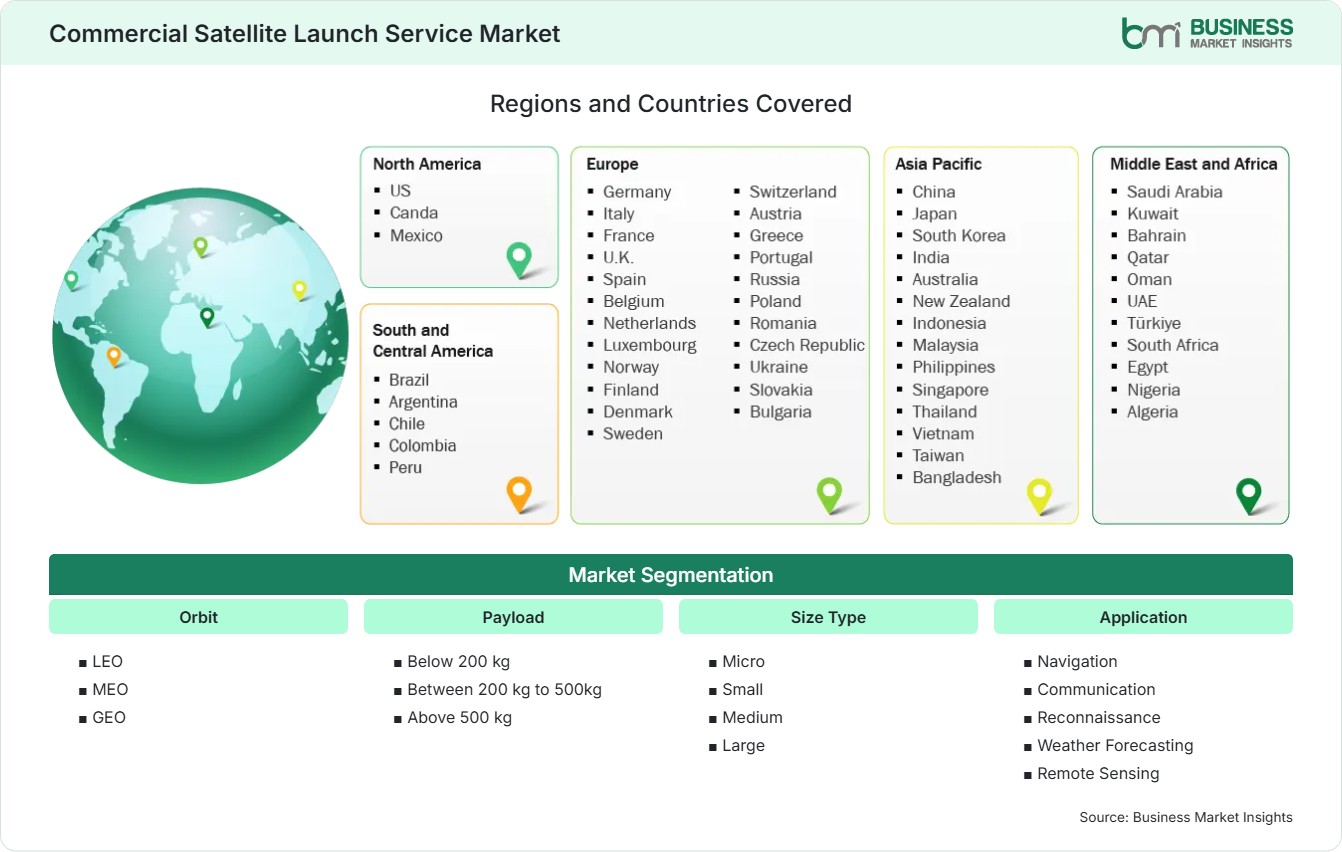
  • Orbit: LEO, MEO, GEO
  • Payload: Below 200 kg, Between 200 kg to 500kg, Above 500 kg
  • Size Type: Micro, Small, Medium, Large
  • Application: Navigation, Communication, Reconnaissance, Weather Forecasting, Remote Sensing
US$ 9.89 Bn Market size in 2025
US$ 31.1 Bn Market Size by 2033
15.4% CAGR, 2026 - 2033
2026-2033 Forecast Period

AI Overview

Commercial Satellite Launch Service Market Summary

  • North America Region: North America holds a 43%–46% share in 2025, growing at a 14.8%–16.2% CAGR through 2033, supported by reusable vehicles, constellation deployment, defense procurement, established spaceports, private investment, and high launch cadence. The U.S. market remains highly competitive, with a 14.5%–16.0% CAGR driven by commercial constellations, defense contracts, and reusable launch technology.
  • Fastest Growing Region: Asia Pacific holds a 24%–27% share in 2025, growing at a 17.0%–19.0% CAGR through 2033, supported by expanding private launch ecosystems, satellite broadband, Earth observation, navigation demand, government investment, and domestic manufacturing capabilities.
  • Leading Segment: LEO holds a 62%–66% share in 2025, growing at a 16.0%–17.8% CAGR through 2033, driven by broadband constellations, Earth observation, defense architectures, technology missions, frequent replenishment, and comparatively accessible orbital requirements.
  • High Growth Segment: Below 200 kg payloads hold a 25%–29% share in 2025, growing at an 18.0%–20.0% CAGR through 2033, supported by CubeSats, small launch vehicles, rideshare demand, technology demonstrations, responsive missions, and proliferated satellite architectures.
  • Key Market Opportunity: Providers can capture demand through reusable vehicles, dedicated small-payload launches, sovereign infrastructure, standardized integration, responsive scheduling, and multi-launch contracts serving commercial and government customers.
  • Major Market Players: Arianespace SAS; Blue Origin, LLC; China Aerospace Science and Technology Corporation; Firefly Aerospace, Inc.; Indian Space Research Organisation; Rocket Lab USA, Inc.; Space Exploration Technologies Corp.; United Launch Alliance, LLC; Relativity Space, Inc.; Isar Aerospace GmbH.
Strategic Insights

Commercial Satellite Launch Service Market: Strategic Insights

Commercial Satellite Launch Service Market Strategic Framework
FREE PDF
Request your free sample
Request free sample
Stakeholder View

Key Takeaways

  • The value chain is becoming more integrated across vehicle development, propulsion, launch sites, payload processing, mission assurance, and deployment. Companies controlling multiple interfaces can reduce scheduling friction and improve customer retention.
  • LEO and smaller payload classes provide strong upside because constellation customers require recurring launches. Dedicated deployment can generate additional value when customers prioritize timing, orbital precision, or mission flexibility.
  • Reusability, additive manufacturing, automated inspection, autonomous flight systems, digital mission planning, and standardized payload interfaces are improving launch cadence and operational efficiency.
  • Asia Pacific offers an attractive investment case as India, Japan, South Korea, Australia, and China expand commercial and institutional space capabilities across launch and satellite ecosystems.
  • Capital is increasingly directed toward vertically integrated space companies combining launch, spacecraft, defense, and infrastructure capabilities. Financing supports vehicle development, production scaling, launch-site construction, and adjacent space services.
Geographic Outlook

Commercial Satellite Launch Service Market Regional Highlights

North America Commercial Satellite Launch Service Market

North America held a 43%–46% share in 2025 and is projected to grow at a 14.8%–16.2% CAGR through 2033. The region benefits from mature launch ranges, reusable vehicles, government procurement, commercial constellations, private investment, and established aerospace suppliers. The United States remains the dominant contributor, supported by communications, defense, navigation, science, and Earth observation missions. Canada is developing complementary launch capabilities. The Commercial Satellite Launch Service Market share remains supported by high launch frequency and extensive downstream space infrastructure.

  • Reusable launch systems support higher flight frequency, improve vehicle utilization, and strengthen economics for recurring constellation deployment programs.
  • Defense procurement supports responsive launch, resilient communications, distributed satellite architectures, and rapid replenishment requirements.
  • Florida, California, Texas, Alaska, and Virginia provide diversified launch infrastructure supporting multiple orbital requirements.
  • Commercial customers increasingly prioritize predictable schedules, encouraging standardized payload interfaces and reserved launch capacity.

US Commercial Satellite Launch Service Market

The U.S. Commercial Satellite Launch Service Market represented a 35%–39% share of global demand in 2025 and is projected to expand at a 14.5%–16.0% CAGR through 2033. The country combines launch providers, satellite manufacturers, government agencies, private investors, launch ranges, and sophisticated commercial customers. Federal procurement provides demand visibility, while commercial constellation operators generate recurring volume. Defense programs increasingly emphasize resilient and distributed architectures, supporting responsive transportation. Established testing facilities, specialized suppliers, insurance capabilities, and engineering expertise further strengthen competitive positioning.

  • Government contracts improve revenue visibility for emerging providers while supporting technical validation and operational development.
  • Private launch infrastructure is expanding orbital access and reducing dependence on a limited number of established launch locations.
  • Defense customers increasingly require rapid replenishment and distributed satellite systems, extending demand beyond conventional communications missions.

Europe Commercial Satellite Launch Service Market

Europe Commercial Satellite Launch Service Market represented an 18%–21% share in 2025 and is projected to grow at a 13.5%–15.5% CAGR through 2033. France and Germany remain leading markets, while Norway, Sweden, the United Kingdom, and Spain are developing complementary launch capabilities. Germany is projected to record a 16.0%–18.0% CAGR, supported by private investment and sovereign-access priorities. Europe is seeking greater independence in orbital transportation as satellite deployment requirements increase. New launch sites and private vehicles are broadening commercial options for small and medium-sized spacecraft.

  • France retains strong launch infrastructure and aerospace expertise supporting institutional and commercial missions.
  • Germany is emerging as a high-growth launch technology center supported by private financing and manufacturing investment.
  • Norway and Sweden provide northern launch infrastructure suitable for polar and high-inclination missions.
  • European procurement increasingly emphasizes resilient supply chains and autonomous orbital access.

Asia Pacific Commercial Satellite Launch Service Market

Asia Pacific Commercial Satellite Launch Service Market held a 24%–27% share in 2025 and is projected to grow at a 17.0%–19.0% CAGR through 2033. China, India, and Japan remain leading markets, while Australia and South Korea are developing rapidly. India is projected to grow at an 18.0%–20.0% CAGR as private participation expands across manufacturing and launch activities. Satellite broadband, Earth observation, navigation, defense, and technology missions are broadening the customer base. Regional governments are also supporting domestic supply chains, creating opportunities across vehicle and satellite production.

  • India is transferring selected launch manufacturing activities toward private industry, expanding domestic production and commercialization.
  • China maintains extensive launch infrastructure and satellite manufacturing depth supporting institutional and commercial deployment.
  • Japan combines established launch capabilities with communications, navigation, science, and Earth observation demand.
  • Australia and South Korea are developing private launch companies, launch infrastructure, and regional satellite manufacturing capabilities.

Rest of World Commercial Satellite Launch Service Market

South and Central America Commercial Satellite Launch Service Market represented approximately 4%–6% of global demand in 2025, while the Middle East and Africa contributed approximately 5%–7%. Brazil and the UAE remain leading markets, supported by communications, Earth observation, national security, and government space programs. Brazil is projected at a 15.0%–17.0% CAGR, while the UAE is projected at a 16.0%–18.0% CAGR. Overall Rest of World demand is projected at approximately 14.0%–17.0% CAGR through 2033 as governments expand domestic capabilities and international launch partnerships.

  • Brazil's geographic position creates opportunities for equatorial and low-inclination missions serving domestic and regional satellite operators.
  • The UAE is expanding communications, Earth observation, exploration, and national-security capabilities, supporting additional launch demand.
  • Saudi Arabia is strengthening its space ecosystem across communications, remote sensing, and sovereign satellite programs.
  • South Africa contributes satellite engineering and Earth observation capabilities while regional operators continue using international launch services.
Global Market Geography
FREE PDF
Request your free sample
Request free sample
Segment Analysis

Commercial Satellite Launch Service Market Segmentation

Orbit

LEO represented the leading orbit category with a 62%–66% share in 2025 and is projected to grow at a 16.0%–17.8% CAGR through 2033. Constellation deployment, lower latency, Earth observation, and defense applications support recurring demand. The Commercial Satellite Launch Service Market scope is increasingly shaped by frequent orbital access, standardized deployment, and replenishment requirements.

  • LEO: Supports broadband, Earth observation, defense, and scientific constellations requiring frequent deployment, flexible orbital access, and scalable replenishment.
  • MEO: Serves navigation and specialized communications systems requiring higher-energy launches, accurate insertion, and dependable orbital transfer.
  • GEO: Remains important for communications and weather missions, favoring heavy-lift systems, precise insertion, and long-duration satellite economics.

Payload

Payload demand is diversifying as spacecraft architectures become more numerous and application-specific. Below 200 kg represented a 25%–29% share in 2025 and is projected to grow at an 18.0%–20.0% CAGR through 2033. Small payloads support responsive missions and constellation replenishment, while heavier spacecraft remain important for communications, defense, weather, and scientific missions.

  • Below 200 kg: Benefits from CubeSats, technology demonstrations, responsive missions, rideshare demand, and dedicated small-launch services.
  • Between 200 kg to 500kg: Supports Earth observation, communications, technology, and defense spacecraft requiring moderate launch capacity and orbital flexibility.
  • Above 500 kg: Serves communications, navigation, defense, weather, and scientific spacecraft requiring high-energy vehicles and rigorous mission assurance.

Size Type

Commercial Satellite Launch Service Market Size Type dynamics reflect the transition toward constellation architectures and standardized spacecraft production. Micro and small spacecraft broaden the customer base, while medium and large spacecraft continue supporting higher-capacity applications. Providers must balance launch flexibility with vehicle utilization, payload integration complexity, and mission assurance across spacecraft classes.

  • Micro: Enables research, technology demonstration, education, and specialized sensing missions with comparatively accessible launch requirements.
  • Small: Benefits from commercial imaging, communications, IoT, and defense constellations requiring recurring deployment and responsive orbital access.
  • Medium: Supports higher-capability communications, observation, navigation, and scientific spacecraft requiring greater integration and launch assurance.
  • Large: Remains concentrated in high-value missions where spacecraft capacity, longevity, and specialized orbital performance justify higher launch expenditure.

Application

Communication and remote sensing applications remain major demand centers, while navigation, reconnaissance, and weather forecasting support institutional and commercial requirements. Diversification reduces customer concentration and encourages differentiated launch schedules. Commercial Satellite Launch Service Market trends increasingly favor flexible architectures serving recurring commercial constellations alongside specialized government missions.

  • Navigation: Requires precise orbital insertion and dependable launch schedules for regional and global positioning architectures.
  • Communication: Generates recurring demand from broadband, direct-to-device, enterprise connectivity, and satellite backhaul constellations.
  • Reconnaissance: Supports defense and intelligence architectures requiring resilient deployment, rapid replenishment, and distributed satellite configurations.
  • Weather Forecasting: Requires dependable orbital access for meteorological satellites supporting forecasting, climate monitoring, and disaster preparedness.
  • Remote Sensing: Expands through imaging, agriculture, environmental monitoring, mapping, infrastructure inspection, and resource-management applications.
Market Forces

Commercial Satellite Launch Service Market Dynamics

Key Market Drivers

Reusable Launch Vehicles Reshape Mission Economics

The reusability of rockets has shifted the focus of competition towards turnaround times, vehicle usage, reliability, and flight capability. The retrieved stages will be able to participate in multiple flights without needing to build a new vehicle each time a launch occurs. This is especially beneficial when constellation providers require multiple flights rather than occasional flights. The Commercial Satellite Launch Service Market growth will therefore increasingly depend on refurbishment times, automated inspection, manufacturing efficiency, and the availability of ranges. The reusability of the rockets has also led customers to sign up for multiple launches and, hence, become long-term customers. Companies with existing retrieval systems can make scheduling easier by spreading costs across multiple flights.

Constellation Deployment Creates Recurring Launch Demand

Commercial constellations have started changing the way satellite launches are procured by creating multi-year deployment needs, explains Dr. Jonathan McDowell. Satellite communications firms, Earth observation companies, and defense agencies require more than one spacecraft to be deployed in orbit simultaneously. The recurring need for multi-year launches makes revenue predictable and creates a need for manufacturing and scheduling aligned with the contracted capacity. Standardized payloads, mission profiles, and launch programs enhance market growth. While rideshares are advantageous for cost-conscious customers, dedicated satellite launches offer greater flexibility in satellite deployment schedules and orbits. Satellite replenishment becomes a source of future demand as satellites age or become obsolete. Launch providers that can integrate launch, deployment, and scheduling will build stronger relationships with satellite constellation owners.

Government and Defense Procurement Strengthens Demand Visibility

Government and defense customers are increasing reliance on distributed satellite architectures to improve resilience and reduce vulnerability associated with concentrated space assets. Responsive Launch is beneficial because it enables agencies to replace malfunctioning satellites more quickly and facilitates demonstrations of new technologies without adhering to normal schedules. There are also commercial purchasing models that allow private firms to bid for institutional launch services. The Commercial Satellite Launch Service Market growth has been positively impacted by this purchasing environment, as government purchasing power will be added to existing commercial communications and Earth observation programs. Defense demands are now focusing on responsive launch, which requires rapid integration, flexible orbit deployment, and launch-site availability. It provides milestone payments and technical validation for emerging enterprises through government purchasing.

Key Market Opportunities

Sovereign Launch Programs Open New Regional Revenue Pools

Governments are increasingly viewing access to space as critical infrastructure. Countries in Europe are ramping up domestic launch capabilities; India is looking to encourage private-sector involvement in launch-vehicle production and other space-related activities; and similar efforts are underway in Australia, Canada, and the Middle East. The Commercial Satellite Launch Service Market Forecasts must then take into consideration demand that will be supported by the government, but not come from commercial satellite operators. Sovereign activities generate repeated business in areas such as vehicles, launch facilities, payload preparation, testing, propulsion, and operations. Private companies can leverage public infrastructure and purchase power without losing commercial clients for other applications.

Dedicated Small-Payload Launch Services Expand Addressable Demand

Small satellites are giving rise to a growing market for specialized launch services that fall between cost-effective rideshare and traditional medium-lift missions. Customers would be able to choose dedicated launches when orbital timing, trajectory, payload readiness, or deployment sequence matters. Operators of Earth-observation systems, defense forces, technology firms, research facilities, and constellation owners could leverage flexible scheduling capabilities. Additionally, dedicated launches can alleviate the need for coordination for rideshare campaigns. Service providers that can ensure repeatable builds and reliable vehicle operation will be able to optimize launch vehicle utilization while offering price differentiation.

Integrated Launch and Space Infrastructure Platforms

There are many opportunities associated with vertical integration in launch vehicles, payload processing, ground infrastructure, mission operations, and certain satellite services. Customers are becoming more inclined toward fewer interfaces since coordination is needed in all areas, such as manufacturing, testing, logistics, range operations, regulatory clearances, and insurance during the launch campaign. There is the ability to reduce coordination costs and increase accountability for scheduling and mission results among integrated providers. The chance is especially relevant for constellation providers who must launch repeatedly over several years. It is possible for providers to generate revenues from spacecraft systems and parts between campaigns.

Market Restraints and Challenges

High Capital Intensity and Reliability Requirements

The orbital launch vehicles require significant investments in propulsion technology development, testing, manufacturing, launch facilities, regulatory compliance, and insurance. Capital intensity can prolong development cycles and pose additional financial risks for startups before establishing a viable commercial launch cadence. Customer expectations for a high degree of reliability are justified by the need to avoid losses in the event of an unsuccessful launch and the associated loss of expensive space vehicles. The new companies without a track record of previous launches could encounter problems with expensive insurance, reluctant customers, and reliance on governmental contracts. The reusable launch systems entail additional infrastructure for recovery and reconditioning. Capital intensity does not cease after developing the vehicle itself.

Launch-Site Capacity and Regulatory Complexity

The launch of an orbital payload is contingent upon range facilities, environmental clearances, airspace arrangements, safety equipment, spectrum coordination, and regulatory approvals. Constraints on available range capabilities may affect the flight rate, even if vehicle manufacturing is not a problem. New range facilities will be required and will entail substantial capital expenditure and time to be cleared. New providers will be constrained geographically until other facilities are up and running. Operating internationally will bring a new set of regulations. Service providers catering to a global clientele will incur more time in preparations and higher administrative costs.

Company Analysis

Competitive Landscape

Commercial Satellite Launch Service Market analysis indicates that competition increasingly depends on launch cadence, payload flexibility, reliability, vehicle economics, infrastructure ownership, and integrated mission capabilities. Established providers retain advantages in flight heritage and infrastructure, while emerging companies compete through specialized vehicles, automation, reusability, and sovereign-access propositions.

Company Name

Overview

Products and Services relevant to this market

Arianespace SAS

Established European launch provider serving institutional and commercial satellite customers across diverse orbital requirements.

Ariane launch services, mission management, payload integration, orbital deployment, and commercial satellite launch solutions.

Blue Origin, LLC

U.S. space company developing heavy-lift orbital transportation and reusable launch infrastructure.

New Glenn orbital launch services, payload deployment, launch infrastructure, and mission support for large spacecraft.

China Aerospace Science and Technology Corporation

Major Chinese aerospace organization with extensive launch vehicle and satellite capabilities.

Commercial and institutional launch services, launch vehicles, payload integration, and satellite deployment.

Firefly Aerospace, Inc.

U.S. commercial space company combining orbital launch, lunar, spacecraft, and defense capabilities.

Alpha launch services, responsive missions, spacecraft systems, lunar delivery, payload integration, and mission operations.

Indian Space Research Organisation

India's national space agency supporting launch vehicle and satellite development.

PSLV and other launch systems, satellite deployment, mission services, technology transfer, and launch infrastructure.

Rocket Lab USA, Inc.

Vertically integrated space company focused on responsive launch and satellite systems.

Electron launch services, launch integration, satellite components, spacecraft platforms, and Neutron services.

Space Exploration Technologies Corp.

U.S. launch provider with extensive reusable-flight experience and constellation activity.

Falcon launch services, rideshare, dedicated missions, satellite deployment, and constellation launch operations.

United Launch Alliance, LLC

U.S. launch provider serving demanding government and commercial missions.

Vulcan launch services, mission integration, payload processing, orbital deployment, and national-security launch support.

Relativity Space, Inc.

U.S. launch developer using additive manufacturing and automated production approaches.

Terran launch development, reusable launch technology, manufacturing systems, and commercial payload deployment.

Isar Aerospace GmbH

German launch company developing sovereign European orbital access through integrated launch operations.

Spectrum launch services, launch-site development, payload integration, orbital deployment, and responsive European capacity.

Trust & Transparency

Research Methodology

The market analysis combines proprietary research with secondary data from government agencies, company disclosures, regulatory filings, industry databases and expert interviews. Market estimates are validated through data triangulation, cross-market benchmarking and analyst review.

View Full Research Methodology

Questions Answered

Frequently Asked Questions

Which customers are likely to generate recurring launch contracts?

Communications constellations, Earth observation networks, defense architectures, navigation systems, and satellite operators requiring regular replenishment are strong candidates. Their recurring deployment requirements can support multi-launch agreements and improve production visibility.

What role will sovereign launch capability play in competition?

Sovereign launch capability is becoming an important procurement priority as governments seek greater control over strategic space infrastructure. This creates opportunities for regional providers while encouraging domestic investment in manufacturing, spaceports, propulsion, and testing.

How does launch cadence affect provider economics?

As per the Commercial Satellite Launch Service Market report, Higher cadence allows infrastructure, engineering resources, manufacturing systems, and operational teams to be utilized across more missions. Providers achieving repeatable production and rapid turnaround can improve asset utilization and customer retention.

What determines the choice between rideshare and dedicated launch?

Customers evaluate orbital precision, schedule requirements, payload readiness, cost, and deployment sequence. Rideshare provides attractive economics when timing is flexible, while dedicated launches offer greater control over orbital parameters and mission timing.

Which orbit will remain the primary demand center through 2033?

LEO is positioned to remain dominant because communications, Earth observation, defense, and technology constellations require frequent deployment and replenishment. Its broad commercial application base supports recurring launch activity.

Access the Full Commercial Satellite Launch Service Market Report

Get segment-level forecasts, regional estimates, competitive benchmarking, company profiles and downloadable Excel datasets.

Access the full Commercial Satellite Launch Service Market Report
350 pages PDF & Excel | 2026-09-28
Similar Research

Related Market Reports