
Satellite Manufacturing and Launch Systems Market Size, Share, Trends & Forecast Report, 2026–2033

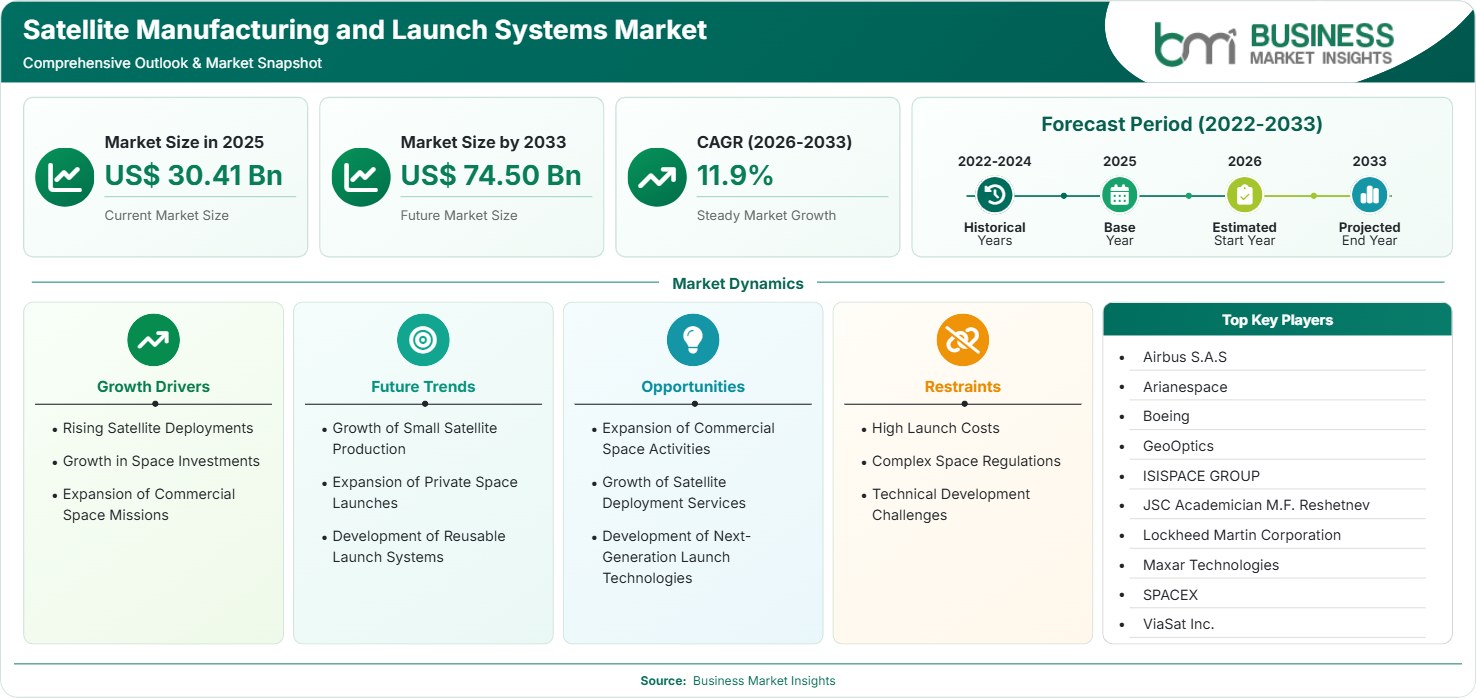
The Satellite Manufacturing and Launch Systems Market size was valued at US$ 30.41 billion in 2025 and is projected to reach US$ 74.50 billion by 2033, growing at a CAGR of 11.9% during 2026–2033, driven by rising satellite deployments, increasing space investments, commercial space mission expansion, next-generation launch technologies, satellite services growth, and defense modernization programs.

Report Coverage
  • Type: Satellite Manufacturing, Satellite Launch Systems
  • Application: Communication Satellite, Military Surveillance, Navigation Satellite, Earth Observation Satellite, Others
  • End-Use: Commercial, Military
US$ 30.41 Bn Market size in 2025
US$ 74.50 Bn Market Size by 2033
11.9% CAGR, 2026 - 2033
2026-2033 Forecast Period

AI Overview

Satellite Manufacturing and Launch Systems Market Summary

  • North America Region: North America holds market share of 38%–42% in 2025, growing with a CAGR of 11.5%–12.2% influenced by commercial space investments, defense satellite programs, private launch activities, and advanced spacecraft development. The US market demonstrates growth with a CAGR of 11.8%–12.5% from 2026–2033, supported by government missions, private space companies, and satellite constellation expansion.
  • Fastest Growing Region: Asia Pacific holds market share of 24%–28% in 2025, growing with a CAGR of 12.2%–13.0% influenced by national space programs, satellite communication demand, commercial launches, and increasing investments in indigenous space capabilities.
  • Leading Segment: Satellite Manufacturing holds market share of 55%–59% in 2025, growing with a CAGR of 11.6%–12.3% influenced by increasing satellite constellation deployments, communication requirements, Earth observation missions, and defense applications.
  • High Growth Segment: Commercial End-Use holds market share of 52%–56% in 2025, growing with a CAGR of 12.0%–12.8% influenced by private space ventures, satellite broadband expansion, commercial launch services, and growing demand for space-based services.
  • Key Market Opportunity: Commercial space expansion, satellite deployment services, and next-generation launch technologies create opportunities through reusable launch systems, smaller satellite platforms, advanced manufacturing, and increased access to orbital services.
  • Major Market Players: Airbus S.A.S, Arianespace, Boeing, GeoOptics, ISISPACE GROUP, JSC Academician M.F. Reshetnev, Lockheed Martin Corporation, Maxar Technologies, SPACEX, and ViaSat Inc.
Strategic Insights

Satellite Manufacturing and Launch Systems Market: Strategic Insights

Satellite Manufacturing and Launch Systems Market Strategic Framework
FREE PDF
Request your free sample
Request free sample
Stakeholder View

Key Takeaways

  • The market ecosystem includes satellite manufacturers, launch service providers, component suppliers, government agencies, defense organizations, and commercial space operators supporting end-to-end space missions.
  • Satellite communication platforms, Earth observation systems, and commercial satellite constellations represent major growth opportunities as demand increases for space-based connectivity and data services.
  • Innovation is shifting toward reusable launch vehicles, small satellite manufacturing, advanced propulsion systems, modular spacecraft designs, and automated production technologies.
  • Asia Pacific presents strong investment potential due to expanding national space programs, increasing commercial participation, and rising demand for satellite-enabled services.
  • Strategic partnerships, government contracts, private investments, and industry consolidation are shaping competition as companies strengthen satellite production and launch capabilities.
  • The growing commercialization of space is creating opportunities for new business models including satellite-as-a-service, shared launches, and flexible orbital deployment solutions.
Geographic Outlook

Satellite Manufacturing and Launch Systems Market Regional Highlights

North America Satellite Manufacturing and Launch Systems Market

North America market accounted for a 38%–42% share in 2025 and is projected to expand at a CAGR of 11.5%–12.2% during 2026–2033. The region maintains leadership due to strong government space programs, private launch companies, defense investments, and advanced aerospace capabilities. The US and Canada represent major markets supported by commercial satellite constellations, military modernization, and increasing demand for space-based communication and observation services.

  • Private space companies are increasing investments in satellite production and launch capabilities.
  • Defense agencies are expanding satellite programs for surveillance and communication applications.
  • Commercial satellite constellations are accelerating demand for manufacturing capacity.
  • Reusable launch technologies are improving mission economics and accessibility.
  • Aerospace companies are developing advanced spacecraft platforms and components.

US Satellite Manufacturing and Launch Systems Market

US Satellite Manufacturing and Launch Systems Market share represented a 34%–38% share in 2025 and is estimated to grow at a CAGR of 11.8%–12.5% between 2026–2033. The country remains a dominant market due to extensive commercial space activities, government contracts, defense requirements, and private launch innovations. Strong investments from aerospace companies are supporting satellite development and deployment capabilities.

  • Commercial launch providers are increasing orbital access through advanced technologies.
  • Government space missions are supporting satellite manufacturing investments.
  • Private companies are expanding communication satellite constellation deployments.
  • Defense organizations are increasing demand for surveillance satellites.

Europe Satellite Manufacturing and Launch Systems Market

Europe market held a 20%–24% share in 2025 and is forecast to register a CAGR of 11.2%–11.9% during 2026–2033. The region benefits from established aerospace capabilities, institutional space programs, and increasing commercial satellite activities. France, Germany, the UK, Italy, and Spain represent key markets, with France and Germany leading due to strong aerospace manufacturing infrastructure and government-backed space initiatives.

  • European aerospace companies are developing advanced satellite platforms.
  • France is strengthening launch capabilities through commercial space programs.
  • Germany is expanding satellite manufacturing and space technology investments.
  • Regional organizations are supporting Earth observation and communication missions.
  • Commercial satellite services are increasing across European markets.

Asia Pacific Satellite Manufacturing and Launch Systems Market

Asia Pacific market accounted for a 24%–28% share in 2025 and is expected to grow at the fastest CAGR of 12.2%–13.0% between 2026–2033. Growth is supported by national space programs, communication infrastructure expansion, defense modernization, and increasing private sector participation. China, India, Japan, South Korea, and Australia represent major markets, with India and China providing significant opportunities through satellite deployment programs and indigenous space development.

  • National space agencies are increasing satellite launch activities.
  • Communication satellite demand is expanding across emerging economies.
  • Private space companies are developing regional launch capabilities.
  • Earth observation applications are supporting satellite manufacturing growth.
  • Governments are increasing investments in space technology infrastructure.

Rest of World Satellite Manufacturing and Launch Systems Market

Rest of World market represented a 8%–12% share in 2025 and is projected to grow at a CAGR of 11.0%–11.7% from 2026–2033. Latin America, Middle East, and Africa markets are developing through satellite communication demand, remote connectivity requirements, and increasing government investments. Brazil, UAE, Saudi Arabia, and South Africa represent important markets supported by space initiatives and commercial satellite applications.

  • Middle Eastern countries are investing in satellite programs and space infrastructure.
  • UAE and Saudi Arabia are expanding commercial space capabilities.
  • Latin American nations are increasing satellite communication adoption.
  • African markets are using satellites for connectivity and observation needs.
  • Regional partnerships are supporting satellite deployment and technology development.
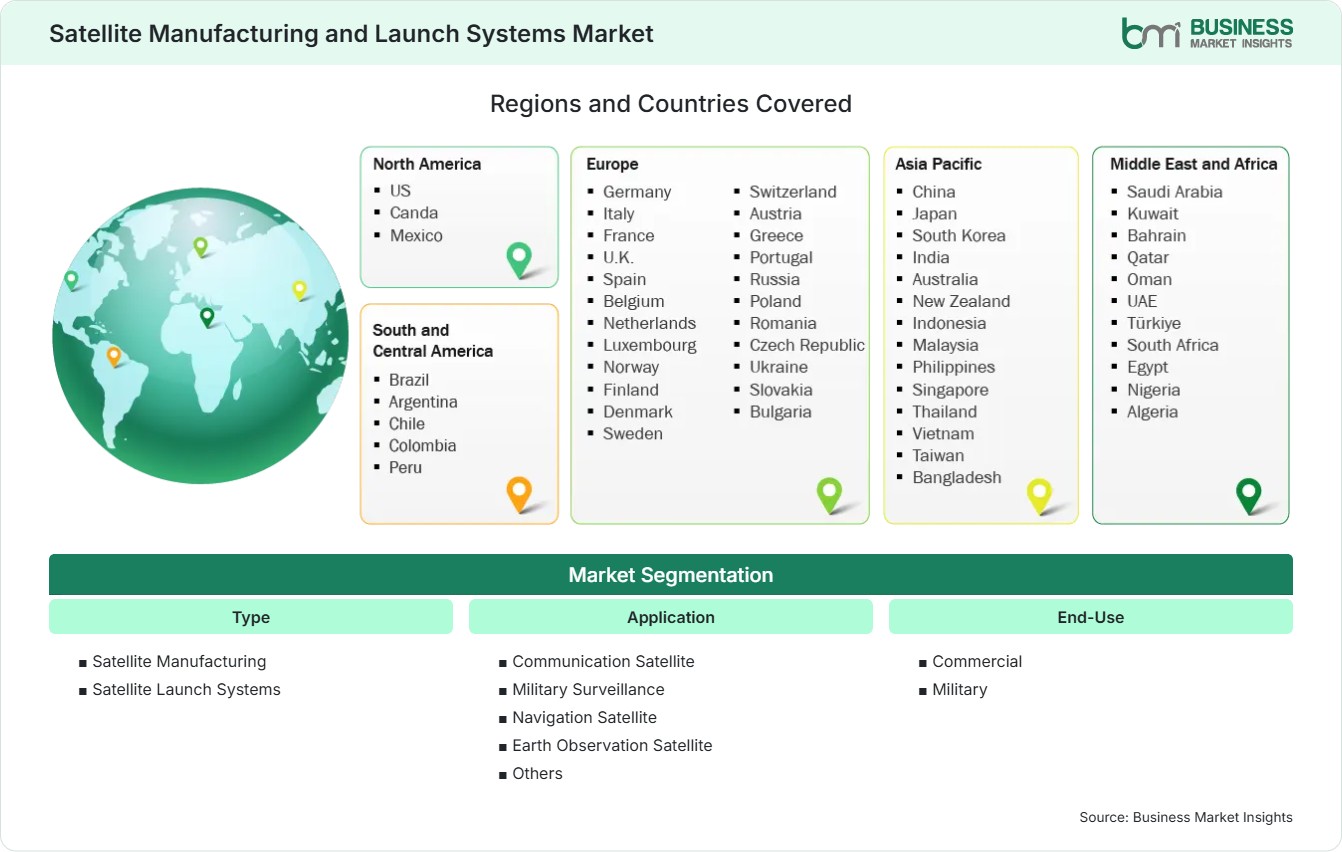
Global Market Geography
FREE PDF
Request your free sample
Request free sample
Segment Analysis

Satellite Manufacturing and Launch Systems Market Segmentation

Type

Type segmentation includes Satellite Manufacturing and Satellite Launch Systems. Satellite Manufacturing maintained a leading position in 2025 with a 55%–59% share and is expected to grow at a CAGR of 11.6%–12.3% from 2026–2033. Growth is supported by increasing satellite constellation deployments, communication requirements, Earth observation missions, and defense applications requiring advanced spacecraft platforms.

  • Satellite Manufacturing: Satellite manufacturing supports communication, defense, navigation, and observation missions through advanced spacecraft development.
  • Satellite Launch Systems: Satellite launch systems enable orbital deployment through advanced rockets, reusable technologies, and commercial launch services.

Application

Application segmentation includes Communication Satellite, Military Surveillance, Navigation Satellite, Earth Observation Satellite, and Others. Communication Satellite represents a significant application segment due to increasing connectivity demand, broadband expansion, and commercial constellation development. Earth observation and military surveillance applications are also gaining importance due to growing demand for monitoring, security, and data intelligence.

  • Communication Satellite: Communication satellites support broadband connectivity, broadcasting, and global communication infrastructure development.
  • Military Surveillance: Military surveillance satellites provide intelligence, monitoring, and security capabilities for defense organizations.
  • Navigation Satellite: Navigation satellites enable positioning, timing, and location-based services across multiple industries.
  • Earth Observation Satellite: Earth observation satellites support environmental monitoring, mapping, agriculture, and disaster management applications.
  • Others: Other applications include scientific research, technology demonstrations, and specialized satellite missions.

End-Use

End-Use segmentation includes Commercial and Military. Commercial end-use maintained a leading position in 2025 with a 52%–56% share and is expected to grow at a CAGR of 12.0%–12.8% from 2026–2033. Growth is supported by private space companies, satellite communication services, commercial launches, and increasing demand for space-based data solutions.

  • Commercial: Commercial users adopt satellite systems for communication, navigation, observation, and emerging space services.
  • Military: Military organizations utilize satellites for surveillance, secure communication, navigation, and strategic defense operations.
Market Forces

Satellite Manufacturing and Launch Systems Market Dynamics

Key Market Drivers

Rising Satellite Deployments

Rising satellite deployments are accelerating demand for spacecraft production, launch services, and supporting technologies as governments and private companies expand communication, navigation, and Earth observation capabilities. The increasing use of satellite constellations for broadband connectivity and data services is encouraging manufacturers to improve production efficiency and scalability. The Satellite Manufacturing and Launch Systems Market growth is supported by rising demand for small satellites, commercial missions, and defense applications. The market trends indicate growing adoption of modular satellite platforms, standardized components, and streamlined manufacturing approaches. Companies are focusing on reducing development timelines while improving satellite performance and mission reliability.

Growth in Space Investments

Growth in space investments is strengthening industry expansion as governments, private investors, and aerospace organizations increase funding for satellite technologies and launch infrastructure. Investment activities are supporting research into advanced propulsion systems, reusable launch vehicles, satellite miniaturization, and next-generation manufacturing capabilities. The market growth is supported by increasing public-private partnerships and commercial space initiatives. The Satellite Manufacturing and Launch Systems Market trends highlight greater focus on cost-efficient spacecraft production, advanced materials, and digital engineering processes. Companies are leveraging investment inflows to expand production capacity, improve launch reliability, and develop innovative solutions for growing space applications.

Expansion of Commercial Space Missions

Expansion of commercial space missions is creating new demand for satellite manufacturing and launch systems as private companies enter communication, imaging, and data service markets. Commercial operators are deploying satellite networks to provide connectivity, monitoring, and specialized space-based services. The market growth is supported by increasing participation from private aerospace companies and growing demand for affordable orbital access. The Satellite Manufacturing and Launch Systems Market trends indicate rising adoption of small satellite platforms, shared launch opportunities, and flexible deployment models. Manufacturers are developing scalable solutions to support diverse commercial missions and improve accessibility to space-based services.

Key Market Opportunities

Expansion of Commercial Space Activities

Expansion of commercial space activities creates opportunities for satellite manufacturers and launch providers as private enterprises increase participation in orbital services, communication networks, and Earth observation missions. The commercialization of space is encouraging companies to develop cost-effective satellite platforms, flexible launch solutions, and integrated deployment services. Growing partnerships between governments and private organizations are supporting innovation across the space ecosystem. Companies that provide scalable manufacturing capabilities and reliable launch solutions can benefit from increasing demand among commercial operators. The expansion of commercial missions is also creating opportunities for specialized satellite services supporting industries such as telecommunications, agriculture, transportation, and environmental monitoring.

Growth of Satellite Deployment Services

Growth of satellite deployment services presents opportunities as increasing satellite launches require efficient, reliable, and flexible orbital delivery solutions. Companies are developing dedicated launch services, rideshare programs, and deployment technologies to support diverse satellite operators. Rising demand for frequent launches is encouraging improvements in launch scheduling, mission planning, and deployment efficiency. Satellite Manufacturing and Launch Systems Market forecast are focusing on reducing costs and improving accessibility for commercial and research organizations. The expansion of satellite constellations and small satellite programs is expected to increase demand for specialized deployment services, creating opportunities for launch companies and technology providers across global space markets.

Development of Next-Generation Launch Technologies

Development of next-generation launch technologies creates opportunities through reusable launch vehicles, advanced propulsion systems, and improved manufacturing methods. Aerospace companies are investing in technologies designed to reduce launch costs, increase mission frequency, and improve operational efficiency. Innovations in materials, automation, and engineering processes are enabling the development of lighter and more capable launch systems. Companies focusing on reusable platforms and advanced launch architectures can address growing demand for affordable space access. These technologies are expected to support commercial space expansion by improving reliability, reducing operational expenses, and enabling more frequent satellite deployment missions.

Market Restraints and Challenges

High Launch Costs

Factor: High launch costs associated with rocket development, fuel requirements, infrastructure, and mission operations create financial barriers for satellite deployment activities.

Impact: Expensive launch services can limit access to space for smaller companies, research organizations, and emerging market participants. Although reusable launch technologies are helping reduce expenses, significant investment is still required for advanced launch systems and supporting infrastructure. Companies must balance cost reduction with safety, reliability, and performance requirements. The industry is addressing this challenge through shared launch programs, improved manufacturing processes, and innovative technologies designed to increase affordability and accessibility of orbital missions.

Complex Space Regulations

Factor: Complex space regulations involving licensing, orbital management, spectrum allocation, and international compliance create operational challenges for satellite companies.

Impact: Regulatory complexity can delay mission timelines, increase administrative requirements, and affect investment decisions across the space industry. Satellite operators must navigate multiple national and international frameworks before deployment. Compliance with safety standards, orbital debris mitigation policies, and communication regulations requires significant planning and resources. Industry stakeholders are working with regulatory bodies to establish clearer frameworks that support innovation while maintaining responsible space operations and long-term sustainability of orbital environments.

Company Analysis

Competitive Landscape

The Satellite Manufacturing and Launch Systems Market analysis highlights competition among aerospace manufacturers, launch service providers, satellite developers, and commercial space companies. Players are focusing on reusable launch technologies, satellite miniaturization, constellation deployment capabilities, and advanced spacecraft manufacturing. Leading companies are expanding through innovation, government contracts, strategic partnerships, and commercial mission development.

Company Name

Overview

Products and Services relevant to this market

Airbus S.A.S

Aerospace company providing satellite and space solutions.

Communication satellites, Earth observation systems, and spacecraft platforms.

Arianespace

European launch service provider specializing in orbital missions.

Commercial satellite launch services and deployment solutions.

Boeing

Aerospace manufacturer involved in space technologies.

Satellite systems, spacecraft development, and defense space solutions.

GeoOptics

Satellite data company focused on Earth observation services.

Satellite platforms and environmental monitoring data solutions.

ISISPACE GROUP

Small satellite manufacturer and mission provider.

CubeSats, satellite platforms, and launch integration services.

JSC Academician M.F. Reshetnev

Russian spacecraft manufacturing organization.

Communication satellites, navigation systems, and spacecraft technologies.

Lockheed Martin Corporation

Aerospace and defense company with space capabilities.

Military satellites, spacecraft systems, and launch technologies.

Maxar Technologies

Space technology company specializing in satellites.

Earth observation satellites, spacecraft manufacturing, and geospatial solutions.

SPACEX

Commercial space company providing launch services.

Launch vehicles, satellite constellations, and orbital deployment services.

ViaSat Inc.

Satellite communication technology company.

Communication satellites, broadband services, and connectivity solutions.

Industry Activity

Recent Developments

January 2026

Airbus SE announced that it had been awarded a contract by Eutelsat Communications SA to manufacture an additional 340 OneWeb low Earth orbit (LEO) satellites. The satellites will be produced at Airbus Defence and Space’s Toulouse manufacturing facility on a newly installed production line, expanding European high-volume satellite production capabilities.

October 2025

Thales Alenia Space (a joint venture between Thales S.A. and Leonardo S.p.A.) announced preparations for a new large-scale satellite manufacturing facility near Rome, Italy. The Space Smart Factory is designed to increase satellite production capacity and support civil and defense satellite programs, with operations planned from late 2025.

September 2025

Lockheed Martin Corporation highlighted progress at its Small Satellite Processing & Delivery (SPD) Center in Colorado, a dedicated facility designed for rapid small satellite production. The facility uses digital engineering and automated production processes and is capable of producing up to 180 spacecraft annually for commercial and government missions.

July 2025

Airbus S.A.S. was selected by Hisdesat Servicios Estratégicos S.A. to design and manufacture two PAZ-2 synthetic aperture radar (SAR) satellites for Spain’s next-generation Earth observation capabilities. The program strengthens Airbus’ role in advanced satellite manufacturing and European space security systems.

Trust & Transparency

Research Methodology

The market analysis combines proprietary research with secondary data from government agencies, company disclosures, regulatory filings, industry databases and expert interviews. Market estimates are validated through data triangulation, cross-market benchmarking and analyst review.

View Full Research Methodology

Questions Answered

Frequently Asked Questions

What does the Satellite Manufacturing and Launch Systems Market Report indicate about future opportunities?

The market report highlights opportunities in commercial space expansion, satellite deployment services, next-generation launch technologies, and increasing demand for space-based applications.

What technologies are shaping future satellite launches?

Reusable launch vehicles, small satellite platforms, advanced propulsion systems, automated manufacturing, and modular spacecraft designs are shaping future satellite launch and deployment capabilities.

How are commercial space companies influencing market growth?

Commercial space companies are increasing satellite deployment frequency, developing private constellations, expanding launch services, and creating new business models for space-based communication and data applications.

Which segment dominates the market?

Satellite Manufacturing represents the leading segment due to increasing demand for communication satellites, Earth observation platforms, navigation systems, and defense-related spacecraft.

What factors are driving growth in the Satellite Manufacturing and Launch Systems Market?

The market is driven by increasing satellite deployments, commercial space missions, defense modernization, growing space investments, satellite communication demand, and advancements in launch technologies.

Access the Full Satellite Manufacturing and Launch Systems Market Report

Get segment-level forecasts, regional estimates, competitive benchmarking, company profiles and downloadable Excel datasets.

Access the full Satellite Manufacturing and Launch Systems Market Report
350 pages PDF & Excel | 2026-07-31