
Commercial Aircraft Disassembly Dismantling And Recycling Market Outlook: Size, Share, Trends, Growth Analysis, Competitive Landscape & Forecast, 2026-2033

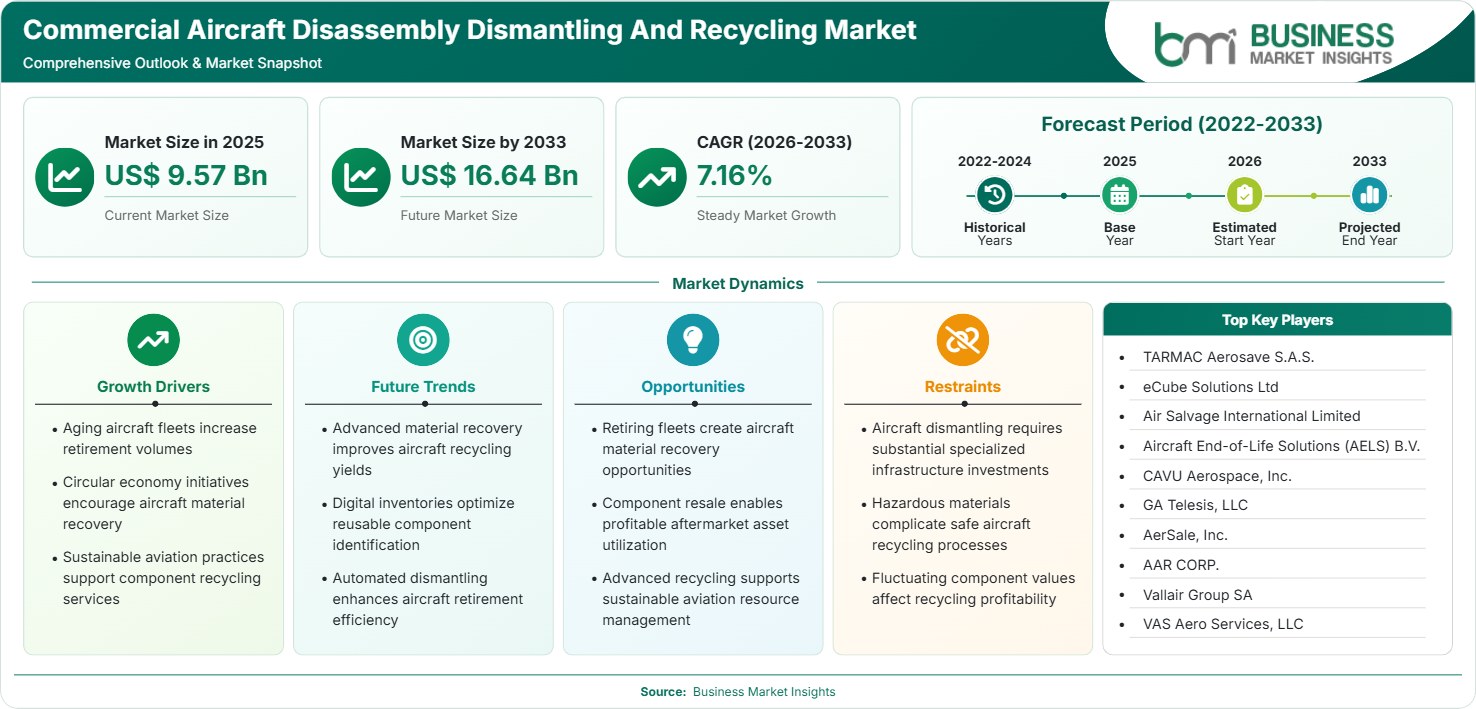
The Commercial Aircraft Disassembly Dismantling And Recycling Market size was valued at US$ 9.57 Billion in 2025 and is projected to reach US$ 16.64 Billion by 2033, growing at a CAGR of 7.16% during 2026–2033, driven by fleet aging, aircraft retirements, USM demand, circularity initiatives, and residual-value optimization.

Report Coverage
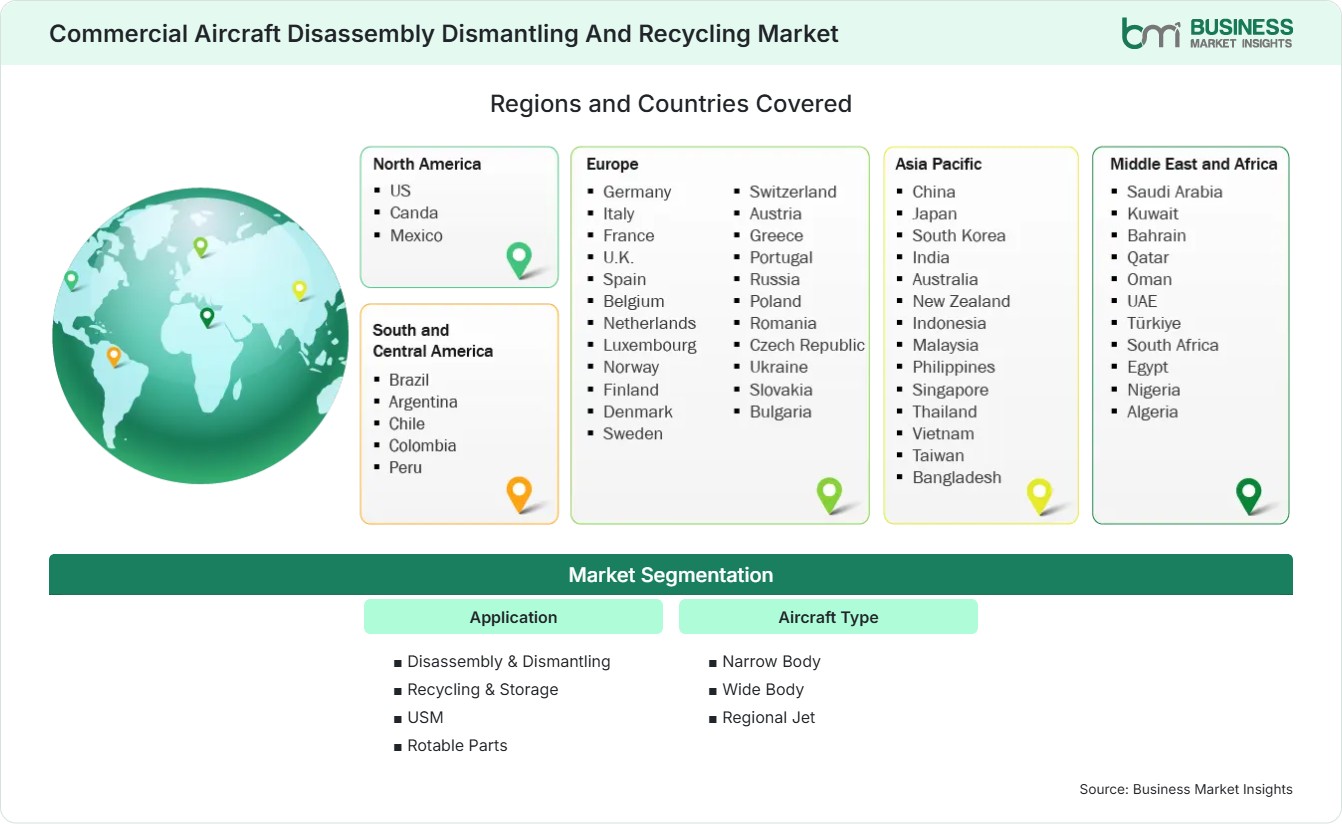
  • Application: Disassembly & Dismantling, Recycling & Storage, USM, Rotable Parts
  • Aircraft Type: Narrow Body, Wide Body, Regional Jet
US$ 9.57 Bn Market size in 2025
US$ 16.64 Bn Market Size by 2033
7.16% CAGR, 2026 - 2033
2026-2033 Forecast Period

AI Overview

Commercial Aircraft Disassembly Dismantling And Recycling Market Summary

  • North America: North America holds 35%–38% of Commercial Aircraft Disassembly Dismantling And Recycling Market share in 2025, growing at a CAGR of 6.7%–7.0%, supported by mature MRO infrastructure, aircraft retirements, storage capacity, USM demand, component traceability, and aftermarket investment. The U.S. market expands at a 6.8%–7.1% CAGR, supported by large fleets, mature MRO clusters, established lessor relationships, and strong aftermarket distribution.
  • Fastest Growing Region: Asia Pacific holds 22%–25% share in 2025 and expands at a CAGR of 8.0%–8.4%, supported by fleet expansion, airline modernization, MRO investment, rising maintenance requirements, growing USM demand, and emerging regional dismantling infrastructure.
  • Leading Segment: Disassembly & Dismantling holds a 38%–41% share in 2025 and grows at a CAGR of 6.9%–7.2%, supported by retirement programs, component harvesting, asset recovery, aircraft storage transitions, and specialist teardown capabilities.
  • High Growth Segment: USM holds a 24%–27% share in 2025 and advances at a CAGR of 8.0%–8.4%, supported by component shortages, affordability requirements, traceability systems, repair capacity, inventory digitization, and airline maintenance-cost control.
  • Key Market Opportunity: Integrated teardown, MRO, USM distribution, digital traceability, storage, and recycling platforms can maximize aircraft residual value while creating multiple revenue streams from retiring commercial assets.
  • Major Market Players: TARMAC Aerosave S.A.S.; eCube Solutions Ltd; Air Salvage International Limited; Aircraft End-of-Life Solutions (AELS) B.V.; CAVU Aerospace, Inc.; GA Telesis, LLC; AerSale, Inc.; AAR CORP.; Vallair Group SA; VAS Aero Services, LLC.
Strategic Insights

Commercial Aircraft Disassembly Dismantling And Recycling Market: Strategic Insights

Commercial Aircraft Disassembly Dismantling And Recycling Market Strategic Framework
FREE PDF
Request your free sample
Request free sample
Stakeholder View

Key Takeaways

  • The value chain increasingly connects owners, lessors, dismantlers, MRO providers, certification specialists, distributors, logistics companies, and recyclers, making integrated lifecycle management increasingly important.
  • USM and rotable parts provide the strongest value-density opportunities because serviceable components can deliver greater recovery value than bulk material recycling.
  • Digital teardown records, serialized tracking, automated inspection, demand analytics, and inventory matching are shifting retirement programs toward measurable yield optimization.
  • Asia Pacific offers a strong investment case because expanding fleets and developing aftermarket infrastructure are creating demand for localized dismantling and component distribution.
  • Integrated platforms combining storage, teardown, MRO, parts distribution, and recycling can capture value across multiple stages of aircraft retirement.
  • Environmental performance is becoming commercially relevant as owners evaluate component reuse, material recovery, landfill avoidance, and responsible disposal alongside financial returns.
Geographic Outlook

Commercial Aircraft Disassembly Dismantling And Recycling Market Regional Highlights

North America Commercial Aircraft Disassembly Dismantling And Recycling Market

North America Commercial Aircraft Disassembly Dismantling And Recycling Market holds a 35%–38% share in 2025 and grows at a 6.7%–7.0% CAGR through 2033. Mature MRO infrastructure, aircraft storage facilities, leasing activity, high fleet utilization, and deep aftermarket distribution support regional leadership. The U.S. remains the principal demand center, while Canada contributes specialized aviation services. Aging aircraft and delivery constraints increase component harvesting opportunities. Strong logistics networks support movement of engines, avionics, landing gear, and rotable components between dismantling facilities and aftermarket customers.

  • Mature MRO infrastructure supports integrated teardown, storage, inspection, certification, and component redistribution across established aviation clusters.
  • High aircraft utilization encourages operators to retain older fleets, increasing replacement-part requirements and demand for recovered components.
  • Established storage locations support aircraft preservation, maintenance transitions, and planned dismantling programs.
  • Digital inventory systems improve visibility of harvested components and accelerate matching with global aftermarket demand.
  • Strong lessor and airline participation provides recurring retirement pipelines and structured asset-transition opportunities.

US Commercial Aircraft Disassembly Dismantling And Recycling Market

The U.S. Commercial Aircraft Disassembly Dismantling And Recycling Market represents 82%–85% of North America's 2025 market and expands at a 6.8%–7.1% CAGR through 2033. Its position reflects extensive commercial fleets, mature MRO clusters, established leasing relationships, and sophisticated aftermarket distribution. Strong demand for engines, avionics, landing gear, flight controls, and rotable components enables dismantlers to generate value through parts recovery. Technical documentation, inspection, traceability, and certification remain essential competitive differentiators.

  • Arizona, New Mexico, Texas, and other aviation locations support storage, maintenance, teardown, and component recovery.
  • Domestic airline and leasing ecosystems provide access to retiring fleets and structured asset-transition programs.
  • Certification and traceability requirements favor providers with established technical records and inspection capabilities.
  • Deep aftermarket participation supports USM monetization through domestic and international customers.

Europe Commercial Aircraft Disassembly Dismantling And Recycling Market

Europe Commercial Aircraft Disassembly Dismantling And Recycling Market holds 28%–31% share in 2025 and records a 7.0%–7.3% CAGR through 2033. France, the United Kingdom, Germany, Spain, and Ireland remain important aviation services locations. Mature MRO capabilities combine with aircraft leasing, recycling, and environmental-management expertise. Circularity initiatives increasingly prioritize component reuse before material recycling. Dense logistics networks connect retirement facilities with aerospace manufacturing and aftermarket centers. France leads specialist lifecycle activity, while Ireland remains important for aircraft leasing and asset management.

  • The United Kingdom benefits from established engineering, aftermarket, storage, and aircraft transition capabilities.
  • Germany provides aerospace manufacturing and MRO capabilities that support industrial recycling partnerships.
  • Ireland's leasing ecosystem creates opportunities for asset transition, remarketing, storage, and retirement management.
  • France supports specialist dismantling and recycling through established aircraft lifecycle infrastructure.

·         European circularity initiatives encourage higher component reuse and more efficient material separation.

Asia Pacific Commercial Aircraft Disassembly Dismantling And Recycling Market

Asia Pacific Commercial Aircraft Disassembly Dismantling And Recycling Market holds 22%–25% share in 2025 and records the fastest regional CAGR of 8.0%–8.4% through 2033. China, India, Singapore, Japan, and Australia represent major aviation markets, while India and Southeast Asia offer strong expansion potential. Fleet growth is increasing future retirement volumes, while MRO investment strengthens regional teardown capabilities. Rising airline utilization also creates demand for affordable replacement components and localized aftermarket support, improving the investment case for strategically positioned dismantling facilities.

  • India combines rapid aviation expansion with growing MRO investment, supporting storage, teardown, repair, and redistribution opportunities.
  • China offers significant fleet scale and developing domestic aftermarket capabilities, supporting long-term dismantling demand.
  • Singapore provides mature MRO infrastructure, international logistics links, and access to Southeast Asian fleets.
  • Southeast Asia presents high-growth potential as carriers expand fleets and seek affordable components.
  • Japan and Australia contribute mature technical capabilities and strategically positioned aviation facilities.

Rest of World Commercial Aircraft Disassembly Dismantling And Recycling Market

South and Central America Commercial Aircraft Disassembly Dismantling And Recycling Market offers growing retirement and aftermarket opportunities as airlines modernize fleets while managing financing constraints. Brazil remains the leading regional aviation market, while Mexico benefits from proximity to North American supply chains. Demand for affordable USM, component repair, storage, and asset optimization supports future dismantling activity.

Middle East and Africa offer additional opportunities through fleet expansion, leasing activity, and aviation connectivity. Gulf markets are important for wide-body assets, while South Africa provides established technical capabilities. Emerging African markets offer longer-term potential as fleet growth increases retirement and component-recovery requirements.

  • Brazil benefits from fleet scale, domestic aviation activity, and demand for cost-effective component sourcing.
  • Mexico's geographic position supports cross-border aircraft transitions, parts logistics, and aftermarket integration.
  • Gulf states create demand for wide-body component recovery because of substantial long-haul fleets.
  • South Africa provides a strategic technical base for aircraft asset transitions across African markets.
  • Emerging African markets offer longer-term potential as expanding fleets create future retirement requirements.
Global Market Geography
FREE PDF
Request your free sample
Request free sample
Segment Analysis

Commercial Aircraft Disassembly Dismantling And Recycling Market Segmentation

Application

Disassembly & Dismantling holds a 38%–41% share in 2025 and grows at a 6.9%–7.2% CAGR through 2033, supported by retirement pipelines, residual-value recovery, and component harvesting. The Commercial Aircraft Disassembly Dismantling And Recycling Market scope increasingly encompasses coordinated teardown, inspection, certification, redistribution, storage, and material processing.

  • Disassembly & Dismantling: Core teardown separates engines, landing gear, avionics, structures, interiors, and rotable components, supported by aircraft retirement and residual-value optimization.
  • Recycling & Storage: Storage preserves aircraft and components before resale or dismantling, while recycling manages non-serviceable materials through metal, composite, plastic, and controlled waste pathways.
  • USM: Used serviceable material provides airlines and MRO providers with cost-effective replacement components, supported by supply constraints and extended fleet operating lives.
  • Rotable Parts: Rotable recovery focuses on reusable components that can be inspected, repaired, recertified, and exchanged repeatedly to support maintenance efficiency.

Aircraft Type

Narrow Body aircraft represent the largest aircraft-type opportunity because of extensive installed fleets, high utilization, and broad airline adoption. Wide Body aircraft generate high-value component recovery, while Regional Jet assets support specialized programs. Fleet renewal, retirement timing, platform standardization, and component interchangeability shape demand across all aircraft categories.

  • Narrow Body: Large installed fleets create consistent teardown pipelines, while A320-family and 737-family demand supports harvesting, certification, inventory, and redistribution.
  • Wide Body: High-value engines, landing gear, avionics, and structural components improve recovery economics during long-haul fleet transitions.
  • Regional Jet: Smaller fleet volumes require specialized economics, but operators value affordable component availability for aging regional platforms.
Market Forces

Commercial Aircraft Disassembly Dismantling And Recycling Market Dynamics

Key Market Drivers

Fleet Aging and Delivery Constraints

Aging of the fleet enhances component recovery because aircraft will operate for longer periods when new aircraft deliveries are delayed. Aging aircraft result in increased maintenance needs. Hence, recovered aircraft have greater value in terms of their engines, avionics, landing gear, actuators, and flight control systems. Commercial Aircraft Disassembly Dismantling And Recycling Market growth is supported by increased usage of aircraft and lack of capability to replace them. Dismantlers equipped with technical information, certification facilities, inspection systems, and distribution networks are better positioned to generate revenue from recovered parts than operators who focus solely on scrap.

Rising Demand for Used Serviceable Material

The USM market demand is supported by parts shortages, higher maintenance costs, and airlines' attempts to optimize their fleets' economics. Aircraft owners have increasingly been treating teardowns as a means of building their inventories rather than disposing of them. Hence, market development will depend on the identification, inspection, documentation, repair, certification, storage, and distribution of reclaimed components. Serial inventories help match demand and reduce the time from aircraft retirement to part sale. Dismantlers integrating teardowns with MRO services, warehousing, logistics, and distribution will be able to obtain additional profit from each retired aircraft. High-value components may be used in exchange cycles, provided that the necessary technical control measures are in place.

Circularity and Material Recovery

Environmental goals are pushing aircraft recycling well beyond metal recovery. Commercial Aircraft Disassembly Dismantling And Recycling Market trends are increasingly looking at component reuse as opposed to material recovery because the serviceable parts are more valuable economically. Aluminum and titanium have well-known recycling options, whereas composite, cabin, plastic, wire, and mixed assemblies have their own specific recycling requirements. Environmental efficiencies are motivating disassemblers to track material flows and refine separation methods. Owners and lessors are increasingly considering environmental performance alongside residual-value recovery, making it business-critical to avoid landfill. Operators who demonstrate high reuse rates and effective material recovery may enhance their relationships with aircraft owners.

Key Market Opportunities

Integrated Teardown and Aftermarket Platforms

Intelligent platforms, which combine storage, dismantling, MRO, certification, logistics, and parts distribution, can monetize multiple revenue streams for each aircraft. Commercial Aircraft Disassembly Dismantling And Recycling Market Forecasts take advantage of long-term trends of fleet growth and replacement cycles, resulting in periodic volumes of retirements. The suppliers can leverage their interactions with airlines and leasing companies before the retirement process to plan their disassembly schedule based on component status, demand, maintenance expenses, and residual value. Modular systems can initially be dedicated to narrow-body aircraft and then expand their capabilities to include engines, wide-body aircraft, materials recovery, and component repairs in growing regions.

Regional Dismantling Capacity in Asia Pacific

Asia Pacific offers an attractive expansion opportunity, with fleet growth and a growing aftermarket infrastructure. Strategically situated dismantling operations will help reduce costs in the ferrying process, shorten component delivery times, and improve the availability of serviceable parts to regional airlines. India, Southeast Asia, and selected aviation regions of China are ideal due to fleet growth, which drives both current maintenance needs and future fleet retirements. Partnering with global dismantlers and MRO firms, airlines, lessors, logistics firms, and local partners helps minimize market entry risks. Initially, narrow-body aircraft will be used to increase capacity utilization, and modular infrastructure can handle wide-body aircraft, engines, material recovery, and component repairs in the future.

Advanced Digital Traceability and Yield Optimization

Digitalization could enhance the profitability of aircraft disassembly by leveraging technology without necessarily requiring physical expansion. The use of serialized data for components, automated inspection systems, digital photos, inventory optimization, demand prediction, and logistical tracking could help enhance yields and shorten time-to-market. Commercial Aircraft Disassembly Dismantling And Recycling Market seems to be shifting towards platforms that integrate physical parts with international market needs. The use of artificial intelligence can assist in component identification, inspection selection, and inventory control, whereas predictive analysis can be used to select components that will generate income faster. Digitalization enhances audit readiness by providing information on part removal, maintenance data, certificates, storage conditions, and customer transactions.

Market Restraints and Challenges

Complex Certification and Traceability Requirements

Factor: Safety regulations in aviation require thorough documentation, inspections, identification, and traceability before any recovered parts can be returned to service. Impact: This factor makes certifications labor-intensive, costly, and time-consuming, and requires increased working capital. When old aircraft come with incomplete documentation kept by airlines, leasing companies, MRO companies, or prior owners, the constraint becomes particularly significant. A qualified labor force, controlled procedures, technical documentation, inspection capabilities, and proper documentation systems are needed for aircraft dismantling, along with physical dismantling facilities. This increases the barrier to entry and slows down market penetration. It also complicates acquisition, since an airplane with high-value physical parts can provide little value in economic recovery due to incomplete documentation.

Uneven Economics of Aircraft Material Recycling

Factor: The aircraft contain metals, composites, plastics, interior parts, coating materials, wires, and special materials with varied recycling values and processing requirements. Impact: The margins for recycling can become unpredictable when the costs of transportation, sorting, processing, certification, and disposal exceed the value of the materials recovered. Usable parts offer better economics than bulk recycling; however, there is no guarantee that all parts will have sufficient demand to warrant repair or certification. It is difficult to recycle composite materials, and separating mixed materials poses difficulties. There needs to be a balance between the goal of being environmentally friendly and recovery rates. Regular material volume, processing technologies, and buyers are required.

Company Analysis

Competitive Landscape

The Commercial Aircraft Disassembly Dismantling And Recycling Market analysis indicates a moderately fragmented competitive structure. Specialist dismantlers compete with diversified aviation-services companies, while differentiation increasingly depends on teardown capacity, technical certification, geographic coverage, storage infrastructure, USM distribution, recycling partnerships, and digital asset management.

Company Name

Overview

Products and Services relevant to this market

TARMAC Aerosave S.A.S.

European aircraft lifecycle specialist focused on storage, dismantling, recycling, and component recovery.

Aircraft storage, dismantling, component harvesting, recycling, material recovery, engine services, and end-of-life management.

eCube Solutions Ltd

Aircraft lifecycle specialist providing storage, transition, disassembly, and end-of-life asset services.

Aircraft storage, disassembly, component recovery, parts management, recycling, disposal, and transition support.

Air Salvage International Limited

Specialist aircraft dismantling and recycling provider serving airlines and lessors.

Aircraft dismantling, component harvesting, storage, recycling, asset recovery, and parts resale support.

Aircraft End-of-Life Solutions (AELS) B.V.

End-of-life aircraft specialist emphasizing recycling and component recovery.

Aircraft dismantling, parts recovery, material recycling, retirement management, and controlled disposal.

CAVU Aerospace, Inc.

Aviation asset-management company supporting aircraft and engine lifecycle transitions.

Aircraft teardown, engine asset management, component sales, parts support, and lifecycle services.

GA Telesis, LLC

Global aviation lifecycle company integrating asset management, teardown, MRO, and distribution.

Aircraft disassembly, component harvesting, MRO, inventory management, parts distribution, and asset recovery.

AerSale, Inc.

Aviation services provider combining MRO, aircraft asset management, and aftermarket support.

Aircraft disassembly, storage, component harvesting, MRO, parts redistribution, and transition services.

AAR CORP.

Diversified aviation services provider with broad aftermarket capabilities.

MRO, parts distribution, supply-chain services, component support, asset management, and lifecycle assistance.

Vallair Group SA

European aviation asset-management specialist covering aircraft, engines, and components.

Aircraft dismantling, storage, engine services, component recovery, parts trading, and asset management.

VAS Aero Services, LLC

Aviation logistics and aftermarket specialist supporting teardown and USM redistribution.

Teardown management, USM harvesting, parts distribution, logistics, component support, and asset recovery.

Trust & Transparency

Research Methodology

The market analysis combines proprietary research with secondary data from government agencies, company disclosures, regulatory filings, industry databases and expert interviews. Market estimates are validated through data triangulation, cross-market benchmarking and analyst review.

View Full Research Methodology

Questions Answered

Frequently Asked Questions

Why are digital systems becoming important for aircraft teardown?

Digital systems connect serial numbers, component records, inspection results, photographs, certification documentation, storage conditions, and sales information. This improves traceability, reduces manual processing, accelerates inventory placement, and identifies higher-value recovery opportunities.

What determines the residual value of a retired aircraft?

Residual value depends on aircraft age, maintenance status, engine condition, component demand, remaining life, technical records, configuration, market demand, and teardown timing. Strong documentation can improve the monetization potential of recovered components.

How does aircraft recycling differ from aircraft dismantling?

Dismantling separates aircraft into components and materials, while recycling processes non-reusable materials into recoverable feedstocks. Modern programs prioritize component reuse because serviceable assets generally provide greater economic value than processed scrap.

What aircraft type offers the broadest dismantling opportunity?

Narrow-body aircraft offer the broadest opportunity because A320-family and 737-family fleets represent large installed populations with extensive global operator coverage. Their utilization and standardized components support recurring demand for harvested parts.

Why is USM important to aircraft dismantling economics?

As per the Commercial Aircraft Disassembly Dismantling And Recycling Market report, USM converts retired aircraft into revenue-generating component inventory instead of treating them primarily as scrap. Engines, landing gear, avionics, actuators, flight controls, and rotable components can retain substantial value when condition and documentation support continued service.

Access the Full Commercial Aircraft Disassembly Dismantling And Recycling Market Report

Get segment-level forecasts, regional estimates, competitive benchmarking, company profiles and downloadable Excel datasets.

Access the full Commercial Aircraft Disassembly Dismantling And Recycling Market Report
350 pages PDF & Excel | 2026-09-28
Similar Research

Related Market Reports