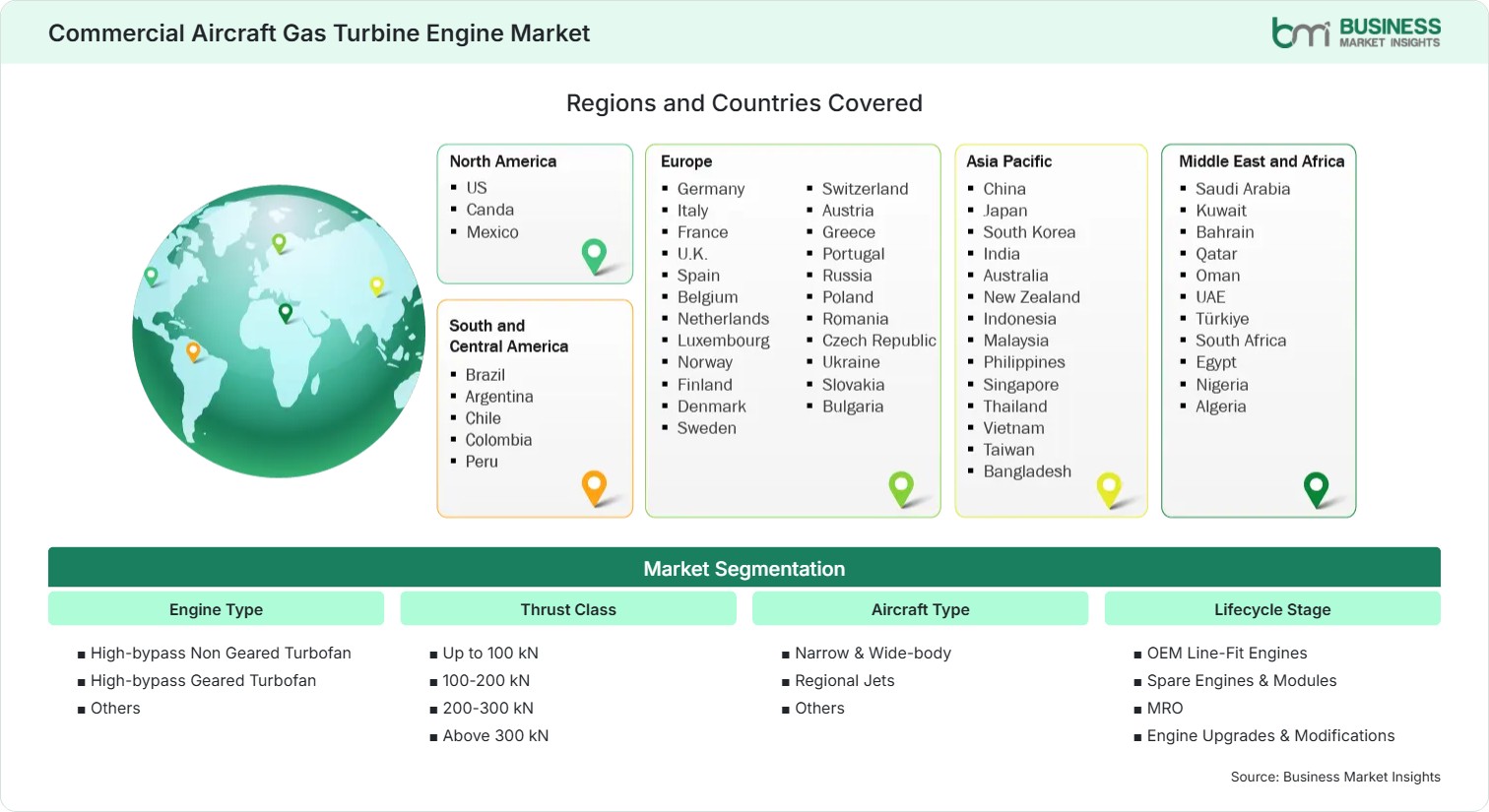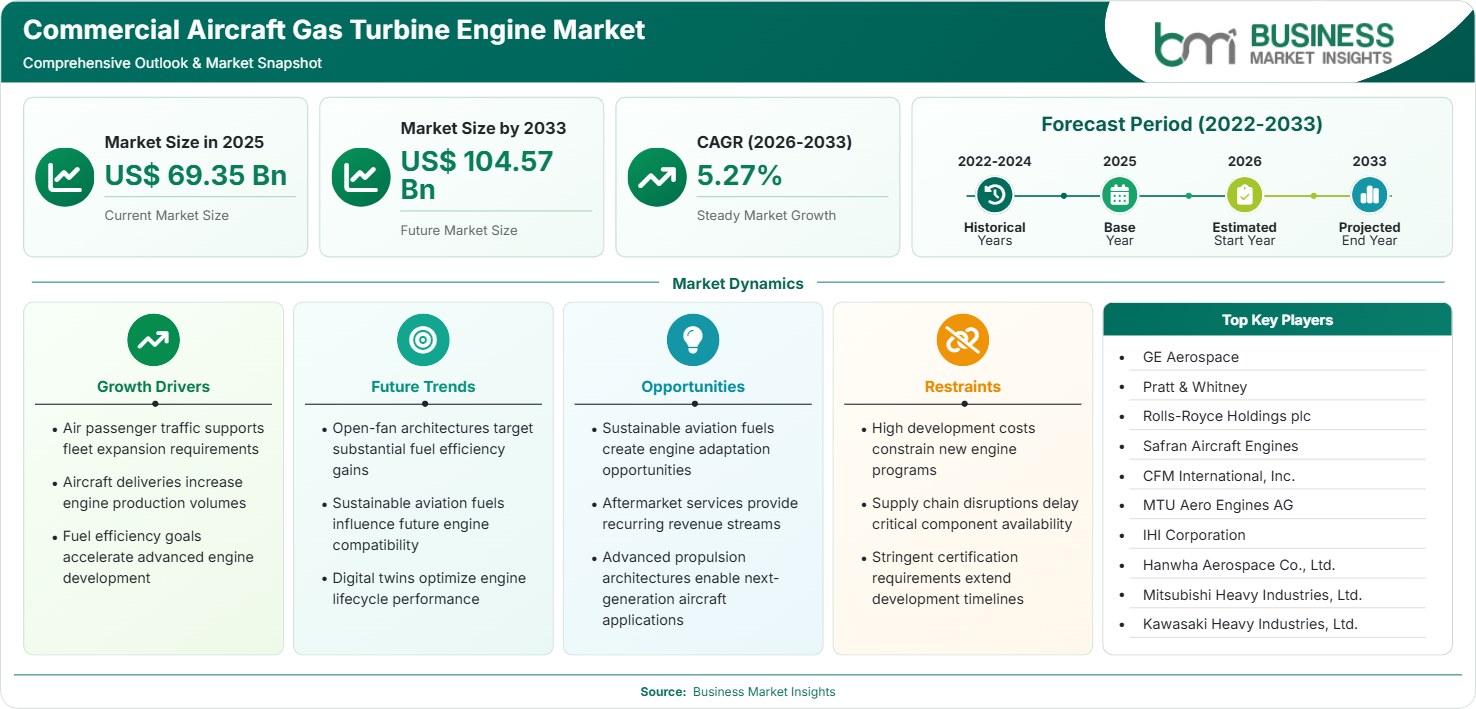
Commercial Aircraft Gas Turbine Engine Market Regional Highlights
North America Commercial Aircraft Gas Turbine Engine Market
North America represented 30%–33% of 2025 revenue and is projected to grow at 4.5%–5.0% CAGR through 2033. The region benefits from mature airline fleets, established aerospace manufacturing clusters, strong MRO capabilities, and substantial replacement demand. The US dominates regional activity because major airlines operate large narrowbody and widebody fleets while domestic manufacturers maintain extensive propulsion portfolios. Commercial aviation recovery, fleet modernization, and demand for higher-efficiency engines sustain the region's Commercial Aircraft Gas Turbine Engine Market share. North American engine demand also benefits from established leasing and aftermarket ecosystems.
- Fleet renewal remains central as airlines replace older CFM56 and legacy turbofan platforms with newer, more fuel-efficient engines. This replacement cycle supports both OEM deliveries and long-term aftermarket contracts across major operators.
- The region's mature aerospace supply chain provides manufacturers with advanced casting, forging, machining, composite, software, and testing capabilities, allowing faster integration of new propulsion technologies.
- Engine availability remains a critical operating issue. IATA estimates that supply-chain disruptions cost airlines more than US$11 billion in 2025, including higher maintenance and engine leasing expenses.
- Digital engine health monitoring is gaining importance as operators seek predictive maintenance, improved dispatch reliability, and optimized shop visits across large commercial fleets.
US Commercial Aircraft Gas Turbine Engine Market
The US accounts for approximately 90%–93% of North America's regional engine demand and is projected to expand at 4.4%–4.9% CAGR during 2026–2033. The country combines leading engine OEMs, major airlines, advanced manufacturing infrastructure, extensive MRO networks, and sophisticated certification capabilities. Large installed fleets generate recurring aftermarket revenue while new aircraft programs sustain OEM demand. The US market also serves as a technology development center for advanced materials, digital propulsion systems, hybrid-electric demonstrators, and next-generation commercial engine architectures. These capabilities strengthen the country's long-term competitive position.
- Major airlines continue placing large engine commitments for narrowbody and widebody fleets, strengthening visibility for engine manufacturers and their aftermarket organizations.
- GE Aerospace's commercial engine deliveries increased 43% year over year in the first quarter of 2026, reflecting improving production throughput and strong customer demand.
- Pratt & Whitney continues expanding the GTF ecosystem, with more than 14,000 orders and commitments reported by July 2026, reinforcing the country's position in geared propulsion.
Europe Commercial Aircraft Gas Turbine Engine Market
Europe held approximately 23%–25% of global revenue in 2025 and is projected to expand at 4.8%–5.4% CAGR through 2033. France, Germany, the UK, Spain, and Italy form important aerospace clusters covering engine design, component manufacturing, assembly, MRO, and research. France leads regional engine manufacturing through Safran and CFM programs, while the UK remains central to large-engine development through Rolls-Royce. Germany provides strong MRO and component capabilities, with MTU increasingly benefiting from commercial maintenance demand. Europe's Commercial Aircraft Gas Turbine Engine Market is closely linked to sustainability objectives and advanced propulsion research.
- France remains a major propulsion hub because Safran participates in high-volume LEAP production and advanced technology development. Safran delivered 1,802 LEAP engines in 2025, representing 28% growth from 2024.
- Germany is strengthening its aftermarket position, with MTU reporting commercial maintenance revenue growth of 21% during the first half of 2026.
- The UK maintains a strong position in high-thrust propulsion. Rolls-Royce reported 638 large-engine orders in 2025 and an order book of 2,207 engines at year-end.
- Spain and Italy provide opportunities in MRO, component manufacturing, and engine partnerships as regional aviation demand expands.
Asia Pacific Commercial Aircraft Gas Turbine Engine Market
Asia Pacific accounted for approximately 36%–38% of global revenue in 2025 and is projected to expand at 6.0%–6.8% CAGR, making it the fastest-growing regional market. China, Japan, India, South Korea, Singapore, and Southeast Asia contribute to demand through fleet expansion, rising passenger traffic, aircraft replacement, and MRO development. India and Southeast Asia are particularly attractive for narrowbody engine demand because low-cost carriers continue expanding capacity. Asia Pacific's Commercial Aircraft Gas Turbine Engine Market growth is also supported by increasing engine partnerships and regional aerospace manufacturing capabilities.
- China represents a major long-term propulsion opportunity because fleet expansion and domestic aerospace ambitions are increasing demand for engine technologies, component manufacturing, and lifecycle services.
- India is developing into an important engine demand center as airlines expand fleets and airports support higher passenger volumes. Fleet growth also increases requirements for spare engines and MRO capacity.
- Japan contributes specialized engine engineering through participation in international programs, including the PW1100G-JM, Trent, and other turbofan platforms. IHI supplies major engine components and participates in development programs.
- Singapore and other Southeast Asian aviation hubs offer attractive MRO opportunities because their geographic positions support engine servicing for regional and international airline fleets.
Rest of World Commercial Aircraft Gas Turbine Engine Market
Rest of World comprises around 7%–10% of the global market in 2025 and is estimated to register a 5.5%–6.5% CAGR through 2033. The regions of South & Central America benefit from fleet modernization and growing connectivity, whereas the Middle East invests in developing aviation hubs, long-range aircraft, and airlines. Gulf airlines drive the demand for high-thrust engines, while the Latin American airlines drive the market toward narrowbody engine systems. The regional Commercial Aircraft Gas Turbine Engine Market remains smaller than the major aviation regions but offers attractive aftermarket potential.
- The Middle East is a high-value market because Gulf airlines operate large widebody fleets and maintain strong long-haul connectivity, creating demand for high-thrust engines, spare engines, and long-term service agreements.
- Saudi Arabia and the United Arab Emirates provide significant investment opportunities as aviation strategies encourage fleet expansion, new airline development, airport investment, and aerospace ecosystem localization.
- Brazil remains the leading Latin American aerospace manufacturing base and offers opportunities in regional aircraft propulsion, components, MRO, and advanced manufacturing.
- Mexico benefits from proximity to the North American aerospace supply chain, supporting component manufacturing, maintenance activity, and supplier diversification.