
Turboprop Engine Market Outlook: Size, Share, Trends, Growth Analysis, Competitive Landscape & Forecast, 2026-2033

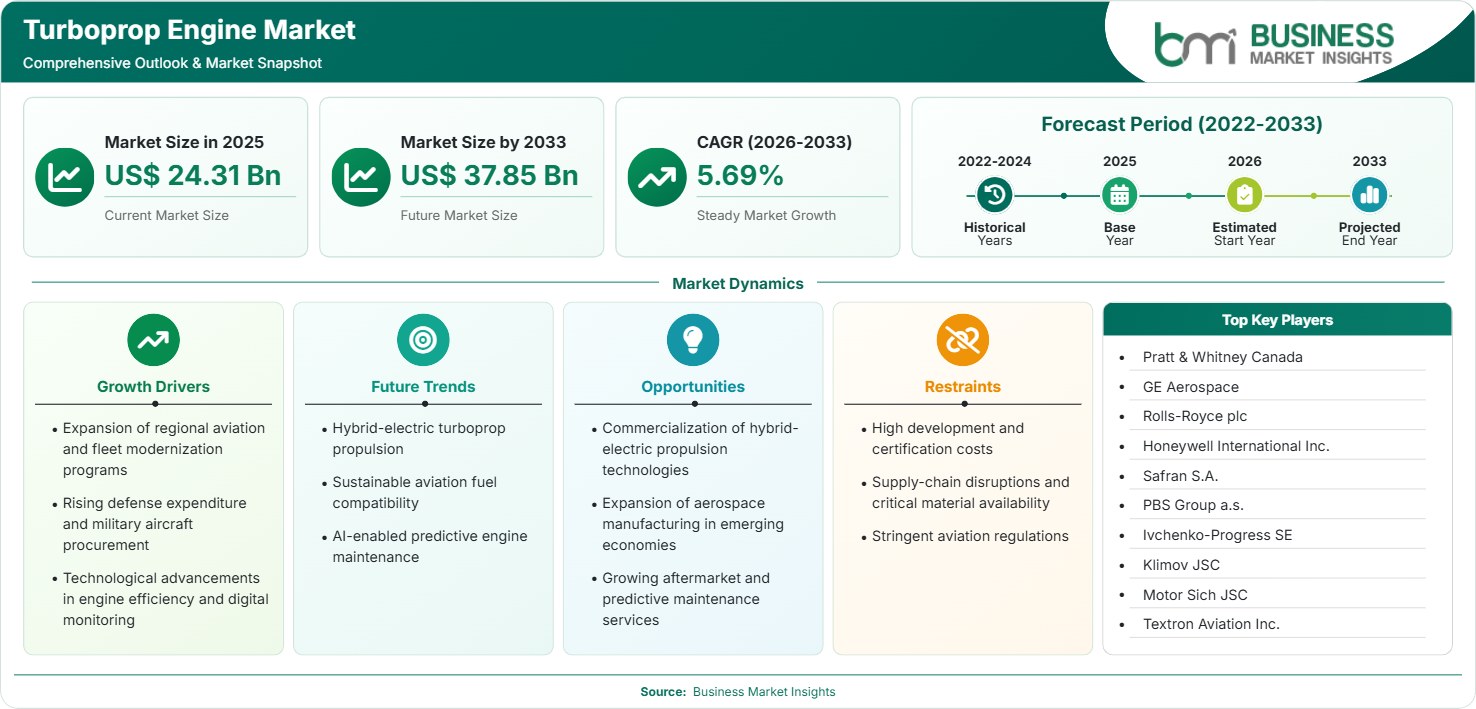
The Turboprop Engine Market size was valued at USD 24.31 billion in 2025 and is projected to reach USD 37.85 billion by 2033, growing at a CAGR of 5.69% during 2026–2033, driven by rising demand for regional air connectivity, military fleet modernization, fuel-efficient propulsion technologies, and hybrid-electric aircraft development continue to strengthen long-term industry expansion while creating opportunities across commercial, defense, and advanced aviation applications.

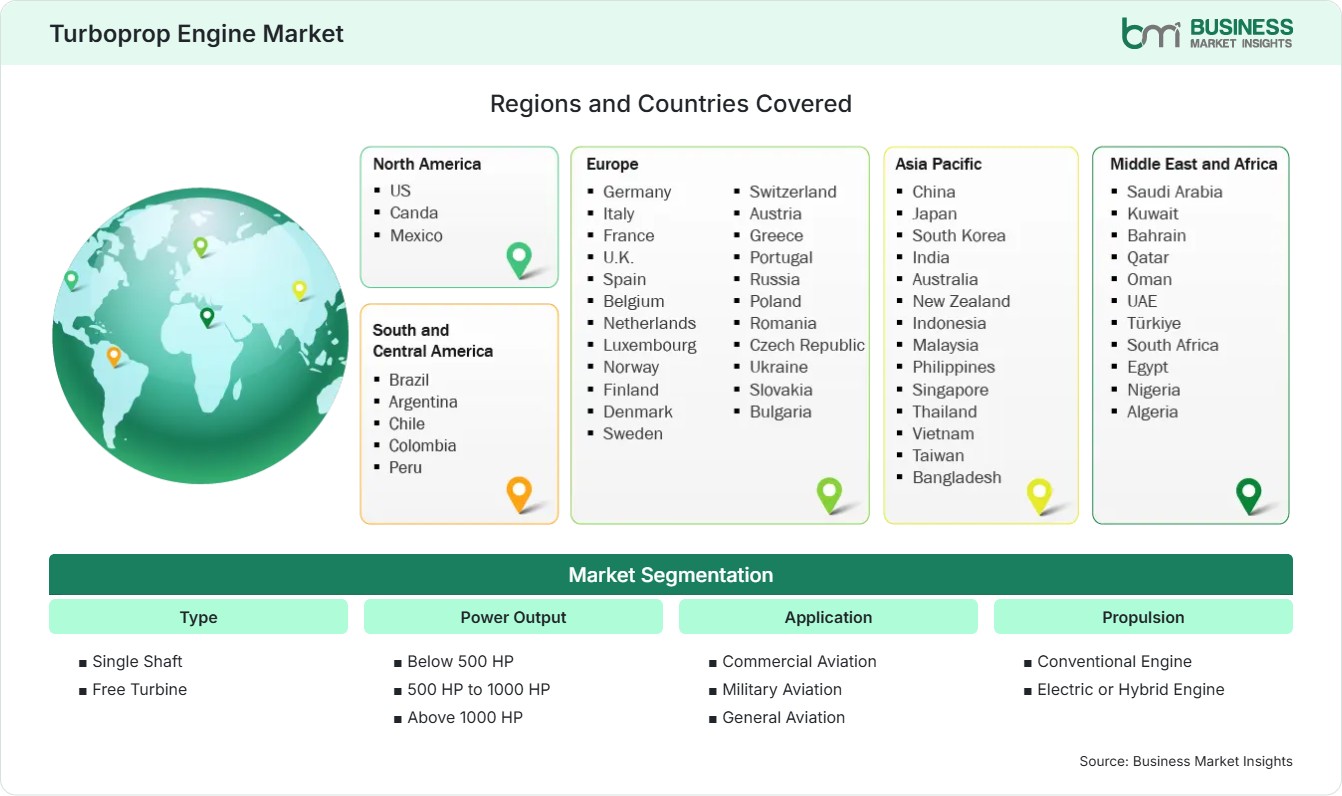
Report Coverage
  • Type: Single Shaft, Free Turbine
  • Power Output: Below 500 HP, 500 HP to 1000 HP, Above 1000 HP
  • Application: Commercial Aviation, Military Aviation, General Aviation
  • Propulsion: Conventional Engine, Electric or Hybrid Engine
US$ 24.31 Bn Market size in 2025
US$ 37.85 Bn Market Size by 2033
5.69% CAGR, 2026 - 2033
2026-2033 Forecast Period

AI Overview

Turboprop Engine Market Summary

North America Region: North America accounts for approximately 34%–37% market share in 2025 and is anticipated to register a CAGR of 5.2%–5.6% during 2026–2033. Demand is supported by defense modernization and sustained investments in sustainable aviation propulsion technologies. The United States remains the regional leader, supported by strong aerospace manufacturing capacity, expanding defense procurement, and an estimated 5.3%–5.7% CAGR through 2033.

Fastest Growing Region: Asia Pacific holds nearly 25%–28% of the Turboprop Engine market share in 2025 and is projected to expand at a CAGR of 6.3%–6.8% between 2026 and 2033. Rising domestic aircraft production, increasing regional airline connectivity, military modernization programs, and government investments in aerospace manufacturing continue creating significant long-term opportunities across emerging aviation economies.

Leading Segment: Commercial Aviation represents approximately 44%–47% market share in 2025 while advancing at a CAGR of 5.5%–5.9% during 2026–2033. Fleet replacement initiatives, growing demand for short-haul regional transportation, lower operating costs, and improved fuel efficiency continue supporting adoption among regional carriers and aircraft manufacturers.

High Growth Segment: Electric or Hybrid Engine propulsion contributes nearly 12%–15% market share in 2025 while recording a CAGR of 8.6%–9.2% during 2026–2033. Technological innovation and next-generation aircraft development continue accelerating commercialization opportunities across civil and defense aviation.

Key Market Opportunity: Increasing commercialization of hybrid-electric propulsion systems, regional aircraft replacement programs, and government-backed sustainable aviation initiatives are creating attractive opportunities for engine manufacturers, component suppliers, technology developers, and aerospace system integrators worldwide.

Major Market Players: Pratt & Whitney Canada, GE Aerospace, Rolls-Royce plc, Honeywell International Inc., Safran S.A., PBS Group a.s., Ivchenko-Progress SE, Klimov JSC, Motor Sich JSC, and Textron Aviation Inc.

Strategic Insights

Turboprop Engine Market: Strategic Insights

Turboprop Engine Market Strategic Framework
FREE PDF
Request your free sample
Request free sample
Stakeholder View

Key Takeaways

  • The industry value chain is increasingly integrating digital engineering, advanced metallurgy, precision component manufacturing, and predictive maintenance services, strengthening collaboration among OEMs, suppliers, MRO providers, and aircraft manufacturers while improving lifecycle cost efficiency.
  • Regional commercial aviation continues offering the strongest long-term revenue opportunity as airlines replace aging fleets with fuel-efficient aircraft capable of serving underserved airports and shorter routes with lower operating costs.
  • Innovation is shifting toward hybrid-electric propulsion, digital engine health monitoring, additive manufacturing, and lightweight turbine materials that improve thermal efficiency, durability, maintenance intervals, and environmental performance across future aircraft platforms.
  • Asia Pacific presents one of the most attractive investment destinations due to expanding domestic aircraft production, government aerospace incentives, rising passenger traffic, defense procurement programs, and rapidly developing regional aviation infrastructure.
  • Strategic collaborations, technology licensing agreements, acquisitions of propulsion technology specialists, and increased investment in sustainable aviation research are strengthening competitive positioning.
  • Increasing demand for dual-use propulsion platforms capable of serving both civil and military applications is encouraging manufacturers to diversify product portfolios while expanding long-term aftermarket service contracts and global maintenance networks.
Geographic Outlook

Turboprop Engine Market Regional Highlights

North America Turboprop Engine Market

North America accounted for approximately 34%–37% of the global market in 2025 and is projected to expand at a CAGR of 5.2%–5.6% through 2033. The Turboprop Engine Market share in the region is supported by an established aerospace manufacturing ecosystem, high defense expenditure, and continuous replacement of aging regional aircraft.

  • Leading engine manufacturers continue investing in lightweight turbine materials, digital engine controls, and predictive maintenance technologies, improving operational efficiency while reducing lifecycle costs for regional airlines and defense operators.
  • Military modernization programs across the United States and Canada continue generating demand for reliable propulsion systems supporting tactical transport aircraft and special mission aviation with improved endurance and payload capability.
  • Regional airlines continue replacing older turboprop fleets with fuel-efficient aircraft capable of serving secondary airports, supporting operational flexibility and expanding passenger connectivity across underserved domestic routes.
  • Strong aerospace supply chains, advanced manufacturing infrastructure, and government-backed research initiatives accelerate commercialization of hybrid propulsion technologies while encouraging collaboration between OEMs, suppliers, and research institutions.
  • Expanding maintenance, repair, and overhaul facilities enhance aftermarket revenue opportunities while supporting fleet availability, operational reliability, and long-term service contracts across commercial and military operators.

US Turboprop Engine Market

The United States represents nearly 27%–30% of the global Turboprop Engine market in 2025 and is anticipated to register a CAGR of 5.3%–5.7% during the forecast period. Strong OEM presence and increasing adoption of digital maintenance technologies further support long-term industry expansion.

  • Federal investments in aerospace innovation continue encouraging development of sustainable aviation technologies, hybrid propulsion systems, and next-generation engine components supporting commercial and defense aviation applications.
  • Growing regional passenger traffic and expanding essential air service programs continue increasing demand for efficient aircraft operating on short-distance routes with lower operating costs and improved dispatch reliability.
  • Strong collaboration between aerospace manufacturers, universities, and technology companies accelerates innovation in additive manufacturing, lightweight materials, and intelligent engine diagnostics for future propulsion systems.
  • A mature maintenance ecosystem enables operators to maximize engine performance, extend service intervals, and reduce lifecycle costs through predictive maintenance and advanced digital monitoring solutions.

Europe Turboprop Engine Market

Europe held approximately 27%–30% of the turboprop engine market share in 2025 and is expected to record a CAGR of 5.4%–5.8% during 2026–2033. Regional growth is driven by sustainable aviation initiatives, established aircraft manufacturing capabilities, and modernization of military transport fleets.

  • European aerospace manufacturers continue prioritizing lower-emission propulsion technologies through collaborative research programs focused on hybrid-electric systems and sustainable aviation objectives.
  • Regional airlines increasingly deploy fuel-efficient turboprop aircraft on short-haul routes where operational economics outperform comparable regional jet operations.
  • Defense procurement initiatives across several European countries continue supporting demand for tactical transport aircraft.
  • Expansion of aerospace component manufacturing facilities strengthens regional supply chains while supporting export opportunities across commercial and military aviation markets.
  • Government funding for aviation decarbonization and research partnerships accelerates commercialization of innovative propulsion technologies throughout the European aerospace ecosystem.

Asia Pacific Turboprop Engine Market

Asia Pacific accounted for approximately 25%–28% of global revenue in 2025 and is projected to grow at a CAGR of 6.3%–6.8%, making it the fastest-growing regional market. Rising domestic aircraft manufacturing, expanding regional airline networks, increasing defense procurement, and favorable government aerospace policies continue driving Turboprop Engine Market growth throughout the region. China leads regional demand, while India records the highest projected growth rate.

  • Growing passenger traffic across developing economies encourages airlines to expand regional connectivity using fuel-efficient turboprop aircraft serving shorter and lower-density routes.
  • Domestic aerospace manufacturing initiatives in China, India, and Southeast Asia strengthen local production capabilities while reducing dependence on imported aviation technologies.
  • Defense modernization programs increase procurement of transport, maritime patrol, and surveillance aircraft requiring reliable high-performance turboprop propulsion systems.
  • Public investment in airport infrastructure and regional aviation development supports long-term fleet expansion while improving connectivity across remote and geographically challenging regions.
  • Increasing partnerships between international engine manufacturers and domestic aerospace companies facilitate technology transfer, localized production, and aftermarket service expansion.

Rest of World Turboprop Engine Market

The Rest of World region accounted for nearly 9%–11% market share in 2025 and is forecast to expand at a CAGR of 5.8%–6.2% through 2033.

South and Central America continue benefiting from expanding regional airline operations, particularly in countries with dispersed populations where turboprop aircraft offer operational advantages.

  • Brazil remains the largest regional market owing to its established aerospace manufacturing base, while Saudi Arabia demonstrates one of the fastest growth rates through aviation diversification initiatives.
  • Fleet modernization programs among regional airlines improve fuel efficiency and reduce maintenance costs while expanding connectivity to remote airports with limited infrastructure.
  • Increasing government investments in defense aviation support procurement of transport and surveillance aircraft equipped with modern turboprop propulsion systems.
  • Infrastructure development, tourism growth, and humanitarian aviation missions continue supporting sustained demand for versatile aircraft capable of operating efficiently under diverse environmental conditions.
  • Expansion of maintenance and overhaul capabilities across emerging aviation hubs improves fleet availability while creating additional aftermarket revenue opportunities for engine manufacturers and service providers.
Global Market Geography
FREE PDF
Request your free sample
Request free sample
Segment Analysis

Turboprop Engine Market Segmentation

Type

The Type segment represented a fundamental classification of propulsion architecture, supporting diverse aircraft performance requirements across commercial, military, and general aviation applications. This segment accounted for approximately 52%–55% market share in 2025 and is projected to expand at a CAGR of 5.5%–5.9% through 2033. The Turboprop Engine Market scope continues broadening as manufacturers optimize engine efficiency, reliability, maintenance intervals, and operational flexibility to address evolving aircraft platform requirements.

  • Single Shaft: Widely adopted in smaller regional and utility aircraft because of its compact design, simplified maintenance requirements, lower manufacturing costs, and dependable operational performance across commercial and general aviation missions.
  • Free Turbine: Increasingly preferred for higher-performance aircraft requiring superior torque characteristics, operational flexibility, and enhanced power transmission efficiency, particularly across military transport, special mission, and larger commercial aviation platforms.

Power Output

Power output classifications determine the compatibility of engines across different aircraft classes, from trainers to regional aircraft. The segment accounted for about 100% of propulsion demand across various power-rating categories in 2025, with the Above 1000 HP category having the highest share. On average, the segment is expected to exhibit a CAGR of 5.6%–6.0% through 2033 as aircraft manufacturers introduce more efficient propulsion systems to improve payload capability and fuel economy.

  • Below 500 HP: Commonly utilized in light aircraft, pilot training platforms, and utility aviation where affordability, lower fuel consumption, straightforward maintenance, and dependable short-distance operations remain primary purchasing considerations.
  • 500 HP to 1000 HP: Supports a broad range of commuter aircraft and specialized aviation applications by balancing fuel efficiency, payload capacity, operational reliability, and lifecycle economics for regional operators.
  • Above 1000 HP: Dominates demand across commercial regional aircraft and military transport platforms because higher power ratings enable greater payload capacity, extended operating range, and improved performance under demanding environmental conditions.

Application

The Applications segment addresses the diverse needs of aviation operators in both the civil and defense sectors. It holds around 44%-47% of the market share in 2025 and is expected to grow at a CAGR of 5.5%-5.9% by 2033. Procurement policies remain affected by factors such as fleet modernization, regional air connectivity efforts, increased defense acquisitions, and demand for efficient aircraft. Turboprop Engine Market trends show ongoing investments in engines that deliver improved efficiency and life-cycle performance.

  • Commercial Aviation: This is the most important use, driven by the growing use of regional aircraft for short-haul flights, owing to the economic benefits of low operating costs and fuel efficiency.
  • Military Aviation: It gains from the increasing expenditure on tactical transport, maritime patrol, intelligence, surveillance, and reconnaissance, and humanitarian operations, which require engines that can perform under challenging environments.
  • General Aviation: It continues to grow in use across business aviation, pilot training, agriculture, air ambulance services, and other utility aircraft applications, where reliability, ease of maintenance, and operational versatility remain key considerations in purchase decisions.

Propulsion

The propulsion segment is undergoing technological changes as sustainable approaches affect airplane manufacturing. The segment is projected to grow at 5.8%–6.2% over the forecast period 2026-2033, as conventional propulsion systems maintain their dominance while hybrid systems are rapidly commercialized.

  • Conventional Engine: Will continue to lead in industry implementation due to its existing certification standards, maintenance capabilities, reliability of performance, and compatibility with existing regional, military, and utility planes around the world.
  • Electric or Hybrid Engine: Holds the highest development prospects in terms of improvements in batteries, distributed propulsion systems, sustainable aviation, and government-sponsored research projects aimed at minimizing fuel usage and CO2 emissions
Market Forces

Turboprop Engine Market Dynamics

Key Market Drivers

Expansion of regional aviation and fleet modernization programs

Growing demand for regional connectivity is accelerating investments in modern turboprop-powered aircraft capable of serving short-haul routes with lower operating costs than regional jets. According to the International Air Transport Association (IATA), passenger traffic continues to expand across emerging aviation markets, encouraging airlines to replace aging fleets with more fuel-efficient aircraft. The Turboprop Engine Market growth is further supported by government-backed regional connectivity initiatives, increasing aircraft utilization, and expanding airport infrastructure in developing economies.

Rising defense expenditure and military aircraft procurement

Defense modernization initiatives worldwide continue to increase demand for turboprop aircraft for transportation, surveillance, maritime patrol, and special missions. Many defense departments are showing a preference for aircraft that can operate from short, makeshift runways and have lower operating costs than jets. Countries forming part of the NATO alliance and some in Asia Pacific are investing in tactical air mobility and intelligence capabilities, which help in the acquisition of new-generation engine propulsion systems. The engine manufacturers are increasing their production capacity and incorporating digital engine control technology.

Technological advancements in engine efficiency and digital monitoring

Innovations in advanced materials used in turbine construction, additive manufacturing, predictive maintenance, and full-authority digital engine control systems have significantly improved propulsion efficiency in both the commercial and defense aviation sectors. Manufacturers have developed lightweight turbine parts that increase thermal efficiency while minimizing maintenance needs. The use of digital monitoring systems enables the prediction of component wear, reduces unnecessary maintenance, and thus improves operational efficiency.

Key Market Opportunities

Commercialization of hybrid-electric propulsion technologies

Sustainability goals are spurring aerospace companies into advancing hybrid-electric propulsion systems for regional aircraft. Government grants, aviation decarbonization plans, and collaboration between engine manufacturers and technology suppliers create a favorable business development environment. According to the Turboprop Engine Market Forecasts, hybrid propulsion will become more viable as battery density grows and the certification process evolves. The first applications of hybrid technology in regional aviation and in demonstrator programs will bring revenue to propulsion system manufacturers, component suppliers, software companies, and maintenance service providers over the next decade.

Expansion of aerospace manufacturing in emerging economies

Countries in Asia-Pacific, the Middle East, and certain Latin American nations will continue to reinforce their domestic aerospace industries through industrial policies, incentives to attract foreign investment, and technology collaborations. Increasing local aircraft assembling operations, supplier localization schemes, and growing maintenance capacity will increase the need for state-of-the-art propulsion technologies. For engine makers, establishing regional production facilities and technical collaborations is a way to make the supply chain more resilient, reduce delivery times, and foster customer relationships. These developments also create opportunities for localized aftermarket services and component manufacturing.

Growing aftermarket and predictive maintenance services

The rise in the number of turboprop aircraft globally presents many possibilities beyond sales of OEM equipment. Airlines and military organizations are focusing on long-term maintenance contracts, digital health management systems, optimized spare parts, and performance analysis to enhance aircraft availability. The use of predictive maintenance systems powered by artificial intelligence and sensor technology helps in achieving preventive maintenance while reducing operational downtime. As aircraft usage rises, aftermarket services will contribute more to the business's total revenues.

Market Restraints and Challenges

High development and certification costs

Factor: Development of next-generation propulsion systems requires extensive engineering validation, testing, regulatory certification, and long product development cycles. Impact: These requirements substantially increase capital expenditure for manufacturers while delaying commercial introduction of innovative engine technologies. Smaller suppliers often face financial barriers to entering the market, limiting competitive diversity and slowing adoption of breakthrough propulsion concepts.

Supply-chain disruptions and critical material availability

Factor: Aerospace manufacturers depend on specialized alloys, precision components, semiconductor electronics, and highly qualified suppliers operating within tightly regulated production networks. Impact: Disruptions affecting raw materials, machining capacity, or logistics can delay engine production, increase procurement costs, and extend aircraft delivery schedules. Persistent supply-chain constraints also reduce manufacturing flexibility, pressure profit margins, and create inventory challenges for OEMs, maintenance providers, and airline operators seeking timely fleet expansion and modernization.

Company Analysis

Competitive Landscape

The competitive landscape is fairly consolidated, and the market includes aerospace propulsion companies that compete through technological innovation, after-service operations, fuel efficiency, and partnerships. According to the Turboprop Engine Market analysis, there is a trend among companies to concentrate on digital engine management and overhaul (MRO) networks to strengthen long-term competitiveness.

Company Name

Overview

Products and Services Relevant to this Market

Pratt & Whitney Canada

Leading aircraft engine manufacturer with a strong global installed base across commercial, business, and special mission aviation.

PT6A and PW100 engine families, aftermarket support, digital engine services, MRO solutions, fleet lifecycle management.

GE Aerospace

Global aerospace technology company delivering commercial and defense propulsion systems with extensive engineering and manufacturing expertise.

Turboprop propulsion technologies, engine components, digital diagnostics, maintenance solutions, engineering support, and aviation services.

Rolls-Royce plc

International aerospace company focused on advanced propulsion technologies and integrated power systems for civil and defense aviation.

Turboprop engines, propulsion integration, digital monitoring, lifecycle support, and advanced aerospace engineering services.

Honeywell International Inc.

Diversified aerospace technology provider specializing in propulsion systems, avionics, and connected aircraft solutions.

Turbine engines, avionics integration, auxiliary power systems, maintenance services, and predictive analytics platforms.

Safran S.A.

Major aerospace manufacturer with capabilities spanning propulsion, aircraft equipment, and advanced aerospace technologies.

Engine systems, propulsion components, aircraft equipment, aftermarket support, and digital maintenance solutions.

PBS Group a.s.

European engineering company recognized for compact turbine engine technologies serving specialized aviation applications.

Small turboprop engines, auxiliary propulsion systems, engineering support, and customized aerospace solutions.

Ivchenko-Progress SE

Aircraft engine design organization specializing in propulsion development for transport, utility, and special mission aircraft.

Turboprop engine design, engineering development, modernization programs, and propulsion technology services.

Klimov JSC

Aerospace engine developer with expertise in military and civil aircraft propulsion technologies.

Aircraft engines, propulsion engineering, modernization services, technical support, and maintenance programs.

Motor Sich JSC

Established aircraft engine manufacturer supplying propulsion systems for commercial, military, and industrial applications.

Turboprop engines, repair services, overhaul capabilities, spare parts, and technical support solutions.

Textron Aviation Inc.

Global aircraft manufacturer integrating advanced propulsion technologies across business, utility, and special mission aircraft.

Turboprop aircraft platforms, aircraft integration, customer support, maintenance programs, and operational services.

Industry Activity

Recent Developments

April 2026

Pratt & Whitney Canada launched PT6C-67C and PW127XT maintenance, repair and overhaul (MRO) services in Singapore, expanding aftermarket support for regional turboprop and helicopter operators across Asia-Pacific.

September 2025

Pratt & Whitney Canada selected by Clean Aviation to lead the PHARES consortium, marking the first Canadian-led Clean Aviation program focused on hybrid-electric propulsion for future regional aircraft.

June 2025

Pratt & Whitney Canada and ATR announced collaboration to advance next-generation regional turboprop propulsion technologies, targeting improved fuel efficiency, sustainability, and lower operating costs.

June 2025

Pratt & Whitney Canada achieved a full-power milestone in its hybrid-electric flight demonstrator program, supporting the development of future regional hybrid-electric aircraft propulsion systems.

Trust & Transparency

Research Methodology

The market analysis combines proprietary research with secondary data from government agencies, company disclosures, regulatory filings, industry databases and expert interviews. Market estimates are validated through data triangulation, cross-market benchmarking and analyst review.

View Full Research Methodology

Questions Answered

Frequently Asked Questions

What technologies are shaping future market competition?

Hybrid-electric propulsion, lightweight composite materials, additive manufacturing, digital engine control systems, predictive maintenance, artificial intelligence-based diagnostics, and sustainable aviation technologies are expected to define future competitive differentiation.

Which companies are major participants in the Turboprop Engine Market Report?

Major participants include Pratt & Whitney Canada, GE Aerospace, Rolls-Royce plc, Honeywell International Inc., Safran S.A., PBS Group a.s., Ivchenko-Progress SE, Klimov JSC, Motor Sich JSC, and Textron Aviation Inc.

Which application segment dominates the market?

Commercial aviation represents the leading application because turboprop aircraft provide lower operating costs, better fuel efficiency, and superior performance on short-distance regional routes compared with larger jet-powered alternatives.

Which region is expected to lead market growth?

Asia Pacific is projected to record the fastest growth owing to expanding domestic aircraft manufacturing, increasing passenger traffic, government aerospace initiatives, and rising defense modernization investments, while North America maintains the largest overall market share.

What is driving demand in the Turboprop Engine Market?

Demand is primarily supported by regional airline expansion, fleet modernization, military aircraft procurement, improved fuel efficiency, and increasing investments in sustainable propulsion technologies, particularly for short-haul and remote-area aviation operations.

Access the Full Turboprop Engine Market Report

Get segment-level forecasts, regional estimates, competitive benchmarking, company profiles and downloadable Excel datasets.

Access the full Turboprop Engine Market Report
350 pages PDF & Excel | 2026-08-03
Similar Research

Related Market Reports