
Turboprop Aircraft Market Outlook: Size, Share, Trends, Growth Analysis, Competitive Landscape & Forecast, 2022-2033

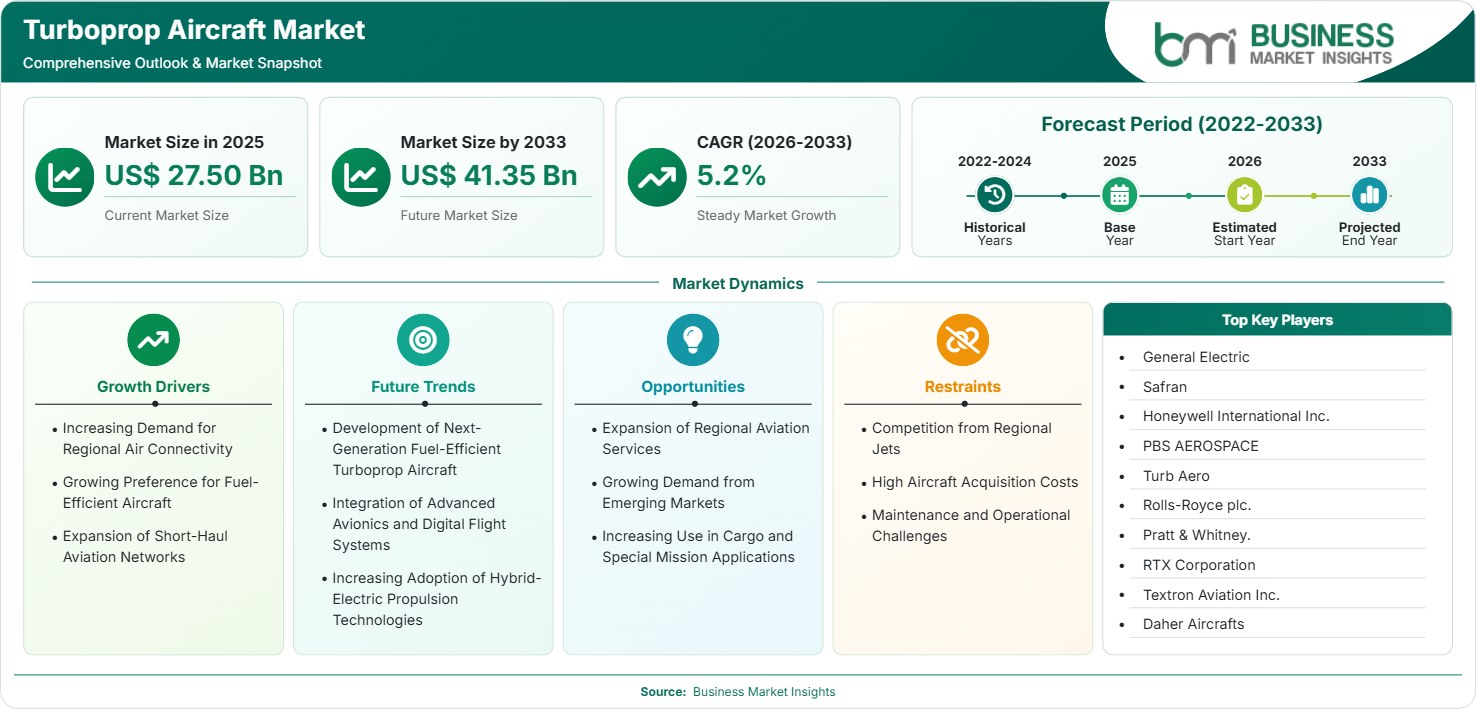
The Turboprop Aircraft Market size was valued at US$ 27.50 billion in 2025 and is projected to reach US$ 41.35 billion by 2033, growing at a CAGR of 5.2% during 2026–2033, driven by increasing regional connectivity, fuel-efficient aircraft adoption, short-haul aviation expansion, and rising demand for specialized transport operations.

Report Coverage
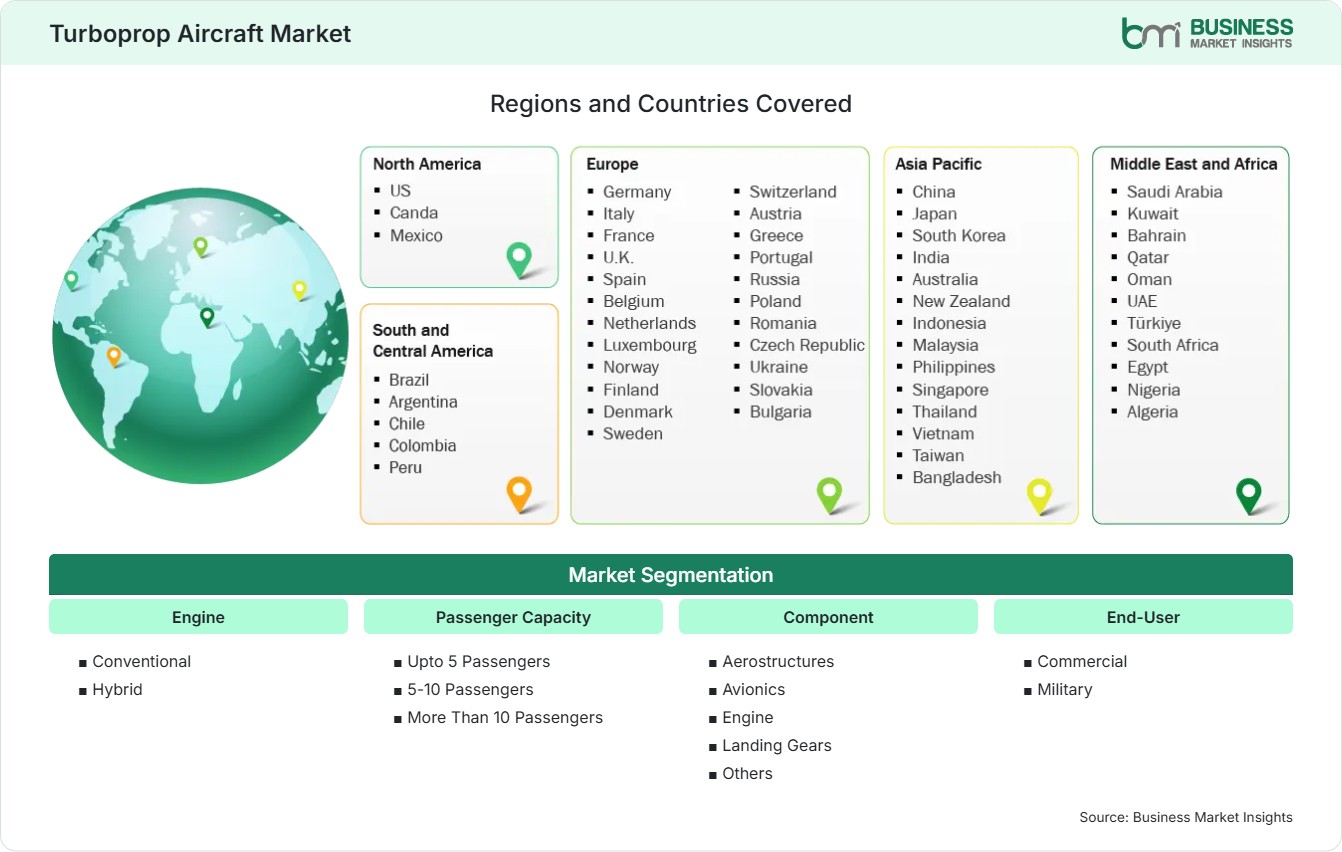
  • Engine: Conventional, Hybrid
  • Passenger Capacity: Upto 5 Passengers, 5-10 Passengers, More Than 10 Passengers
  • Component: Aerostructures, Avionics, Engine, Landing Gears, Others
  • End-User: Commercial, Military
  • Point of Sale: New, Pre-owned
US$ 27.50 Bn Market size in 2025
US$ 41.35 Bn Market Size by 2033
5.2% CAGR, 2026 - 2033
2026-2033 Forecast Period

AI Overview

Turboprop Aircraft Market Summary

  • North America Region: North America holds a 34%–38% share in 2025, expanding at a CAGR of 4.8%–5.2% during 2026–2033, supported by regional aviation networks, fleet modernization, and demand for efficient aircraft operations. The US market analysis indicates growth at a CAGR of 4.9%–5.3% between 2026 and 2033, driven by replacement of aging regional fleets and increased connectivity requirements.
  • Fastest Growing Region: Asia Pacific accounts for a 24%–28% share in 2025, recording a CAGR of 5.8%–6.3% during 2026–2033, supported by expanding regional air routes, emerging aviation markets, infrastructure development, and increasing demand for economical short-distance air transportation.
  • Leading Segment: Conventional Engine aircraft represent a 82%–86% share in 2025, growing at a CAGR of 4.8%–5.2% during 2026–2033, driven by established technology, operational reliability, lower maintenance complexity, and widespread adoption among commercial and military operators.
  • High Growth Segment: Hybrid Engine aircraft demonstrate a 5%–8% share in 2025, advancing at a CAGR of 8.0%–8.5% during 2026–2033, supported by sustainable aviation initiatives, emissions reduction targets, and research into next-generation propulsion systems.
  • Key Market Opportunity: Expansion of regional aviation services, emerging market connectivity, and increasing cargo and special mission applications create opportunities through advanced propulsion systems, fleet upgrades, and multipurpose aircraft utilization.
  • Major Market Players: General Electric, Safran, Honeywell International Inc., PBS Aerospace, TurbAero, Rolls-Royce plc., Pratt & Whitney, RTX Corporation, Textron Aviation Inc., and Daher Aircraft.
Strategic Insights

Turboprop Aircraft Market: Strategic Insights

Turboprop Aircraft Market Strategic Framework
FREE PDF
Request your free sample
Request free sample
Stakeholder View

Key Takeaways

  • The turboprop aircraft ecosystem is evolving toward more efficient propulsion technologies, with manufacturers focusing on improved fuel economy, reduced emissions, and enhanced operational performance to maintain competitiveness.
  • Regional passenger aviation remains a core growth area, while cargo transport, military operations, and special mission applications provide additional opportunities for aircraft manufacturers and component suppliers.
  • Hybrid propulsion development is becoming a major innovation direction as aviation companies explore technologies that reduce fuel consumption and support future sustainability targets.
  • Asia Pacific represents a strong investment opportunity due to increasing regional connectivity requirements, expanding airport infrastructure, and growing demand from emerging aviation economies.
  • Strategic collaborations between aircraft manufacturers, engine developers, and technology providers are increasing as companies seek to accelerate next-generation aircraft development and improve market positioning.
  • Pre-owned aircraft demand continues supporting market flexibility by enabling smaller operators and emerging airlines to expand fleets with lower acquisition costs.
Geographic Outlook

Turboprop Aircraft Market Regional Highlights

North America Turboprop Aircraft Market

North America accounted for 34%–38% of the global market in 2025 and is projected to expand at a CAGR of 4.8%–5.2% during 2026–2033. The Turboprop Aircraft Market share in the region is supported by established regional aviation networks, replacement of aging aircraft fleets, and continued demand for economical short-haul transportation. Operators are prioritizing aircraft with lower operating costs, flexible airport accessibility, and improved fuel efficiency to support regional connectivity.

  • The United States remains the largest regional contributor due to extensive commuter aviation networks, fleet modernization programs, and strong demand for regional passenger transportation.
  • Canada is supporting market expansion through remote area connectivity requirements, where turboprop aircraft provide efficient access to geographically dispersed communities.
  • Commercial operators are increasingly adopting newer turboprop models offering improved avionics, enhanced passenger comfort, and reduced maintenance requirements.
  • Military and government agencies continue utilizing turboprop platforms for surveillance, training, transport, and specialized operational missions.
  • Regional airport development programs are strengthening demand for aircraft capable of operating efficiently from smaller airfields.

US Turboprop Aircraft Market

The United States represented 30%–34% of the global market in 2025 and is expected to register a CAGR of 4.9%–5.3% during 2026–2033. The country maintains a strong turboprop aircraft market trend is supported by regional airlines, business aviation operators, defense organizations, and aircraft manufacturers. Fleet replacement initiatives and demand for cost-efficient regional operations continue driving adoption.

  • Regional airlines are upgrading fleets with modern turboprop aircraft to improve route profitability and operational efficiency.
  • Business aviation operators are adopting turboprop aircraft for flexible travel requirements, particularly across shorter domestic routes.
  • Defense applications continue generating demand for specialized turboprop aircraft used in surveillance, logistics, and training operations.
  • Aircraft manufacturers are investing in advanced avionics and propulsion improvements to strengthen competitiveness in domestic aviation markets.

Europe Turboprop Aircraft Market

Europe accounted for 22%–25% of the market in 2025 and is anticipated to expand at a CAGR of 4.7%–5.1% through 2026–2033. The region benefits from strong regional connectivity networks, replacement demand for aging fleets, and sustainability-focused aviation policies. France, Germany, and the United Kingdom remain key markets, while Eastern European countries are experiencing increased adoption due to expanding domestic connectivity requirements.

  • France maintains a strong position through aircraft manufacturing capabilities and regional aviation demand across domestic and international routes.
  • Germany is increasing adoption through business aviation, regional transport requirements, and aviation technology development initiatives.
  • The United Kingdom continues supporting demand through regional airport connectivity and specialized aviation operations.
  • Eastern European markets are experiencing growth as governments improve regional mobility and aviation infrastructure.
  • Sustainability regulations are encouraging operators to evaluate efficient propulsion technologies and lower-emission aircraft solutions.

Asia Pacific Turboprop Aircraft Market

Asia Pacific held a 24%–28% share in 2025 and is projected to record the highest CAGR of 5.8%–6.3% during 2026–2033. The region represents the fastest-growing market due to expanding domestic aviation networks, rising passenger mobility, and increasing investment in regional airports. The Turboprop Aircraft Market growth is supported by emerging aviation economies including China and India, where short-haul connectivity remains a priority.

  • China is expanding regional aviation infrastructure and supporting aircraft adoption for domestic connectivity and regional transport applications.
  • India represents a high-growth market due to government-supported regional air connectivity programs and increasing demand for smaller aircraft.
  • Southeast Asian countries are adopting turboprop aircraft to connect island regions and underserved communities.
  • Growing tourism activity is increasing demand for economical regional air transportation solutions across emerging markets.
  • Cargo operators are exploring turboprop platforms for efficient short-distance freight transportation and logistics operations.

Rest of World Turboprop Aircraft Market

The rest of the world accounted for 12%–15% of the Turboprop Aircraft market in 2025 and is expected to grow at a CAGR of 5.0%–5.5% during 2026–2033. South America, Middle East, and Africa are creating opportunities through regional aviation expansion, remote connectivity requirements, and specialized aircraft applications. Brazil represents the leading South American market, while Middle Eastern and African countries are investing in improved air mobility infrastructure.

Brazil continues supporting market demand through domestic aviation networks, regional connectivity needs, and commercial aviation operations. African markets are increasingly adopting turboprop aircraft market for remote transportation, humanitarian missions, and regional passenger services.

  • Brazil remains a key market due to extensive regional routes and demand for economical aircraft operations.
  • African nations are increasing turboprop adoption to improve connectivity between remote and underserved communities.
  • Middle Eastern operators are utilizing aircraft for specialized missions, government operations, and regional transport requirements.
  • Latin American airlines are upgrading fleets to improve operational efficiency and reduce short-haul transportation costs.
  • Remote infrastructure development continues creating opportunities for versatile aircraft platforms capable of operating in challenging environments.
Global Market Geography
FREE PDF
Request your free sample
Request free sample
Segment Analysis

Turboprop Aircraft Market Segmentation

Engine

Engine segment is a critical factor influencing aircraft efficiency, operating economics, and future aviation development. Conventional Engine aircraft dominated the market with a 82%–86% share in 2025 and are projected to grow at a CAGR of 4.8%–5.2% during 2026–2033. The segment benefits from proven reliability, established maintenance infrastructure, and widespread adoption across commercial and defense aviation applications.

  • Conventional: Remains the preferred propulsion technology due to operational reliability, lower maintenance complexity, established supply chains, and extensive global deployment across regional aircraft fleets.
  • Hybrid: Emerging as an advanced propulsion solution focused on reducing fuel consumption and emissions through electric assistance, improved efficiency, and next-generation aircraft development initiatives.

Passenger Capacity

Passenger capacity influences aircraft selection based on route demand, operating economics, and connectivity requirements. Aircraft supporting more than 10 passengers represented the largest segment with a 62%–66% share in 2025 and are expected to grow at a CAGR of 5.0%–5.4% during the forecast period due to strong commercial aviation adoption.

  • Upto 5 Passengers: Used primarily for private aviation, utility transportation, and specialized operations requiring flexible mobility and access to smaller airports.
  • 5-10 Passengers: Preferred by business aviation operators and regional transport providers seeking economical aircraft solutions for shorter routes and limited passenger demand.
  • More Than 10 Passengers: Widely adopted by commercial airlines and regional operators due to higher passenger capacity, route efficiency, and suitability for scheduled aviation services.

Component

Component segment includes critical aircraft systems required for safe operation, performance improvement, and passenger comfort. The engine component category held the leading position with a 35%–39% share in 2025 and is projected to grow at a CAGR of 5.1%–5.5% during 2026–2033 due to continuous propulsion technology advancements.

  • Aerostructures: Demand is increasing due to lightweight material adoption, aerodynamic improvements, and aircraft efficiency enhancement initiatives supporting next-generation aircraft development.
  • Avionics: Growth is supported by digital cockpit upgrades, navigation improvements, safety requirements, and increasing adoption of advanced flight management systems.
  • Engine: Remains a key component category due to continuous demand for efficient propulsion systems, improved fuel performance, and lower operating costs.
  • Landing Gears: Adoption is supported by durability requirements, safety standards, and increasing aircraft modernization programs among commercial and specialized operators.

End-User

Commercial aviation accounted for the largest end-user share with 65%–69% in 2025 and is expected to expand at a CAGR of 5.1%–5.5% during 2026–2033. Regional airlines are increasingly adopting turboprop aircraft due to lower operating expenses, route flexibility, and suitability for short-distance transportation networks.

  • Commercial: Demand is driven by regional airlines, commuter services, and operators seeking economical aircraft solutions for connecting smaller cities and secondary airports.
  • Military: Adoption continues through surveillance, reconnaissance, transport, training, and special mission requirements requiring reliable aircraft performance in diverse operating environments.

Point of Sale

The new aircraft segment represented the dominant category with a 58%–62% share in 2025 and is forecast to grow at a CAGR of 5.3%–5.7% during 2026–2033. Rising fleet modernization activities, improved aircraft technologies, and demand for efficient propulsion systems are supporting new aircraft purchases.

  • New: Supported by airline fleet renewal programs, improved aircraft efficiency, advanced avionics integration, and manufacturer investments in next-generation platforms.
  • Pre-owned: Continues gaining traction among smaller operators due to lower acquisition costs, faster fleet expansion capabilities, and availability of proven aircraft models.
Market Forces

Turboprop Aircraft Market Dynamics

Key Market Drivers

Increasing Demand for Regional Air Connectivity

Growing regional air connectivity is leading to an increase in demand for turboprop aircraft market because governments, airlines, and operators are looking for affordable options for less connected routes. Some airports and remote regions may need aircraft that can fly economically using shorter runways and less airport infrastructure. The sector is experiencing growth due to greater investments in regional airline networks especially in developing nations where better connectivity helps foster economic growth. The turboprop aircraft market has an advantage in terms of lower fuel costs and routing options than larger aircraft. Airlines are opting for such platforms in order to make profits on short-haul flights.

Growing Preference for Fuel-Efficient Aircraft

High fuel prices and the need for sustainability are making it necessary for aircraft operators to consider efficient aircraft technologies in their operations. One of the benefits of turboprop aircraft is that they perform well in short-distance flights because they have low fuel consumption as opposed to regional jets that undertake the same route. Aircraft companies are improving technology through engine efficiency, lighter weight structures, and better aerodynamics. Operators are taking into consideration the performance of aircraft using life-cycle costs, maintenance, and flexibility of operation.

Expansion of Short-Haul Aviation Networks

The development of short-haul aviation networks is providing further openings for the use of turboprops in both the commercial and specialized aviation segments. Regional airlines are expanding their network connectivity by connecting smaller towns to big transport centers. Developing economies are building airport facilities and aviation-related operations to cater to domestic transport. These aircraft serve as an apt choice for such operations due to their economic operation in lesser demand flights. Cargo operations, government departments, and special missions are also using these aircraft in larger quantities.

Key Market Opportunities

Expansion of Regional Aviation Services

The increased development of regional aviation networks is providing an opportunity for aircraft manufacturers, operators, and maintenance companies because governments have started improving connectivity between small cities and important economic cities. Improvement in regional aviation is being provided through government airport development schemes, route development schemes, and aviation infrastructural development. There are several operational benefits that turboprop aircraft can provide to these sectors because of their ability to operate short haul flights at low costs. Air carriers are becoming increasingly inclined towards developing their regional aircraft fleet for improved efficiencies and access to underserved locations.

Growing Demand from Emerging Markets

Aviation infrastructure is being developed in countries across the Asia-Pacific region, Latin America, and Africa, enhancing movement and connectivity within the region. The turboprops offer an economical alternative to airlines looking to establish themselves in emerging markets where the volume of traffic might not warrant the use of large aircraft. Aircraft manufacturers are trying to target such emerging regions through localized support and financial partnership programs.

Increasing Use in Cargo and Special Mission Applications

The increased use of turboprop airplanes for cargo transport, surveillance, medevacs, and governmental operations is opening up business opportunities outside of passenger flights. Turboprop aircraft market forecast offers operational efficiency, reduced fuel costs, and the capability of reaching remote locations that lack basic facilities. More logistics firms are now incorporating turboprops in their fleets in order to perform regional cargo operations where road transport may not be as fast or efficient. Specialized airplanes are also being used by defense and security organizations for surveillance, patrolling, and other emergency tasks.

Market Restraints and Challenges

Competition from Regional Jets

Factor: Regional jets continue competing with turboprop aircraft by offering higher speed, longer range capabilities, and improved passenger perception for certain commercial routes.

Impact: Competition from regional jets can limit turboprop adoption among airlines operating higher-demand routes where travel time reduction is a key purchasing factor. Although turboprops maintain advantages in fuel efficiency and short-route economics, operators may select regional jets for markets requiring faster connections and greater passenger capacity. Aircraft manufacturers must continue improving performance, cabin comfort, and operational efficiency to maintain competitiveness. Advancements in propulsion systems, noise reduction technologies, and passenger experience improvements are becoming important strategies for strengthening the position of turboprop aircraft in regional aviation markets.

High Aircraft Acquisition Costs

Factor: New turboprop aircraft require significant capital investment due to advanced engineering, certification requirements, specialized components, and manufacturing complexity.

Impact: High acquisition costs can restrict fleet expansion among smaller airlines, operators, and aviation service providers with limited financial resources. Financing availability and aircraft leasing options become important factors influencing purchasing decisions, particularly in emerging markets. Manufacturers are addressing this challenge through flexible financing programs, maintenance support packages, and improved lifecycle cost management. However, upfront investment remains a key barrier for potential buyers evaluating fleet modernization. Increased availability of pre-owned aircraft provides an alternative pathway for operators seeking lower-cost fleet expansion solutions.

Company Analysis

Competitive Landscape

The Turboprop Aircraft Market analysis highlights a competitive environment shaped by aircraft manufacturers, engine developers, and aerospace technology companies focusing on propulsion innovation, fleet modernization, regional expansion, and sustainable aviation solutions. Leading companies are investing in advanced engines, improved aircraft designs, and specialized mission capabilities to strengthen their market positions.

Company Name

Overview

Products and Services Relevant to this Market

General Electric

Global aerospace company providing advanced aviation technologies and propulsion systems.

Turboprop engine technologies, aerospace systems, and aircraft propulsion solutions.

Safran

International aerospace company specializing in aircraft systems and engines.

Propulsion systems, aircraft components, avionics, and aerospace technologies.

Honeywell International Inc.

Technology company supplying aerospace systems and aviation solutions.

Avionics, flight systems, navigation technologies, and aircraft equipment.

PBS Aerospace

Aerospace manufacturer focused on aircraft engines and propulsion technologies.

Turboprop engines, auxiliary power units, and aerospace propulsion products.

TurbAero

Aerospace company developing next-generation turboprop engine technologies.

Advanced turboprop propulsion systems for aviation applications.

Rolls-Royce plc.

Global aerospace company producing aircraft propulsion technologies.

Aircraft engines, propulsion systems, and aviation support services.

Pratt & Whitney

Aerospace manufacturer specializing in aircraft engines and propulsion solutions.

Regional aircraft engines, maintenance services, and propulsion technologies.

RTX Corporation

Aerospace and defense company providing aviation technologies.

Aircraft systems, propulsion technologies, and aerospace components.

Textron Aviation Inc.

Aircraft manufacturer producing business and utility aircraft.

Turboprop aircraft, aviation services, and aircraft support solutions.

Daher Aircraft

Aerospace manufacturer specializing in general aviation aircraft.

Turboprop aircraft platforms, aircraft manufacturing, and support services.

Industry Activity

Recent Developments

June 2026

Honeywell International Inc. announced its aerospace business growth strategy, including continued investment in aerospace technologies and operational capabilities as part of its planned Honeywell Aerospace standalone business structure. Honeywell remains a key turboprop engine and aviation systems supplier through platforms such as the TPE331 engine family.

April 2026

Daher Aircraft Company delivered the 1,300th aircraft from its TBM turboprop family, marking a major production milestone for its TBM 900-series aircraft. The company highlighted continued global demand for TBM aircraft among private aviation, business aviation, and utility operators.

January 2026

Textron Aviation Inc. reported increased commercial turboprop aircraft activity, with higher deliveries of Cessna Caravan and other turboprop aircraft contributing to improved segment performance. The company highlighted continued demand for its commercial turboprop portfolio.

June 2025

RTX Corporation (Pratt & Whitney Canada) announced a collaboration with ATR to advance next-generation propulsion technologies for regional turboprop aircraft. The partnership focuses on improving fuel efficiency, durability, operating economics, and future low-emission turboprop solutions, including technologies supporting ATR’s future aircraft concepts.

Trust & Transparency

Research Methodology

The market analysis combines proprietary research with secondary data from government agencies, company disclosures, regulatory filings, industry databases and expert interviews. Market estimates are validated through data triangulation, cross-market benchmarking and analyst review.

View Full Research Methodology

Questions Answered

Frequently Asked Questions

What does the Turboprop Aircraft Market Report include?

The Report covers market size, segmentation, regional analysis, competitive landscape, technological developments, growth drivers, opportunities, restraints, and forecast trends through 2033.

What role do hybrid engines play in future turboprop aircraft development?

Hybrid engines are gaining attention as manufacturers explore technologies that improve fuel efficiency, reduce emissions, and support sustainable aviation goals through electric-assisted propulsion and advanced energy management systems.

Why are airlines choosing turboprop aircraft over other aircraft types?

Airlines prefer turboprop aircraft for short-distance routes because of lower fuel consumption, reduced operating costs, shorter runway capability, and improved economic performance on routes with moderate passenger demand.

Which region holds the largest share of the market?

North America represents the largest regional market due to established aviation infrastructure, strong regional airline networks, aircraft replacement programs, and continued demand for cost-efficient transportation solutions.

What factors are driving the growth of the Turboprop Aircraft Market?

The market is driven by rising regional air connectivity demand, increasing preference for fuel-efficient aircraft, expansion of short-haul aviation networks, fleet modernization initiatives, and growing adoption of turboprop aircraft for commercial, cargo, and special mission applications.

Access the Full Turboprop Aircraft Market Report

Get segment-level forecasts, regional estimates, competitive benchmarking, company profiles and downloadable Excel datasets.

Access the full Turboprop Aircraft Market Report
350 pages PDF & Excel | 2026-08-06
Similar Research

Related Market Reports