
Scramjet Engine Market Outlook: Size, Share, Trends, Growth Analysis, Competitive Landscape & Forecast, 2026-2033

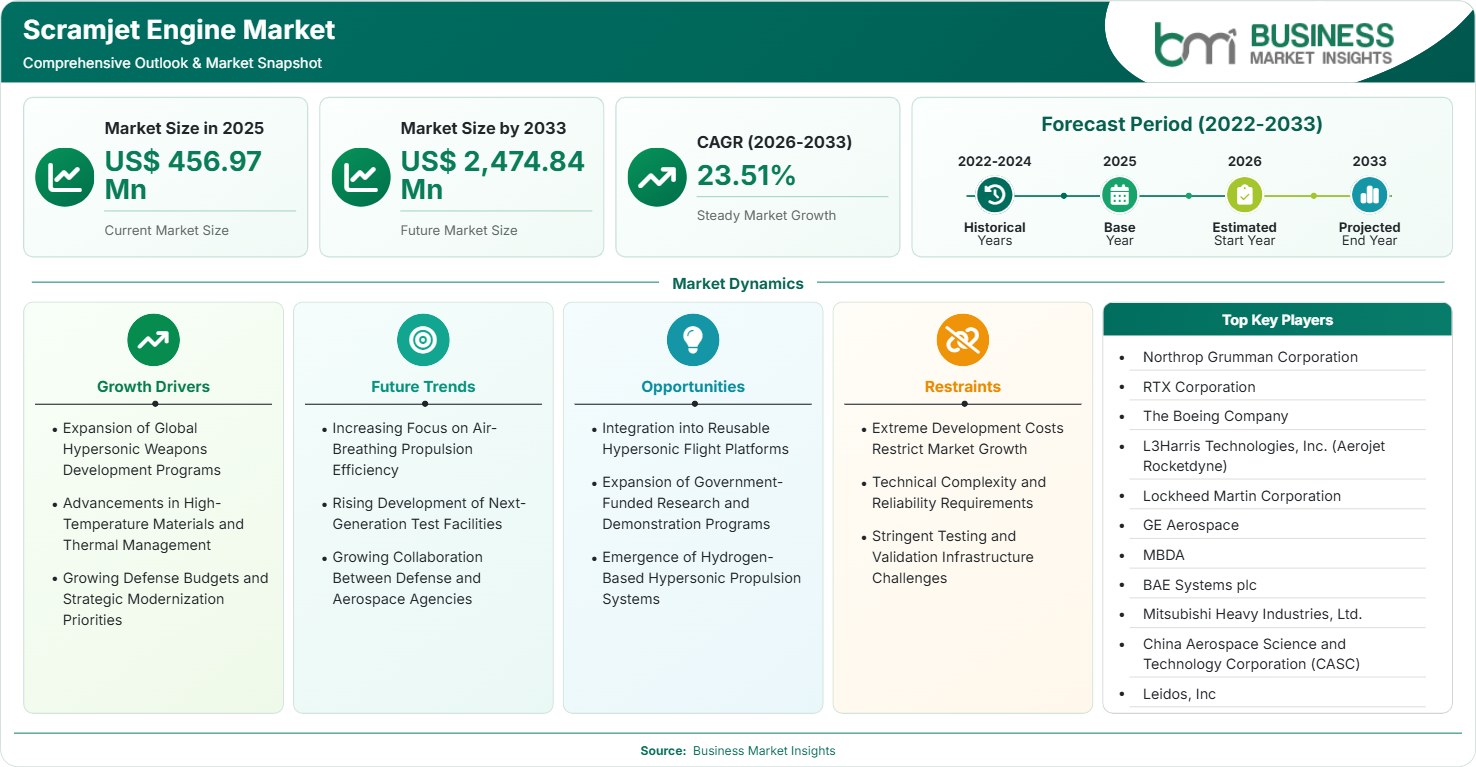
The Scramjet Engine Market size was valued at US$ 456.97 Million in 2025 and is projected to reach US$ 2474.84 Million by 2033, growing at a CAGR of 23.51% during 2026–2033. Rising hypersonic weapon development programs, and growing demand for high-speed propulsion technologies are creating substantial opportunities across military and aerospace applications worldwide.

Report Coverage
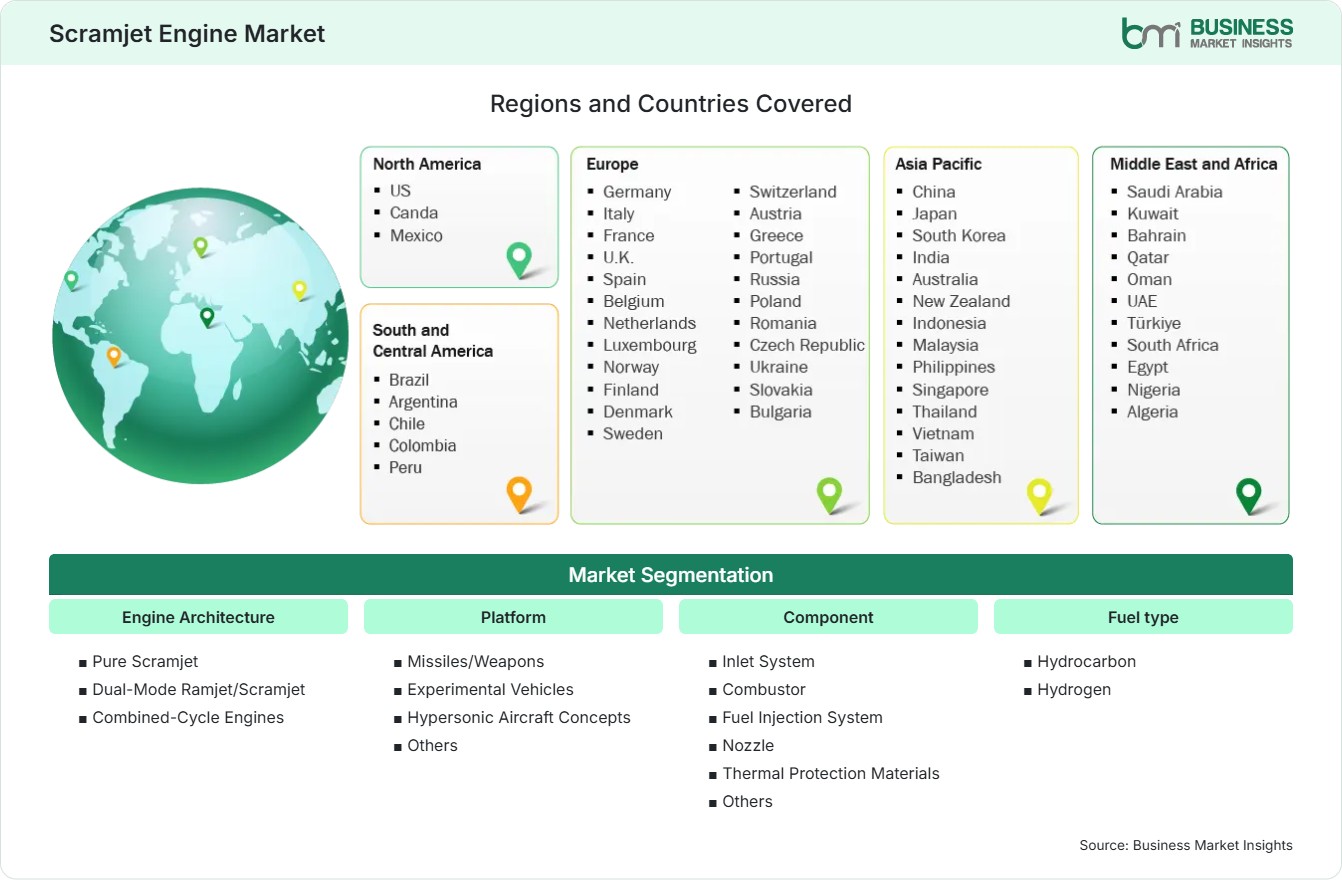
  • Engine Architecture: Pure Scramjet, Dual-Mode Ramjet/Scramjet, Combined-Cycle Engines
  • Platform: Missiles/Weapons, Experimental Vehicles, Hypersonic Aircraft Concepts, Others
  • Component: Inlet System, Combustor, Fuel Injection System, Nozzle, Thermal Protection Materials, Others
  • Fuel type: Hydrocarbon, Hydrogen
  • Application: Defense strike, Research & demonstration, Others
US$ 456.97 Mn Market size in 2025
US$ 2,474.84 Mn Market Size by 2033
23.51% CAGR, 2026 - 2033
2026-2033 Forecast Period

AI Overview

Scramjet Engine Market Summary

  • North America Region: North America holds a market share of 38%–42% in 2025, growing at a CAGR of 22%–24% during 2026–2033. Strong defense procurement, and agencies continue accelerating commercial and defense-oriented technology advancement. The U.S. dominates regional demand through sustained hypersonic weapon investments and advanced propulsion demonstrations, expanding at approximately 23%–25% CAGR.
  • Fastest Growing Region: Asia Pacific accounts for 24%–28% market share in 2025 and is projected to expand at a CAGR of 25%–28% during 2026–2033. Rising defense expenditure, indigenous missile development programs, and accelerating hypersonic technology demonstrations are supporting rapid adoption across strategic applications.
  • Leading Segment: Missiles/Weapons represents 48%–52% share in 2025 and advances at a CAGR of 23%–25% during 2026–2033. Increasing deployment requirements, long-range strike modernization programs, and continuous propulsion efficiency improvements are driving substantial procurement and technology development activities globally.
  • High Growth Segment: Hydrogen Fuel Type captures 18%–22% share in 2025 and is expected to register a CAGR of 27%–30% during 2026–2033. Superior combustion characteristics, higher theoretical performance potential, and next-generation hypersonic vehicle development programs continue encouraging technology investments.
  • Key Market Opportunity: Growing integration of hypersonic propulsion systems into reusable flight platforms creates opportunities for advanced testing programs, strategic partnerships, propulsion innovation, dual-use aerospace applications, and long-term commercialization initiatives.
  • Major Market Players: Northrop Grumman Corporation, RTX Corporation, The Boeing Company, L3Harris Technologies, Inc. (Aerojet Rocketdyne), Lockheed Martin Corporation, GE Aerospace, MBDA, BAE Systems plc, Mitsubishi Heavy Industries, Ltd., China Aerospace Science and Technology Corporation (CASC), and Leidos, Inc.
Strategic Insights

Scramjet Engine Market: Strategic Insights

Scramjet Engine Market Strategic Framework
FREE PDF
Request your free sample
Request free sample
Stakeholder View

Key Takeaways

  • Industry value chain continues to be very concentrated among propulsion developers, high-tech materials, defense integrators, testing centers, and government organizations.
  • Commercial gains are primarily coming from hypersonic weapon systems and advancements in defense systems.
  • Innovations are largely centered around dual-mode ramjet and scramjet engines, advanced fuel management systems, digital simulations, and thermal protection materials.
  • Asia-Pacific region provides a strong opportunity for investments with governments in the region enhancing their aerospace capabilities, increasing defense budget spending and conducting testing of systems.
  • Defense funded agreements and technology partnerships continue to influence competitive dynamics.
  • Supply chain strength has become a key competitive advantage as companies are looking for robust supply of high-temperature materials and testing capability.
Geographic Outlook

Scramjet Engine Market Regional Highlights

North America Scramjet Engine Market

North America accounted for approximately 38%–42% of global revenue in 2025 and is projected to expand at a CAGR of 22%–24% through 2033. The area receives high defense spending, developed aerospace facilities, well-developed propulsion research laboratories, and significant development projects for hypersonics. The Scramjet Engine Market share of the region is the highest worldwide owing to the continuous spending by military organizations and defense contractors.

  • The U.S. Department of Defense spends continually to develop hypersonic weapons and propulsion validation programs and develop testing facilities in the area.
  • Defense contractors spend increasingly in partnership with government laboratories in improving combustion efficiency and thermal protection systems.
  • Significant funding for strategic deterrence initiatives encourages procurement of next-generation propulsion systems capable of supporting long-range, high-speed mission requirements.

US Scramjet Engine Market

The United States Scramjet Engine Market represents approximately 78%–82% of North American demand and continues expanding at a CAGR of 23%–25% through 2033. Federal funding, availability of hypersonic testing facilities, and involvement of the top aerospace companies are additional aspects that enhance national leadership. An approach adopted by the state regarding the creation of an advanced strike force, missiles, and propulsion systems favors technology advancement.

  • Defense modernization projects continue to emphasize technologies that can perform hypersonically, making way for more investments in propulsion research and testing.
  • Government-sponsored research organizations continue to invest in combustion research and thermal management technologies aimed at increasing mission effectiveness.
  • Public-private partnerships strengthen collaboration between government laboratories, universities, and aerospace manufacturers working on next-generation propulsion concepts.

Europe Scramjet Engine Market

Europe Scramjet Engine Market held approximately 22%–26% of global revenue in 2025 and is expected to register a CAGR of 21%–24% through 2033. Growth drivers in this sector include growing efforts on defense cooperation programs, native missile development programs, and investment in aerospace research. France continues to dominate as the biggest market in terms of the strength of the missile manufacturing industry. The United Kingdom is set to register highest growth rates in the region.

  • France dominates the regional market thanks to its expertise in missile development programs, propulsion research, and involvement in collaborative defense projects.
  • The United Kingdom is set to record a compound annual growth rate of about 23%–25% supported by expanding investments in future combat and hypersonic technology initiatives.
  • European defense organizations are increasing research spending focused on advanced materials and high-temperature propulsion components.
  • Growing emphasis on strategic autonomy encourages domestic development of critical propulsion technologies and supporting manufacturing infrastructure.

Asia Pacific Scramjet Engine Market

Asia Pacific Scramjet Engine Market accounted for 24%–28% of global revenue in 2025 and is forecast to grow at a CAGR of 25%–28% through 2033, representing the fastest-growing regional market. Rising geopolitical competition, expanding aerospace manufacturing capacity, and increasing defense expenditure are driving demand.

  • China continues investing heavily in advanced missile systems, propulsion technologies, and aerospace research programs aimed at strengthening indigenous capabilities.
  • India is projected to record a CAGR of approximately 26%–29%, supported by national hypersonic technology demonstration efforts and domestic defense modernization priorities.
  • Regional governments are increasing funding for aerospace innovation, encouraging development of next-generation propulsion architectures and testing facilities.
  • Expanding manufacturing capabilities improve supply chain localization while supporting accelerated development of strategic defense technologies.
  • Strong emphasis on technological self-reliance is encouraging broader participation from domestic aerospace firms and research organizations.

Rest of World Scramjet Engine Market

The Rest of World region accounted for approximately 10%–14% of global revenue in 2025 and is expected to expand at a CAGR of 20%–23% through 2033. Growth is primarily supported by defense modernization initiatives across the Middle East and selected aerospace investments in South and Central America.

The nations in the Middle East region are more actively considering modern missile and aerospace technologies to enhance their national defense capabilities. Brazil emerges as the most active player in South and Central America, whereas Saudi Arabia emerges as an important new market in the Middle East and African regions. The growth forecast of the overall Scramjet Engine Market is still strong due to defense-related agreements.

  • The investments in sophisticated defense technologies by Saudi Arabia have provided scope for international collaboration as well as technology acquisition programs.
  • Brazil continues to be the top contributor in the field of aerospace technology in South and Central America due to its experience in aerospace engineering and technology.
  • Defense diversification programs in the Gulf countries have led to exploration in the domain of advanced propulsion technology.
  • International defense cooperation deals are providing access to research facilities as well as aerospace technology.
  • Gradual expansion of aerospace research programs across emerging economies supports long-term capability development and technology adoption.
Global Market Geography
FREE PDF
Request your free sample
Request free sample
Segment Analysis

Scramjet Engine Market Segmentation

Engine Architecture

Engine architecture represents the foundation of propulsion performance and operational flexibility across hypersonic platforms. This segment accounted for approximately 30%–34% market share in 2025 and is projected to expand at a CAGR of 23%–26% through 2033. Growing emphasis on combustion efficiency, sustained high-speed operation, and thermal management capabilities continues driving research and development investments.

  • Pure Scramjet: Designed for sustained hypersonic flight at extremely high velocities, these systems offer efficient combustion under supersonic airflow conditions and remain central to advanced missile and experimental vehicle development programs.
  • Dual-Mode Ramjet/Scramjet: Provides operational flexibility by transitioning between ramjet and scramjet modes, enabling broader flight envelopes and supporting evolving military requirements for long-range, high-speed applications.
  • Combined-Cycle Engines: Integrates multiple propulsion mechanisms within a single architecture, supporting acceleration across diverse speed regimes while improving mission versatility for future aerospace and defense platforms.

Platform

Platform deployment remains one of the most commercially significant categories within the industry, accounting for approximately 34%–38% market share in 2025 and advancing at a CAGR of 24%–26% through 2033. Expanding defense procurement initiatives, increasing demand for hypersonic strike capabilities, and government-backed technology demonstrations are supporting adoption.

  • Missiles/Weapons: The dominant deployment category, supported by growing military demand for rapid-response strike systems capable of overcoming conventional defense architectures and improving strategic deterrence effectiveness.
  • Experimental Vehicles: Widely utilized for propulsion validation, materials testing, and aerodynamic research, enabling governments and aerospace organizations to mature next-generation hypersonic technologies.
  • Hypersonic Aircraft Concepts: Receiving increasing attention as aerospace stakeholders evaluate future high-speed transportation and defense applications requiring advanced propulsion integration and thermal management capabilities.

Component

The component segment contributes substantially to overall industry value creation, accounting for approximately 16%–20% market share in 2025 and growing at a CAGR of 24%–27% through 2033. Continuous innovation across combustion systems, inlet designs, and thermal protection technologies remains essential for improving reliability and operational efficiency.

  • Inlet System: Critical for compressing incoming air efficiently before combustion, directly influencing engine performance, fuel efficiency, and operational stability during hypersonic flight.
  • Combustor: Serves as the primary energy-generation section where fuel-air mixing and combustion occur under challenging thermal and aerodynamic conditions.
  • Fuel Injection System: Enhances combustion efficiency through precise fuel delivery, supporting stable ignition and optimized performance across varying flight regimes.
  • Nozzle: Converts thermal energy into thrust while influencing propulsion efficiency, speed capability, and overall mission effectiveness.
  • Thermal Protection Materials: Increasingly important due to extreme temperatures encountered during hypersonic operation, helping safeguard structural integrity and improve operational durability.

Fuel type

Fuel selection significantly impacts propulsion efficiency, operational range, and future technology development strategies. This segment accounted for approximately 12%–16% market share in 2025 and is projected to register a CAGR of 25%–29% through 2033. Advancements in combustion science and fuel management technologies are encouraging evaluation of alternative fuels capable of enhancing performance while supporting evolving aerospace requirements.

  • Hydrocarbon: Remains the most widely adopted option due to established infrastructure, storage advantages, operational practicality, and compatibility with current defense-focused propulsion development programs.
  • Hydrogen: Emerging as the fastest-growing fuel category because of superior combustion properties, higher theoretical efficiency potential, and increasing interest in advanced aerospace propulsion research.

Application

Application-specific requirements continue shaping investment priorities, procurement strategies, and technology development pathways. The segment represented approximately 18%–22% market share in 2025 and is forecast to grow at a CAGR of 23%–26% through 2033.

  • Defense strike: The leading application area, driven by increasing demand for advanced long-range strike capabilities, rapid-response systems, and strategic deterrence modernization programs.
  • Research & demonstration: Supports technology validation, aerodynamic testing, propulsion optimization, and development of future operational platforms through government-funded experimental initiatives.

End User

End-user demand patterns are heavily influenced by defense procurement cycles, national security priorities, and long-term aerospace research programs. This segment accounted for approximately 20%–24% market share in 2025 and is expected to expand at a CAGR of 24%–27% through 2033. Procurement agencies, aerospace manufacturers, and specialized integrators continue investing in advanced propulsion capabilities to strengthen competitiveness and technological readiness across future high-speed flight applications.

  • Military & Defense: Represents the largest end-user category, supported by substantial investments in hypersonic weapons, strategic deterrence initiatives, and advanced propulsion deployment programs.
  • Government Agencies: Play a central role in funding research, conducting technology demonstrations, and supporting long-term propulsion innovation through national aerospace initiatives.
  • OEMs/Integrators: Increasingly involved in system integration, engineering development, component qualification, and commercialization efforts associated with advanced propulsion platforms.
Market Forces

Scramjet Engine Market Dynamics

Key Market Drivers

Expansion of Global Hypersonic Weapons Development Programs

The most influential growth catalyst for advanced hypersonic propulsion technologies is the accelerating pace of hypersonic weapons development across major defense powers. The United States, China, Russia, India, France, and several allied nations continue increasing investments in systems capable of operating above Mach 5. As strategic deterrence priorities evolve, the Scramjet Engine Market trends increasingly reflect demand for engines capable of delivering greater range, maneuverability, and survivability. Continuous flight-testing activities and technology demonstrations are further accelerating development cycles while supporting broader adoption across advanced defense platforms worldwide.

Advancements in High-Temperature Materials and Thermal Management

Hypersonic propulsion systems operate under extreme aerodynamic and thermal conditions, creating substantial demand for advanced materials capable of maintaining structural integrity during sustained high-speed flight. Progress in ceramic matrix composites, ultra-high-temperature ceramics, advanced coatings, and thermal barrier technologies is improving operational reliability while reducing performance degradation. Research organizations, aerospace manufacturers, and government laboratories are expanding efforts to develop materials capable of withstanding temperatures exceeding several thousand degrees Celsius during atmospheric flight. Improved thermal protection systems are enabling longer mission durations and greater operational flexibility.

Growing Defense Budgets and Strategic Modernization Priorities

Defense modernization remains a primary factor supporting sustained industry expansion. Governments increasingly view hypersonic capabilities as critical components of future defense architectures due to their speed, maneuverability, and strategic deterrence value. The resulting procurement programs are creating stable demand for propulsion development, testing infrastructure, and supporting subsystems. The Scramjet Engine Market growth outlook is strongly linked to these modernization efforts, particularly across North America and Asia Pacific. As geopolitical competition intensifies, defense agencies are expected to maintain long-term investment commitments that support continued technological advancement and industrial capacity expansion.

Key Market Opportunities

Integration into Reusable Hypersonic Flight Platforms

Reusable hypersonic vehicles represent one of the most promising future opportunities for propulsion developers. Governments and aerospace organizations are increasingly evaluating reusable architectures capable of reducing operational costs while improving mission flexibility. Advanced scramjet-powered systems may eventually support rapid-response defense missions, high-speed reconnaissance operations, and experimental aerospace transportation concepts. Emerging development programs across North America, Europe, and Asia Pacific are creating opportunities for propulsion manufacturers, materials specialists, and systems integrators seeking participation in future aerospace ecosystems supported by long-term Scramjet Engine Market Forecasts.

Expansion of Government-Funded Research and Demonstration Programs

National aerospace agencies and defense research organizations continue expanding investments in propulsion demonstration programs designed to accelerate technology readiness. Flight-testing campaigns, wind tunnel facilities, digital engineering initiatives, and advanced simulation platforms are receiving substantial public-sector funding. These programs help reduce technical risks while creating commercial opportunities for specialized suppliers and research partners. As governments seek to maintain technological leadership in hypersonic systems, funding for propulsion research is expected to remain robust, supporting broader participation from emerging suppliers and engineering organizations.

Emergence of Hydrogen-Based Hypersonic Propulsion Systems

Hydrogen is gaining attention as a strategic fuel option for future hypersonic propulsion concepts due to its favorable combustion characteristics and potential performance advantages. Ongoing aerospace research indicates that hydrogen can contribute to improved combustion efficiency and enhanced thermal management under specific operating conditions. Increasing global investment in hydrogen ecosystems is creating indirect benefits for propulsion innovation by encouraging advances in storage, handling, and fuel-system technologies. Aerospace developers are exploring how hydrogen-based propulsion architectures can support next-generation high-speed flight applications.

Market Restraints and Challenges

Extreme Development Costs Restrict Market Growth

Factor: The development of hypersonic propulsion technologies requires substantial financial resources, creating one of the industry's most significant barriers. Propulsion testing facilities, high-temperature materials research, computational modeling platforms, and flight demonstration programs demand considerable long-term investment commitments. Impact: These high development costs limit participation primarily to government-supported programs and large aerospace contractors with extensive resources. Smaller organizations often face challenges securing sufficient funding to compete effectively.

Technical Complexity and Reliability Requirements

Factor: Hypersonic propulsion systems must operate under exceptionally demanding conditions involving extreme temperatures, pressure variations, aerodynamic stresses, and combustion stability challenges. Achieving consistent performance across diverse operating environments remains a complex engineering task requiring extensive validation. Impact: Stringent qualification requirements increase testing durations, development costs, and certification timelines. Engine developers must conduct repeated ground and flight evaluations before technologies can be considered operationally reliable. Delays in testing schedules or performance validation can postpone deployment programs and increase project uncertainty.

Company Analysis

Competitive Landscape

The competitive environment remains concentrated among major aerospace and defense contractors possessing expertise in hypersonic propulsion, advanced materials, missile integration, and flight-testing infrastructure. Current Scramjet Engine Market analysis indicates that leading participants are prioritizing government-funded research contracts, strategic partnerships, digital engineering capabilities, and advanced manufacturing investments to strengthen their positions in emerging hypersonic ecosystems.

Company Name

Overview

Products and Services Relevant to This Market

Northrop Grumman Corporation

Major U.S. defense contractor with extensive expertise in advanced weapons, propulsion technologies, aerospace systems, and next-generation defense solutions.

Scramjet propulsion technologies, ramjet systems, hypersonic weapon development, advanced materials engineering, propulsion integration, and defense research services.

RTX Corporation

Global aerospace and defense technology provider with significant investments in air-breathing hypersonic propulsion and missile systems development.

Scramjet-powered hypersonic systems, missile technologies, propulsion components, guidance systems, and aerospace engineering solutions.

The Boeing Company

Leading aerospace manufacturer engaged in advanced defense programs, aerospace innovation, and future hypersonic flight technology initiatives.

Hypersonic research programs, aerospace platforms, propulsion integration support, flight testing, and advanced aerospace engineering services.

L3Harris Technologies, Inc. (Aerojet Rocketdyne)

Established propulsion specialist recognized for advanced rocket propulsion, defense technologies, and aerospace system development capabilities.

Scramjet propulsion research, propulsion subsystems, combustion technologies, missile propulsion solutions, and aerospace engineering services.

Lockheed Martin Corporation

Global defense leader actively involved in hypersonic technology development, advanced weapons integration, and strategic aerospace programs.

Hypersonic systems, missile integration, propulsion platform development, advanced defense technologies, and aerospace engineering solutions.

GE Aerospace

Aerospace technology company supporting advanced propulsion research, materials innovation, and future high-performance aerospace applications.

Advanced propulsion technologies, aerospace materials research, engineering services, and next-generation aerospace system development.

MBDA

European missile systems developer serving defense customers through advanced weapon technologies and multinational collaboration programs.

Missile systems, propulsion integration, defense engineering, advanced strike capabilities, and aerospace technology solutions.

BAE Systems plc

International defense and aerospace company supporting strategic technology development across air, land, maritime, and space domains.

Defense technologies, aerospace systems engineering, advanced materials research, and support for future hypersonic capabilities.

Mitsubishi Heavy Industries, Ltd.

Diversified engineering and aerospace company engaged in defense modernization and advanced aerospace technology development.

Aerospace engineering, propulsion research, defense technologies, advanced manufacturing, and strategic aerospace development programs.

China Aerospace Science and Technology Corporation (CASC)

Major Chinese aerospace organization involved in missile systems, launch technologies, and advanced propulsion research.

Hypersonic technology programs, propulsion research, missile development, aerospace engineering, and strategic defense technologies.

Leidos, Inc.

Technology and defense solutions provider supporting advanced aerospace research, hypersonic development, and engineering programs.

Hypersonic system development, digital engineering, testing services, propulsion research support, and defense technology integration.

Trust & Transparency

Research Methodology

The market analysis combines proprietary research with secondary data from government agencies, company disclosures, regulatory filings, industry databases and expert interviews. Market estimates are validated through data triangulation, cross-market benchmarking and analyst review.

View Full Research Methodology

Questions Answered

Frequently Asked Questions

What insights does a Scramjet Engine Market Report provide to stakeholders?

A comprehensive Market Report helps stakeholders evaluate technology trends, competitive positioning, and long-term commercialization prospects across the hypersonic propulsion ecosystem.

Which regions are investing most aggressively in hypersonic technologies?

North America currently leads investment activity through extensive defense programs and testing infrastructure.

How does hydrogen influence future propulsion development?

Hydrogen offers attractive combustion characteristics and high theoretical performance potential.

What technological challenge is most critical for propulsion developers?

Maintaining stable combustion at hypersonic speeds remains one of the most complex engineering challenges.

What are the primary applications driving demand for advanced hypersonic propulsion systems?

Defense strike platforms account for the majority of demand due to requirements for long-range precision engagement, rapid-response missions, and enhanced survivability..

Access the Full Scramjet Engine Market Report

Get segment-level forecasts, regional estimates, competitive benchmarking, company profiles and downloadable Excel datasets.

Access the full Scramjet Engine Market Report
350 pages PDF & Excel | 2026-08-27