
Fixed Wing Turbine Aircraft Market Outlook: Size, Share, Trends, Growth Analysis, Competitive Landscape & Forecast, 2026-2033

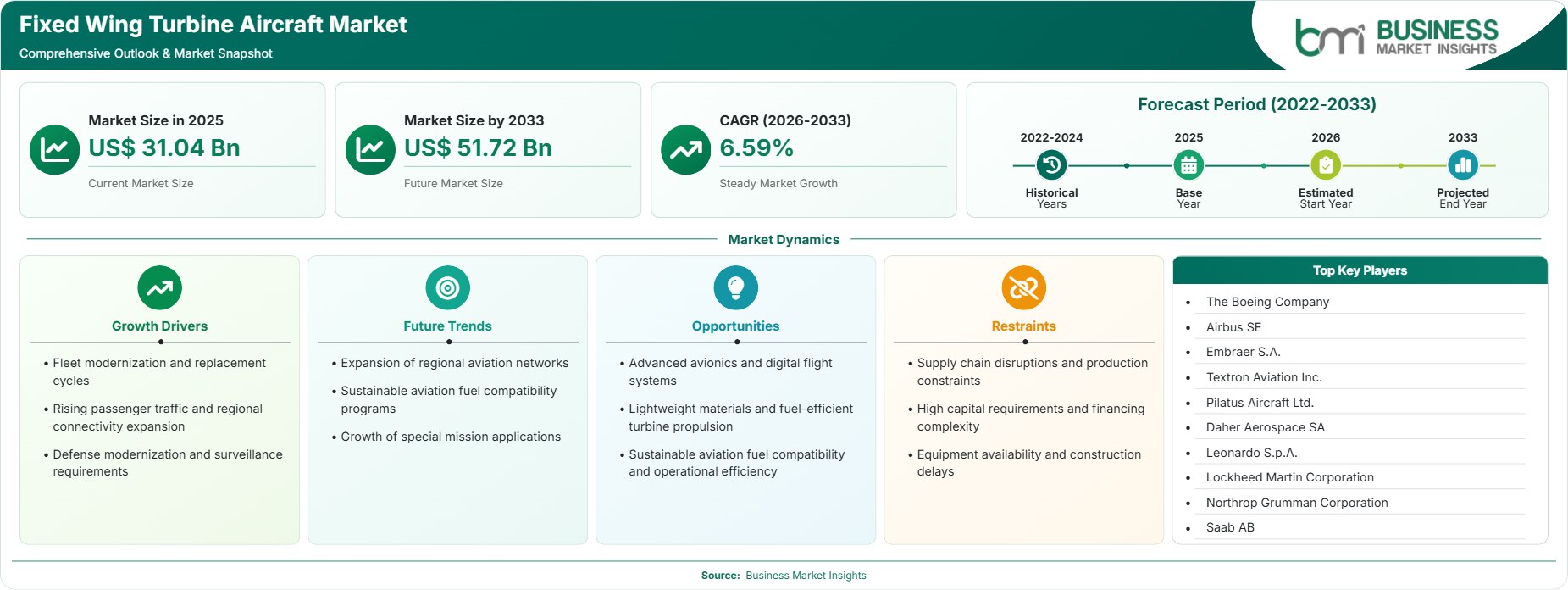
The Fixed Wing Turbine Aircraft Market size was valued at US$ 31.04 Billion in 2025 and is projected to reach US$ 51.72 Billion by 2033, growing at a CAGR of 6.59% during 2026–2033, driven by fleet modernization, regional connectivity expansion, defense procurement programs, sustainable aviation investments, and rising demand for fuel-efficient aircraft across commercial and special-mission applications.

Report Coverage
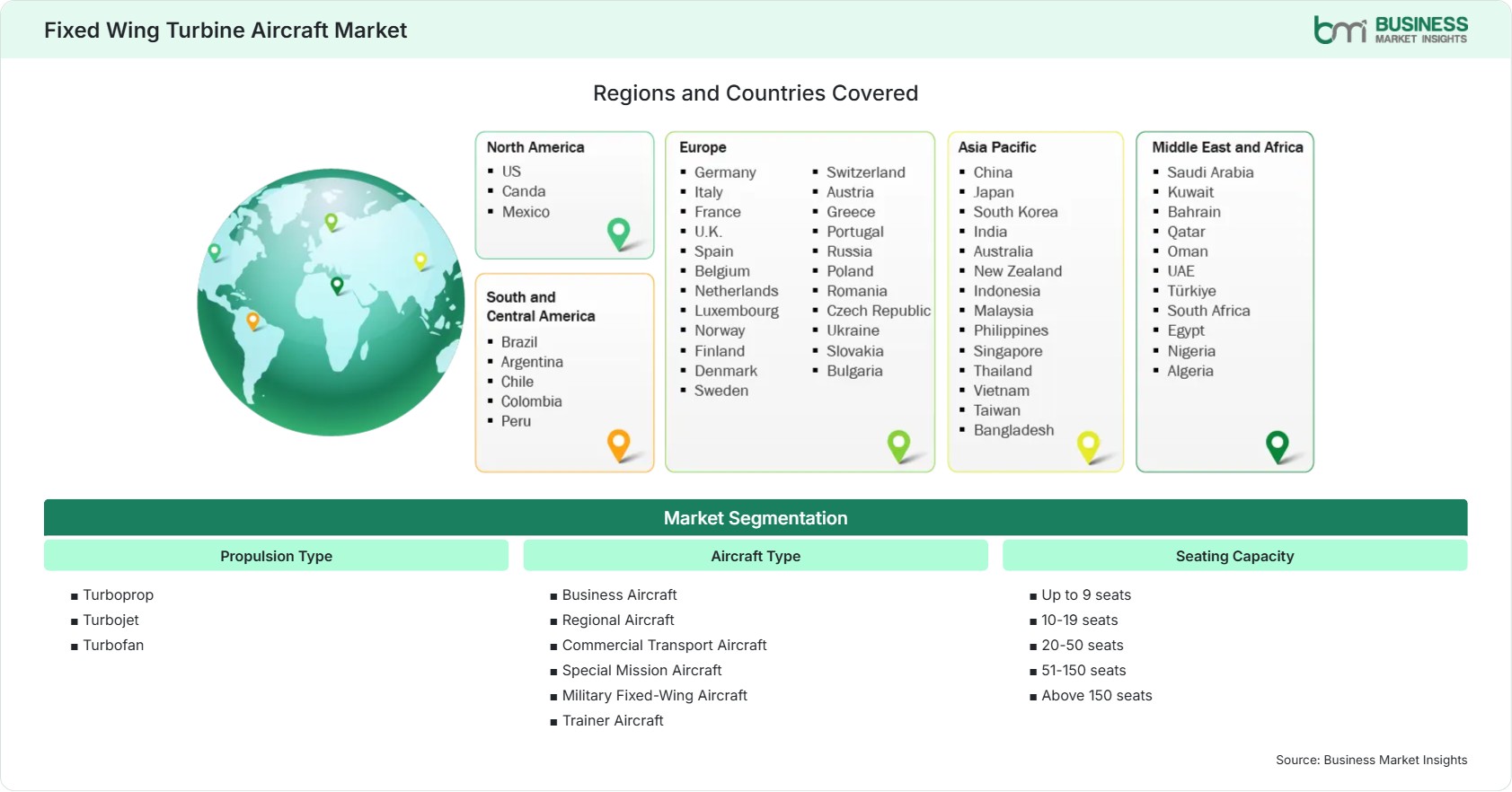
  • Propulsion Type: Turboprop, Turbojet, Turbofan
  • Aircraft Type: Business Aircraft, Regional Aircraft, Commercial Transport Aircraft, Special Mission Aircraft, Military Fixed-Wing Aircraft, Trainer Aircraft
  • Seating Capacity: Up to 9 seats, 10-19 seats, 20-50 seats, 51-150 seats, Above 150 seats
US$ 31.04 Bn Market size in 2025
US$ 51.72 Bn Market Size by 2033
6.59% CAGR, 2026 - 2033
2026-2033 Forecast Period

AI Overview

Fixed Wing Turbine Aircraft Market Summary

  • North America Region: North America holds a market share of 37%–40% in 2025, growing at a CAGR of 5.8%–6.2% during 2026–2033, supported by fleet replacement cycles, defense aviation spending, aftermarket services expansion, and advanced manufacturing investments. Opportunity stems from sustainable propulsion integration and regional fleet modernization. US market benefits from large commercial fleets, defense procurement programs, and business aviation demand, advancing at 5.9%–6.3% CAGR.
  • Fastest Growing Region: Asia Pacific holds a market share of 26%–29% in 2025, growing at a CAGR of 7.8%–8.4% during 2026–2033, driven by passenger traffic growth, regional airline expansion, airport development, defense acquisitions, and domestic aerospace manufacturing capabilities across emerging economies.
  • Leading Segment: Commercial Transport Aircraft accounts for 34%–37% share in 2025 and expands at 6.3%–6.8% CAGR, supported by airline network expansion, replacement demand, fuel efficiency requirements, fleet optimization strategies, and increasing long-haul passenger traffic across global markets.
  • High Growth Segment: Military Fixed-Wing Aircraft represents 18%–21% share in 2025 and advances at 7.2%–7.8% CAGR, supported by defense modernization initiatives, intelligence missions, surveillance requirements, border security priorities, and next-generation airborne platform procurement programs globally.
  • Key Market Opportunity: Expanding regional aviation networks, advanced turbofan adoption, sustainable aviation fuel compatibility, defense fleet recapitalization, and emerging-market airport investments create attractive long-term revenue opportunities for manufacturers, suppliers, operators, and maintenance providers.
  • Major Market Players: The Boeing Company, Airbus SE, Embraer S.A., Textron Aviation Inc., Pilatus Aircraft Ltd., Daher Aerospace SA, Leonardo S.p.A., Lockheed Martin Corporation, Northrop Grumman Corporation, Saab AB.
Strategic Insights

Fixed Wing Turbine Aircraft Market: Strategic Insights

Fixed Wing Turbine Aircraft Market Strategic Framework
FREE PDF
Request your free sample
Request free sample
Stakeholder View

Key Takeaways

  • Aircraft value chains are increasingly centered on engine suppliers, avionics integrators, composite material producers, and MRO providers, creating diversified revenue streams beyond original aircraft manufacturing.
  • Regional commercial transportation and military surveillance platforms offer the strongest medium-term demand visibility due to infrastructure expansion and defense readiness priorities.
  • Research investments are accelerating toward digital flight systems, lightweight structures, predictive maintenance analytics, and compatibility with sustainable aviation fuels.
  • Asia Pacific presents an attractive investment proposition driven by airport construction pipelines, rising middle-class air travel demand, and indigenous aerospace manufacturing programs.
  • Strategic partnerships, supplier acquisitions, and capacity expansion initiatives are becoming important competitive tools as OEMs seek greater production stability and backlog execution.
  • Lifecycle support services, retrofit programs, and operational performance upgrades are generating recurring revenues and strengthening customer retention across aviation segments.
Geographic Outlook

Fixed Wing Turbine Aircraft Market Regional Highlights

North America Fixed Wing Turbine Aircraft Market

North America accounted for 37%–40% of global revenue in 2025 and is projected to grow at a 5.8%–6.2% CAGR through 2033. The region benefits from large commercial fleets, premium business aviation demand, advanced aerospace manufacturing ecosystems, and sustained defense expenditures. Strong OEM presence, established MRO infrastructure, and continuous technology upgrades support deployment across passenger transportation, surveillance, logistics, and special-mission applications. The region maintains the highest Fixed Wing Turbine Aircraft Market share globally through enduring replacement demand and operational modernization.

  • Commercial airline fleet modernization programs continue supporting demand for efficient narrow-body and regional aircraft platforms.
  • Defense spending priorities emphasize airborne surveillance, maritime patrol, and intelligence mission aircraft acquisitions.
  • Advanced aerospace supply chains and technology innovation hubs strengthen manufacturing competitiveness and export potential.
  • Sustainable aviation fuel adoption initiatives encourage operators to transition toward environmentally responsible fleet strategies.
  • MRO capacity expansion improves aircraft availability and supports long-term aftermarket revenue growth.

US Fixed Wing Turbine Aircraft Market

The United States contributes 78%–82% of the North American Fixed Wing Turbine Aircraft Market revenue and is expected to record a 5.9%–6.3% CAGR through 2033. Demand is supported by commercial fleet replacements, robust charter aviation activity, and continued procurement of military aircraft. Federal aviation investments, aerospace innovation initiatives, and a strong installed aircraft base create favorable operating conditions. Domestic manufacturers retain competitive advantages through technological leadership, extensive distribution networks, and integrated support capabilities across multiple aviation categories.

  • Major airlines are continuing fleet optimization strategies focused on operating cost reduction and fuel efficiency.
  • Defense agencies are expanding airborne intelligence, surveillance, reconnaissance, and training capabilities.
  • Business aviation utilization remains resilient, encouraging investment in turbine-powered corporate transportation solutions.
  • Domestic aerospace R&D spending supports next-generation avionics integration and advanced manufacturing methods.

Europe Fixed Wing Turbine Aircraft Market

Europe represented 24%–27% of global revenue in 2025 and is forecast to expand at a 5.9%–6.5% CAGR through 2033. Strong aerospace engineering capabilities, commercial aircraft manufacturing leadership, and environmental sustainability initiatives support regional demand. France and Germany remain leading contributors, while Poland and Spain demonstrate faster growth supported by aerospace investments and defense modernization. Regulatory emphasis on emissions reduction and operational efficiency encourages adoption of advanced turbine-powered platforms across civil and governmental aviation fleets.

  • Airbus-centered manufacturing ecosystems reinforce production activity and supplier development opportunities.
  • Regional airline recovery supports fleet renewal programs across passenger transportation networks.
  • Defense modernization efforts stimulate procurement of surveillance and special-mission aircraft platforms.
  • France leads regional demand, while Poland records one of the fastest aerospace expansion rates.
  • Sustainable aviation initiatives support investment in fuel-efficient aircraft technologies and supporting infrastructure.

Asia Pacific Fixed Wing Turbine Aircraft Market

Asia Pacific held 26%–29% of global revenue in 2025 and is anticipated to achieve the fastest CAGR of 7.8%–8.4% through 2033. Expanding middle-class populations, airport infrastructure projects, regional airline growth, and defense procurement programs support robust market momentum. China remains the largest contributor, while India demonstrates the strongest growth profile. Ongoing investments in domestic aerospace manufacturing and aviation connectivity programs continue accelerating aircraft acquisitions throughout the region.

  • Rising passenger traffic stimulates regional and commercial transport aircraft procurement across multiple markets.
  • India records rapid expansion supported by airport development and airline capacity growth.
  • China maintains strong demand through fleet expansion and indigenous aerospace manufacturing initiatives.
  • Defense modernization programs increase acquisitions of trainer, patrol, and surveillance aircraft.
  • Expanding MRO capabilities strengthen lifecycle support ecosystems and operational efficiency.

Rest of World Fixed Wing Turbine Aircraft Market

Rest of World accounted for 8%–11% of revenue in 2025 and is expected to record a 6.5%–7.1% CAGR through 2033. The Middle East benefits from airline fleet investments and aviation hub development, while South and Central America continue expanding regional connectivity networks. Saudi Arabia and the UAE lead Middle Eastern demand, whereas Brazil represents a major Latin American aviation center. The region's Fixed Wing Turbine Aircraft Market growth is supported by infrastructure investments and defense procurement activity.

  • Middle Eastern carriers continue investing in fleet expansion and premium aviation services.
  • Brazil remains a significant aerospace manufacturing and aircraft operations center.
  • Government-led airport infrastructure projects enhance connectivity and aircraft deployment opportunities.
  • Defense and border security programs support demand for mission-specific turbine aircraft.
  • Charter and business aviation activity expands across emerging economic corridors.
Global Market Geography
FREE PDF
Request your free sample
Request free sample
Segment Analysis

Fixed Wing Turbine Aircraft Market Segmentation

Propulsion Type

This segment accounted for approximately 100% market participation by propulsion classification, with an estimated 6.5%–7.0% CAGR through 2033. Demand patterns are influenced by mission requirements, operational economics, fuel efficiency, and technological advancements. The Fixed Wing Turbine Aircraft Market scope within propulsion technologies continues expanding as operators prioritize emissions reduction and lifecycle cost optimization.

  • Turboprop: Preferred for short-haul operations, regional connectivity routes, and lower operating costs, benefiting from fuel efficiency and runway flexibility.
  • Turbojet: Sustains niche demand in military and specialized applications requiring high-speed performance and mission-specific operating characteristics.
  • Turbofan: Dominates modern commercial aviation through superior efficiency, lower noise levels, extended range capability, and technological maturity.

Aircraft Type

Commercial transport platforms remain dominant with 34%–37% share in 2025 and a projected 6.3%–6.8% CAGR. Fleet replacement programs, passenger demand growth, defense modernization, and specialized operational requirements influence adoption. The segment reflects ongoing evolution across civil, training, and mission-focused turbine aircraft categories.

  • Business Aircraft: Demand is supported by executive mobility requirements, time-sensitive travel, and expanding charter operations.
  • Regional Aircraft: Benefits from connectivity initiatives linking secondary cities and underserved aviation corridors.
  • Commercial Transport Aircraft: Remains central to airline expansion strategies, fleet renewal programs, and passenger transportation networks.
  • Special Mission Aircraft: Gains traction through surveillance, environmental monitoring, and emergency response applications.
  • Military Fixed-Wing Aircraft: Experiences strong momentum from modernization initiatives, intelligence missions, and national security priorities.
  • Trainer Aircraft: Supported by pilot training requirements and defense aviation workforce development programs.

Seating Capacity

Capacity requirements vary according to route structure and mission objectives. This segment advances at a projected 6.2%–6.9% CAGR, reflecting broad aircraft deployment requirements. The Fixed Wing Turbine Aircraft Market trends indicate rising interest in both regional capacity optimization and high-density commercial operations.

  • Up to 9 seats: Widely used in private aviation, air taxi services, and specialized transportation applications.
  • 10–19 seats: Supports remote connectivity missions, charter services, and regional mobility requirements.
  • 20–50 seats: Popular among regional operators balancing network flexibility with operating efficiency objectives.
  • 51–150 seats: Serves growing medium-distance passenger traffic and expanding domestic aviation markets.
  • Above 150 seats: Essential for major commercial airline networks addressing high-volume passenger transportation demand.

Weight Capacity

Aircraft weight classifications influence payload capability, operational range, and mission suitability. The segment is expected to progress at 6.1%–6.8% CAGR through 2033, supported by diversified end-user requirements and technological innovation across aviation platforms.

  • Light: Favored for business aviation, pilot training, and localized transportation requirements.
  • Medium: Balances payload capability, operational flexibility, and economic performance across multiple applications.
  • Heavy: Supports long-range transportation, large passenger loads, and extensive mission-specific deployments.

End User

Commercial airlines represent the leading end-user category with 42%–45% share in 2025 and a projected 6.4%–6.9% CAGR. Demand stems from fleet expansion, operational efficiency targets, and passenger growth. Procurement decisions increasingly prioritize sustainability, digital capability, and lifecycle value.

  • Commercial airlines: Continue investing in modern fleets to enhance efficiency, capacity utilization, and passenger experience.
  • Charter/Business Aviation Operators: Benefit from flexibility requirements, premium mobility demand, and expanding corporate travel activity.
  • Government Agencies: Require aircraft for transportation, surveillance, emergency response, and public service missions.
Market Forces

Fixed Wing Turbine Aircraft Market Dynamics

Key Market Drivers

Rising Global Passenger Traffic and Fleet Renewal

IATA forecasts long-term passenger traffic expansion, encouraging airlines to invest in modern aircraft capable of reducing fuel consumption and operating costs. Fleet renewal continues to be a key motivation for procurement due to rising costs associated with maintenance of the older fleet, coupled with growing regulations on the environmental front. There has been an increased focus from airlines on the procurement of more economical turbofan-driven aircraft. The synergy between the elements of capacity increase, efficiency gains, and sustainability has been leading to capital spending in the commercial aviation sector.

Defense Modernization and Surveillance Requirements

Governments worldwide are allocating larger budgets toward airborne intelligence, surveillance, reconnaissance, maritime patrol, and training capabilities. Military institutions will need adaptable turbine-based platforms that can accommodate new security challenges and meet their readiness goals. The development of surveillance along borders and strategic deterrence initiatives is among the driving forces behind the growing demand for more sophisticated fixed-wing aircraft. Current buying trends are focused on mission adaptability, systems integration, and long life span. These purchases create an underlying base of demand that is not sensitive to commercial passenger cycle dynamics.

Advancements in Aircraft Efficiency and Digital Systems

Manufacturers continue introducing lightweight materials, advanced avionics, predictive maintenance platforms, and improved propulsion technologies. Such developments help decrease fuel costs, improve dispatch accuracy and efficiency, and improve overall performance. Airlines and military customers tend to consider not just the cost of purchase but the total lifecycle economics when choosing their fleet. Digital health management systems also optimize fleet usage and minimize maintenance issues. This helps to promote such solutions for various types of planes and facilitate further improvements.

Key Market Opportunities

Expansion of Regional Aviation Networks

Economies under development have been making huge investments in airports and regional connection programs. There is a need for more efficient turbine-powered aircraft that can operate economically at lower load factors in many underdeveloped routes. The government recognizes that air transportation plays an important role in the economic development of any country, tourism, and businesses. Equipment manufacturers and other stakeholders can take advantage of the increasing procurement activity. Long-term Fixed Wing Turbine Aircraft Market Forecasts remain favorable as multiple countries seek to improve accessibility between metropolitan centers and smaller population hubs through dedicated aviation investment initiatives.

Sustainable Aviation Fuel Compatibility Programs

Environmental regulations and corporate sustainability targets are accelerating interest in aircraft capable of maximizing sustainable aviation fuel utilization. Airlines are pledging to reduce their emissions through pathways such as modernizing their fleets and using sustainable aviation fuels. There are potential opportunities in terms of making distinctions through greater efficiencies and sustainability, fuel certification of engines and planes by manufacturers and airplane and engine makers, respectively. The need for environmentally friendly airplanes will rise as the goals of carbon reduction get tougher.

Growth of Special Mission Applications

Natural disaster monitoring, environmental surveillance, law enforcement operations, border control, and maritime security requirements continue expanding globally. Aircraft platforms provide extended endurance and mission-specific capabilities that cannot be easily duplicated by other means. There is an increasing trend towards the deployment of airborne platforms with real-time surveillance capabilities for intelligence gathering and emergency management. Those suppliers who can integrate advanced sensors and communications equipment in their platforms stand to gain from increased demand.

Market Restraints and Challenges

Supply Chain Disruptions and Production Constraints

Factor: Aerospace manufacturers remain exposed to shortages affecting engines, avionics, electronic components, and specialized materials. Impact: The schedule of delivery might face negative impacts, there could be an increase in production cost, and there is no certainty that the orders backlog will become sales as expected. Consistent disruptions in the supply chain lead to uncertainties for the airlines, leasing companies, and the government, who need aircraft delivered on time. Capacity issues from key suppliers affect the ability to scale up production in the season of high demand. However, the aircraft industry has recovered from previous stages of disruption.

High Capital Requirements and Financing Complexity

Factor: Aircraft acquisition requires substantial upfront capital investment alongside ongoing maintenance, training, and infrastructure expenditures. Impact: Small airlines may defer their procurement decision, leading to reduced replacement cycle and expansion plan for their fleets. Fluctuations in interest rates and the availability of finance may play a role in purchase decisions. Government entities and commercial airlines may undertake an investment appraisal process that is long-term in nature, which may prolong the procurement process. Financial limitations may affect regional airlines in particular due to positive demand fundamentals.

Company Analysis

Competitive Landscape

The competitive environment remains shaped by OEM scale, global support networks, propulsion innovation, and lifecycle service capabilities. Current Fixed Wing Turbine Aircraft Market analysis indicates strong competition across commercial, regional, defense, and business aviation categories.

Company Name

Overview

Products and Services relevant to this market

The Boeing Company

Global aerospace manufacturer serving commercial, defense, and government customers through extensive aircraft and services portfolios.

Commercial jetliners, military aircraft, training platforms, aviation services, digital solutions, and fleet support programs.

Airbus SE

Leading aircraft manufacturer with strong global presence across commercial, military, and special-mission aviation markets.

Commercial aircraft, military transports, surveillance platforms, support services, and aviation technology solutions.

Embraer S.A.

Major regional aircraft specialist with growing defense and executive aviation capabilities worldwide.

Regional jets, business aircraft, defense platforms, pilot training support, and maintenance services.

Textron Aviation Inc.

Prominent producer of business and utility aircraft with broad customer reach.

Cessna and Beechcraft turbine aircraft, support services, training programs, and aftermarket solutions.

Pilatus Aircraft Ltd.

Swiss aerospace company recognized for utility, trainer, and business aircraft expertise.

Turbine-powered trainers, business aircraft, special-mission platforms, and customer support services.

Daher Aerospace SA

Aircraft manufacturer focused on turboprop platforms and aerospace industrial services.

Turboprop aircraft, logistics support, engineering services, and operational assistance solutions.

Leonardo S.p.A.

European aerospace and defense company serving military and governmental aviation applications.

Trainer aircraft, surveillance platforms, defense technologies, mission systems, and support services.

Lockheed Martin Corporation

Major defense contractor with broad military aviation capabilities and global footprint.

Military aircraft, mission systems integration, modernization services, and lifecycle support solutions.

Northrop Grumman Corporation

Defense technology provider specializing in advanced airborne mission capabilities.

Surveillance aircraft systems, intelligence solutions, mission electronics, and operational support.

Saab AB

Aerospace and defense company serving military aviation and specialized mission markets.

Trainer aircraft, surveillance solutions, defense aviation technologies, and support services.

Trust & Transparency

Research Methodology

The market analysis combines proprietary research with secondary data from government agencies, company disclosures, regulatory filings, industry databases and expert interviews. Market estimates are validated through data triangulation, cross-market benchmarking and analyst review.

View Full Research Methodology

Questions Answered

Frequently Asked Questions

What does the Fixed Wing Turbine Aircraft Market Report typically evaluate?

A comprehensive Fixed Wing Turbine Aircraft Market Report examines demand drivers, competitive positioning, segmentation trends, regional dynamics, investment opportunities, technology developments, and future growth outlook.

How are sustainability goals affecting purchasing decisions?

Operators increasingly prioritize fuel-efficient platforms, sustainable aviation fuel compatibility, lower emissions, and digital performance management technologies when evaluating new aircraft purchases.

Which region offers the strongest long-term expansion potential?

Asia Pacific presents the strongest growth outlook due to rapid aviation infrastructure development, airline expansion, urbanization, and increasing defense investments.

What aircraft category generates the largest revenue contribution?

Commercial transport aircraft represent the leading category because of extensive airline fleet deployment, replacement demand, and global passenger transportation requirements.

What factors are influencing demand for turbine-powered fixed-wing aircraft?

Fleet replacement, passenger traffic growth, defense modernization, fuel-efficiency requirements, and regional connectivity initiatives are driving procurement decisions across commercial, government, and special-mission operators.

Access the Full Fixed Wing Turbine Aircraft Market Report

Get segment-level forecasts, regional estimates, competitive benchmarking, company profiles and downloadable Excel datasets.

Access the full Fixed Wing Turbine Aircraft Market Report
350 pages PDF & Excel | 2026-08-31