Market Summary
Executive Summary and Global Market Analysis
Aircraft micro turbine engines are compact gas turbine systems designed to deliver high power-to-weight efficiency for small aircraft, unmanned aerial vehicles, and emerging advanced air mobility platforms. These engines operate on high-speed combustion principles, enabling efficient thrust generation in lightweight aviation systems. The Aircraft Micro Turbine Engines Market is becoming more prominent because of the growing use of UAVs, increasing preference for electric/hybrid engine solutions, and the fast development of eVTOL and advanced air mobility systems. Such engines are often chosen because of their compactness, ability to work on different types of fuel, and high reliability both for manned and unmanned aircraft.
The market faces certain operational and technical challenges. High development costs and complex engineering requirements make micro turbine engines less accessible for small-scale manufacturers. The control of thermal stresses and material reliability continues to be an important consideration due to extremely high operating temperatures. Sound generation and the need to conserve fuel economy are other aspects that must be considered when making advancements in the technology. Furthermore, the rigorous certification process in aviation is another bottleneck.
Despite these challenges, the market is expected to expand steadily with ongoing technological advancements. Increasing investment in UAV-based logistics, surveillance, and defense applications is strengthening demand for efficient propulsion systems. Growth in eVTOL aircraft development and advanced air mobility projects is creating new application areas. Advances in lightweight materials, additive manufacturing, and hybrid-electric technology have enhanced the performance efficiency in the industry. There are also other technological developments being undertaken in the Aircraft Micro Turbine Engines Market, such as in sustainable aviation fuel and next-generation propulsion technology.
Segment Analysis
Aircraft Micro Turbine Engines Market Segmentation
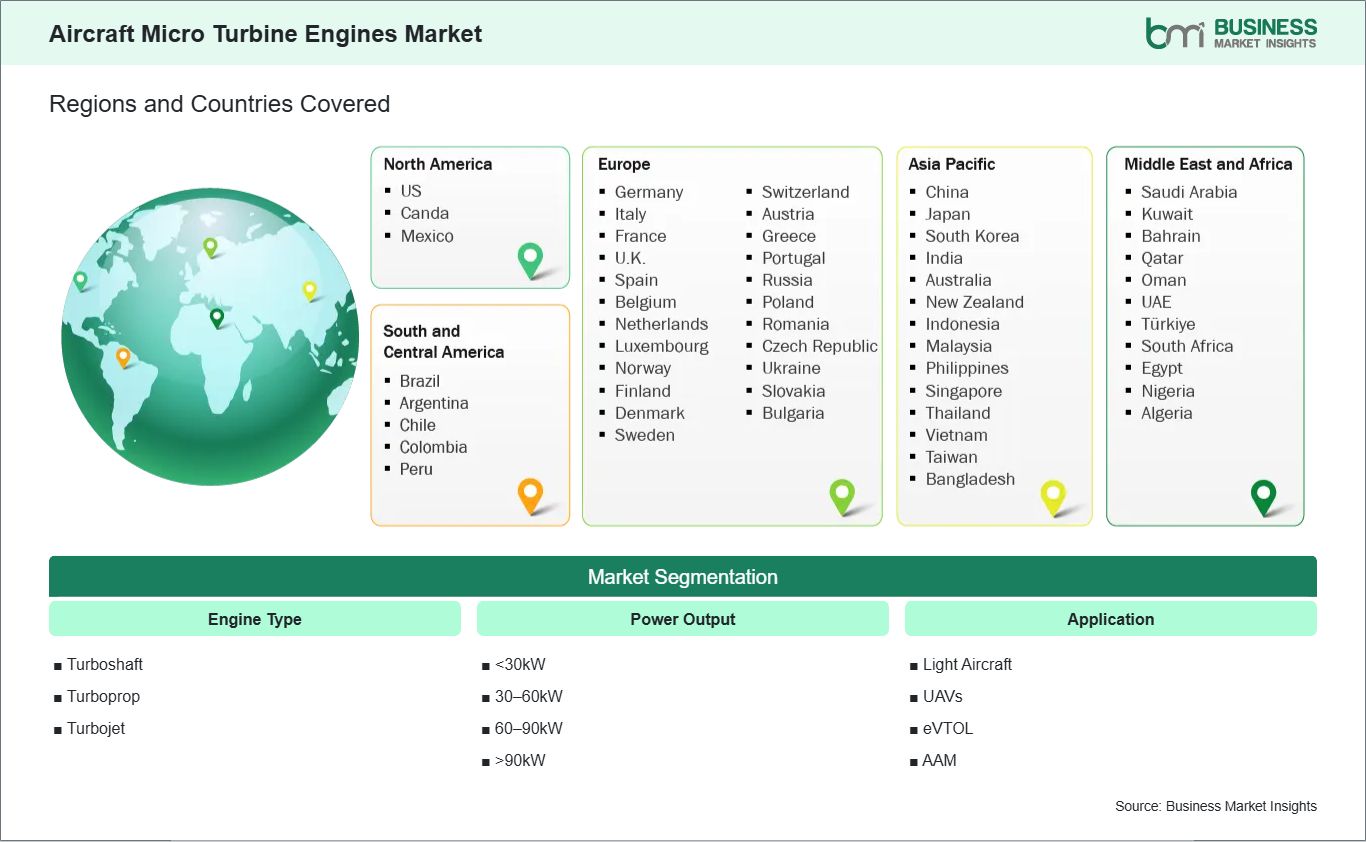
The Aircraft Micro Turbine Engines Market is segmented based on engine type, power output, and application. Each segment plays a key role in defining performance efficiency, operational capability, and end-use suitability.
By Engine Type
- Turboshaft: Widely used for rotary-wing aircraft and UAVs requiring stable mechanical power output.
- Turboprop: Used in light aircraft for improved fuel efficiency and moderate-speed operations.
- Turbojet: Preferred for high-speed applications requiring strong thrust generation in compact systems.
By Power Output
- <30kW: Used in small UAVs and lightweight drones requiring minimal propulsion power.
- 30-60kW: Suitable for medium UAVs and light aviation applications.
- 60-90kW: Used in advanced UAVs and hybrid propulsion systems.
- >90kW: Applied in high-performance aircraft and advanced mobility platforms.
By Application
- Light Aircraft: Supports general aviation and training aircraft with compact propulsion systems.
- UAVs: Major growth segment driven by surveillance, defense, and logistics applications.
- eVTOL: Emerging application area focusing on urban air mobility solutions.
- AAM: Advanced air mobility platforms integrating next-generation propulsion technologies.
Market Forces
Aircraft Micro Turbine Engines Market Drivers and Opportunities
Rising Demand for Lightweight and High-Efficiency Propulsion Systems
The increasing need for lightweight and efficient propulsion systems is a major factor driving the Aircraft Micro Turbine Engines Market. Modern aviation platforms, especially UAVs and advanced air mobility systems, require compact engines that deliver high power output with reduced weight. Micro turbine engines meet these requirements by offering strong thrust-to-weight ratios and operational flexibility across different flight conditions. This increased usage of UAVs in various military, monitoring, and logistics uses has only helped to increase the demand for such propulsion mechanisms. Another area where there has been an increased use of micro turbine engines is within the domain of eVTOL aircraft.
Environmental regulations are also influencing engine design improvements. Manufacturers are focusing on reducing emissions and improving fuel efficiency to comply with global aviation standards. Continuous advancements in combustion technology, material science, and thermal management systems are enhancing engine performance and reliability. These developments are strengthening the adoption of micro turbine engines across both manned and unmanned aviation platforms.
Expansion of Advanced Air Mobility and UAV Ecosystems
The development of advanced air mobility and UAV ecosystems presents strong opportunities for the Aircraft Micro Turbine Engines Market. Increasing investments in urban air transportation, drone logistics, and autonomous flight systems are creating new demand for compact and efficient propulsion technologies. Micro turbine engines are well suited for these applications due to their scalability, reliability, and ability to operate in hybrid configurations. Technological innovation is playing a key role in expanding market opportunities. Incorporation of hybrid-electric technology and advanced techniques in fuel injection, along with lightweight composite material, is contributing to efficient engine performance and minimizing limitations. The utilization of additive manufacturing is aiding the manufacture of complicated engine parts with minimized weight.
Sustainability in the field of aviation is leading to an increased interest in the development of alternative fuels and low-emission propulsion engines. Development in the area of advanced turbine design technology is contributing to increased energy efficiency and minimized impact on the environment. With the increasing use of UAVs and eVTOL aircraft worldwide, there will be considerable demand for micro-turbine engines.
Size and Share Analysis
Aircraft Micro Turbine Engines Market Size and Share Analysis
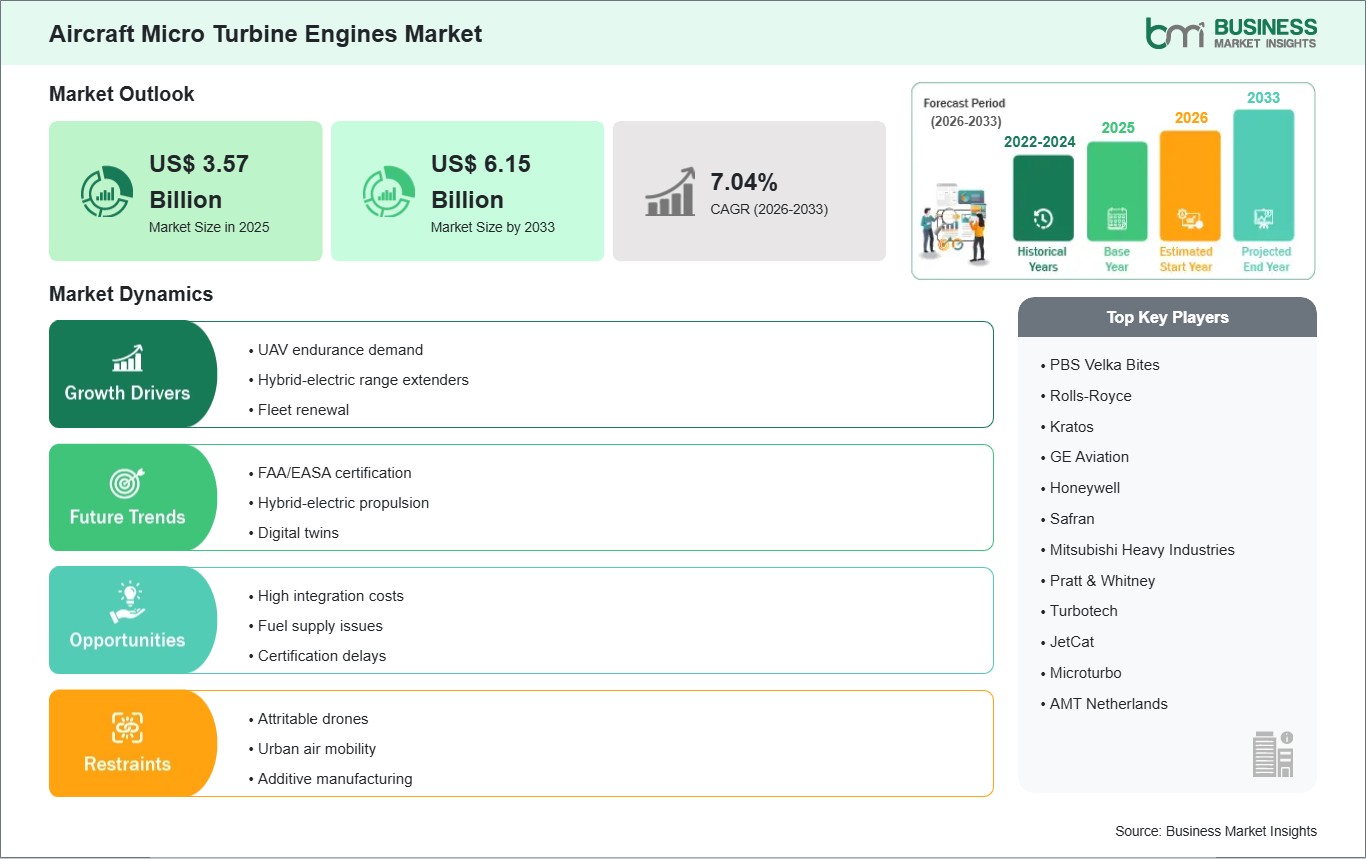
The Aircraft Micro Turbine Engines Market is projected to grow from US$ 3.57 Billion in 2025 to US$ 6.15 Billion by 2033 , registering a CAGR of 7.04% from 2026 to 2033.
By engine type, turboshaft engines hold a strong position due to their widespread use in UAV and rotorcraft applications. Turboprop engines remain important for light aircraft operations, while turbojet systems are used in high-performance aviation platforms. By power output, the 30-60kW and 60-90kW segments are gaining traction due to their balance of efficiency and performance across multiple aviation applications.
By application, UAVs dominate the market due to increasing use in surveillance, logistics, and defense operations. eVTOL and advanced air mobility applications are emerging as high-growth segments, driven by urban transportation development and autonomous flight innovations. Light aircraft applications continue to contribute stable demand, supporting overall market expansion.
Report Coverage
Aircraft Micro Turbine Engines Market Report Coverage and Deliverables
The "Aircraft Micro Turbine Engines Size and Forecast (2022-2033)" report provides a detailed analysis of the market covering below areas:
- Aircraft Micro Turbine Engines market size and forecast at global, regional, and country levels for all the key market segments covered under the scope
- Aircraft Micro Turbine Engines market trends, as well as market dynamics such as drivers, restraints, and key opportunities
- Aircraft Micro Turbine Engines market analysis covering key market trends, global and regional framework, major players, regulations, and recent market developments
- Industry landscape and competition analysis covering market concentration, heat map analysis, prominent players, and recent developments for the market
- Detailed company profiles, including SWOT analysis
Geographic Insights
Aircraft Micro Turbine Engines Market Geographic Insights
The Aircraft Micro Turbine Engines Market shows diverse regional adoption patterns influenced by growing UAV deployment, advanced aviation manufacturing capabilities, and increasing investment in next-generation propulsion technologies.
North America, being a technologically advanced region, has a strong aerospace ecosystem and high adoption of UAV and advanced air mobility systems. The region comprises the United States and Canada, where strong defense spending, active research programs, and advanced aviation infrastructure support the development and integration of micro turbine engines. The region focuses on improving propulsion efficiency, reducing emissions, and advancing hybrid-electric aviation technologies. Established regulatory frameworks and strong engineering capabilities further support market maturity and consistent innovation in aircraft propulsion systems.
Asia Pacific is growing significantly due to rapid expansion in aviation infrastructure, increasing UAV applications, and rising investment in aerospace manufacturing. The region comprises countries such as China, India, Japan, and South Korea, where growing demand for drones in commercial and defense sectors is driving adoption of micro turbine engines. The region focuses on strengthening domestic aviation capabilities, improving propulsion efficiency, and supporting emerging eVTOL development. Increasing industrialization and government-backed aerospace initiatives are further enhancing market growth and technology adoption.
Both regions are contributing significantly to the growth of the Aircraft Micro Turbine Engines Market, focusing on propulsion innovation, UAV expansion, and the development of advanced aviation systems supporting future air mobility solutions.
Industry Activity
Recent Developments
The Aircraft Micro Turbine Engines Market is analyzed using a mix of primary and secondary research sources, including corporate publications, industry associations, and verified databases. This approach ensures accurate tracking of innovation trends and strategic developments influencing the market.
- In March 2024, Honeywell announced advancements in its small turbine engine technologies aimed at improving efficiency and reducing emissions for unmanned and light aviation platforms. The development focused on enhancing fuel performance and supporting emerging UAV applications. These improvements are aligned with growing demand for compact and efficient propulsion systems.
- In October 2023, Rolls-Royce Holdings highlighted progress in its next-generation small engine programs targeting advanced air mobility and hybrid propulsion systems. The update emphasized improved efficiency, reduced weight, and integration potential with electric systems. This supports increasing adoption of advanced propulsion technologies in aviation innovation.
Trust & Transparency
Research Methodology
The market analysis combines proprietary research with secondary data from government agencies, company disclosures, regulatory filings, industry databases and expert interviews. Market estimates are validated through data triangulation, cross-market benchmarking and analyst
review.
View Full Research Methodology
Key Sources Referred:
World Bank - Global Trade Indicators
World Trade Organization (WTO)
International Monetary Fund (IMF)
International Trade Administration (ITA)
Company Websites
Company Annual Reports
Company Investor Presentations