Market Summary
Executive Summary and Global Market Analysis
More electric aircraft are aircraft platforms that replace conventional hydraulic, pneumatic, and mechanical subsystems with electrically powered alternatives to improve energy efficiency, weight distribution, and system controllability. This architecture uses electric power conversion and distribution to support flight-critical and non-flight-critical functions across fixed-wing and unmanned platforms.
Airframe manufacturers and operators are advancing electrified subsystem integration to reduce fuel burn, simplify maintenance pathways, and support tighter emissions objectives. Electrification also improves response precision in onboard functions, making it attractive for next-generation commercial fleets, defense aircraft, and specialized mission platforms.
Technology segmentation reflects how onboard electrical architectures are becoming more distributed and performance-oriented. Power electronics manage conversion and control efficiency, generators support higher onboard loads, actuators replace hydraulic mechanisms in targeted systems, and electric pumps improve subsystem responsiveness across critical aircraft functions.
Design progress is centered on higher-voltage networks, lighter electrical components, and smarter control integration. These advances enable aircraft programs to shift more onboard functions toward electric operation without compromising reliability, while also opening room for modular architectures suited to evolving commercial, military, and UAV requirements.
Competitive conditions are shaped by subsystem integration capability, certification readiness, thermal management expertise, and electrical reliability under demanding flight profiles. Suppliers compete through component efficiency, compact design, and their ability to align electrified systems with broader aircraft modernization strategies.
Segment Analysis
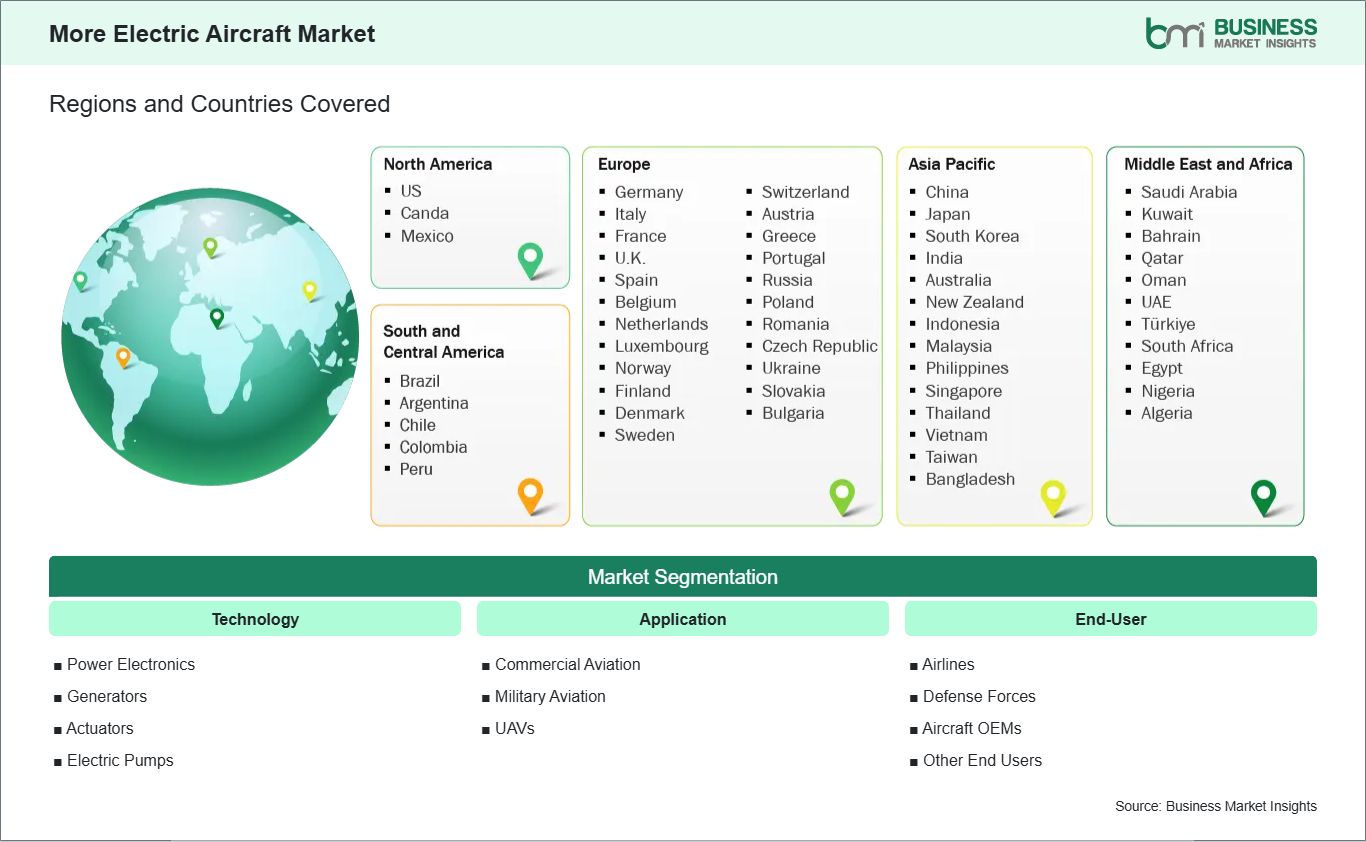
More Electric Aircraft Market Segmentation
The more electric aircraft market is segmented by technology, application, and end-user across evolving aviation deployment models.
By Technology
- Power Electronics: Governs efficient energy conversion across increasingly complex onboard electrical architectures.
- Generators: Supports elevated electrical loads in modernized airborne power networks.
- Actuators: Replaces selected hydraulic functions with precise electrically controlled motion systems.
- Electric Pumps: Enhances subsystem control through compact electrically powered fluid management.
By Application
- Commercial Aviation: Prioritizes fuel efficiency, lower maintenance complexity, and quieter subsystem performance.
- Military Aviation: Emphasizes mission reliability, power availability, and reduced mechanical dependency.
- UAVs: Benefits from lightweight electrical systems and integrated control responsiveness.
By End-User
- Airlines: Evaluates electrified systems for operational efficiency and fleet modernization priorities.
- Defense Forces: Seeks resilient electrical architectures for demanding mission environments.
- Aircraft OEMs: Integrates electric subsystems to support next-generation platform design goals.
- Other End Users: Includes research bodies, operators, and specialized aviation service organizations.
Market Forces
More Electric Aircraft Market Drivers and Opportunities
Aircraft Efficiency Requirements Accelerating Electrical Substitution
Aircraft developers are under sustained pressure to improve efficiency without relying solely on aerodynamic refinement. That need is directing attention toward electrically powered subsystems that reduce reliance on bleed air, hydraulic routing, and mechanically intensive assemblies. As electrical architectures become more capable, OEMs are integrating generators, actuators, and power electronics to support lower system losses and better controllability across modern aircraft programs.
The impact extends beyond component replacement because electrification influences maintenance logic, system packaging, and onboard energy management. In commercial aviation, this shift aligns with long-term fleet efficiency priorities. In defense aviation, the same transition supports higher onboard power availability and system resilience. These combined factors keep more electric aircraft strategies relevant across platform classes and development timelines.
High-Voltage Architectures Opening New Integration Pathways
Interest in higher-voltage aircraft networks is creating room for more capable electrical subsystems and tighter functional integration. Innovation in conversion hardware, thermal control, and compact actuation is allowing engineers to distribute power more effectively across the airframe. This trend is especially relevant where aircraft designers need scalable architectures that support avionics loads, environmental control functions, and mission-specific electrical demands.
Future scope is broadening as electrical designs move from subsystem enhancement to architecture-level differentiation. Expansion opportunities are emerging in retrofit programs, next-generation narrow-body development, advanced military platforms, and UAV configurations requiring compact power distribution. The market stands to benefit as validated electrical components become easier to integrate, certify, and align with long-horizon aircraft modernization programs.
Size and Share Analysis
More Electric Aircraft Market Size and Share Analysis
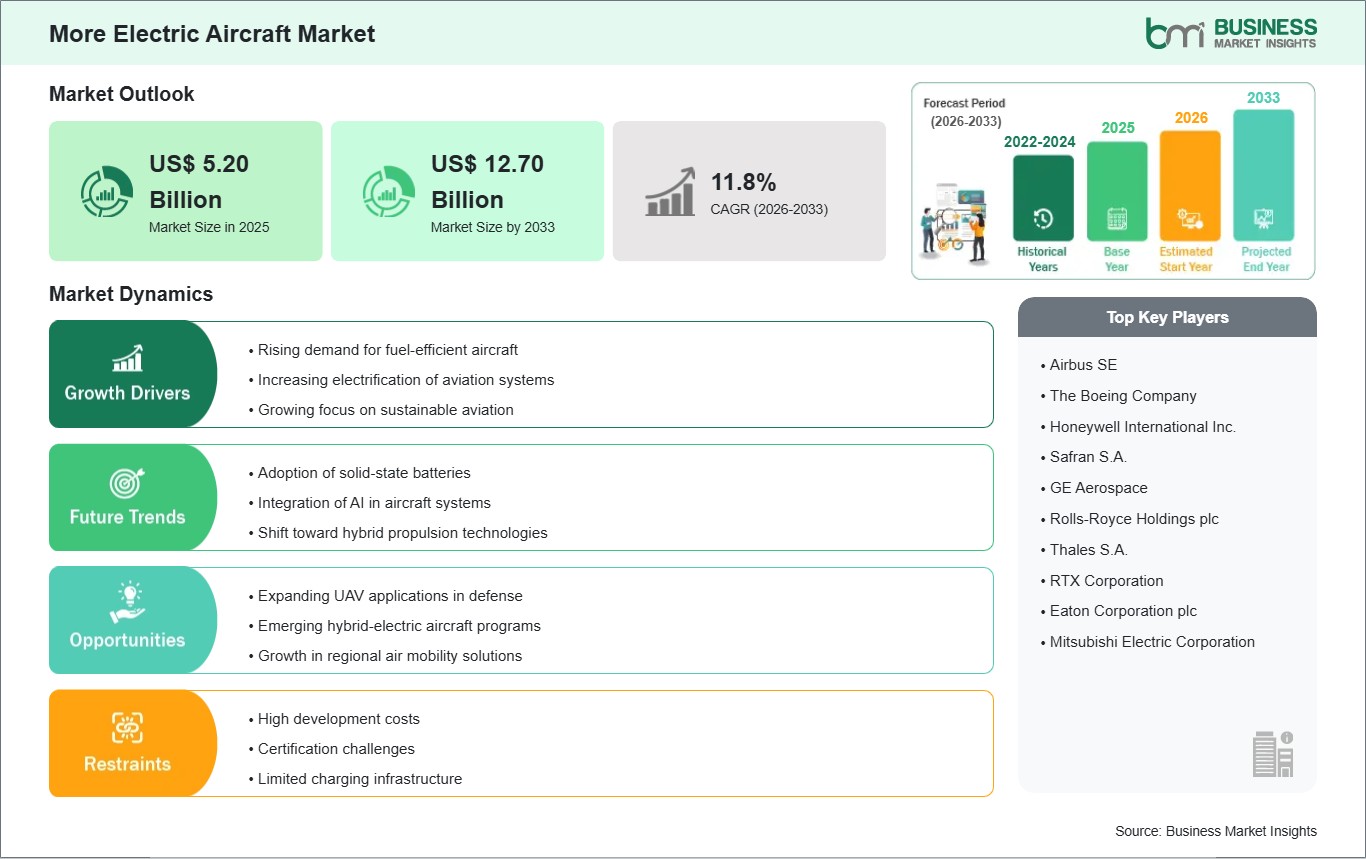
The More Electric Aircraft market size is expected to reach US$ 12.70 Billion by 2033 from US$ 5.20 Billion in 2025. The market is estimated to record a CAGR of 11.8% from 2026 to 2033. This expansion indicates steady integration of electrical subsystems into aircraft design priorities, supported by the need for efficiency, better controllability, and reduced dependence on legacy mechanical architectures.
By technology, power electronics hold a central position because they regulate conversion, control, and distribution across electrified aircraft functions. Generators also maintain strategic importance as onboard electrical loads expand. Actuators continue to gain attention where aircraft programs seek precise motion control with lower hydraulic dependence, while electric pumps support compact and responsive subsystem management.
By application, commercial aviation represents the leading arena for electrified subsystem deployment because efficiency and lifecycle performance remain central procurement considerations. Military aviation follows with emphasis on power-rich mission systems and operational robustness. UAVs present a distinct growth avenue as compact electrical architectures fit well with lightweight platforms, automated control needs, and evolving mission versatility.
Report Coverage
More Electric Aircraft Market Report Coverage and Deliverables
The " More Electric Aircraft Market Size and Forecast (2022-2033)" report provides a detailed analysis of the market covering below areas:
- More Market size and forecast at global, regional, and country levels for all the key market segments covered under the scope
- More Market trends, as well as market dynamics such as drivers, restraints, and key opportunities
- More Market analysis covering key market trends, global and regional framework, major players, regulations, and recent market developments
- Industry landscape and competition analysis covering market concentration, heat map analysis, prominent players, and recent developments for the market
- Detailed company profiles, including SWOT analysis
Geographic Insights
More Electric Aircraft Market Geographic Insights
The More Electric Aircraft market shows diverse regional adoption patterns influenced by industrial capability, certification pathways, fleet renewal strategies, and defense modernization agendas. Across the global landscape, the shift toward electrically powered subsystems reflects a broader effort to improve aircraft efficiency, simplify maintenance-intensive architectures, and support long-term platform evolution in both civil and military aviation environments.
North America holds a strong position because of its deep aerospace engineering base, established aircraft programs, and sustained investment in subsystem innovation. The region benefits from close coordination among OEMs, component suppliers, and defense stakeholders working on higher-power onboard systems. Commercial and military development activity continues to reinforce interest in generators, actuators, and advanced electrical control units.
Asia Pacific is building momentum through expanding aerospace manufacturing capability, rising air traffic requirements, and stronger national interest in indigenous aviation technologies. The region presents opportunities for electrical subsystem suppliers as aircraft programs place greater emphasis on efficiency and platform modernization. UAV development and defense procurement are also contributing to broader acceptance of compact, power-conscious onboard electrical architectures.
Europe remains important due to its concentration of aircraft design expertise and sustained focus on lower-emission aviation technologies. Electrified subsystem development is closely tied to collaborative innovation programs and next-generation aircraft concepts. Beyond the major regions, emerging markets in the Middle East, Latin America, and selected African economies are gaining relevance as fleet expansion, defense acquisition, and aviation infrastructure upgrades create space for more advanced aircraft systems.
Industry Activity
Recent Developments
The more electric aircraft market is evaluated by gathering qualitative and quantitative data post primary and secondary research, which includes important corporate publications, association data, and databases. Recent developments and news in the market include:
- April 2026: Joby Aviation, Inc. announced the completion of the first-ever point-to-point electric vertical takeoff and landing (eVTOL) air taxi demonstration flights in New York City's history, marking the start of a week-long public campaign across the city's existing heliport network. Framed against the most iconic skyline in the world, the campaign offers the first real-world demonstration of how electric air taxis, which are quiet and produce zero operating emissions, will be able to connect the region, linking vertiports, international airports, and communities across the New York metropolitan area.
- March 2026: Surf Air Mobility Inc. and BETA Technologies announced an Aircraft Purchase Agreement and strategic partnership intended to accelerate the introduction of safe, reliable, and profitable advanced air mobility solutions. Under the terms of the Aircraft Purchase Agreement, Surf Air Mobility has signed a firm order for 25 all-electric ALIA CTOL aircraft and has the option to add up to 75 additional aircraft to its order. The aircraft will be introduced into Surf Air Mobility's platform for regional operations. This order adds to BETA's growing commercial aircraft backlog and highlights the versatility of its ALIA aircraft across passenger, cargo, and medical use cases.
Trust & Transparency
Research Methodology
The market analysis combines proprietary research with secondary data from government agencies, company disclosures, regulatory filings, industry databases and expert interviews. Market estimates are validated through data triangulation, cross-market benchmarking and analyst
review.
View Full Research Methodology
Key Sources Referred:
International Civil Aviation Organization (ICAO)International Air Transport Association (IATA)National Aeronautics and Space Administration (NASA)European Union Aviation Safety Agency (EASA)Commercial Aviation Alternative Fuels Initiative (CAAFI)Company filingsAcademic studiesPeer-reviewed journalsTechnical conference papers