
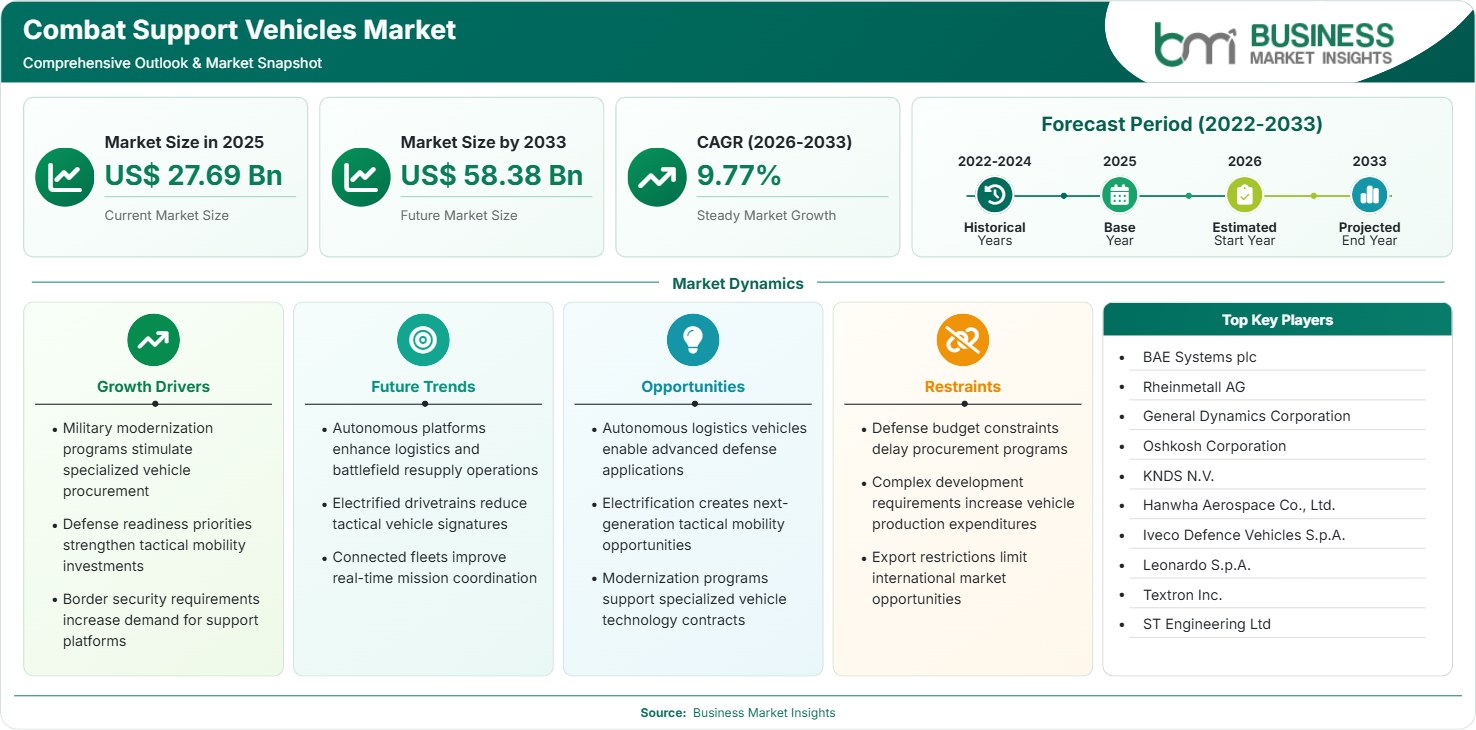
Combat Support Vehicles Market Outlook: Size, Share, Trends, Growth Analysis, Competitive Landscape & Forecast, 2026-2033

The Combat Support Vehicles Market size was valued at US$ 27.69 Billion in 2025 and is projected to reach US$ 58.38 Billion by 2033, growing at a CAGR of 9.77% during 2026–2033. Key drivers include defense modernization, battlefield mobility requirements, engineering vehicle procurement, survivability upgrades, autonomous support platforms, military logistics digitization, and expanding cross-border security programs.

Report Coverage
  • Vehicle Type: Recovery, Maintenance, Combat Engineering, Crossing
  • Platform: Tracked, Wheeled, Amphibious, Trailer-Based, Modular Mission, Robotic & Air-Transportable
  • Weight Class: Ultra-Light, Light, Medium, Heavy, Very Heavy
  • Protection Level: Soft-Skin, Protected Cab, Armored
  • Propulsion: Diesel ICE, Electric, Auxiliary, Powertrain
US$ 27.69 Bn Market size in 2025
US$ 58.38 Bn Market Size by 2033
9.77% CAGR, 2026 - 2033
2026-2033 Forecast Period

AI Overview

Combat Support Vehicles Market Summary

  • North America Region: North America holds a market share of 34%–37% in 2025, growing at a CAGR of 8.5%–9.2% during 2026–2033, supported by fleet recapitalization, multi-domain operations integration, engineering vehicle upgrades, enhanced recovery capabilities, defense budget expansion, autonomous mission systems adoption, and logistics modernization initiatives. The U.S. market benefits from sustained platform modernization programs and is expected to record a CAGR of 8.7%–9.4%.
  • Fastest Growing Region: Asia Pacific accounts for a 24%–27% share in 2025 and advances at a CAGR of 11.2%–12.1% during 2026–2033. Growth stems from indigenous armored vehicle production, border infrastructure programs, force mobility enhancement, military engineering modernization, larger procurement pipelines, and regional security preparedness investments.
  • Leading Segment: Tracked platforms represent 30%–33% of the Combat Support Vehicles Market share in 2025 with a CAGR of 9.3%–10.0% through 2033. Demand is driven by superior terrain mobility, frontline support requirements, armored formation compatibility, battlefield survivability, engineering mission versatility, and expanding modernization of mechanized force structures.
  • High Growth Segment: Robotic & Air-Transportable platforms hold 9%–12% share in 2025 and are forecast to grow at 12.8%–13.8% CAGR through 2033. Adoption is supported by autonomous operations, reduced crew risk, rapid deployment requirements, expeditionary warfare concepts, and integration of advanced mission-control technologies.
  • Key Market Opportunity: Defense ministries increasingly seek modular support fleets capable of recovery, engineering, and logistics missions across changing operational environments, creating long-term procurement pathways for adaptable platform architectures and mission systems.
  • Major Market Players: BAE Systems plc, Rheinmetall AG, General Dynamics Corporation, Oshkosh Corporation, KNDS N.V., Hanwha Aerospace Co., Ltd., Iveco Defence Vehicles S.p.A., Leonardo S.p.A., Textron Inc., ST Engineering Ltd.
Strategic Insights

Combat Support Vehicles Market: Strategic Insights

Combat Support Vehicles Market Strategic Framework
FREE PDF
Request your free sample
Request free sample
Stakeholder View

Key Takeaways

  • Defense supply chains increasingly prioritize integrated ecosystems combining vehicle OEMs, electronics suppliers, armor specialists, maintenance providers, and autonomous technology developers.
  • Robotic support platforms and modular engineering vehicles offer the strongest upside potential as militaries seek flexible force-projection capabilities without expanding personnel requirements.
  • Electrification-enabling auxiliary power systems, predictive maintenance analytics, and autonomous navigation technologies are becoming central R&D priorities among major defense vehicle manufacturers.
  • Asia Pacific presents a compelling investment case due to sustained procurement programs across India, South Korea, Australia, Japan, and Southeast Asian defense modernization initiatives.
  • Strategic partnerships, industrial participation agreements, and vehicle upgrade programs are gaining preference over standalone procurements, encouraging consolidation across specialized defense mobility segments.
  • Lifecycle support contracts are becoming increasingly important as governments emphasize operational readiness, availability metrics, and long-term fleet sustainment economics.
Geographic Outlook

Combat Support Vehicles Market Regional Highlights

North America Combat Support Vehicles Market

North America was estimated to account for 34%-37% of the Combat Support Vehicles Market share in 2025, and the region is expected to grow at an 8.5%-9.2% CAGR from 2026 to 2033. Drivers in the region include modernization initiatives in the military, engineering force renewal, upgrades to recovery vehicles, and increased spending on autonomous battlefield technologies. Procurement practices in the region now focus on interoperability, survivability, and logistics readiness. The US remains the major contributor, while Canada focuses on mobility solutions in line with NATO’s objectives.

  • U.S. Army modernization programs continue driving procurement of engineering, bridging, recovery, and sustainment vehicles integrated with digitally connected battlefield networks.
  • NATO readiness initiatives encourage inventory expansion and accelerated replacement of aging support platforms across alliance-aligned defense organizations.
  • Vehicle protection enhancements focus on mine resistance, modular armor, and crew survivability across operationally demanding environments.
  • Autonomous convoy technologies and predictive maintenance systems attract greater investment across military logistics ecosystems.

US Combat Support Vehicles Market

The United States accounted for 78%-82% of regional demand in 2025 and will register an 8.7%-9.4% CAGR through the forecast period. Procurement focus lies on engineering support, combat recovery, tactical mobility, and sustainment. The U.S. defense forces are developing their Multi-Domain Operations doctrine, hence rising demand for digital integration capabilities in assets. U.S.-based manufacturers enjoy favorable conditions due to high levels of defense budget allocation and vehicle modernization requirements supporting operational readiness.

  • Investments increasingly support autonomous sustainment missions capable of reducing personnel exposure in contested operational environments.
  • Modernization strategies prioritize lifecycle management and upgrades to improve platform longevity and battlefield effectiveness.
  • Electric auxiliary power systems receive attention for silent watch capabilities and enhanced energy efficiency requirements.
  • Domestic production resilience remains central to long-term procurement planning and supply chain security strategies.

Europe Combat Support Vehicles Market

The Europe region had around 27%-30% market share in 2025 and is expected to report 10.2%-11.0% CAGR of the Combat Support Vehicles Market up to 2033. Geopolitical security and military preparedness considerations drive the procurement of engineering, recovery, and bridging vehicles. Germany represents the leading buyer in the region, while Poland shows the greatest growth prospects at 11.5%-12.5% CAGR. Defense-industrial collaboration and NATO interoperability requirements continue to encourage fleet upgrades and domestic manufacturing investments across major European markets.

  • Replenishment of military inventories supports sustained procurement pipelines for tracked and wheeled support platforms.
  • Germany continues leading regional investments through armored mobility modernization and engineering capability enhancements.
  • Poland records among the strongest growth rates due to large-scale force expansion and modernization initiatives.
  • Collaborative European defense programs strengthen technology sharing and production efficiencies.
  • Battlefield engineering capabilities receive additional attention following evolving mobility and infrastructure requirements.

Asia Pacific Combat Support Vehicles Market

The Asia Pacific region accounted for 24%-27% in 2025 and is the fastest-growing regional market, with a CAGR of 11.2%-12.1%. China, India, Japan, South Korea, and Australia have been increasing their inventories of support vehicles to improve the mobility and resilience of their forces. While India continues to be a prominent demand center, Australia has seen growth of 11.8%-12.8% owing to modernization programs. Indigenous manufacturing, border security priorities, and regional defense investments collectively support sustained procurement activity across multiple operational categories.

  • Defense self-reliance policies encourage local production and technology transfer partnerships.
  • India strengthens engineering and logistics vehicle capabilities through modernization programs.
  • Australia expands investment in deployable support capabilities supporting expeditionary operations.
  • Advanced mobility technologies and digital command integration receive growing military attention.
  • Regional security dynamics continue encouraging long-term procurement planning.

Rest of World Combat Support Vehicles Market

The Rest of World segment constitutes around 10% to 13% market share in 2025 and is forecast to experience a 9.8% to 10.6% CAGR in the Combat Support Vehicles Market through 2033. The South & Central American regions will focus more on mobility, disaster relief, and engineering applications, while the Middle Eastern and African markets will place greater emphasis on armored support vehicles. The largest spender in the region is Saudi Arabia, and the UAE shows considerable growth due to military modernization and local defense industrial growth.

  • Gulf countries continue investing in advanced armored engineering and recovery vehicle capabilities.
  • Localization policies encourage regional maintenance, assembly, and support infrastructure development.
  • South American modernization programs increasingly focus on versatile mobility support assets.
  • Infrastructure and bridging capabilities remain priorities for military engineering missions.
  • International partnerships facilitate technology access and long-term fleet sustainment programs.
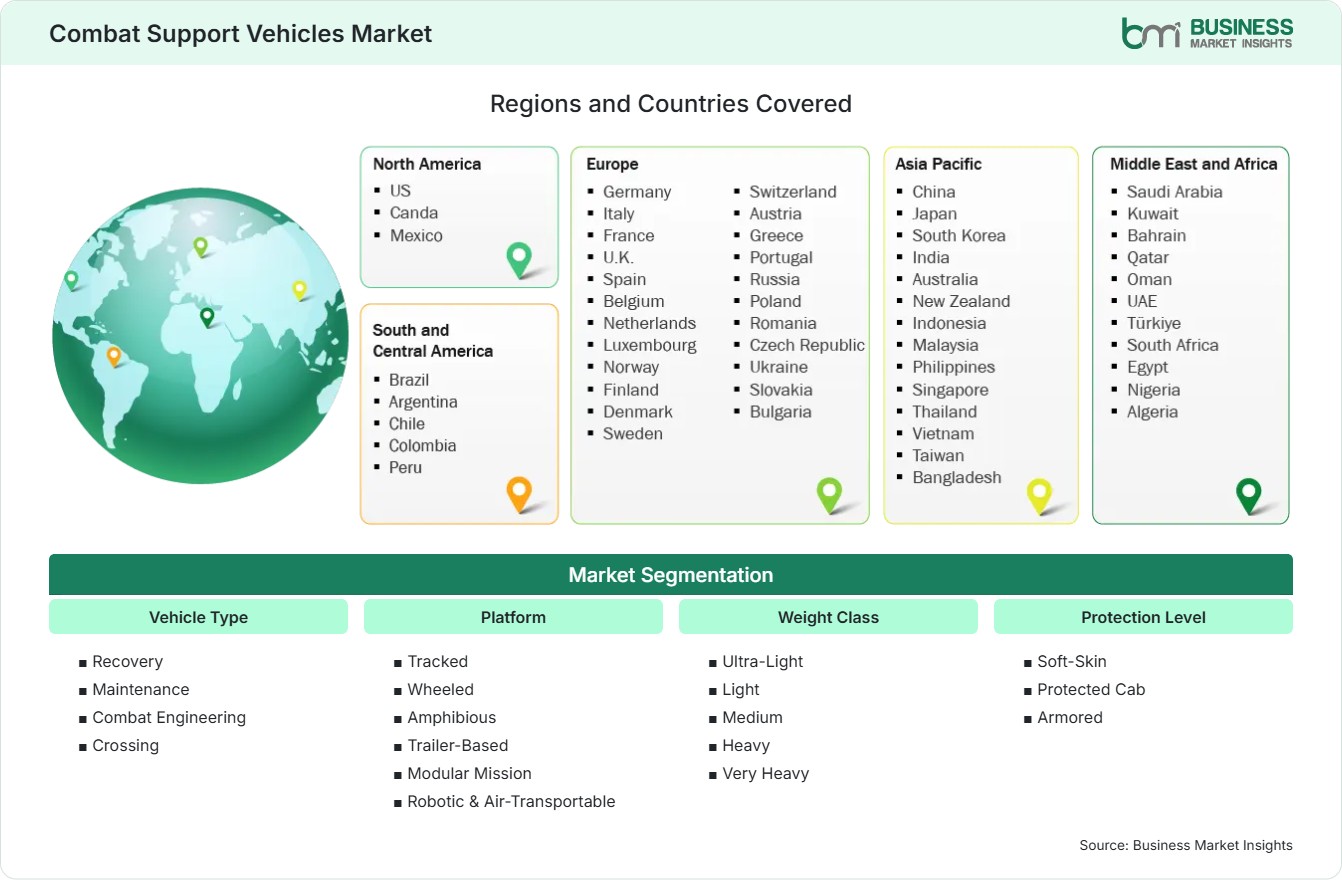
Global Market Geography
FREE PDF
Request your free sample
Request free sample
Segment Analysis

Combat Support Vehicles Market Segmentation

Vehicle Type

The Vehicle Type holds a substantial market share, with estimates ranging from 28%-31% in 2025, while the market is expected to grow at a CAGR of 9.6%-10.3%. Factors driving growth in the market include increased demand for combat mobility, engineering, force sustainment, and recovery capabilities. Procurement strategies increasingly emphasize multi-role functionality and operational flexibility.

  • Recovery: Essential for damaged vehicle extraction and battlefield sustainment, supporting operational continuity while reducing equipment losses during high-intensity missions.
  • Maintenance: Enables field repair operations, minimizing downtime and improving readiness through deployable maintenance capabilities and integrated technical support functions.
  • Combat Engineering: Supports obstacle clearance, route preparation, fortification, and mobility enhancement tasks required across contemporary military operations.
  • Crossing: Addresses military bridging and water obstacle mobility requirements through specialized deployment systems supporting rapid troop and equipment movement.

Platform

The platform category has the maximum operational deployment base. The scope of the Combat Support Vehicles Market is continually expanding due to growing demand for modular and adaptable architectures. The segment accounted for around 30%-33% market share in 2025 and is anticipated to expand at a 9.8%-10.5% CAGR.

  • Tracked: Preferred for demanding terrain conditions, delivering superior mobility, survivability, and compatibility with armored combat formations.
  • Wheeled: Favored for rapid deployment, lower operating costs, and strategic mobility across broad operational environments.
  • Amphibious: Supports water-crossing and littoral operations where mobility across mixed terrain remains critical.
  • Trailer-Based: Provides mission-specific support capabilities with flexible logistics deployment and transport efficiency.
  • Modular Mission: Enables reconfiguration according to operational objectives, enhancing procurement efficiency and fleet utilization.
  • Robotic & Air-Transportable: Expands autonomous mission capability while supporting rapid expeditionary deployment requirements.

Weight Class

Weight Class segmentation accounted for roughly 18%–21% share in 2025 and is projected to achieve 9.4%–10.1% CAGR. Vehicle selection depends on transportability, protection requirements, payload capacity, and force structure priorities.

  • Ultra-Light: Optimized for rapid mobility, air transport, and expeditionary operations in challenging environments.
  • Light: Balances deployability and operational flexibility for support and reconnaissance-oriented missions.
  • Medium: Provides versatile capability across engineering, recovery, and sustainment requirements.
  • Heavy: Supports armored formations requiring enhanced payload capacity and survivability.
  • Very Heavy: Designed for major engineering and recovery tasks involving substantial battlefield support demands.

Protection Level

Protection-oriented procurement remains central to force survivability. This segment held approximately 15%–18% share in 2025 and records 9.7%–10.4% CAGR of the Combat Support Vehicles Market as operational risks evolve.

  • Soft-Skin: Cost-effective solutions primarily serving rear-area support and logistics missions.
  • Protected Cab: Offers greater crew protection while maintaining operational flexibility and manageable lifecycle costs.
  • Armored: Supports frontline missions requiring high survivability against kinetic and explosive threats.

Propulsion

Propulsion technologies are undergoing gradual transformation, representing 11%–14% segment share in 2025 with CAGR between 10.1%–10.9%. Sustainability and energy resilience shape procurement preferences.

  • Diesel ICE: Continues to dominate military fleets due to proven reliability and established support infrastructure.
  • Electric: Gains attention for silent mobility, energy efficiency, and operational flexibility benefits.
  • Auxiliary: Enhances onboard energy management while reducing fuel consumption during stationary operations.
  • Powertrain: Integrates advanced mobility technologies supporting future operational requirements.

Procurement Model

Procurement models influence acquisition economics and readiness outcomes. The segment accounted for approximately 10%–12% share in 2025 and is expected to expand at 9.3%–10.0% CAGR.

  • New-Build Vehicles: Preferred where comprehensive capability modernization and lifecycle longevity are priorities.
  • Platform Conversion: Provides cost-effective capability expansion using existing military inventories.
  • Retrofit: Extends operational life through targeted technology, survivability, and systems upgrades.

End User

End-user demand remains concentrated within land forces and expeditionary units. This segment represented approximately 14%–17% share in 2025 and records 9.8%–10.6% CAGR.

  • Army: Largest procurement contributor owing to broad operational mobility and engineering requirements.
  • Marine: Emphasizes expeditionary support, amphibious mobility, and rapid deployment capabilities.
  • Operations: Supports specialized missions demanding versatile and adaptable support platforms.
Market Forces

Combat Support Vehicles Market Dynamics

Key Market Drivers

Increasing Military Modernization Investments

The amount spent on global defense recently surpassed US$2.4 trillion, spurring investments in mobility, logistics, and engineering platforms. Defense spending in NATO countries is increasing, while Indo-Pacific countries continue their modernization programs. Combat Support Vehicles Market trends reveal that support vehicles are crucial for maintaining troops' operational capability, mobility, and maneuver. Requirements for procurement are now extending from combat vehicles to include engineering, recovery, and support platforms capable of functioning in challenging environments. Modern military doctrines require resilient sustainment capabilities, driving fleet replacement programs and adoption of digitally connected support platforms across multiple regions.

Expansion of Battlefield Mobility Requirements

The key elements of military operations include rapid deployment, engineering assistance, road clearance, and obstacle crossing. To be successful on the battlefield, forces must have vehicles that enable them to move quickly. The need for new recovery systems, combat engineering vehicles, and bridging equipment is increasing due to frequent expeditionary operations. Advanced mobility support helps to eliminate operational constraints and improve efficiency. Modern sensors, remote systems, and diagnostic capabilities contribute to the growing interest among defense organizations seeking improved battlefield sustainment performance.

Digitalization and Autonomous Support Technologies

The emergence of advanced communication, autonomous navigation, predictive maintenance, and vehicle health monitoring solutions is changing the nature of support fleets. Defense organizations are increasingly procuring systems capable of supporting network-centric warfare. The use of unmanned technologies makes the mission more efficient by exposing personnel to less risk. Such initiatives are helping drive shorter refresh cycles and are presenting opportunities for vendors of autonomous mobility, secure communication, and mission management systems.

Key Market Opportunities

Growth of Autonomous Engineering Support Platforms

Unmanned platforms offer exciting prospects for manufacturers who want to differentiate themselves. Unmanned recovery, route-clearance, and logistics platforms can operate in hostile environments without exposing personnel to risk. Increasing numbers of experiments conducted by NATO and Indo-Pacific military forces hint at possible future acquisitions. These platforms enable greater operational endurance and reduce the number of people needed for operations. Investments in artificial intelligence, autonomy, and remote missions will create numerous procurement opportunities for technology-based defense contractors during the forecast period.

Demand for Modular Multi-Mission Architectures

Defense customers are increasingly preferring vehicle designs that can perform multiple missions on a single vehicle. Modularity makes it easier to acquire the vehicles, simplifies maintenance, and makes fleets more flexible. As procurement budgets come under pressure for greater efficiency, buyers look for systems that can provide engineering, logistics, command, recovery, and transportation services in a reconfigurable form. Combat Support Vehicles Market Forecasts suggest an increasing preference for such architectures due to lifecycle benefits and operational adaptability.

Electrification and Advanced Power Management

The armed forces are investigating the use of hybrid electric vehicles, auxiliary power units, and innovative energy systems, which increase mission endurance. Electrification offers advantages in silent operation, energy management, and equipment capabilities, while reducing fuel costs. The future battlefield will need energy-hungry sensors, communication equipment, and autonomous technology. Thus, vendors with advanced power management solutions and electrified mobility capabilities should receive more attention from the military and research funding across major defense markets.

Market Restraints and Challenges

Budget Constraints and Procurement Delays

Factor: Even with increased defense spending, procurement will remain subject to budget cycles, government approval, and military demands. Impact: The procurement process can take a long time, which may affect the vehicles' delivery schedule. Large-scale support vehicle programs usually require extensive testing, localization, and industrial involvement. Allocating budgets to other programs, such as missiles, air defense, or naval equipment, could also delay the procurement process. These dynamics create uncertainty for manufacturers and may slow the deployment of next-generation support capabilities in some regions.

Complex Integration and Lifecycle Support Requirements

Factor: There is increased use of modern support vehicles, which incorporate more complex electronic systems, automation, communications technology, and survivability systems. Impact: Complexity increases the cost of development, maintenance, and operator training. Military organizations need to put in place the appropriate technical support structure and systems in place before mass production can be realized. There are additional issues arising from the supply chain of unique parts. The manufacturer faces challenges related to affordability and compatibility.

Company Analysis

Competitive Landscape

The current Combat Support Vehicles Market analysis reflects competition centered on mobility technology, armored engineering solutions, autonomous capabilities, and lifecycle sustainment expertise.

Company Name

Overview

Products and Services relevant to this market

BAE Systems plc

Global defense contractor with extensive armored vehicle and military support platform experience.

Recovery vehicles, engineering platforms, armored support systems, lifecycle services, modernization solutions.

Rheinmetall AG

Leading European land systems supplier focused on protected mobility and support vehicles.

Engineering vehicles, recovery systems, logistic support platforms, digital vehicle technologies.

General Dynamics Corporation

Major defense manufacturer serving land systems and military mobility requirements worldwide.

Armored support vehicles, sustainment solutions, tracked platforms, engineering support systems.

Oshkosh Corporation

U.S.-based specialist in tactical mobility and military transport technologies.

Heavy tactical vehicles, recovery systems, logistics mobility platforms, modernization services.

KNDS N.V.

European defense group delivering advanced armored and engineering vehicle solutions.

Bridging systems, support vehicles, engineering platforms, mobility enhancement technologies.

Hanwha Aerospace Co., Ltd.

Fast-growing defense manufacturer with expanding armored vehicle portfolio.

Support vehicles, tracked mobility systems, engineering mission equipment, modernization programs.

Iveco Defence Vehicles S.p.A.

Military mobility specialist focused on protected and tactical vehicle solutions.

Wheeled support vehicles, logistics platforms, troop support and recovery systems.

Leonardo S.p.A.

Defense technology provider supporting military land mobility and system integration.

Mission electronics, vehicle integration, communication solutions, sustainment support.

Textron Inc.

Diversified defense company offering advanced mobility and tactical mission capabilities.

Tactical vehicles, autonomous technologies, maintenance support solutions, mission systems.

ST Engineering Ltd.

Integrated defense engineering company serving military vehicle modernization needs.

Armored support vehicles, sustainment services, engineering and upgrade programs.

Trust & Transparency

Research Methodology

The market analysis combines proprietary research with secondary data from government agencies, company disclosures, regulatory filings, industry databases and expert interviews. Market estimates are validated through data triangulation, cross-market benchmarking and analyst review.

View Full Research Methodology

Questions Answered

Frequently Asked Questions

What does a Combat Support Vehicles Market Report typically cover?

It evaluates market size, competitive positioning, regional demand, procurement trends, technology developments, segmentation performance, investment opportunities, and forecast scenarios influencing industry growth.

Which platforms currently dominate demand?

Tracked platforms maintain leadership because they provide superior mobility, survivability, and compatibility with mechanized formations operating across complex and demanding terrain.

How are autonomous technologies influencing future vehicle designs?

Autonomous navigation, predictive maintenance, remote mission control, and unmanned sustainment capabilities are increasingly integrated to improve safety, efficiency, and operational persistence.

Which region offers the strongest long-term growth potential?

Asia Pacific presents the strongest growth outlook due to indigenous defense manufacturing, infrastructure development, force modernization, and sustained military investment across multiple countries.

What is driving procurement of combat support vehicles globally?

Military modernization, logistics resilience requirements, engineering mobility needs, and battlefield sustainment priorities are encouraging governments to acquire advanced recovery, bridging, maintenance, and engineering platforms.

Access the Full Combat Support Vehicles Market Report

Get segment-level forecasts, regional estimates, competitive benchmarking, company profiles and downloadable Excel datasets.

Access the full Combat Support Vehicles Market Report
350 pages PDF & Excel | 2026-09-16
Similar Research

Related Market Reports