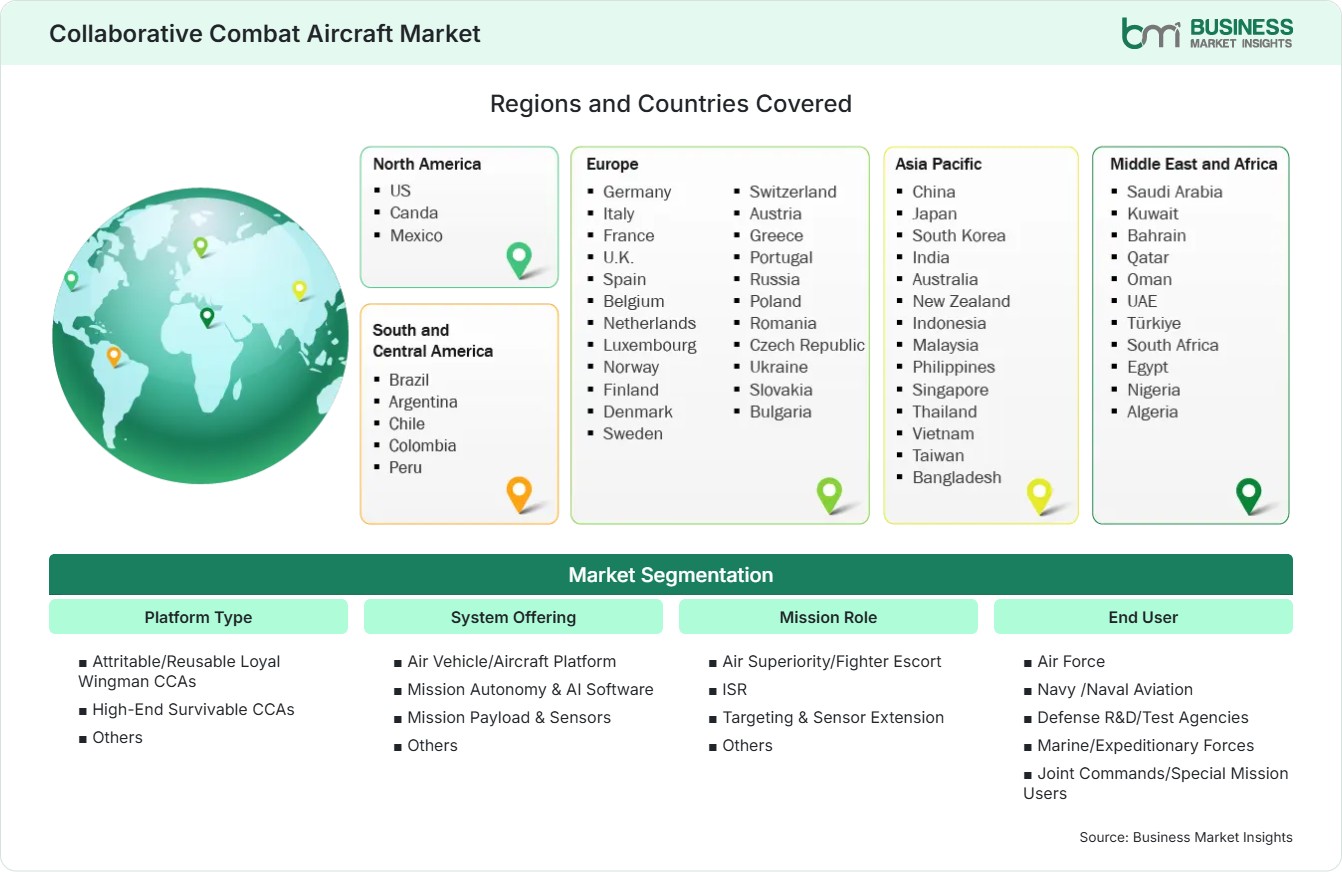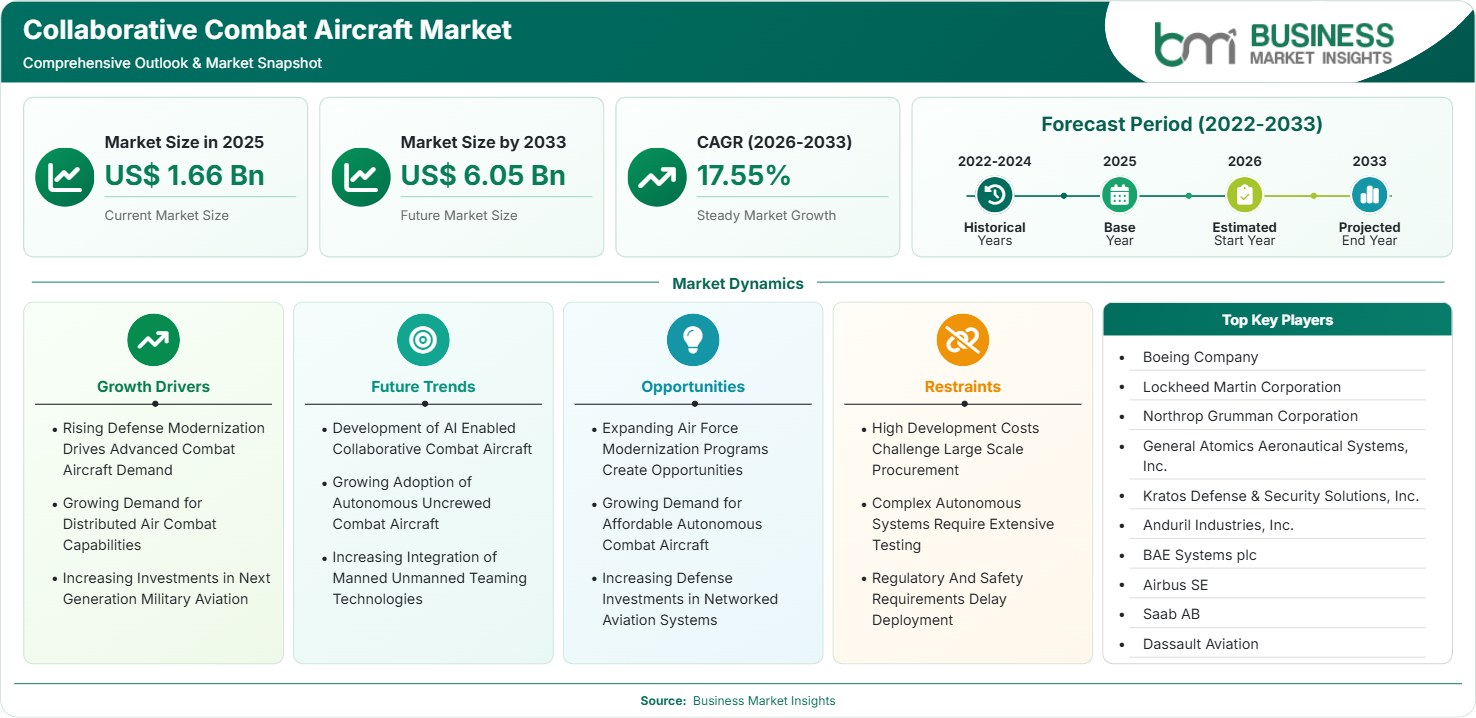
Collaborative Combat Aircraft Market Regional Highlights
North America Collaborative Combat Aircraft Market
North America holds a 35%–39% share in 2025 and is projected to advance at a 16.0%–18.0% CAGR through 2033. The region benefits from extensive defense testing infrastructure, established aerospace capabilities, and active procurement programs focused on distributed airpower.
- The US continues to be the prime consumer market, where purchases focus on cost-effective bulk, manned-unmanned cooperation, survivability, and integration into current fighter and command systems.
- Military organizations are more and more differentiating between aircraft procurement and mission autonomy solutions, which opens up room for software companies apart from aircraft producers.
- There is also Canada, where there can be found an opportunity due to aerospace capacities, allied interoperability demands, and defense modernization programs in North America.
US Collaborative Combat Aircraft Market
The US represents a 31%–35% of the North American share in 2025 and is advancing at a 16.5%–18.5% CAGR through 2033. Procurement programs, advanced testing capabilities, and strong defense technology investment create a substantial domestic demand base.
- Programs in the Air Force are concentrating on developing semi-autonomous aircraft that will be able to work with manned aircraft, but also increase their range and distributed combat capabilities.
- The separation of software for mission autonomy from airframes will allow for increasing competition and speeding up technology integration into future aircraft increments.
- Laboratories, flight test organizations, primes, and technology companies form a wide range of the ecosystem.
Europe Collaborative Combat Aircraft Market
Europe accounts for a 20%–24% share in 2025 and is advancing at a 15.0%–17.0% CAGR. Germany, the UK, France, Italy, Spain, and Sweden represent important demand centers, while Germany is positioned as a leading growth market.
- Germany has potential in this regard due to its plans to incorporate collaborative aircraft within future air force operations, along with the increasing demand for involvement of the domestic industry in these activities.
- The UK and France have the ability to take advantage of their respective aerospace industries and investment in high-tech combat aviation, sensors, and networking.
- Sweden and other European nations are sources of more integrated systems that can complement their fighter aircraft and specific mission requirements.
Asia Pacific Collaborative Combat Aircraft Market
Asia Pacific represents a 28%–32% share in 2025 and records the fastest growth at an 18.0%–20.0% CAGR. Australia, Japan, South Korea, India, and selected Southeast Asian markets provide diverse opportunities.
- Australia serves as an essential market for development due to the already existing unmanned combat aircraft programs and strong military cooperation with the US.
- Japan demonstrates an increased interest in air power capabilities, which makes it possible to implement interoperable systems for distributed sensors and combat operations.
- South Korea and India represent promising long-term markets due to domestic aerospace developments and modernization programs.
Rest of World Collaborative Combat Aircraft Market
Rest of World holds a 10%–14% share in 2025 and is projected to advance at a 14.0%–16.0% CAGR. Middle Eastern and Latin American markets offer selective opportunities linked to air force modernization and technology partnerships.
Middle East procurement can play an enabling role to drive the need for more sophisticated UAVs due to air force modernization and increased surveillance, escort, and distributed operations needs. Latin American countries' interest is more selective, and affordability, maintainability, interoperability, and mission flexibility will affect their adoption.
- Gulf States create situations in which airpower modernization programs are characterized by advanced sensor development, networked aircraft, and expanded operations.
- Aerospace environments related to Israel create an impact on regional technology transfer because of a high interest in unmanned systems and advanced mission systems.
- Brazil, alongside other Latin American areas, provides a sustainable opportunity whereby defense modernization coincides with the development of aerospace in the region.
- The international partnerships will improve market access through localization of maintenance, training, and technology adaptation.