
Low Cost Attritable Aircraft Market Outlook: Size, Share, Trends, Growth Analysis, Competitive Landscape & Forecast, 2026–2033

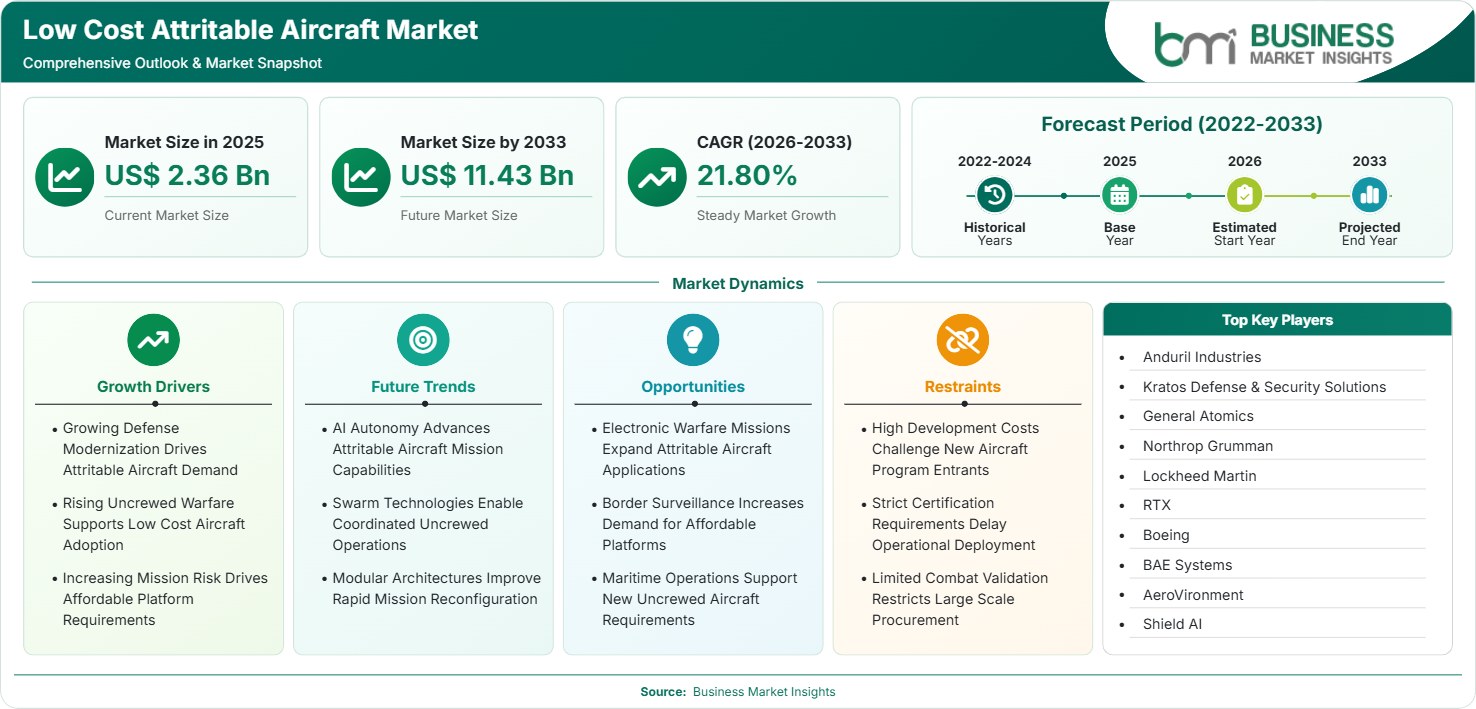
The Low Cost Attritable Aircraft Market size was valued at US$ 2.36 billion in 2025 and is projected to reach US$ 11.43 billion by 2033, growing at a CAGR of 21.80% during 2026–2033. Growing defense modernization programs, rising uncrewed warfare requirements, increasing demand for affordable mission platforms, autonomous technology advancement, and evolving military operational strategies are driving market expansion and creating new opportunities.

Report Coverage
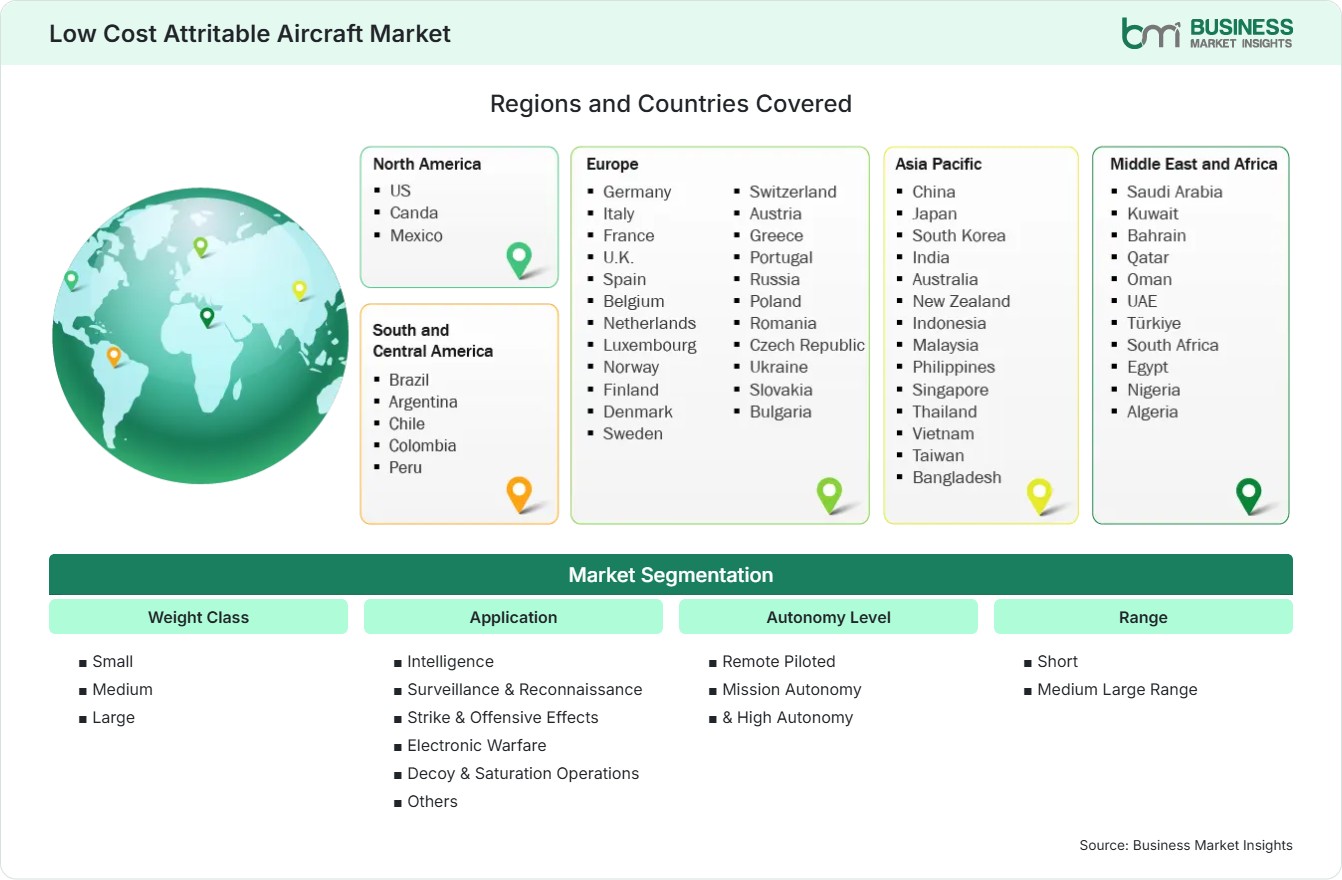
  • Weight Class: Small , Medium , Large
  • Application: Intelligence, Surveillance & Reconnaissance , Strike & Offensive Effects, Electronic Warfare, Decoy & Saturation Operations, Others
  • Autonomy Level: Remote Piloted, Mission Autonomy, & High Autonomy
  • Range: Short, Medium Large Range
  • End User: Army, Navy, & Airforce
US$ 2.36 Bn Market size in 2025
US$ 11.43 Bn Market Size by 2033
21.80% CAGR, 2026 - 2033
2026-2033 Forecast Period

01 AI Overview

Low Cost Attritable Aircraft Market Summary

  • North America Region: North America maintains a leading position with a share ranging between 42%–46% in 2025 and is projected to grow at a CAGR of 21.0%–21.8% through 2033. Strong defense spending, advanced aerospace capabilities, autonomous warfare initiatives, and procurement programs support regional adoption. The U.S. contributes approximately 85%–89% of North America’s market and is expected to grow at a CAGR of 21.2%–22.0%, driven by investments in scalable unmanned platforms, distributed operations, and next-generation combat systems.
  • Fastest Growing Region: Asia Pacific represents the fastest-growing region with a share ranging between 22%–26% in 2025 and is expected to expand at a CAGR of 22.5%–23.5% through 2033. Rising defense modernization, regional security requirements, autonomous technology investments, and increasing focus on cost-efficient military capabilities are accelerating adoption across emerging defense markets.
  • Leading Segment: Small Weight Class aircraft represent the leading segment with a share ranging between 48%–52% in 2025 and are projected to grow at a CAGR of 21.5%–22.3% through 2033. Lower production costs, operational flexibility, and suitability for distributed military missions support segment leadership.
  • High Growth Segment: Mission Autonomy represents the high-growth autonomy segment with a share ranging between 32%–36% in 2025 and a CAGR of 23.0%–24.0% through 2033. Advances in artificial intelligence, autonomous decision support, and reduced operator dependency are increasing adoption.
  • Key Market Opportunity: Expansion of electronic warfare, maritime surveillance, border monitoring, and distributed combat operations is creating opportunities for affordable autonomous aircraft platforms that provide scalable military capabilities.
  • Major Market Players: Anduril Industries, Kratos Defense & Security Solutions, General Atomics, Northrop Grumman Corporation, Lockheed Martin Corporation, RTX Corporation, The Boeing Company, BAE Systems plc, AeroVironment, Inc., and Shield AI.
02 Strategic Insights

Low Cost Attritable Aircraft Market: Strategic Insights

Low Cost Attritable Aircraft Market Strategic Framework
FREE PDF
Request your free sample
Request free sample
03 Stakeholder View

Key Takeaways

  • The market ecosystem includes defense contractors, autonomous technology developers, propulsion suppliers, software providers, and military organizations focused on affordable next-generation aviation capabilities.
  • Intelligence, surveillance, reconnaissance, electronic warfare, and strike missions provide strong growth opportunities due to increasing demand for scalable operational assets.
  • Innovation is shifting toward artificial intelligence-enabled autonomy, modular aircraft designs, advanced communication systems, and improved mission flexibility.
  • North America remains an attractive investment region due to defense technology leadership, military modernization programs, and strong unmanned systems development capabilities.
  • Companies are pursuing strategic partnerships, defense contracts, technology acquisitions, and production expansion initiatives to strengthen competitive positions.
  • Future market competitiveness will depend on balancing affordability, operational effectiveness, autonomous capability, and rapid manufacturing scalability for evolving defense requirements.
04 Geographic Outlook

Low Cost Attritable Aircraft Market Regional Highlights

North America Low Cost Attritable Aircraft Market

North America accounted for approximately 42%–46% of the market share in 2025 and is projected to grow at a CAGR of 21.0%–21.8% through 2033. The region benefits from advanced aerospace capabilities, defense modernization programs, autonomous warfare initiatives, and strong military technology investments. The U.S. remains the primary contributor due to significant development activities and procurement interest in affordable uncrewed platforms.

  • Defense organizations are investing in attritable aircraft to enhance operational flexibility and support distributed military missions.
  • Aerospace companies are developing modular platforms focused on affordability, rapid production, and mission adaptability.
  • Autonomous technologies are improving aircraft capabilities for intelligence, surveillance, reconnaissance, and combat support applications.
  • Military modernization programs are encouraging adoption of scalable unmanned aviation solutions.

US Low Cost Attritable Aircraft Market

The U.S. represented approximately 85%–89% of North America’s market share in 2025 and is expected to grow at a CAGR of 21.2%–22.0% through 2033. Strong defense investments, advanced aerospace infrastructure, and increasing focus on autonomous military systems support market expansion. The country remains a major center for development and deployment of attritable aircraft technologies.

  • Defense agencies are increasing investments in affordable platforms for high-risk operational environments.
  • Aerospace contractors are expanding autonomous aircraft development programs through advanced technologies.
  • Military users are exploring scalable systems for enhanced mission coverage and operational resilience.
  • Research initiatives are supporting integration of artificial intelligence into unmanned aircraft operations.

Europe Low Cost Attritable Aircraft Market

Europe represented approximately 18%–22% of the Low Cost Attritable Aircraft Market share in 2025 and is projected to grow at a CAGR of 20.4%–21.2% through 2033. Germany, the United Kingdom, France, and other European defense markets are increasing investments in autonomous systems, surveillance capabilities, and affordable defense technologies. Regional security priorities are supporting demand for advanced unmanned platforms.

  • European defense organizations are evaluating attritable aircraft for intelligence and operational support missions.
  • Aerospace manufacturers are developing autonomous aviation technologies through collaborative defense programs.
  • Increasing defense modernization efforts are supporting investment in next-generation military systems.
  • Electronic warfare requirements are creating demand for adaptable unmanned platforms.

Asia Pacific Low Cost Attritable Aircraft Market

Asia Pacific accounted for approximately 22%–26% of the market share in 2025 and is expected to register the fastest growth with a CAGR of 22.5%–23.5% through 2033. China, India, Japan, South Korea, and regional defense markets are investing in unmanned capabilities due to changing security environments and modernization requirements.

  • Defense forces are adopting cost-efficient unmanned platforms to improve surveillance and operational capabilities.
  • Regional aerospace industries are increasing investments in autonomous aircraft development programs.
  • Border monitoring requirements are encouraging adoption of affordable aerial systems.
  • Maritime security applications are creating additional opportunities for attritable aircraft deployment.

Rest of World Low Cost Attritable Aircraft Market

The Rest of World region accounted for approximately 10%–14% of the market share in 2025 and is projected to grow at a CAGR of 19.5%–20.5% through 2033. Latin America, Middle East, and Africa markets are gradually exploring affordable unmanned aircraft solutions for surveillance, security, and defense modernization requirements.

Middle Eastern countries are investing in advanced defense technologies, while Latin American and African nations are evaluating cost-effective unmanned platforms for border protection and security operations.

  • Border surveillance requirements are increasing interest in affordable unmanned aircraft systems.
  • Defense modernization programs are creating opportunities for international technology suppliers.
  • Maritime monitoring applications are expanding demand for long-range autonomous platforms.
  • Regional security challenges are supporting adoption of flexible aerial solutions.
Global Market Geography
FREE PDF
Request your free sample
Request free sample
05 Segment Analysis

Low Cost Attritable Aircraft Market Segmentation

Weight Class

Small weight class aircraft represent the leading segment due to lower manufacturing costs, easier deployment, and suitability for distributed military operations. The Low Cost Attritable Aircraft Market scope is expanding as defense organizations prioritize scalable platforms that provide operational flexibility and affordable mission capabilities.

  • Small (Less than 1,500 kg MTOW): Small aircraft provide cost advantages and support surveillance, reconnaissance, and tactical mission applications.
  • Medium (1,500–4,500 kg MTOW): Medium platforms offer increased payload capacity and extended operational capabilities for advanced missions.
  • Large (More than 4,500 kg MTOW): Large aircraft support complex missions requiring greater endurance, payload capacity, and operational range.

Application

Intelligence, Surveillance & Reconnaissance (ISR) represents a major application segment due to increasing military demand for persistent monitoring and situational awareness. Expanding mission requirements are encouraging adoption across multiple defense applications.

  • Intelligence, Surveillance & Reconnaissance (ISR): ISR platforms provide real-time information collection and support battlefield awareness requirements.
  • Strike & Offensive Effects: These systems support affordable combat operations and precision mission capabilities.
  • Electronic Warfare: Electronic warfare applications utilize autonomous platforms for communication disruption and spectrum operations.
  • Decoy & Saturation Operations: Attritable aircraft support mission complexity through affordable distributed operational strategies.
  • Others: Additional applications include specialized defense missions requiring flexible unmanned capabilities.

Autonomy Level

Mission autonomy is gaining importance as defense users seek reduced operator involvement and improved operational efficiency. Advanced autonomous features are supporting complex missions and expanding aircraft capabilities.

  • Remote Piloted: Remote-controlled aircraft provide operational flexibility with human-controlled mission execution.
  • Mission Autonomy: Mission autonomous systems enable automated navigation, decision support, and operational assistance.
  • High Autonomy: High autonomy platforms support advanced missions with limited human intervention requirements.

Range

Medium range platforms are gaining attention due to their balance between operational reach, cost efficiency, and mission flexibility. Increasing demand for extended surveillance capabilities supports development across range categories.

  • Short: Short-range aircraft support tactical operations, local surveillance, and rapid deployment missions.
  • Medium Range (500 km to 1,500 km): Medium-range systems provide extended operational coverage for diverse defense applications.
  • Large Range (More than 1,500 km): Long-range platforms support strategic missions requiring broader geographic reach.

End User

Military forces remain the primary end users as defense organizations adopt attritable aircraft to improve operational effectiveness and reduce mission costs. Adoption is increasing across multiple service branches.

  • Army: Army applications include battlefield surveillance, tactical operations, and intelligence missions.
  • Navy: Naval forces utilize unmanned platforms for maritime monitoring and operational support.
  • Airforce: Air forces deploy advanced aircraft systems for surveillance, combat support, and autonomous missions.
06 Market Forces

Low Cost Attritable Aircraft Market Dynamics

Key Market Drivers

Growing Defense Modernization Drives Attritable Aircraft Demand

Defense establishments around the world are placing high emphasis on modernization efforts that offer flexible operations, lower acquisition costs, and greater mission capabilities. The use of low-cost attritable aircraft offers an alternative for scalable deployment of low-cost platforms in military operations. The Low Cost Attritable Aircraft Market's growth is driven by evolving defense approaches, the rising importance of autonomous solutions, and the need for cost-efficient force multiplication. Military establishments are using low-cost attritable aircraft in future warfare operations, where large numbers of low-cost platforms may support conventional platforms. Improvements in technologies related to manufacturing, artificial intelligence, and autonomous flight have been supporting this.

Rising Uncrewed Warfare Supports Low Cost Aircraft Adoption

The growing importance of uncrewed systems in contemporary warfare is driving a need for cost-effective aircraft capable of undertaking high-risk operations. Defense consumers have embraced attritable aircraft, which enhance operational survivability while minimizing reliance on costly manned systems. The platforms serve to gather intelligence, conduct electronic warfare, perform surveillance operations, and conduct tactical operations. Innovations in autonomous navigation technology, communications, and mission planning capabilities are enhancing the efficiency of such aircraft platforms. The growing acceptance of unmanned warfare is driving defense contractors to design cost-effective aircraft platforms.

Increasing Mission Risk Drives Affordable Platform Requirements

The number of military operations in contested environments has increased the need for aircraft capable of carrying out missions without incurring substantial costs for aircraft losses. There is an increase in the use of attritable aircraft, which offer an affordable means of conducting operations compared to conventional aircraft. The Low Cost Attritable Aircraft Market trend shows greater interest in aircraft with survivability, adaptability, and ease of replacement. The defense planners are analyzing this kind of aircraft for the missions that require persistence and cost-effectiveness. Manufacturers have reacted by incorporating modularity into their products to ensure high performance without compromising cost-effectiveness or production time.

Key Market Opportunities

Electronic Warfare Missions Expand Attritable Aircraft Applications

Requirements for electronic warfare are presenting new prospects for attritable aircraft, enabling cost-effective platforms to conduct spectrum operations, jam communications, and gather electronic intelligence. Such aircraft can provide operational benefits through their distributed nature and reduced exposure to risk. Growing reliance on networked warfare systems is prompting investments in platforms capable of performing sophisticated electronic warfare missions. The development of autonomous systems and mission-specific payloads is opening opportunities for applications beyond surveillance. Aerospace companies designing flexible aircraft and configurations for specific missions will be able to capitalize on increasing demand for such capabilities.

Border Surveillance Increases Demand for Affordable Platforms

There is a growing need for border security, which is creating opportunities for low-cost unmanned aircraft that can provide persistent surveillance and intelligence. There is an increasing requirement from government agencies and military bodies to develop cost-efficient platforms that enhance surveillance capabilities without incurring high operational costs. Attritable aircraft will prove effective for surveillance missions in remote areas, security missions, and increased situational awareness. The Low Cost Attritable Aircraft Market forecast highlights future opportunities from the security mission as nations seek to develop their surveillance technology.

Maritime Operations Support New Uncrewed Aircraft Requirements

There is a growing need for unmanned aircraft to assist in carrying out surveillance, reconnaissance, and security missions over vast geographical areas in maritime operations. The Navy is looking at ways to acquire platforms that can help increase coverage in its operations while minimizing risks to both personnel and costly equipment. The attritable aircraft can be used to increase maritime awareness through distribution and improved sensor technology. The growing emphasis on coastal security, fleet protection, and ocean surveillance is leading to new applications for unmanned platforms. Manufacturers of aircraft designed for marine conditions, long-endurance capabilities, and autonomous operation can take advantage of these opportunities.

Market Restraints and Challenges

High Development Costs Challenge New Aircraft Program Entrants

Factor: The development of attritable aircraft requires substantial investment in aerospace engineering, autonomous systems, testing facilities, and advanced manufacturing technologies. Impact: Costly development processes could become an obstacle for small firms seeking to enter the industry and compete with existing defense companies. Although these aircraft were designed to be affordable, their research and development are rather costly. Firms have to find the right balance between cost reduction and performance. Strategic alliances, government contracts, and technological cooperation may help achieve lower costs and involve more businesses in aerospace projects.

Strict Certification Requirements Delay Operational Deployment

Factor: Military aircraft programs require extensive testing, validation, regulatory approvals, and operational certification before deployment. Impact: Complex certification procedures can delay introduction timelines and increase program costs for attritable aircraft developers. Defense organizations must ensure reliability, safety, communication security, and mission effectiveness before integrating new platforms into operations. These requirements may slow commercialization despite strong demand for affordable unmanned systems. Manufacturers are addressing challenges through simulation, digital engineering, iterative testing approaches, and collaboration with defense agencies to streamline development processes while maintaining required performance and operational standards.

07 Company Analysis

Competitive Landscape

The Low Cost Attritable Aircraft Market analysis highlights competition among aerospace manufacturers, defense technology companies, autonomous system developers, and military solution providers focused on affordable unmanned aviation platforms. Companies are emphasizing modular designs, autonomous capabilities, strategic partnerships, and scalable production methods to address evolving defense requirements.

Company Name

Overview

Products and Services relevant to this market

Anduril Industries

Defense technology company focused on autonomous systems and AI-enabled solutions.

Autonomous aircraft platforms, mission systems, defense software, and unmanned technologies.

Kratos Defense & Security Solutions

Defense contractor specializing in unmanned systems and target aircraft.

Attritable aircraft systems, tactical drones, autonomous platforms, and defense technologies.

General Atomics

Aerospace company developing advanced unmanned aircraft systems.

Military unmanned aircraft, surveillance platforms, and autonomous aviation solutions.

Northrop Grumman Corporation

Global aerospace and defense company providing advanced military systems.

Unmanned aircraft, autonomous technologies, aerospace systems, and defense solutions.

Lockheed Martin Corporation

Defense technology company developing advanced aerospace platforms.

Military aircraft systems, autonomous technologies, and defense aviation solutions.

RTX Corporation

Aerospace and defense company providing advanced military technologies.

Sensors, defense systems, aerospace technologies, and mission solutions.

The Boeing Company

Aerospace manufacturer supporting military aviation programs.

Defense aircraft, autonomous systems, and advanced aerospace platforms.

BAE Systems plc

Defense company developing military technologies and platforms.

Autonomous systems, electronic warfare solutions, and defense technologies.

AeroVironment, Inc.

Unmanned systems company specializing in tactical aircraft.

Small unmanned aircraft, loitering systems, and autonomous platforms.

Shield AI

Artificial intelligence defense company focused on autonomous operations.

AI-enabled aircraft autonomy, unmanned systems, and military software solutions.

10 Trust & Transparency

Research Methodology

The market analysis combines proprietary research with secondary data from government agencies, company disclosures, regulatory filings, industry databases and expert interviews. Market estimates are validated through data triangulation, cross-market benchmarking and analyst review.

View Full Research Methodology

11 Questions Answered

Frequently Asked Questions

What does the Low Cost Attritable Aircraft Market report indicate about future competition?

The report indicates that competition will focus on autonomous capabilities, modular aircraft designs, rapid production methods, and mission-specific solutions. Companies that combine affordability with advanced technology integration are expected to strengthen their positions.

Why are defense organizations adopting low cost aircraft platforms?

Defense organizations are adopting these platforms to increase operational capacity, reduce procurement costs, and support missions where traditional aircraft may involve higher financial or operational risks.

How are autonomous technologies changing attritable aircraft development?

Autonomous technologies are enabling improved navigation, mission execution, decision support, and reduced operator dependency. These advancements are helping manufacturers develop aircraft capable of performing complex missions in challenging operational environments.

Which applications present the strongest opportunity in the market?

Intelligence, surveillance, reconnaissance, electronic warfare, border monitoring, and maritime operations present strong opportunities. These applications benefit from affordable platforms capable of supporting distributed missions and improving operational coverage.

What factors are improving Low Cost Attritable Aircraft Market return on investment?

Lower production costs, scalable manufacturing, reduced mission risk, and autonomous capabilities are improving return on investment. Attritable aircraft allow defense organizations to deploy affordable platforms for high-risk missions while maintaining operational flexibility and reducing reliance on expensive traditional aircraft.

Access the Full Low Cost Attritable Aircraft Market Report

Get segment-level forecasts, regional estimates, competitive benchmarking, company profiles and downloadable Excel datasets.

Access the full Low Cost Attritable Aircraft Market Report
350 pages PDF & Excel | 2026-08-11