
Cloud Telephony Service Market Outlook: Size, Share, Trends, Growth Analysis, Competitive Landscape & Forecast, 2026-2033

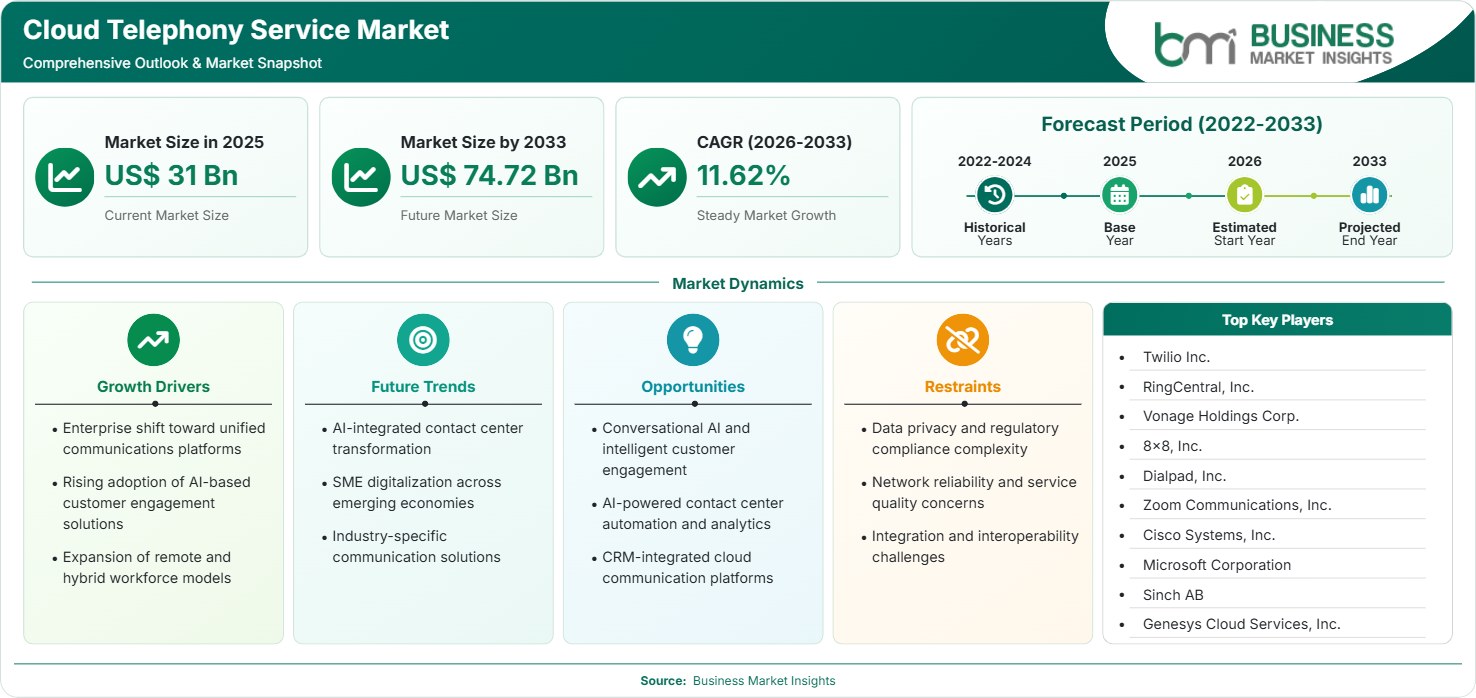
The Cloud Telephony Service Market size was valued at US$ 31 billion in 2025 and is projected to reach US$ 74.72 billion by 2033, growing at a CAGR of 11.62% during 2026–2033, driven by enterprise digital communications, AI-enabled customer engagement, remote work adoption, omnichannel integration, cloud migration initiatives, and rising demand for scalable business voice infrastructure.

Report Coverage
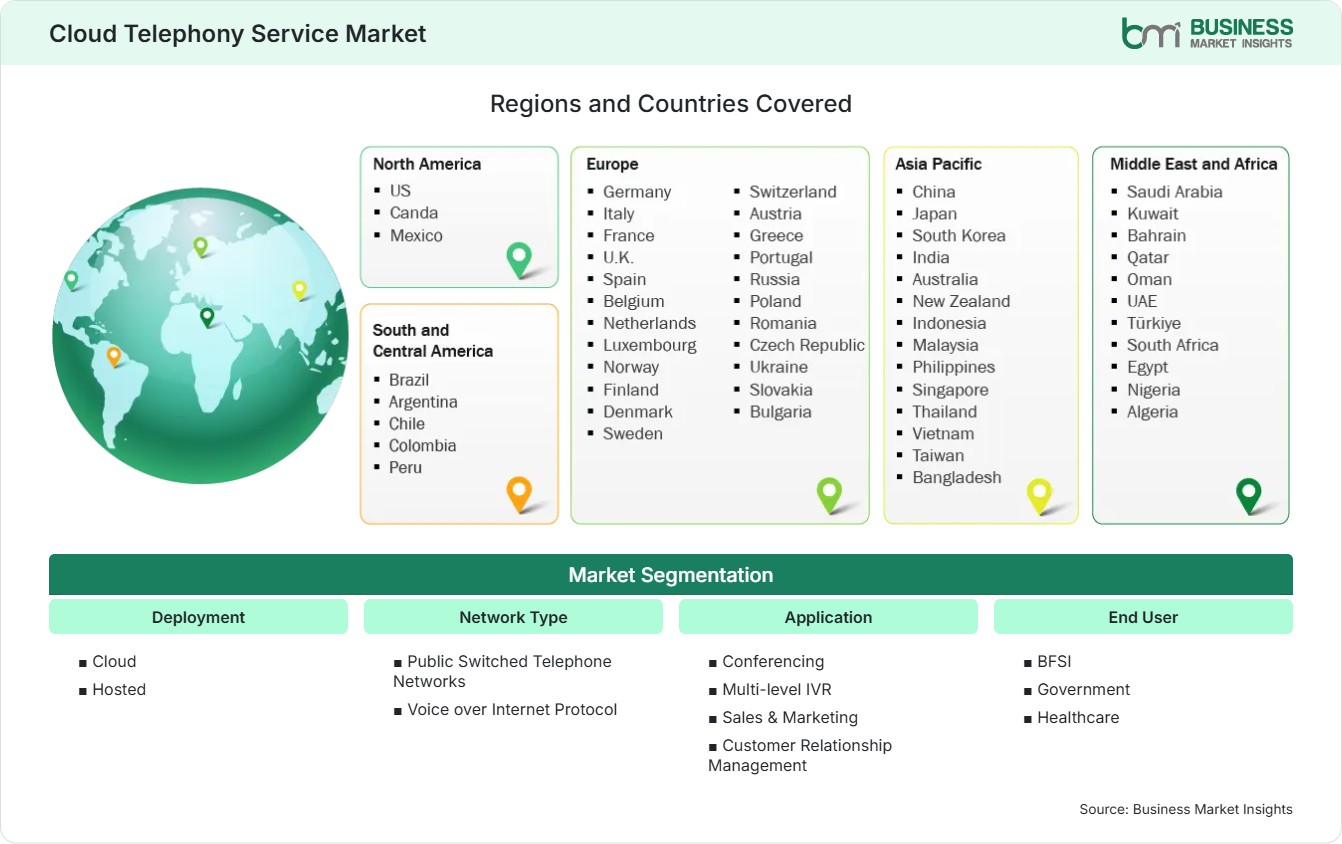
  • Deployment: Cloud, Hosted
  • Network Type: Public Switched Telephone Networks, Voice over Internet Protocol
  • Application: Conferencing, Multi-level IVR, Sales & Marketing, Customer Relationship Management
  • End User: BFSI, Government, Healthcare
US$ 31 Bn Market size in 2025
US$ 74.72 Bn Market Size by 2033
11.62% CAGR, 2026 - 2033
2026-2033 Forecast Period

AI Overview

Cloud Telephony Service Market Summary

  • North America Region: Holds a market share of 34%–37% in 2025, growing at a CAGR of 10.2%–11.0% during 2026–2033. Strong UCaaS adoption, AI-powered contact centers, hybrid workforce expansion, cloud migration strategies, and enterprise communication modernization continue supporting long-term investment opportunities across industries. US market benefits from mature cloud communications ecosystems, advanced AI deployment, and 10.4%–11.2% CAGR outlook.
  • Fastest Growing Region: Asia Pacific accounts for 25%–28% share in 2025 and advances at 13.5%–14.5% CAGR through 2026–2033. Expanding SME digitization, rising broadband penetration, growing SaaS ecosystems, mobile-first enterprises, and government-backed digital transformation programs create substantial opportunities for providers and investors.
  • Leading Segment: Voice over Internet Protocol holds 58%–62% share in 2025 and records 12.0%–13.0% CAGR. Organizations prioritize lower communication costs, flexible scalability, unified communications integration, enhanced call quality, and analytics-enabled customer engagement platforms supporting operational efficiency objectives.
  • High Growth Segment: Customer Relationship Management applications represent 18%–22% share in 2025 and expand at 13.8%–14.8% CAGR. Growing customer experience investments, data-driven engagement strategies, AI-assisted workflows, omnichannel communications, and cloud-based sales enablement platforms strengthen deployment momentum globally.
  • Key Market Opportunity: Integration of conversational AI, analytics, and cloud communications enables intelligent customer interactions, operational automation, improved agent productivity, personalized engagement, and recurring revenue expansion across enterprise vertical environments globally.
  • Major Market Players: Twilio Inc., RingCentral, Inc., Vonage Holdings Corp., 8x8, Inc., Dialpad, Inc., Zoom Communications, Inc., Cisco Systems, Inc., Microsoft Corporation, Sinch AB, and Genesys Cloud Services, Inc.
Strategic Insights

Cloud Telephony Service Market: Strategic Insights

Cloud Telephony Service Market Strategic Framework
FREE PDF
Request your free sample
Request free sample
Stakeholder View

Key Takeaways

  • The value chain is shifting from standalone voice providers toward integrated communication ecosystems combining telephony, collaboration, analytics, AI, CRM integration, and contact-center functionality.
  • CRM-linked communication workflows and intelligent customer engagement applications present the strongest revenue upside as enterprises prioritize customer retention and personalized service delivery.
  • AI-powered call routing, speech analytics, automated transcription, and virtual assistants are becoming core differentiators influencing vendor selection and platform modernization decisions.
  • Asia Pacific offers a compelling investment case due to accelerating SME digitization, cloud infrastructure development, and government-supported digital economy programs.
  • Strategic acquisitions continue to reshape the competitive environment as vendors seek capabilities in conversational AI, customer experience management, and cloud contact-center technologies.
  • Regulatory focus on data security and communications compliance is increasing demand for enterprise-grade platforms with advanced governance and monitoring capabilities.
Geographic Outlook

Cloud Telephony Service Market Regional Highlights

North America Cloud Telephony Service Market

North America accounted for 34%–37% of global revenue in 2025 and is expected to expand at a 10.2%–11.0% CAGR through 2033. The region benefits from advanced cloud infrastructure, mature UCaaS adoption, extensive enterprise modernization initiatives, and widespread deployment of AI-enabled customer experience platforms. The Cloud Telephony Service Market share remains highest in this region because organizations continue replacing legacy telephony systems with scalable cloud-native alternatives supporting hybrid workplaces and digital customer engagement requirements.

  • Enterprises increasingly adopt integrated communication platforms linking telephony, collaboration, analytics, and workflow automation capabilities.
  • Contact-center modernization programs remain a major investment area across BFSI, healthcare, and technology sectors.
  • Strong cloud infrastructure and cybersecurity investments enhance reliability and enterprise adoption confidence.
  • AI-driven speech analytics and intelligent routing improve customer service productivity and service quality.
  • Strategic partnerships between cloud vendors and telecom operators accelerate innovation and deployment efficiency.

US Cloud Telephony Service Market

The United States represents approximately 76%–80% share within North America and is projected to register a 10.4%–11.2% CAGR during the forecast period. Enterprise cloud communications investments remain robust as organizations prioritize digital engagement strategies, remote workforce enablement, and intelligent contact center solutions. Strong innovation ecosystems and high SaaS adoption continue supporting demand.

  • Large enterprises prioritize omnichannel communication platforms integrating customer service and sales functions.
  • Healthcare providers increasingly deploy secure cloud communications to improve patient engagement and coordination.
  • AI-enabled analytics, automation, and conversation intelligence are becoming standard procurement requirements.
  • Strong venture investment activity supports innovation across communication platform technologies.

Europe Cloud Telephony Service Market

Europe held 27%–30% share in 2025 and is forecast to expand at a 10.8%–11.8% CAGR through 2033. Demand is supported by digital workplace transformation, increasing cloud adoption, and regulatory emphasis on secure communications infrastructure. Germany remains the largest market, while Eastern European economies demonstrate stronger expansion rates. Organizations are deploying cloud-based communication tools to improve workforce collaboration and enhance customer experience operations.

  • Germany leads regional revenues, while Poland records among the highest growth rates near regional averages.
  • GDPR compliance requirements encourage adoption of secure enterprise communication environments.
  • Growing remote and hybrid work models drive investments in hosted communication platforms.
  • Financial services organizations remain major adopters of compliant cloud voice solutions.
  • Integrated UCaaS deployments continue replacing fragmented communications infrastructure.

Asia Pacific Cloud Telephony Service Market

Asia Pacific accounted for 25%–28% share in 2025 and is anticipated to achieve the fastest growth at 13.5%–14.5% CAGR. Rapid digitalization, expanding startup ecosystems, increasing broadband penetration, and large SME populations are driving deployment momentum. China, Japan, and India collectively represent significant revenue opportunities, while Southeast Asian markets deliver strong adoption potential. Regional Cloud Telephony Service Market growth is reinforced by expanding cloud investments and mobile-first business models.

  • India represents one of the fastest-growing national markets driven by SME cloud adoption.
  • Enterprises increasingly migrate from traditional PBX systems to cloud communication environments.
  • Expanding e-commerce sectors stimulate demand for scalable customer engagement infrastructure.
  • Government digital economy initiatives support technology modernization and cloud investments.
  • Growing AI adoption enhances value propositions across communication platforms.

Rest of World Cloud Telephony Service Market

Rest of World represents 10%–12% share of global revenue and is projected to expand at a 11.8%–12.8% CAGR. South and Central America benefit from improving enterprise connectivity and digital transformation spending. Middle East and Africa markets are supported by smart city initiatives, telecom modernization, and increasing cloud infrastructure investments.

  • Brazil remains the leading Latin American market, while Mexico demonstrates strong adoption momentum.
  • UAE leads Middle Eastern demand through smart government and digital transformation programs.
  • Telecom infrastructure upgrades improve service quality and cloud communication accessibility.
  • Growing SME participation creates opportunities for subscription-based communication offerings.
  • Expanding cloud data center investments strengthen regional deployment capabilities.
Global Market Geography
FREE PDF
Request your free sample
Request free sample
Segment Analysis

Cloud Telephony Service Market Segmentation

Deployment

Deployment solutions account for core platform adoption trends. This segment represented approximately 48%–52% market share in 2025 and is expected to expand at 11.0%–12.0% CAGR through the forecast period. Increasing enterprise migration from on-premises communications infrastructure, flexible scalability requirements, and subscription-based purchasing models strengthen demand. The Cloud Telephony Service Market scope continues expanding as organizations prioritize agility and cost optimization.

  • Cloud: Widely adopted for scalability, remote accessibility, rapid deployment, and integration capabilities supporting digital communication transformation across enterprises.
  • Hosted: Preferred among organizations seeking managed communication services with reduced infrastructure management burdens and predictable operational expenditure.

Network Type

Network Type remains fundamental to communication performance and adoption decisions. The segment contributes nearly 30%–34% share in 2025 and advances at 11.5%–12.5% CAGR. Enterprise demand increasingly favors internet-based communication architectures enabling flexibility, advanced functionality, and reduced communication expenditure across distributed work environments.

  • Public Switched Telephone Networks (PSTNs): Retains relevance in organizations requiring traditional connectivity, regulatory compliance, and established communication reliability.
  • Voice over Internet Protocol: Dominates adoption due to cost efficiency, scalability, global reach, and seamless integration with digital business applications.

Application

Applications represent the primary revenue-generation layer and account for 34%–38% share in 2025 with 12.0%–13.0% CAGR. Demand is driven by customer engagement modernization, collaboration requirements, sales optimization, and automation initiatives. The Cloud Telephony Service Market trends increasingly favor AI-enhanced communication workflows and analytics-enabled engagement models.

  • Conferencing: Supports distributed collaboration, business continuity, and workforce productivity across geographically dispersed teams.
  • Multi-level IVR: Improves call routing efficiency, self-service capabilities, and customer experience management.
  • Sales & Marketing: Enhances lead engagement, campaign tracking, and communication effectiveness through integrated workflows.
  • Customer Relationship Management: Strengthens customer retention, service personalization, and data-driven engagement strategies.

End User

End-user adoption patterns vary according to compliance requirements, communication intensity, and digital maturity levels. This segment held approximately 28%–32% share in 2025 and is projected to register 11.8%–12.8% CAGR through 2033 as organizations modernize customer communication infrastructure.

  • BFSI: Adopts secure cloud communications for customer engagement, compliance management, and operational efficiency improvements.
  • Government: Utilizes digital communication platforms to enhance citizen services, accessibility, and administrative coordination.
  • Healthcare: Deploys telephony solutions supporting patient engagement, appointment management, and healthcare collaboration workflows.
Market Forces

Cloud Telephony Service Market Dynamics

Key Market Drivers

Enterprise Shift Toward Unified Communications Platforms

Organizations are increasingly consolidating voice, messaging, video, and collaboration capabilities into unified environments. Industry uptake will be facilitated by the development of hybrid workforce models and increased use of SaaS applications. Companies want efficiency through management from one place and cost savings on their infrastructure needs. This creates a positive effect on the demand of the platform in large companies and SMEs. Increased need for smooth workflow communications leads to ongoing platform modernization. Moreover, increased integration with productivity tools and business applications increases adoption possibilities in the future.

Rising Adoption of AI-Based Customer Engagement Solutions

Artificial intelligence is transforming communication systems through automated call routing, speech analytics, transcription, sentiment analysis, and virtual assistant capabilities. Enterprises are investing heavily in technologies that enhance the efficiency of agents and customer satisfaction levels. The use of advanced analytics allows organizations to gain some insights from the conversation and improve the efficiency of operations. These advancements bring more value to the platforms and aid decision-making for deployments. The customer experience is becoming a key differentiator for organizations.

Expansion of Remote and Hybrid Workforce Models

Workplace flexibility remains a significant catalyst for cloud communication investments. Modern enterprises need communication solutions that can provide security, scalability, and independence from physical locations. Cloud-delivered telephony gives employees the ability to use enterprise-level communication solutions from various devices and locations. The technology trend is in line with the goals of mobility, resiliency, and continuity of the business. Acceptance of flextime work practices in both developed and developing nations is fueling the demand for communication solutions and managed services.

Key Market Opportunities

AI-Integrated Contact Center Transformation

The deployment of customer experience intelligence platforms that feature telephony, analytics, automation, and conversational AI is being made by enterprises more and more often today. This opens the door for vendors who can deliver tangible improvements to their customers’ operations. The use of predictive analytics, agent assistance systems, and automation allows for improving the quality of responses while lowering the costs. According to evolving Cloud Telephony Service Market Forecasts, intelligent communication environments are expected to emerge as core digital transformation priorities across service-centric industries.

SME Digitalization Across Emerging Economies

Small and medium-sized businesses represent a large untapped opportunity base, particularly in Asia Pacific, Latin America, and parts of Africa. Higher digital adoption rates, enhanced internet availability, and lower cost of communication solutions through subscriptions drive market penetration. Providers that enable easy implementations, offer flexible pricing models, and provide local presence are able to tap into a large customer base. SMEs' need for upgrading to communications is becoming increasingly capital-light.

Industry-Specific Communication Solutions

Vertical-tailored platforms addressing compliance, workflow integration, and sector-specific communication requirements offer substantial growth prospects. Financial companies need secure communication environments, healthcare businesses require engagement and scheduling capabilities, and governmental agencies require accessibility and reliability of communication channels. Providers that create customized products will be able to differentiate themselves from others and retain their customers for longer.

Market Restraints and Challenges

Data Privacy and Regulatory Compliance Complexity

Factor: Increasing global data protection regulations require communication providers to maintain rigorous governance, storage, and monitoring capabilities. Impact: Compliance duties will increase the cost and complexity of the implementation process for suppliers and customers. Companies with business operations in different jurisdictions will have difficulty maintaining a consistent framework of compliance and offering scalable communication solutions. Uncertainty around regulations and shifting legal obligations can cause delays in purchasing decisions. It is imperative for companies to keep on investing in security, monitoring, and compliance.

Network Reliability and Service Quality Concerns

Factor: Cloud communication performance depends heavily on internet connectivity quality, bandwidth availability, and infrastructure reliability. Impact: Disruptions to the services could directly impact customer engagement, business continuity, and user confidence. Organizations operating in environments with poor connectivity might face performance challenges that may impede adoption. To ensure satisfactory voice quality and uptime, organizations must continually invest in their network capabilities. This problem continues to be very pertinent in emerging market contexts.

Company Analysis

Competitive Landscape

The Cloud Telephony Service Market analysis indicates competition centered on AI capabilities, UCaaS functionality, CRM integration, global connectivity, analytics, and contact-center innovation.

Company Name

Overview

Products and Services relevant to this market

Twilio Inc.

Global cloud communications platform enabling programmable voice and customer engagement solutions.

Voice APIs, communication platforms, messaging, contact center integration, customer engagement tools.

RingCentral, Inc.

Leading UCaaS provider serving enterprises and SMEs worldwide.

Cloud PBX, business telephony, video meetings, contact center and collaboration solutions.

Vonage Holdings Corp.

Cloud communications specialist supporting enterprise digital engagement strategies.

VoIP services, communications APIs, unified communications and contact center solutions.

8x8, Inc.

Provider of integrated cloud communications and CX technologies.

Voice services, contact center applications, UCaaS platforms and analytics capabilities.

Dialpad, Inc.

AI-driven communications provider emphasizing productivity enhancement.

AI voice services, unified communications, contact center and conversation intelligence.

Zoom Communications, Inc.

Enterprise collaboration company expanding cloud calling capabilities.

Zoom Phone, conferencing, business communications and collaboration services.

Cisco Systems, Inc.

Global networking and communications technology leader.

Webex Calling, collaboration platforms, enterprise communications infrastructure.

Microsoft Corporation

Major enterprise software provider integrating communications across ecosystems.

Teams Phone, collaboration, cloud communications and productivity integrations.

Sinch AB

Communications platform company with strong global messaging presence.

Voice services, carrier connectivity, communications APIs and engagement solutions.

Genesys Cloud Services, Inc.

Customer experience and cloud contact center technology provider.

Cloud contact centers, telephony integration, analytics and AI engagement tools.

Trust & Transparency

Research Methodology

The market analysis combines proprietary research with secondary data from government agencies, company disclosures, regulatory filings, industry databases and expert interviews. Market estimates are validated through data triangulation, cross-market benchmarking and analyst review.

View Full Research Methodology

Questions Answered

Frequently Asked Questions

Why should organizations use a Cloud Telephony Service Market Report?

A comprehensive Cloud Telephony Service Market Report helps stakeholders assess competitive positioning, investment opportunities, technology shifts, regulatory influences, regional demand patterns, and future growth strategies.

What differentiates modern cloud telephony platforms from traditional PBX systems?

Modern platforms provide AI analytics, remote accessibility, subscription pricing, CRM integration, automation tools, omnichannel capabilities, and significantly faster deployment compared with traditional infrastructure.

How does VoIP influence long-term market development?

VoIP reduces operating costs, improves scalability, supports mobility, and enables integration with analytics and collaboration platforms, making it central to modern communication architectures.

What industries generate the highest demand for cloud telephony solutions?

BFSI, healthcare, government, retail, technology, and customer service-intensive industries represent the largest demand centers due to their communication-intensive operational requirements.

What factors are accelerating cloud telephony adoption across enterprises?

Cloud-based communication flexibility, AI integration, lower infrastructure costs, remote-work support, and omnichannel customer engagement requirements are driving enterprise deployment decisions globally.

Access the Full Cloud Telephony Service Market Report

Get segment-level forecasts, regional estimates, competitive benchmarking, company profiles and downloadable Excel datasets.

Access the full Cloud Telephony Service Market Report
350 pages PDF & Excel | 2026-08-31