Market Summary
Executive Summary and Global Market Analysis
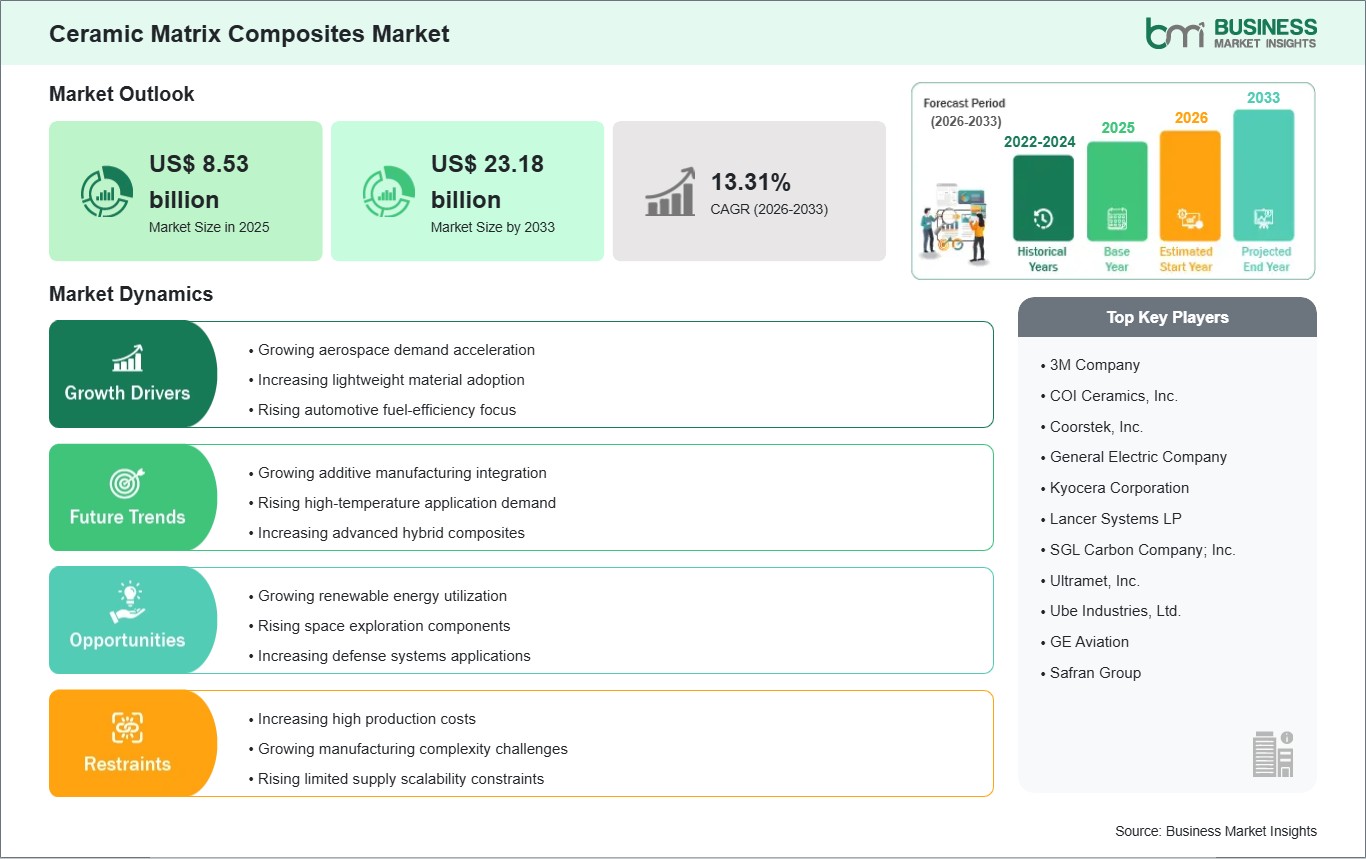
Ceramic matrix composites (CMCs) are engineered materials made of ceramic fibers set in a ceramic matrix. They offer high strength, toughness against fractures, and resistance to extreme temperatures and corrosive conditions. CMCs are popular in aerospace, defense, energy, and automotive industries because they are lightweight and can keep their structure under high thermal and mechanical stress. They are commonly used in aircraft engines, gas turbines, heat shields, braking systems, and industrial processing equipment, where they help improve fuel efficiency, cut emissions, and extend the life of components.
Market growth stems from the rising demand for lightweight and high-performance materials in aerospace and defense, especially in new aircraft and propulsion systems. The growth of renewable and traditional power generation infrastructure, along with improvements in turbine technology, also promotes their use. Additionally, more investments in research and development, a greater focus on energy efficiency and reducing carbon emissions, and the need for durable materials that work well in harsh conditions are speeding up the use of ceramic matrix composites in both developed and developing markets.
Segment Analysis
Ceramic Matrix Composites Market Segmentation
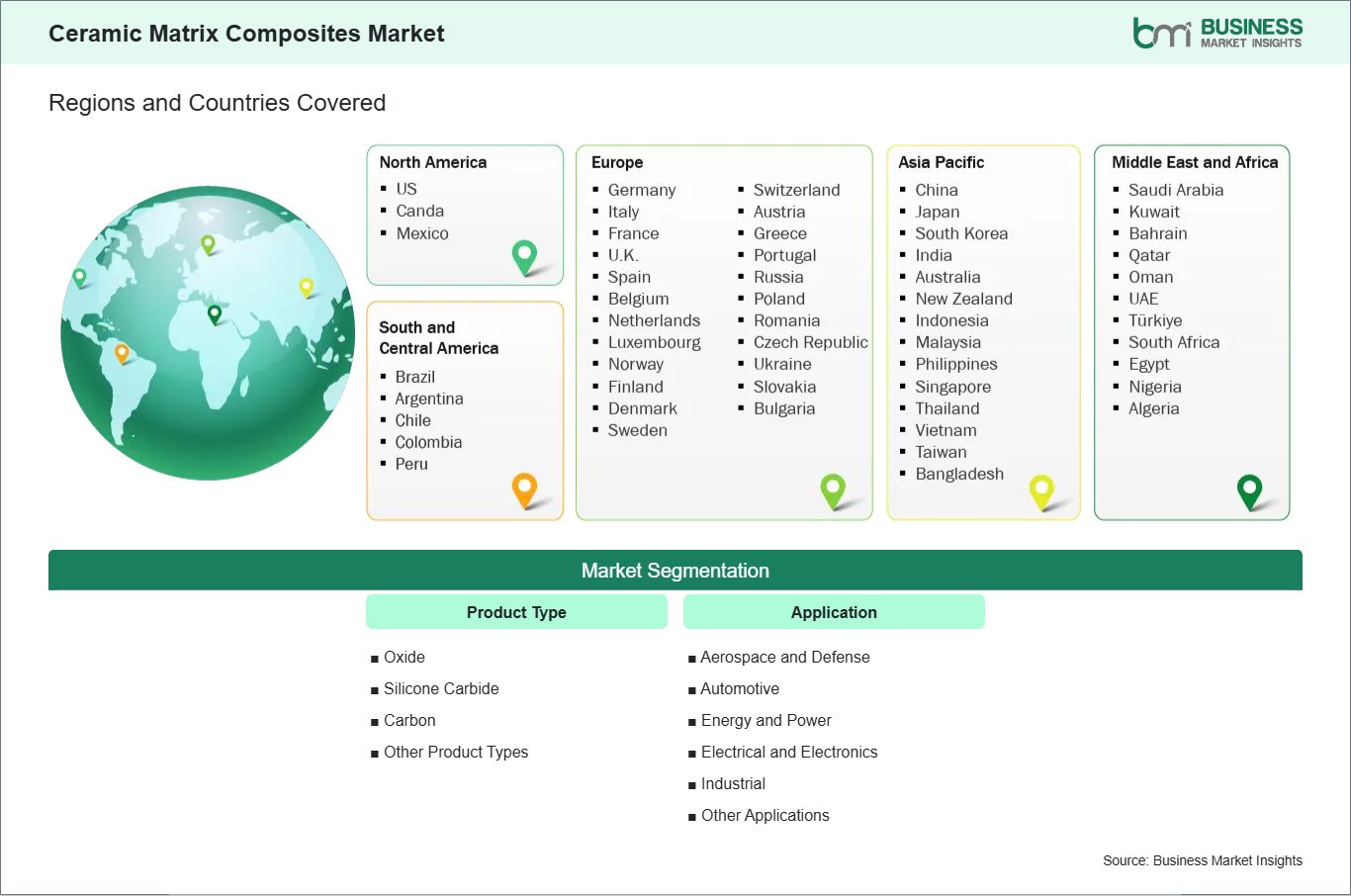
Key segments that contributed to the derivation of the ceramic matrix composites market analysis are product type and application.
- By product type, the ceramic matrix composites market is segmented into oxide, silicon carbide, carbon, and others. The silicon carbide segment held the largest market share in 2025.
- By application, the ceramic matrix composites market is segmented into aerospace and defense, automotive, energy and power, electrical and electronics, industrial, and others. The aerospace and defense segment held the largest market share in 2025.
Market Forces
Ceramic Matrix Composites Market Drivers and Opportunities
Rising Demand in Aerospace and Defense Applications
The increasing need for advanced materials in aerospace and defense is a major factor driving the ceramic matrix composites market. These composites mix the high-temperature capability of ceramics with improved toughness and damage resistance. This combination allows for reliable performance under extreme mechanical and thermal stress. In both commercial and military aviation, manufacturers are using ceramic matrix composites more frequently in turbine shrouds, combustor liners, nozzles, and exhaust structures to boost fuel efficiency and cut aircraft weight. Their ability to operate at much higher temperatures than conventional superalloys enables engines to run hotter with less cooling needed, which helps improve propulsion efficiency and reduce emissions.
Additionally, longer component life and lower maintenance requirements lead to reduced lifecycle costs for operators. Increased aircraft production rates, fleet upgrades, and steady defense spending in key markets are driving innovation in propulsion and structural systems. As aerospace OEMs continue to focus on reducing weight, durability, and optimizing performance, ceramic matrix composites are becoming increasingly important in next-generation engine platforms and hypersonic and space applications.
Expansion in Energy and Power Generation Applications
Growing global investments in energy and power generation infrastructure present a significant growth opportunity for the ceramic matrix composites market. These materials offer excellent resistance to oxidation, corrosion, and thermal shock, making them suitable for harsh operating environments found in gas turbines, nuclear reactors, and advanced renewable energy systems. As utilities and equipment manufacturers aim to improve plant efficiency and cut emissions, ceramic matrix composites allow turbines and high-temperature components to operate at higher temperatures and pressures. This increases overall energy output and reliability.
The ongoing shift toward cleaner energy technologies, including hydrogen-based systems and concentrated solar power, is opening up more potential applications for high-performance ceramic components. Additionally, the modernization of aging power infrastructure in developed countries and new capacity additions in emerging markets are increasing the demand for durable, low-maintenance materials. Continuous research and development focused on improving manufacturability and cost efficiency is expected to boost commercial viability, positioning ceramic matrix composites as a key material solution for the next generation of high-efficiency power systems worldwide.
Size and Share Analysis
Ceramic Matrix Composites Market Size and Share Analysis
The ceramic matrix composites market demonstrates steady growth, with size and share analysis revealing evolving trends and competitive positioning among key players. The report examines subsegments categorized within product type, and application, offering insights into their contribution to overall market performance. By application, the aerospace and defense segment holds the largest market share. This dominance comes from the widespread use of ceramic matrix composites in high-temperature and high-stress environments, especially in aircraft engines, gas turbines, and defense systems. Silicon carbide-based ceramic matrix composites are highly valued for being lightweight, having strong thermal resistance, and offering exceptional mechanical strength compared to traditional superalloys. The industry prefers ceramic matrix composites because they improve fuel efficiency, lower emissions, and boost overall engine performance. Growth in this segment is driven by rising aircraft production, increased defense spending, and the ongoing demand for materials that support next-generation propulsion systems. Technological advancements in engine design and hypersonic applications are also promoting wider use.
Report Coverage
Ceramic Matrix Composites Market Report Coverage and Deliverables
The " Ceramic Matrix Composites Market Size and Forecast (2022 - 2033)" report provides a detailed analysis of the market covering below areas:
- Ceramic matrix composites market size and forecast at global, regional, and country levels for all the key market segments covered under the scope
- Ceramic matrix composites market trends, as well as market dynamics such as drivers, restraints, and key opportunities
- Ceramic matrix composites market analysis covering key market trends, global and regional framework, major players, regulations, and recent market developments
- Industry landscape and competition analysis covering market concentration, heat map analysis, prominent players, and recent developments for the ceramic matrix composites market
- Detailed company profiles, including SWOT analysis
Geographic Insights
Ceramic Matrix Composites Market Geographic Insights
The geographical scope of the ceramic matrix composites market report is divided into five regions: North America, Asia Pacific, Europe, the Middle East & Africa, and South & Central America. North America holds a significant share of the ceramic matrix composites market. This is due to its strong aerospace and defense manufacturing base and ongoing investment in material research and development. The existence of top aircraft engine makers, defense contractors, and space technology firms in the United States drives high demand for materials that can handle extreme conditions. Ceramic matrix composites are widely used in next-generation jet engines, turbine parts, and thermal protection systems, which help improve fuel efficiency and reduce emissions.
Additionally, large defense budgets and continuous modernization programs lead to regular purchases of advanced propulsion and structural technologies. The region also benefits from established research institutions, government-backed innovation programs, and close partnerships between industry and academic institutions, speeding up the commercialization of new composite technologies. Moreover, a greater emphasis on energy efficiency and advanced power generation systems supports the use of these composites in industrial gas turbines and other high-temperature applications.
Industry Activity
Recent Developments
The ceramic matrix composites market is evaluated by gathering qualitative and quantitative data post-primary and secondary research, which includes important corporate publications, association data, and databases. A few of the key developments in the ceramic matrix composites market are:
- In February 2026, General Atomics Electromagnetic Systems, working with Oak Ridge National Laboratory, announced an expansion of industrial manufacturing for ceramic matrix composites. This initiative focuses on developing improved CMCs for extreme environments, specifically for aerospace, defense, and industrial use.
- In April 2025, Firefly Aerospace, a US-based aerospace company, introduced a ceramic matrix composite rocket engine nozzle extension under a US Air Force contract. The nozzle, designed for high-temperature and high-stress environments, aims to reduce engine weight and improve launch vehicle performance.
Trust & Transparency
Research Methodology
The market analysis combines proprietary research with secondary data from government agencies, company disclosures, regulatory filings, industry databases and expert interviews. Market estimates are validated through data triangulation, cross-market benchmarking and analyst
review.
View Full Research Methodology
Key Sources Referred:
World Bank - Global Trade IndicatorsWorld Trade Organization (WTO)International Monetary Fund (IMF)International Trade Administration (ITA)Company WebsitesCompany Annual ReportsCompany Investor PresentationsInternational Committee on Composite Materials (ICCM)Aerospace Materials Division, SAE InternationalASM InternationalAmerican Ceramic Society (ACerS)