
Catalysts Market Outlook: Size, Share, Trends, Growth Analysis, Competitive Landscape & Forecast, 2026-2033

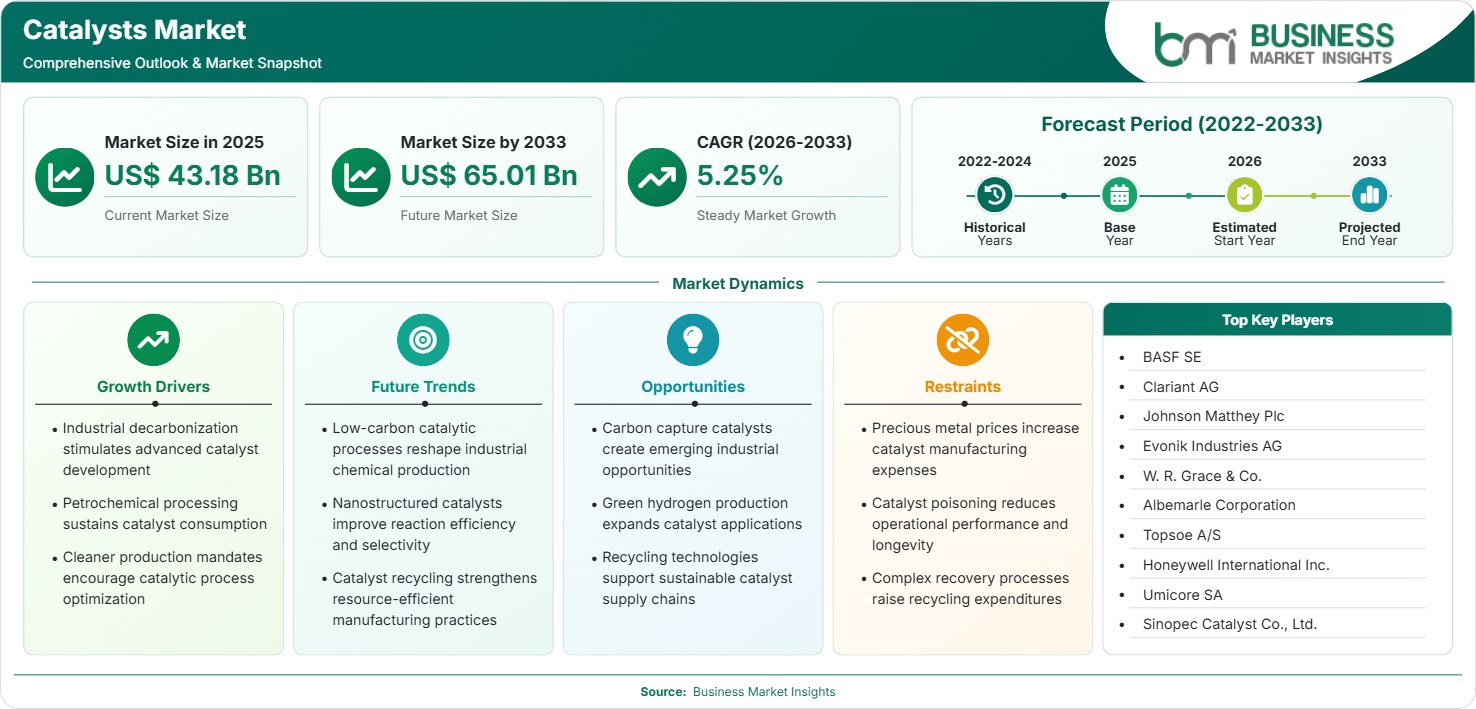
The Catalysts Market size was valued at US$ 43.18 Billion in 2025 and is projected to reach US$ 65.01 Billion by 2033, growing at a CAGR of 5.25% during 2026–2033. Growth is supported by stricter emissions regulations, refinery optimization, petrochemical expansion, hydrogen value-chain investments, sustainable fuel production, and rising adoption of advanced catalytic materials across industrial processing applications.

Report Coverage
  • Type: Heterogeneous Catalysts, Homogeneous Catalysts, Others
  • Application: Environmental, Chemical Synthesis, Polymer Catalysis, Petroleum Refining, Others
US$ 43.18 Bn Market size in 2025
US$ 65.01 Bn Market Size by 2033
5.25% CAGR, 2026 - 2033
2026-2033 Forecast Period

AI Overview

Catalysts Market Summary

  • North America Region: Holds 27%–30% share in 2025, growing at a CAGR of 4.6%–5.0% during 2026–2033. Growth is supported by refinery modernization, renewable fuel investments, emissions compliance, catalyst regeneration demand, industrial decarbonization strategies, hydrogen projects, specialty chemical production expansion, process efficiency enhancement, advanced manufacturing deployment, and energy security initiatives.
    US market analysis: Strong refining infrastructure and clean-fuel investments support a CAGR of 4.7%–5.1% through 2033.
  • Fastest Growing Region: Asia Pacific holds 38%–42% share in 2025 and grows at a CAGR of 5.9%–6.4% during 2026–2033. Growth stems from expanding chemicals output, refining capacity additions, environmental regulations, hydrogen development, manufacturing investments, urbanization, increasing plastics demand, energy-transition projects, higher industrial consumption, and catalytic process upgrades.
  • Leading Segment: Heterogeneous Catalysts command 68%–72% share in 2025 and expand at a CAGR of 5.0%–5.5%. Adoption remains driven by refinery processing, chemical production efficiency, catalyst recovery advantages, cost effectiveness, large-scale reaction suitability, operational stability, environmental performance requirements, and industrial process optimization.
  • High Growth Segment: Environmental applications account for 29%–33% share in 2025 and grow at a CAGR of 6.1%–6.6%. Expansion reflects emission-control mandates, clean transportation initiatives, industrial pollution reduction programs, circular economy measures, renewable energy investments, sustainability targets, air-quality improvements, and decarbonization strategies.
  • Key Market Opportunity: Green hydrogen, sustainable aviation fuel, renewable diesel, carbon utilization technologies, and low-carbon chemical manufacturing are creating significant opportunities for advanced catalysts with improved selectivity, efficiency, durability, and lifecycle performance.
  • Major Market Players: BASF SE, Clariant AG, Johnson Matthey Plc, Evonik Industries AG, W. R. Grace & Co., Albemarle Corporation, Topsoe A/S, Honeywell International Inc., Umicore SA, Sinopec Catalyst Co., Ltd.
Strategic Insights

Catalysts Market: Strategic Insights

Catalysts Market Strategic Framework
FREE PDF
Request your free sample
Request free sample
Stakeholder View

Key Takeaways

  • The value chain increasingly integrates catalyst manufacturers, raw-material suppliers, regenerators, refiners, chemical producers, and environmental solution providers, creating a highly interconnected ecosystem.
  • Environmental applications and hydrogen-related uses provide the strongest upside, supported by energy-transition spending and tightening emissions requirements across developed and emerging economies.
  • Innovation is shifting toward highly selective, longer-life, regenerable catalysts that improve process economics while reducing waste generation and energy consumption.
  • Asia Pacific presents the most compelling investment opportunity due to ongoing industrialization, refining expansion, specialty chemicals growth, and manufacturing capacity development.
  • Strategic acquisitions and partnerships are focused on sustainable technologies, emission-control systems, renewable fuels, and advanced materials expertise.
  • Companies capable of combining catalyst performance, digital process optimization, and circular regeneration services are likely to strengthen competitive positioning.
Geographic Outlook

Catalysts Market Regional Highlights

North America Catalysts Market

North America accounts for 27%–30% market share in 2025 and is projected to expand at a 4.6%–5.0% CAGR through 2033. The region benefits from advanced refining infrastructure, strong environmental compliance requirements, and significant investments in renewable fuels. The Catalysts Market share remains supported by ongoing modernization programs across petrochemical and chemical manufacturing facilities. Demand is increasingly linked to hydrogen projects, sustainable fuels, and industrial decarbonization initiatives.

  • Refinery modernization programs continue driving demand for FCC, hydroprocessing, and specialty catalysts.
  • Renewable diesel investments expand catalyst requirements across fuel conversion processes.
  • Industrial emissions compliance strengthens environmental catalyst deployment.
  • Hydrogen production projects create opportunities for advanced catalytic technologies.

US Catalysts Market

The United States represents approximately 72%–76% of regional revenue and advances at 4.7%–5.1% CAGR. Strong refining capacity, chemical manufacturing leadership, and energy-transition investments sustain demand. Federal incentives for clean-energy technologies and low-carbon fuel production support catalyst adoption across multiple industries. Research activity remains concentrated in advanced materials and sustainable chemistry.

  • Gulf Coast refining and petrochemical investments remain key demand contributors.
  • Hydrogen hubs stimulate need for catalysts in production and processing applications.
  • Specialty chemicals manufacturing sustains high-value catalyst consumption.
  • Environmental regulations encourage deployment of emission-control technologies.

Europe Catalysts Market

Europe holds 22%–25% share in 2025 and expands at 4.4%–4.8% CAGR. The region emphasizes decarbonization, circular manufacturing, and advanced environmental technologies. Germany leads regional demand, while Eastern European industrial markets show faster growth. Sustainability-driven investments support catalyst demand in chemicals, refining transition projects, and low-carbon fuel production.

  • Germany remains the largest regional market due to chemical manufacturing strength.
  • Poland and other Eastern European markets exhibit higher growth momentum.
  • Renewable fuel projects increase demand for specialized catalyst systems.
  • Circular economy initiatives encourage catalyst regeneration and reuse practices.

Asia Pacific Catalysts Market

Asia Pacific captures 38%–42% share in 2025 and records the fastest growth at 5.9%–6.4% CAGR. China remains the largest market, while India demonstrates the strongest expansion. Rapid industrialization, petrochemical investments, growing energy demand, and environmental requirements continue supporting consumption. The Catalysts Market growth trajectory benefits from capacity additions across refining and specialty chemicals.

  • China dominates regional consumption through extensive industrial production.
  • India records accelerated demand from refining and chemical expansion.
  • Southeast Asian petrochemical investments generate additional opportunities.
  • Environmental policy implementation supports cleaner production technologies.
  • Hydrogen and ammonia developments expand future demand potential.

Rest of World Catalysts Market

Rest of World accounts for 8%–11% market share in 2025 and advances at 5.2%–5.7% CAGR. Middle Eastern refining and petrochemical investments drive significant volumes, while South and Central America benefit from modernization initiatives. Saudi Arabia leads regional demand and Brazil demonstrates stronger growth prospects. Infrastructure development and industrial diversification support long-term opportunities.

  • Saudi Arabia continues expanding refining and petrochemical capacities.
  • Brazil benefits from industrial modernization and fuel processing investments.
  • Mining and energy projects support specialized catalyst requirements.
  • Environmental standards gradually increase adoption across industrial sectors.
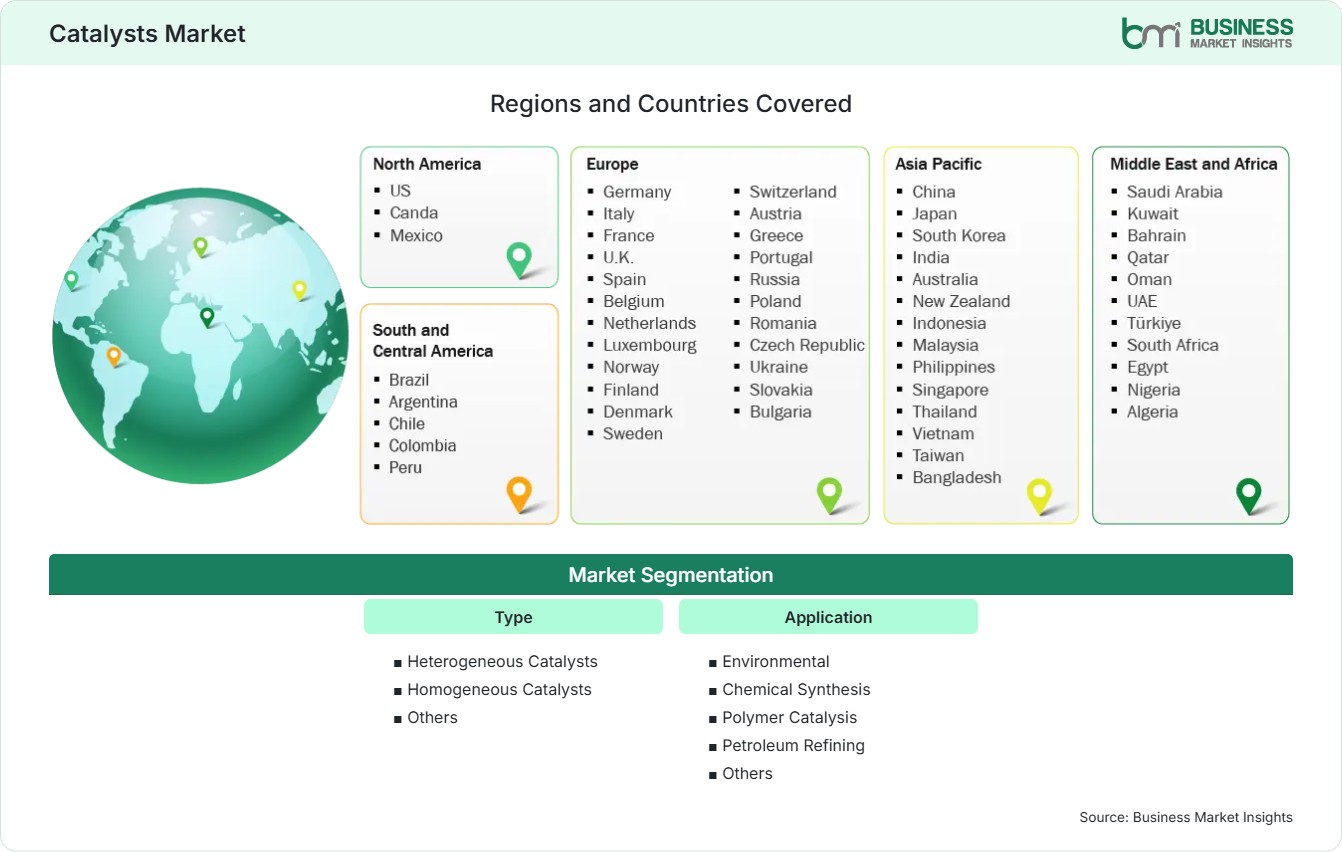
Global Market Geography
FREE PDF
Request your free sample
Request free sample
Segment Analysis

Catalysts Market Segmentation

Type

Type segmentation remains dominated by heterogeneous catalysts with 68%–72% share in 2025 and a 5.0%–5.5% CAGR through 2033. Their durability, ease of separation, and industrial suitability support widespread adoption. The Catalysts Market scope continues expanding through improved catalyst efficiency, enhanced selectivity, and broader deployment across refining, petrochemicals, environmental technologies, and advanced manufacturing applications.

  • Heterogeneous Catalysts: Preferred in large-scale industrial processes due to separation efficiency, operational stability, catalyst recovery capability, and broad utilization across refining, petrochemical, and environmental applications.
  • Homogeneous Catalysts: Widely used in specialty chemical synthesis, pharmaceutical production, and precision reaction systems where high selectivity and controlled reaction environments remain critical.

Application

Application demand is led by petroleum refining, while environmental applications exhibit the highest growth. Environmental uses account for 29%–33% share in 2025 and progress at a 6.1%–6.6% CAGR. Catalysts Market trends increasingly reflect sustainability objectives, emissions reductions, cleaner fuels, and industrial efficiency improvements across diverse end-use sectors.

  • Environmental: Adoption increases due to emission-control requirements, stricter air-quality regulations, industrial sustainability programs, and demand for pollution mitigation technologies.
  • Chemical Synthesis: Essential for reaction efficiency, product quality enhancement, resource optimization, and specialty chemical manufacturing processes across multiple industries.
  • Polymer Catalysis: Supports advanced plastics production, process consistency, material innovation, and growing demand for performance polymers.
  • Petroleum Refining: Remains a major application due to hydrocracking, reforming, desulfurization, and fuel-quality improvement requirements.
Market Forces

Catalysts Market Dynamics

Key Market Drivers

Stringent Global Emissions Regulations

Governments around the world have kept adopting stringent emission regulations for factories, transportation fuel, and chemical production. It has become mandatory for most governments in North America, Europe, and Asia to have technology available to control sulfur dioxide, nitrogen oxides, and particulate emissions. Environmental catalysts are being used not only for meeting regulatory requirements but are also playing their role in the achievement of broader sustainability objectives. They are being used in many industries such as power generation, refining industry, petrochemical plants, and industrial manufacturing. As environmental requirements become more demanding, these factors are expected to support Catalysts Market growth through wider deployment of catalytic solutions.

Expansion of Refining and Petrochemical Capacity

Refining and petrochemical plants are still the largest users of catalyst technologies and thus provide continuous demand across major production areas. The expansion of capacity in Asia and the Middle East is driving greater demand for fluid catalytic cracking, hydroprocessing, reforming, and specialty catalyst solutions. Manufacturers are seeking out technologies that will increase yields, enable them to deal with a wider variety of feedstocks, and boost overall operational efficiency. Catalysts assist in optimizing chemical processes and in the production of higher-value fuels, petrochemical intermediates, and specialty chemicals. The ongoing demand for transportation fuels and chemical products is prompting more investment in new facilities and in the upgrading of existing ones. At the same time, market participants are focusing on catalyst formulations that enable longer operating cycles, higher conversion efficiency, and more consistent process performance.

Growth of Hydrogen and Low-Carbon Technologies

Hydrogen, renewable fuels, and carbon management technologies depend heavily on advanced catalysts to enable efficient production and conversion processes. Government support programs, energy-transition targets, and industrial sustainability commitments are accelerating the development of projects in these areas. Catalysts play an important role in electrolysis-related processes, hydrogen production, renewable diesel manufacturing, sustainable aviation fuel development, and carbon utilization pathways. As investment in these emerging technologies increases, the potential application base for catalytic solutions is also becoming broader. Technology providers that can deliver higher activity, durability, and selectivity are well-positioned to benefit from this transition. The growing focus on cleaner energy systems is therefore creating new opportunities for demand and strengthening Catalysts Market trends related to low-carbon technologies and advanced process efficiency.

Key Market Opportunities

Scale-Up of Sustainable Aviation Fuel Production

The expansion of sustainable aviation fuel production represents a major commercial opportunity for catalyst manufacturers and technology providers. Increased commitments by airlines, governments, and fuel producers towards low-carbon aircraft fuel solutions are driving up the demand for technology that will enable mass production. Catalysts can help increase the efficiency and cost-effectiveness of the conversion process. With the expansion of production plants in North America, Europe, and Asia, the need for catalytic technologies is likely to rise alongside capacity expansion. The progression of SAF projects from a pilot stage to commercial plants can present long-term opportunities for catalyst suppliers. Catalysts Market Forecasts increasingly reflect the growing participation of renewable fuel value chains as investment moves toward commercial deployment.

Industrial Carbon Capture and Utilization Projects

Industrial carbon capture and utilization projects are providing new opportunities for catalysts that can enhance the conversion of captured carbon dioxide into useful products. Since carbon utilization technologies require catalytic systems that enable higher conversion rates while improving process economics and energy efficiency, demand is growing for catalysts used in chemical conversion processes and in the production of alternative fuels. If carbon utilization technologies are to be successfully commercialized, new markets for their use will open up beyond the usual applications of catalysts. Developers are therefore focusing on improving the activity, durability, and selectivity of catalysts to facilitate larger-scale operations. As carbon management projects progress from the research and demonstration stages to industrial implementation, catalyst technologies could become increasingly important to their commercial success.

Advanced Circular Chemical Manufacturing

Chemical companies are now adopting circular-economy principles, with an emphasis on recycling, recovering feedstocks, making better use of resources, and reducing waste. Catalysts play a key role in these initiatives, as they can enhance chemical recycling and enable the conversion of alternative feedstocks into valuable products. The increasing amount of money being invested in plastic circularity, bio-based chemicals, and resource-efficient manufacturing is creating opportunities for catalyst technologies based on more sustainable production methods. Manufacturers are looking for solutions that allow them to process recycled or alternative feedstocks without compromising end-product quality or operational efficiency. Businesses that can offer catalysts that help achieve the goals of circular manufacturing are likely to receive sustainability-oriented capital expenditure. As chemical producers continue to reduce waste and improve resource use, advanced catalytic solutions are expected to become increasingly important in emerging circular production methods.

Market Restraints and Challenges

Volatile Raw Material Availability and Costs

Factor: Many catalyst formulations rely on special metals and raw materials that are susceptible to supply-chain volatility. This leads to price variations, which in turn affect manufacturing costs, procurement planning, and profit margins. Impact: It becomes difficult for producers to keep their prices competitive without compromising on performance standards. Further uncertainty is caused by geopolitical events, trade restrictions, and the concentration of supplies. When price volatility increases, customers tend to delay their purchases, which in turn brings about difficulties for suppliers and distributors. As a result, companies are increasingly investing in recycling and regeneration capabilities to reduce their exposure to risks associated with raw materials.

Performance Degradation Under Harsh Operating Conditions

Factor: It is possible for catalysts to suffer from poisoning, fouling, thermal degradation, and a decrease in activity when they are operated for long periods. Impact: Since performance drops, there is a need for more maintenance, operational interruptions, and higher replacement costs. Because end users want technologies that can keep stable in tough industrial conditions, it is still a technical challenge to achieve long operating lives without losing selectivity. Ongoing research investment is required to enhance durability, regeneration potential, and overall lifecycle economics, which in turn leads to higher development costs for manufacturers.

Company Analysis

Competitive Landscape

The competitive environment reflects ongoing innovation in refining, environmental technologies, chemicals, and hydrogen-related solutions. Current Catalysts Market analysis indicates competition centered on performance improvements, sustainability benefits, regeneration capabilities, and application-specific customization.

Company Name

Overview

Products and Services relevant to this market

BASF SE

Global chemicals leader with extensive catalyst technologies serving refining, chemicals, and environmental industries.

Refining catalysts, emission-control catalysts, process technologies, catalyst regeneration solutions.

Clariant AG

Specialty chemicals company focused on industrial performance and sustainable catalyst innovation.

Syngas catalysts, petrochemical catalysts, specialty catalyst systems, process optimization services.

Johnson Matthey Plc

Major sustainable technologies provider with strong catalyst expertise.

Emission-control catalysts, hydrogen technologies, process catalysts, precious-metal services.

Evonik Industries AG

Specialty materials company serving industrial manufacturing sectors globally.

Catalysts, catalyst supports, specialty additives, advanced chemical solutions.

W. R. Grace & Co.

Prominent provider of refining and specialty catalyst technologies.

FCC catalysts, process catalysts, catalyst supports, performance materials.

Albemarle Corporation

Advanced materials producer serving refining and chemical markets.

Hydroprocessing catalysts, clean-fuel technologies, refinery optimization solutions.

Topsoe A/S

Technology provider specializing in energy and chemical transformation.

Hydrogen catalysts, ammonia catalysts, refining technologies, decarbonization solutions.

Honeywell International Inc.

Industrial technology company with process and catalyst capabilities.

UOP catalysts, refining technologies, petrochemical process solutions.

Umicore SA

Materials technology company focused on sustainable applications.

Emission-control catalysts, precious-metal catalyst technologies, recycling services.

Sinopec Catalyst Co., Ltd.

Major catalyst supplier supporting refining and petrochemical industries.

Refining catalysts, petrochemical catalysts, industrial catalytic solutions.

Trust & Transparency

Research Methodology

The market analysis combines proprietary research with secondary data from government agencies, company disclosures, regulatory filings, industry databases and expert interviews. Market estimates are validated through data triangulation, cross-market benchmarking and analyst review.

View Full Research Methodology

Questions Answered

Frequently Asked Questions

What insights does a Catalysts Market Report typically provide?

A Catalysts Market Report generally covers market sizing, competitive positioning, regional demand patterns, technology trends, investment opportunities, regulatory impacts, and future industry outlook.

How are sustainability targets influencing technology development?

Manufacturers are creating catalysts that improve selectivity, reduce energy consumption, increase regeneration potential, and support low-carbon industrial processes.

Which region offers the strongest long-term investment potential?

Asia Pacific presents the most attractive opportunity due to industrial expansion, refining additions, specialty chemicals growth, and increasing environmental compliance requirements.

What makes heterogeneous catalysts dominant in industrial applications?

They provide easier separation, scalability, operational stability, and lower processing costs, making them suitable for large-volume industrial production environments.

What factors are creating new demand beyond petroleum refining?

Advanced hydrogen production, sustainable fuels, emissions control, carbon utilization, and circular chemical manufacturing are expanding catalyst consumption across multiple emerging industries.

Access the Full Catalysts Market Report

Get segment-level forecasts, regional estimates, competitive benchmarking, company profiles and downloadable Excel datasets.

Access the full Catalysts Market Report
350 pages PDF & Excel | 2026-09-21
Similar Research

Related Market Reports