
Building Integrated Photovoltaics Market Outlook: Size, Share, Trends, Growth Analysis, Competitive Landscape & Forecast, 2026-2033

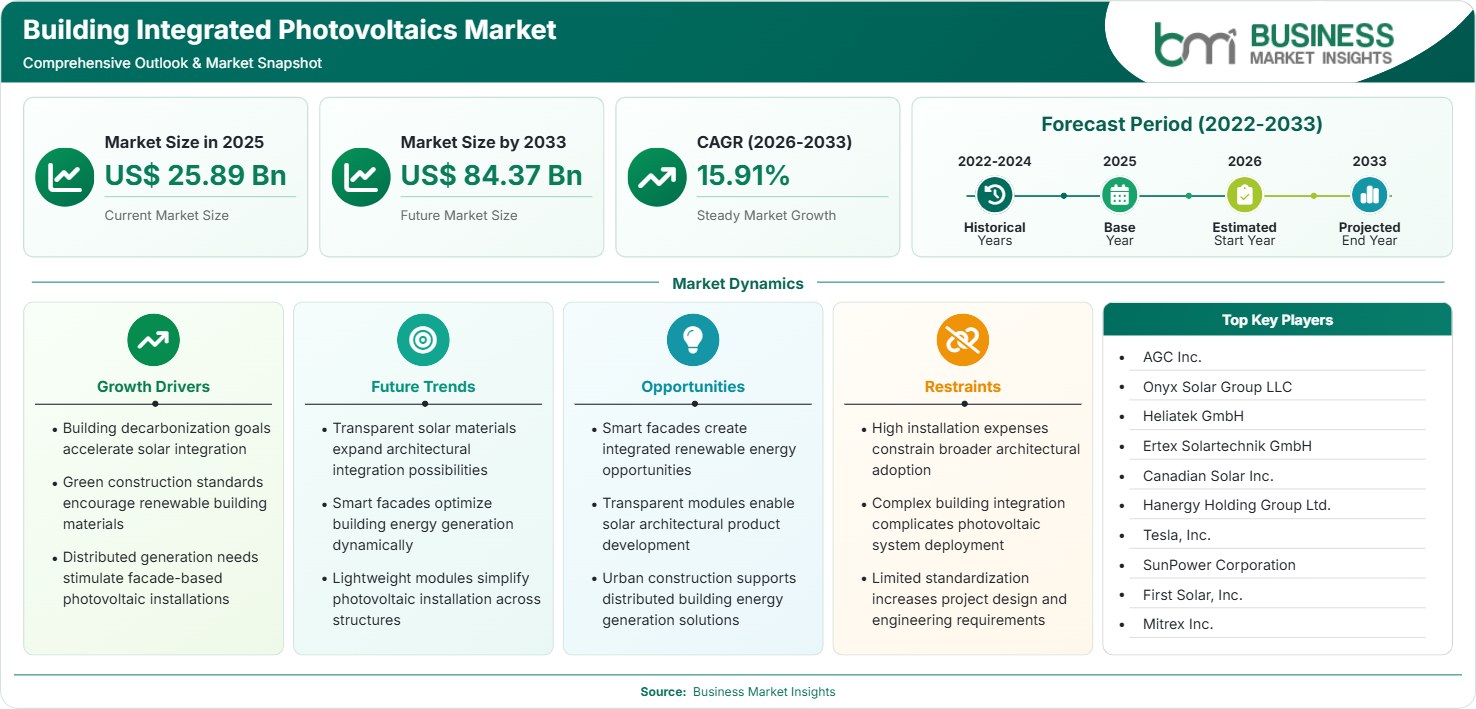
The Building Integrated Photovoltaics Market size was valued at US$ 25.89 Billion in 2025 and is projected to reach US$ 84.37 Billion by 2033, growing at a CAGR of 15.91% during 2026–2033. Rising net-zero building mandates, expanding urban renewable integration, energy-efficient construction investments, and advances in photovoltaic façade technologies are creating substantial long-term opportunities across commercial, residential, and industrial infrastructure projects.

Report Coverage
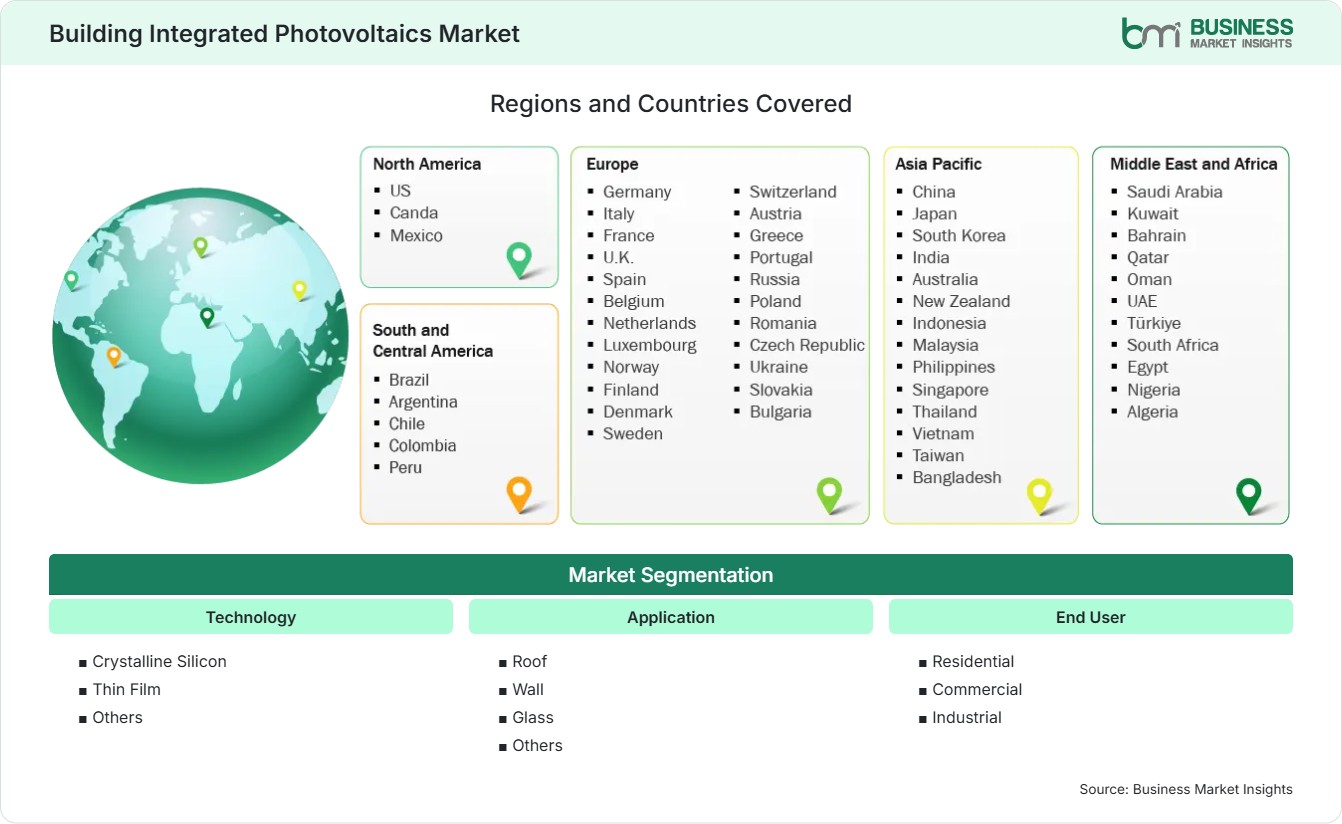
  • Technology: Crystalline Silicon, Thin Film, Others
  • Application: Roof, Wall, Glass, Others
  • End User: Residential, Commercial, Industrial
US$ 25.89 Bn Market size in 2025
US$ 84.37 Bn Market Size by 2033
15.91% CAGR, 2026 - 2033
2026-2033 Forecast Period

AI Overview

Building Integrated Photovoltaics Market Summary

  • North America Region: North America holds a market share of 33%–36% in 2025, growing with a CAGR of 14.5%–15.5% during 2026–2033. Growth is supported by green building regulations, federal clean-energy incentives, commercial retrofit activity, and demand for energy-generating building envelopes across urban developments. Brief U.S. analysis: Strong tax incentives, net-zero construction programs, and corporate sustainability commitments support a CAGR of 14.8%–15.8% through 2033.
  • Fastest Growing Region: Asia Pacific accounts for 26%–29% share in 2025 and is expected to expand at 17.5%–18.8% CAGR during 2026–2033. Rapid urbanization, high-rise construction activity, renewable-energy mandates, manufacturing scale advantages, and smart-city investments continue accelerating adoption across emerging and developed economies.
  • Leading Segment: Roof applications represent 41%–44% market share in 2025 and are projected to grow at 15.0%–16.0% CAGR during 2026–2033. Established installation practices, superior energy output, compatibility with new construction, and increasing rooftop sustainability requirements strengthen segment leadership globally.
  • High Growth Segment: Glass applications hold 18%–21% share in 2025 and are projected to advance at 17.8%–18.8% CAGR through 2033. Demand for transparent power-generating façades, premium commercial architecture, energy-efficient skyscrapers, and aesthetic integration requirements support rapid market expansion worldwide.
  • Key Market Opportunity: Large-scale adoption of photovoltaic façades within smart-city developments creates opportunities for integrated energy generation, reduced building operating costs, improved sustainability ratings, and compliance with tightening carbon-emission regulations globally.
  • Major Market Players: AGC Inc., Onyx Solar Group LLC, Heliatek GmbH, Ertex Solartechnik GmbH, Canadian Solar Inc., Hanergy Holding Group Ltd., Tesla, Inc., SunPower Corporation, First Solar, Inc., and Mitrex Inc.
Strategic Insights

Building Integrated Photovoltaics Market: Strategic Insights

Building Integrated Photovoltaics Market Strategic Framework
FREE PDF
Request your free sample
Request free sample
Stakeholder View

Key Takeaways

  • The value chain is becoming more integrated; photovoltaic manufacturers, specialists in facades, suppliers of building materials, and engineering contractors are now working together at an earlier stage in the project lifecycle to optimize performance and installation efficiency.
  • The best near-term opportunities for revenue are in the case of commercial buildings and high-end urban developments since increasing influence on the economics of projects and on tenant preferences is now exerted by sustainability certifications and lower operating costs.
  • Innovation is now focusing on transparent solar glass, on lightweight thin-film materials, and on multifunctional building components which combine electricity generation with insulation, weather protection, and architectural aesthetics.
  • The investment environment in the Asia Pacific is one of the most appealing because of the region's rapid urbanization, the large number of construction projects underway, the requirements regarding renewable energy, and the fact that it has domestic capabilities for manufacturing photovoltaics.
  • The number of strategic partnerships being entered into between providers of clean-energy technologies and construction companies is rising, and the number of acquisitions is concentrating on extending the range of integrated building solutions and on strengthening the regional distribution networks.
  • Demand is no longer limited to energy generation; developers are now placing greater emphasis on resilience, carbon reduction, energy independence, and adherence to the ever-more-stringent environmental performance standards.
Geographic Outlook

Building Integrated Photovoltaics Market Regional Highlights

North America Building Integrated Photovoltaics Market

North America accounted for approximately 33%–36% of global revenue in 2025 and is projected to grow at a 14.5%–15.5% CAGR during 2026–2033. The region benefits from strong policy frameworks supporting renewable construction, rising deployment of net-zero energy buildings, and increased retrofitting of commercial assets. The Building Integrated Photovoltaics Market share remains highest in North America due to advanced building codes, widespread ESG adoption, and favorable project financing conditions.

  • Federal incentives for clean energy continue to enhance project returns, prompting developers to include solar roofs and facades in both new construction and the renovation of commercial buildings in major metropolitan areas.
  • The demand for energy-producing building materials is growing because of corporate sustainability targets, which are designed to lower operating costs and at the same time support companies' carbon-reduction commitments and their environmental certification requirements.
  • Increasingly, large-scale schemes for urban redevelopment are incorporating integrated renewable technologies, which creates long-term prospects for the use of photovoltaic glass, roofing systems, and façade applications.
  • Architectural firms and engineering consultants are working more closely with providers of photovoltaic technology to offer solutions that are visually attractive and at the same time meet energy-efficiency requirements without sacrificing design flexibility.
  • As awareness of the energy savings over a building's lifecycle increases, so too do advanced financing models, thereby promoting greater market acceptance in both institutional and mixed-use building developments.

US Building Integrated Photovoltaics Market

The United States represents approximately 73%–77% of North American Building Integrated Photovoltaics Market demand in 2025 and is expected to register a 14.8%–15.8% CAGR through 2033. Factors that contribute to growth include tax incentives, state-based renewable energy initiatives, and investments in green construction. There is especially high demand on commercial campuses, educational facilities, and luxury residential areas.

  • Efforts to achieve net-zero emissions are still having an impact on construction planning in large cities, leading to a faster installation of photovoltaic roofing and façade systems in new buildings.
  • More owners of corporate real estate are placing a high priority on achieving energy independence and reducing their long-term operating costs, which in turn leads to a continuous demand for integrated solar building materials.
  • The increasing amount of money being invested in smart-building technologies is leading to greater use of multifunctional building components, which are able to produce power while at the same time improving building performance.
  • The policies concerning procurement in the public sector are increasing the opportunities for incorporating photovoltaic systems into projects related to transportation, government, and educational infrastructure.

Europe Building Integrated Photovoltaics Market

Europe accounted for around 28%–31% of Building Integrated Photovoltaics Market revenue in 2025 and is forecast to expand at a 15.5%–16.5% CAGR during 2026–2033. Germany leads regional revenue generation with a CAGR of approximately 15.2%–16.2%, while Spain represents one of the fastest-growing national markets, advancing at 16.8%–17.8% CAGR.

  • The policies aimed at energy transition in Europe are still encouraging the incorporation of renewable energy in building projects in the residential, commercial, and public sectors all over the region.
  • Interest in photovoltaic facades and solar glass is growing among premium commercial buildings where both design quality and sustainability performance are important.
  • Germany holds on to its regional leadership due to its advanced green building initiatives, its strong adoption of technology, and its well-established photovoltaic supply chains.
  • Spain is becoming a high-growth market, due to its favorable solar resources, the expansion of construction activities, and increasing investment in renewable energy.
  • There are considerable opportunities to incorporate photovoltaic systems into older buildings to increase efficiency and lower energy consumption.

Asia Pacific Building Integrated Photovoltaics Market

Asia Pacific held approximately 26%–29% share in 2025 and is projected to record the fastest regional expansion at a 17.5%–18.8% CAGR through 2033. China remains the leading market with an estimated 18.0%–19.0% CAGR, while India is among the fastest-growing countries at 19.0%–20.0% CAGR. The Building Integrated Photovoltaics Market growth momentum is reinforced by local manufacturing capacity, smart-city projects, and increasing demand for sustainable infrastructure.

  • The broad photovoltaic manufacturing network in China contributes to its cost competitiveness and is helping to speed up uptake in commercial, industrial and residential construction projects.
  • India benefits from the advantages of its ambitious targets in renewable energy, its expansion of urban development initiatives, and the growing level of sustainability investment by the private sector.
  • Throughout the region, smart city projects are leading to a great demand for construction materials that generate energy in both public and private infrastructure.
  • Increasingly, high-rise commercial developments are using photovoltaic glass and façade technologies to enhance their energy performance and sustainability credentials.
  • The government's offer of incentives, concerns about energy security, and increasing environmental awareness are all still helping to drive long-term growth in the regional market.

Rest of World Building Integrated Photovoltaics Market

The Rest of World region accounted for approximately 9%–12% Building Integrated Photovoltaics Market share in 2025 and is anticipated to expand at a 15.8%–17.0% CAGR through 2033. South and Central America are witnessing increasing adoption as renewable-energy policies strengthen and urban construction activity expands.

In both the Middle East and Africa, investment in sustainable cities and large-scale infrastructure projects is setting the stage for the incorporation of photovoltaic systems. In South and Central America Brazil is achieving the highest rate of growth at a compound annual growth rate of 16.0% to 17.0%, and in the Middle East the United Arab Emirates is one of the fastest-growing markets with a compound annual growth rate of 17.2% to 18.2%.

  • Brazil is benefiting from increasing interest in distributed solar generation and growing adoption of sustainable building practices within commercial real estate developments.
  • The United Arab Emirates is still investing in its smart-city and green-building projects, which in turn generates a high demand for advanced photovoltaic building materials.
  • The Middle East's efforts to diversify its energy sources are aiding the installation of renewable technologies as part of major urban infrastructure projects.
  • The level of construction activity growing in various African economies is gradually creating more opportunities for the use of integrated photovoltaic systems in commercial buildings.
  • Access to renewable construction technologies is being improved in emerging markets through international development financing and sustainability-focused investment programmes.
Global Market Geography
FREE PDF
Request your free sample
Request free sample
Segment Analysis

Building Integrated Photovoltaics Market Segmentation

Technology

The technology segment remains central to long-term industry expansion as developers seek higher efficiency, durability, and architectural flexibility. Technology solutions accounted for approximately 100% market coverage, with Crystalline Silicon holding 57%–60% share in 2025 and growing at 15.0%–16.0% CAGR through 2033. The Building Integrated Photovoltaics Market scope increasingly extends beyond energy generation to encompass aesthetics, sustainability, and building performance requirements.

  • Crystalline Silicon: Dominates installations due to high efficiency, proven reliability, extended operational lifespan, and compatibility with roofing and façade systems used across residential, commercial, and industrial developments.
  • Thin Film: Gains traction in lightweight and design-oriented projects where flexibility, appearance, and adaptability to curved or irregular building surfaces provide meaningful architectural advantages.

Application

Application diversity is expanding as integrated photovoltaic systems become a strategic element of sustainable construction. Roof installations account for the largest segment with 41%–44% share in 2025 and a projected 15.0%–16.0% CAGR through 2033. Building Integrated Photovoltaics Market Demand is supported by established installation methods, favorable sunlight exposure, and lower integration complexity.

  • Roof: Widely adopted because of extensive surface availability, strong solar exposure, established installation expertise, and favorable economics within both new construction and renovation projects.
  • Wall: Adoption is increasing in urban environments where vertical surfaces provide opportunities for renewable energy generation while improving building aesthetics and sustainability performance.
  • Glass: Represents the fastest-growing application category, supported by demand for transparent energy-producing façades and advanced architectural designs in commercial and institutional buildings.

End User

End-user demand patterns continue evolving as sustainability standards strengthen globally. Commercial buildings represent the largest end-user category with approximately 46%–49% share in 2025 and a projected 15.5%–16.5% CAGR through 2033. Adoption is being driven by corporate carbon-reduction commitments, green building certification requirements, and operational cost optimization.

  • Residential: Growing interest in energy independence, rising electricity costs, and net-zero housing initiatives is encouraging homeowners to adopt integrated photovoltaic roofing and façade solutions.
  • Commercial: Strong demand stems from sustainability objectives, ESG reporting requirements, tenant expectations, and efforts to reduce lifecycle energy costs across office and mixed-use developments.
  • Industrial: Manufacturers are integrating photovoltaic building materials into facilities to reduce grid dependence, enhance sustainability performance, and support corporate decarbonization initiatives.
Market Forces

Building Integrated Photovoltaics Market Dynamics

Key Market Drivers

Net-Zero Building Policies Accelerating Solar Integration

Government decarbonization targets are increasingly linked to building-sector emissions reduction, creating favorable conditions for integrated photovoltaic adoption. Buildings account for a significant share of global energy consumption, prompting regulators to introduce stricter efficiency requirements for new and renovated structures. Green building certification programs, zero-energy building mandates, and renewable-energy obligations are encouraging architects and developers to incorporate photovoltaic roofs, façades, and glazing solutions from the design stage. These factors continue supporting Building Integrated Photovoltaics Market growth by transforming renewable generation from an optional sustainability feature into a strategic infrastructure component for long-term energy management.

Advancements in Photovoltaic Materials and Architecture

Technological innovation is improving efficiency, durability, and design flexibility across integrated photovoltaic systems. Manufacturers are introducing thinner modules, enhanced transparent solar glass, and lightweight materials capable of meeting both architectural and energy-generation requirements. Modern building envelopes increasingly combine weather protection, thermal insulation, and electricity production within a single component, improving project economics. Architectural firms are adopting customized photovoltaic façades that blend with premium building designs while supporting sustainability objectives.

Rising Energy Costs and Corporate Sustainability Goals

Energy-price volatility is encouraging organizations to reduce dependence on conventional electricity sources through distributed generation. Large corporations increasingly incorporate renewable-energy strategies into ESG commitments, creating sustained demand for photovoltaic building materials. Commercial property developers view integrated solar solutions as assets that improve operational efficiency while supporting environmental reporting requirements. The Building Integrated Photovoltaics Market trends indicate growing interest among property owners seeking long-term cost predictability and carbon-emission reductions. Industrial facilities are similarly investing in integrated systems to strengthen energy resilience and sustainability performance.

Key Market Opportunities

Smart-City Development Programs Creating New Demand

Smart-city initiatives are creating attractive opportunities for integrated solar building technologies. Governments and urban planners increasingly prioritize infrastructure capable of supporting energy efficiency, sustainability, and distributed electricity generation. Photovoltaic façades, energy-generating glass panels, and solar roofing systems align closely with these objectives. Large mixed-use developments, transportation hubs, and public-sector facilities provide high-value installation opportunities due to extensive surface areas and long operating lifecycles. Building Integrated Photovoltaics Market Forecasts increasingly reflect the role of smart cities in expanding deployment potential across developed and emerging economies.

Expansion of Solar Glass and Transparent Facades

Transparent and semi-transparent photovoltaic glass represents a rapidly emerging opportunity across premium commercial architecture. High-rise office towers, hotels, airports, and institutional facilities increasingly require design solutions that balance aesthetics with sustainability performance. Solar glass enables buildings to generate electricity while maintaining natural lighting and architectural appeal. Continued improvements in transparency, efficiency, and durability are increasing commercial viability. Property developers are also recognizing the marketing value associated with visually distinctive energy-producing structures.

Emerging Markets Offering Large Construction Pipelines

Rapid urban development across Asia, the Middle East, Latin America, and selected African economies presents substantial growth potential. Many emerging markets are simultaneously expanding renewable-energy capacity and investing in modern infrastructure. Urban commercial centers, smart-city developments, industrial parks, and residential housing projects offer a broad installation base for photovoltaic integration. Supportive policy frameworks and international sustainability financing initiatives further enhance market attractiveness. Because many projects remain in early planning stages, developers can integrate photovoltaic technologies during initial design phases rather than through later retrofits.

Market Restraints and Challenges

High Initial Capital Costs Impact Adoption Decisions

Factor: Integrated photovoltaic solutions generally require higher upfront investment than conventional construction materials due to specialized design, engineering, and installation requirements. Impact: Cost-sensitive developers may delay adoption despite favorable lifecycle economics. While long-term energy savings can offset initial expenditures, financing challenges remain particularly relevant in emerging markets and smaller construction projects. Budget constraints often lead stakeholders to prioritize traditional building materials with lower immediate costs. Additional customization requirements can further increase project expenses.

Design Complexity and Skilled Workforce Limitations

Factor: Successful implementation requires coordination among architects, engineers, photovoltaic specialists, and construction contractors. Impact: Project complexity can increase development timelines, installation risks, and overall execution costs. Integrated systems must simultaneously satisfy structural, aesthetic, electrical, and regulatory requirements, making project planning more demanding than traditional solar installations. Workforce shortages in specialized photovoltaic design and installation further constrain deployment in some regions. Variations in local building standards and approval processes can also create implementation challenges.

Company Analysis

Competitive Landscape

Building Integrated Photovoltaics Market analysis highlights a competitive environment characterized by technological innovation, architectural partnerships, and expansion of integrated renewable building solutions.

Company Name

Overview

Products and Services relevant to this market

AGC Inc.

Global glass manufacturer with extensive expertise in architectural materials and energy-efficient construction technologies.

Photovoltaic glass solutions, façade materials, architectural glazing systems, and integrated sustainable building products.

Onyx Solar Group LLC

Specialist provider focused on photovoltaic glass and energy-generating architectural solutions for commercial projects.

Solar glass, photovoltaic skylights, façades, canopies, curtain walls, and customized building-integrated solar systems.

Heliatek GmbH

Developer of organic photovoltaic technologies designed for lightweight and flexible building integration applications.

Organic photovoltaic films, lightweight solar materials, façade integration solutions, and sustainable architectural energy systems.

Ertex Solartechnik GmbH

European provider specializing in customized photovoltaic building envelopes and architectural solar integration.

Solar façades, photovoltaic roofs, glass-glass modules, and tailored building integration engineering services.

Canadian Solar Inc.

Major solar technology company supplying photovoltaic products and energy solutions internationally.

High-efficiency modules, integrated building solutions, solar systems, and renewable-energy project expertise.

Hanergy Holding Group Ltd.

Recognized for thin-film photovoltaic technologies applicable to building integration applications.

Thin-film solar technologies, photovoltaic construction materials, and integrated energy-generation solutions.

Tesla, Inc.

Technology and energy company expanding distributed renewable-energy solutions for buildings.

Solar Roof systems, energy storage solutions, integrated renewable-energy technologies, and smart energy management.

SunPower Corporation

Solar energy provider focused on high-efficiency photovoltaic technologies and premium applications.

High-performance solar products, integrated building systems, rooftop photovoltaic solutions, and energy optimization services.

First Solar, Inc.

Leading photovoltaic manufacturer recognized for advanced solar technology and large-scale deployment expertise.

Thin-film solar modules, sustainable photovoltaic technologies, and energy-generation solutions suitable for integrated applications.

Mitrex Inc.

Specialized manufacturer delivering aesthetically integrated photovoltaic products for modern architecture.

Solar façades, building-integrated photovoltaic panels, cladding systems, and customized architectural solar solutions.

Trust & Transparency

Research Methodology

The market analysis combines proprietary research with secondary data from government agencies, company disclosures, regulatory filings, industry databases and expert interviews. Market estimates are validated through data triangulation, cross-market benchmarking and analyst review.

View Full Research Methodology

Questions Answered

Frequently Asked Questions

What insights does a Building Integrated Photovoltaics Market Report provide to stakeholders?

A Building Integrated Photovoltaics Market Report helps stakeholders evaluate market structure, competitive positioning, technology developments, regulatory trends, regional opportunities, investment priorities, demand patterns, and long-term growth prospects across key segments.

Which region presents the strongest long-term investment opportunity?

Asia Pacific offers a compelling long-term opportunity because of rapid urbanization, significant construction activity, policy support for renewable energy, smart-city investments, and extensive photovoltaic manufacturing capabilities that enhance deployment affordability.

How does photovoltaic glass differ from conventional building glass?

Photovoltaic glass incorporates solar cells capable of generating electricity while functioning as a building envelope material. It allows natural daylight transmission while contributing to onsite renewable energy generation and improved building energy performance.

Which end-user category generates the highest demand worldwide?

Commercial buildings generate the largest demand due to strong sustainability commitments, ESG reporting requirements, green-building certifications, and the need to reduce long-term energy expenses across office, retail, hospitality, and mixed-use developments.

What are the primary benefits of integrated photovoltaic systems compared with conventional solar installations?

Integrated photovoltaic systems replace traditional construction materials while generating electricity, enabling dual functionality. They improve building aesthetics, support energy-efficiency objectives, reduce operational costs, and help developers meet sustainability certifications without requiring separate mounting structures.

Access the Full Building Integrated Photovoltaics Market Report

Get segment-level forecasts, regional estimates, competitive benchmarking, company profiles and downloadable Excel datasets.

Access the full Building Integrated Photovoltaics Market Report
350 pages PDF & Excel | 2026-09-23
Similar Research

Related Market Reports