
FPSO Market Outlook: Size, Share, Trends, Growth Analysis, Competitive Landscape & Forecast, 2026-2033

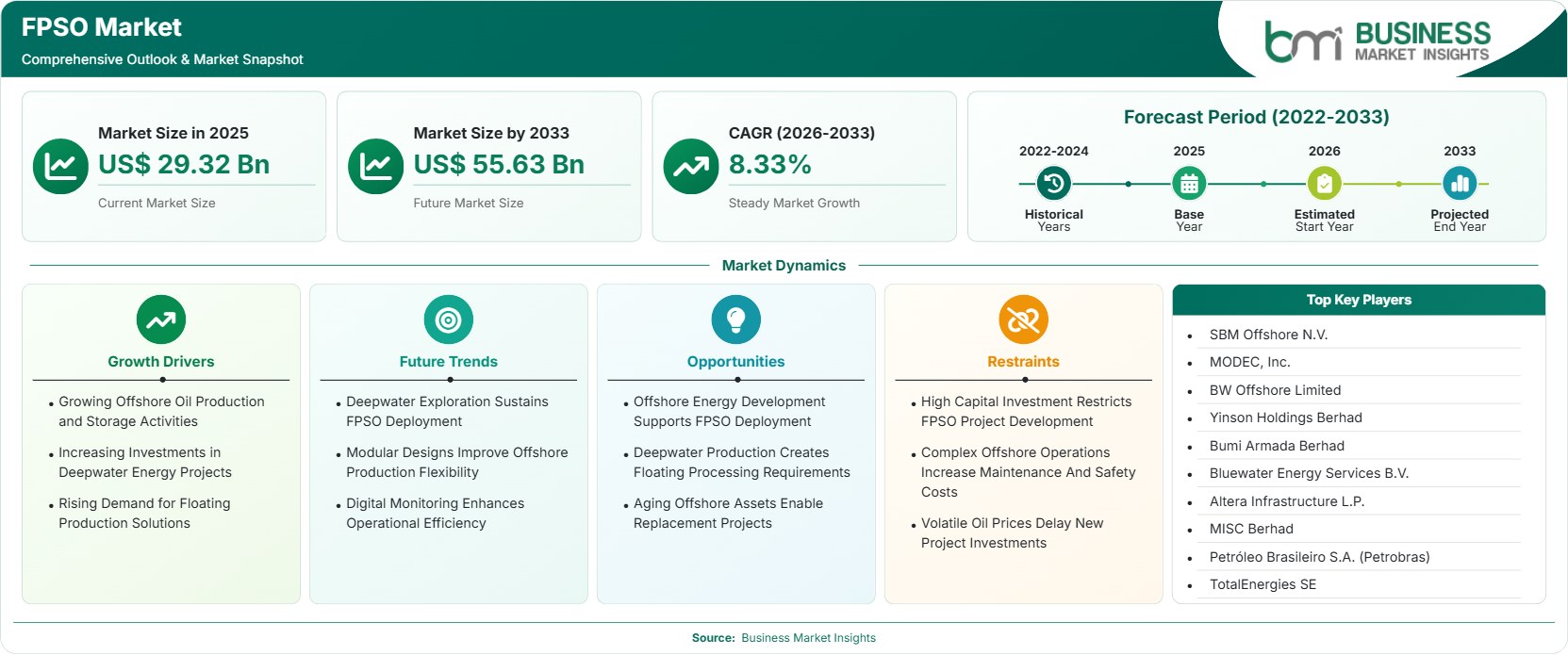
The FPSO Market size was valued at US$ 29.32 Billion in 2025 and is projected to reach US$ 55.63 Billion by 2033, growing at a CAGR of 8.33% during 2026–2033. Rising offshore hydrocarbon discoveries, deepwater project sanctions, digitalized production systems, enhanced recovery technologies, and increasing investments in Brazil, Guyana, West Africa, and Asia-Pacific are creating strong long-term opportunities.

Report Coverage
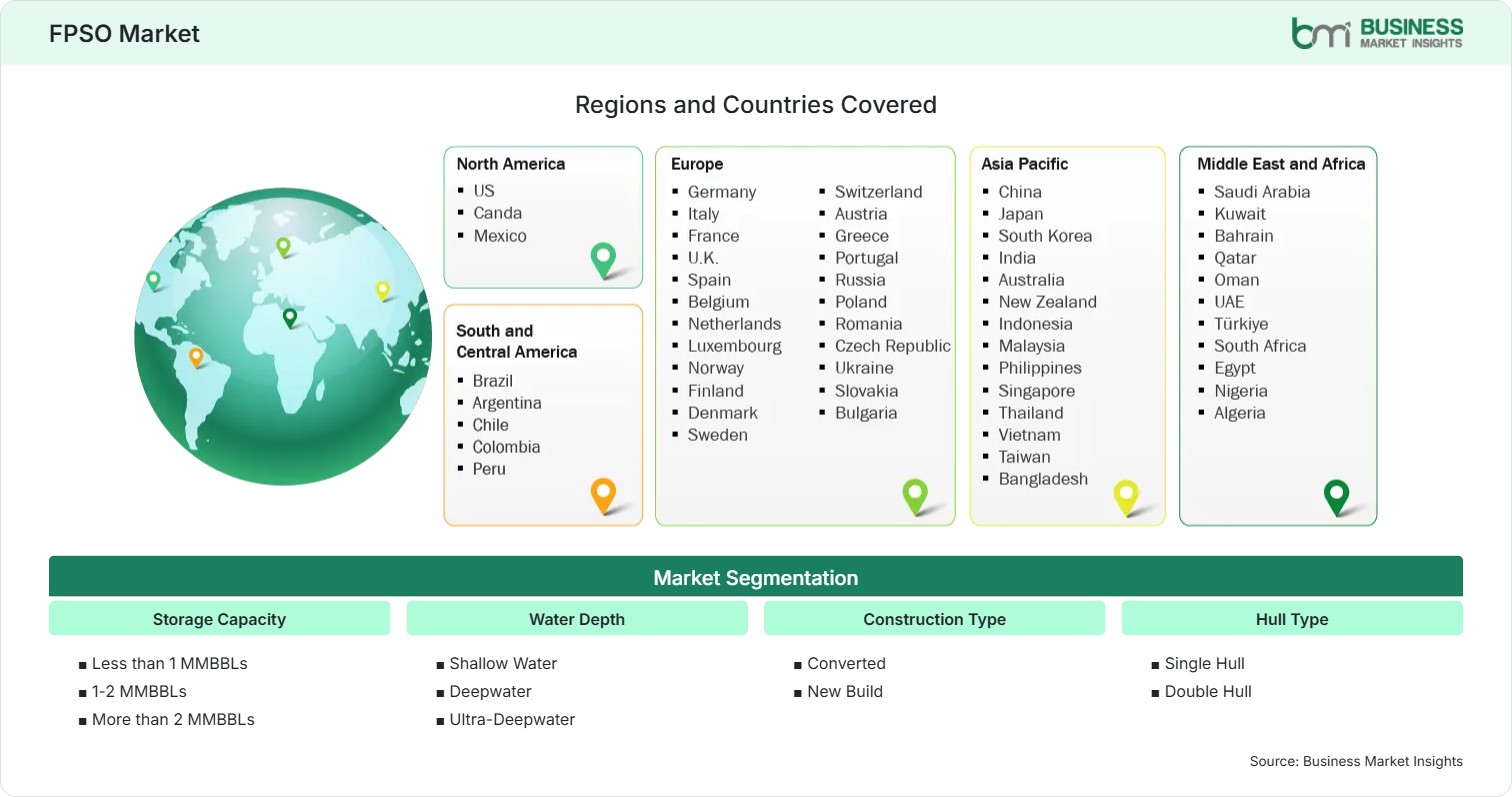
  • Storage Capacity: Less than 1 MMBBLs, 1-2 MMBBLs, More than 2 MMBBLs
  • Water Depth: Shallow Water, Deepwater, Ultra-Deepwater
  • Construction Type: Converted, New Build
  • Hull Type: Single Hull, Double Hull
  • Ownership: Contractor Owned, Operator Owned
US$ 29.32 Bn Market size in 2025
US$ 55.63 Bn Market Size by 2033
8.33% CAGR, 2026 - 2033
2026-2033 Forecast Period

AI Overview

FPSO Market Summary

  • North America Region: North America holds a market share of 22%–25% in 2025, growing with a CAGR of 7.2%–8.0% during 2026–2033. Key drivers include Gulf of Mexico redevelopment, subsea tiebacks, digital monitoring, enhanced recovery, and offshore infrastructure modernization supporting production reliability and capital efficiency gains. US market benefits from Gulf projects and redevelopments, advancing at an estimated CAGR of 7.5%–8.2% through 2033.
  • Fastest Growing Region: Asia Pacific holds a market share of 18%–21% in 2025, growing with a CAGR of 9.6%–10.4% during 2026–2033. Key drivers include offshore gas monetization, regional energy security priorities, growing investments, field redevelopment, local fabrication capabilities, and supportive upstream policies accelerating deployment programs.
  • Leading Segment: Deepwater accounts for 46%–49% FPSO Market share in 2025 and advances at 8.8%–9.4% CAGR during 2026–2033. Large reserves, favorable project economics, extended production life, technological maturity, and operator preference for scalable offshore facilities support sustained deployment activity.
  • High Growth Segment: New Build FPSOs represent 33%–36% share in 2025 and expand at 9.5%–10.2% CAGR through 2033. Increasing development of complex ultra-deepwater assets, standardization programs, and demand for higher processing capacity continue supporting investment momentum.
  • Key Market Opportunity: Expansion of carbon-conscious offshore developments encourages integration of electrification, flare reduction systems, digital twins, and low-emission processing technologies, creating attractive opportunities for engineering firms, operators, and long-term asset owners globally.
  • Major Market Players: SBM Offshore N.V., MODEC, Inc., BW Offshore Limited, Yinson Holdings Berhad, Bumi Armada Berhad, Bluewater Energy Services B.V., Altera Infrastructure L.P., MISC Berhad, Petróleo Brasileiro S.A. (Petrobras), TotalEnergies SE.
Strategic Insights

FPSO Market: Strategic Insights

FPSO Market Strategic Framework
FREE PDF
Request your free sample
Request free sample
Stakeholder View

Key Takeaways

  • The value chain increasingly integrates shipyards, subsea suppliers, digital technology providers, EPC contractors, leasing firms, and operators, creating long-term recurring revenue opportunities beyond vessel deployment.
  • Ultra-deepwater developments in Brazil, Guyana, and emerging African basins present the strongest upside due to high reserve productivity and multi-decade production potential.
  • Digital twins, predictive maintenance platforms, emissions monitoring technologies, and advanced process automation are becoming essential differentiators in new project tenders.
  • Asia-Pacific offers an attractive investment case as energy security strategies and offshore gas developments drive demand for flexible production platforms.
  • Consolidation among offshore service providers and long-duration leasing agreements continues strengthening revenue visibility and backlog quality across the industry.
  • Standardized new-build concepts are improving schedule certainty, reducing engineering repetition, and enabling contractors to pursue multiple projects simultaneously.
Geographic Outlook

FPSO Market Regional Highlights

North America FPSO Market

North America accounts for approximately 22%–25% FPSO Market share in 2025 and is forecast to expand at a CAGR of 7.2%–8.0% through 2033. Activity centers on the Gulf of Mexico, where operators are optimizing infrastructure utilization through tiebacks and redevelopment projects. Persistent investment in deepwater assets supports production continuity despite volatility in commodity prices. Advanced monitoring systems, operational efficiency programs, and enhanced recovery technologies strengthen regional competitiveness while supporting long-term offshore development economics.

  • Gulf of Mexico redevelopment programs continue extending asset life while reducing infrastructure costs through integration with existing production networks.
  • Major operators are prioritizing digital asset management platforms that improve uptime, maintenance planning, and production optimization across offshore portfolios.
  • Deepwater project approvals remain supported by reserve quality, established service ecosystems, and mature regulatory frameworks.
  • Carbon management initiatives encourage deployment of energy-efficient processing systems and reduced-flaring technologies on offshore facilities.

US FPSO Market

The United States represents approximately 72%–76% of North American revenue and is projected to advance at 7.5%–8.2% CAGR through 2033. Offshore investment remains concentrated in Gulf of Mexico developments characterized by advanced subsea architectures and long-life reservoirs. Operators increasingly favor flexible production systems capable of maximizing output while managing operating expenditures. Strong engineering capabilities, offshore expertise, and access to capital continue supporting deployment across selected development programs.

  • Existing offshore infrastructure supports economically attractive tieback opportunities that extend production from mature and newly discovered fields.
  • Technology adoption including predictive analytics and remote operations is enhancing efficiency across offshore asset portfolios.
  • Energy security considerations continue supporting upstream investment strategies in strategically important producing regions.

Europe FPSO Market

Europe holds 16%–19% market share in 2025 and is expected to grow at 6.8%–7.6% CAGR through 2033. Norway remains the leading market owing to advanced offshore expertise and continued field development activity. The United Kingdom supports redevelopment opportunities and asset life extension programs. High-growth activity is emerging in frontier offshore projects linked to energy diversification strategies. Regional operators increasingly focus on emissions reduction, electrification initiatives, and digital performance optimization across offshore assets.

  • Norway remains the regional leader, supported by sophisticated offshore engineering capabilities and continued investment in production infrastructure.
  • The United Kingdom benefits from brownfield redevelopment projects and operational upgrades aimed at improving efficiency.
  • Electrification and low-emission technologies are gaining prominence as sustainability targets influence capital allocation decisions.
  • Advanced offshore digitalization programs help improve productivity and reduce operational risks across mature assets.

Asia Pacific FPSO Market

Asia Pacific commands 18%–21% share in 2025 and records the fastest expansion, achieving 9.6%–10.4% CAGR through 2033. The region benefits from offshore gas investments, energy security priorities, and growing exploration activities. Malaysia remains a leading deployment center, while Indonesia demonstrates strong growth potential driven by offshore resource development. Expanding shipyard capabilities and increasing participation from regional engineering suppliers are strengthening execution capacity, improving competitiveness, and supporting large-scale offshore developments.

  • Malaysia maintains leadership through established offshore production expertise and active deployment programs.
  • Indonesia represents a high-growth market supported by exploration investments and offshore resource monetization efforts.
  • Regional fabrication capacity expansion enables improved delivery schedules and reduced project execution risks.
  • Energy demand growth continues encouraging governments and operators to invest in offshore production infrastructure.

Rest of World FPSO Market

Rest of World represents 36%–40% market share and is expected to record 8.8%–9.6% CAGR through 2033. South America remains dominant, led by Brazil and Guyana, where large offshore discoveries support sustained investment. In the Middle East and Africa, Angola and Namibia offer compelling growth opportunities through new project sanctions and exploration success. These regions benefit from world-class reservoirs, improving regulatory frameworks, and increasing participation by global energy companies seeking long-term production growth.

  • Brazil remains the largest single-country opportunity globally due to extensive pre-salt development programs.
  • Guyana continues attracting international investment supported by highly productive offshore discoveries.
  • Angola maintains project momentum through redevelopment initiatives and new offshore developments.
  • Namibia's exploration success is strengthening expectations for future deployment demand and associated infrastructure investment.
Global Market Geography
FREE PDF
Request your free sample
Request free sample
Segment Analysis

FPSO Market Segmentation

Storage Capacity

Storage capacity accounted for around 34%-37% of the FPSO Market scope in 2025 and is expected to grow at a CAGR of 8.1%-8.8%. The demand is becoming more closely aligned with the reservoir size, production characteristics, transportation considerations, and field economics. Storage capacity needs become higher for remote offshore projects where export infrastructure remains limited and operational flexibility is valuable.

  • Less than 1 MMBBLs: Common in marginal field applications where lower production volumes and cost-sensitive development strategies require flexible deployment and manageable capital commitments.
  • 1-2 MMBBLs: Widely adopted across established offshore developments due to balanced storage capability, operational efficiency, and compatibility with diversified production profiles.
  • More than 2 MMBBLs: Increasingly utilized in major deepwater projects requiring substantial storage capacity and reduced dependence on frequent tanker offloading operations.

Water Depth

Water Depth remains a defining deployment criterion, with deepwater activity accounting for a 46%–49% share and expanding at 8.8%–9.4% CAGR. Increasing discoveries within high-potential offshore basins, improved subsea engineering, and greater operational experience continue supporting development in progressively deeper environments.

  • Shallow Water: Maintains relevance for mature offshore provinces emphasizing redevelopment, incremental production gains, and infrastructure optimization opportunities.
  • Deepwater: Benefits from large reserve potential, attractive project economics, and strong operator preference for scalable offshore production solutions.
  • Ultra-Deepwater: Experiences rapid adoption through technological advances enabling reliable production in increasingly challenging offshore environments.

Construction Type

Construction Type is shaped by project schedules, capital availability, and technical complexity. The FPSO Market trends indicate increasing preference for standardized platforms. New-build systems account for a 33%–36% share and advance at 9.5%–10.2% CAGR due to demand for high-capacity production solutions.

  • Converted: Offers accelerated deployment schedules and lower upfront costs, making it attractive for select redevelopment programs and medium-sized discoveries.
  • New Build: Supports advanced processing requirements, increased storage capacities, and optimized performance in complex deepwater developments.

Hull Type

Hull selection influences operational safety, regulatory compliance, storage capacity, and lifecycle performance. Double-hull adoption continues increasing as operators prioritize risk mitigation and environmental protection across offshore production assets.

  • Single Hull: Maintains presence in legacy installations, particularly where existing infrastructure remains operationally effective and economically viable.
  • Double Hull: Gains preference due to enhanced safety performance, environmental protection capabilities, and alignment with evolving industry standards.

Ownership

Ownership structure affects the flexibility of financing, operational accountability, and risk sharing in projects. Ownership by the contractor firm preserves leadership with about 57% to 61% and a CAGR of 8.4% to 90%, supported by leasing expertise and long-term service arrangements.

  • Contractor Owned - Contractor Managed: Enables fully integrated service delivery with responsibility consolidated under specialized offshore asset operators.
  • Contractor Owned - Operator Managed: Provides financing flexibility while giving operators direct influence over production management decisions.
  • Operator Owned - Contractor Managed: Supports technical optimization through specialized operational expertise while maintaining asset ownership with producers.
  • Operator Owned - Operator Managed: Preferred by companies pursuing greater strategic control and integration across upstream production portfolios.
Market Forces

FPSO Market Dynamics

Key Market Drivers

Expansion of Deepwater and Ultra-Deepwater Developments

Significant offshore discoveries in Brazil, Guyana, Namibia, and West Africa are fueling strong demand for vessels. Deepwater fields tend to offer enhanced production efficiency and extended asset lifetimes, even if development is more expensive. Floating solutions have become more popular because building pipelines in distant offshore areas has become too difficult. Increased offshore investment spending, coupled with advances in drilling technology and subsea engineering, continues to facilitate deployment. The FPSO market growth is closely tied to the project-sanctioning cycle in deepwater basins, where production infrastructure flexibility delivers meaningful commercial advantages.

Growing Energy Security and Offshore Production Investments

Investment is being made upstream by both the government and producers to improve domestic supply resiliency and to diversify production sources. Offshore fields are a major part of the future growth of conventional hydrocarbons worldwide. The flexibility of offshore platforms ensures that oil and gas reserves can be produced without constructing expensive onshore facilities. National energy policies in Latin America, Africa, and Asia are now supporting offshore development plans. This is driving demand for offshore production assets engineering, construction, and operations over the coming decade.

Advancement of Digital and Automation Technologies

Digital twin technology, remote monitoring, predictive maintenance, optimization software, and artificial intelligence are revolutionizing offshore operations. Such advancements make the equipment more reliable, minimize downtime, improve crew efficiency, and create better conditions for safe operations. The asset owners are now using data analytics to make better decisions about how to maximize performance through maintenance scheduling. With offshore projects becoming larger and more technologically complex, digitalization enables improved lifecycle management and helps operators achieve greater productivity from long-term production assets.

Key Market Opportunities

Deployment in Emerging Offshore Provinces

The successes in exploration in countries like Namibia, Suriname, Mozambique, and certain Southeast Asian countries have created an excellent pipeline for future projects. These discoveries are in areas with no developed export infrastructure, making floating production systems more attractive. Early involvement provides an opportunity for contractors and engineers to acquire long-term contracts. FPSO Market Forecasts are beginning to reflect increased demand for these platforms, driven by upcoming offshore projects.

Low-Emission Offshore Production Solutions

Sustainability goals are being met through electrification, increased energy efficiency, reductions in flaring, carbon-tracking software, and improved gas-use technologies. There is a need for offshore installations that can reduce emissions while maintaining production. Contractors that provide comprehensive environmental performance solutions will be able to strengthen their competitive position when bidding. The move towards low-emission operations has opened up possibilities for technology suppliers, engineers, and asset holders focused on long-term portfolio modernization.

Standardized New-Build Programs and Replicable Designs

Standardized hull designs and modular construction methodologies help reduce engineering complexity, improve scheduling predictability, and lower costs over the vessels' lifetimes. Repeated designs on multiple projects will be useful for contractors, improving efficiencies in procurement and implementation. Operators will appreciate shorter development schedules and minimized project risks. Greater standardization is expected to open up more possibilities for companies to build offshore platforms at competitive economics.

Market Restraints and Challenges

High Capital Requirements and Project Delays

The deployment of offshore production systems requires considerable capital for engineering, hull fabrication, topside integration, subsea facility installation, and commissioning. Multibillion-dollar investments are usually associated with large-scale projects, which also have relatively long implementation periods. The decision on the final investment can be delayed when commodity prices fall, and financing terms become more difficult. Increased costs of construction, logistics, and labor issues are other potential difficulties. These factors collectively increase deployment risk and may delay capacity additions despite favorable long-term demand fundamentals.

Execution Complexity and Cost Overruns

Major offshore projects call for highly specialized engineering work, complex coordination of the worldwide supply chain, regulatory compliance, and challenging installation conditions. Delays or difficulties in integration could lead to substantial cost overruns and lower-than-projected profitability of the projects. The topsides system, the subsea connections, and the commissioning process necessitate good project management practices. As ships become increasingly advanced, even engineering and logistical problems could have a major impact on their performance, profitability, and stakeholder confidence across the project lifecycle.

Company Analysis

Competitive Landscape

FPSO Market analysis indicates competition is shaped by fleet scale, execution capabilities, long-term leasing expertise, engineering specialization, and regional presence.

Company Name

Overview

Products and Services relevant to this market

SBM Offshore N.V.

Leading offshore contractor specializing in floating production systems with strong deepwater project portfolio.

FPSO design, leasing, operations, engineering, procurement, integration, lifecycle support services.

MODEC, Inc.

Global provider with extensive offshore deployment expertise across multiple regions.

FPSO construction, chartering, operations, maintenance, project management services.

BW Offshore Limited

Offshore specialist focused on production infrastructure and field development solutions.

FPSO ownership, operation, redevelopment, engineering, production support services.

Yinson Holdings Berhad

Growing global player with strong project backlog and operational presence.

FPSO leasing, project execution, offshore asset management solutions.

Bumi Armada Berhad

International offshore energy infrastructure company serving major producers.

Floating production facilities, operations, maintenance, offshore engineering services.

Bluewater Energy Services B.V.

Specialist operator with decades of offshore production system expertise.

FPSO ownership, mooring systems, offshore operations and support services.

Altera Infrastructure L.P.

Offshore infrastructure provider with diversified marine energy portfolio.

FPSO operations, shuttle tanker services, offshore logistics solutions.

MISC Berhad

Energy-related maritime company participating in offshore production infrastructure.

Offshore floating assets, engineering solutions, marine support activities.

Petróleo Brasileiro S.A. (Petrobras)

Major offshore producer and one of the largest FPSO users globally.

Offshore production, field development, FPSO ownership and operation.

TotalEnergies SE

Global energy company actively deploying floating production facilities.

Offshore development, project operation, production management services.

Trust & Transparency

Research Methodology

The market analysis combines proprietary research with secondary data from government agencies, company disclosures, regulatory filings, industry databases and expert interviews. Market estimates are validated through data triangulation, cross-market benchmarking and analyst review.

View Full Research Methodology

Questions Answered

Frequently Asked Questions

What does the FPSO Market Report examine?

The Market Report evaluates regional demand patterns, technology developments, ownership models, construction strategies, competitive positioning, and long-term investment opportunities.

How does digitalization support offshore operations?

Digital tools improve maintenance planning, increase equipment availability, enhance production efficiency, reduce downtime, and strengthen operational decision-making across offshore assets.

What factors influence construction type selection?

Operators evaluate project schedule, field size, reserve profile, financing availability, technical complexity, and lifecycle economics before choosing converted or new-build platforms.

Why are deepwater projects important for industry expansion?

Deepwater reservoirs often contain large recoverable resources and support long production lifecycles, making floating production systems commercially attractive despite high initial investment.

Which region leads global demand for floating production systems?

South America remains the largest deployment center due to extensive offshore development activity in Brazil and growing investment across Guyana's deepwater fields.

Access the Full FPSO Market Report

Get segment-level forecasts, regional estimates, competitive benchmarking, company profiles and downloadable Excel datasets.

Access the full FPSO Market Report
350 pages PDF & Excel | 2026-09-08