
Bioenergy Market Outlook: Size, Share, Trends, Growth Analysis, Competitive Landscape & Forecast, 2026-2033

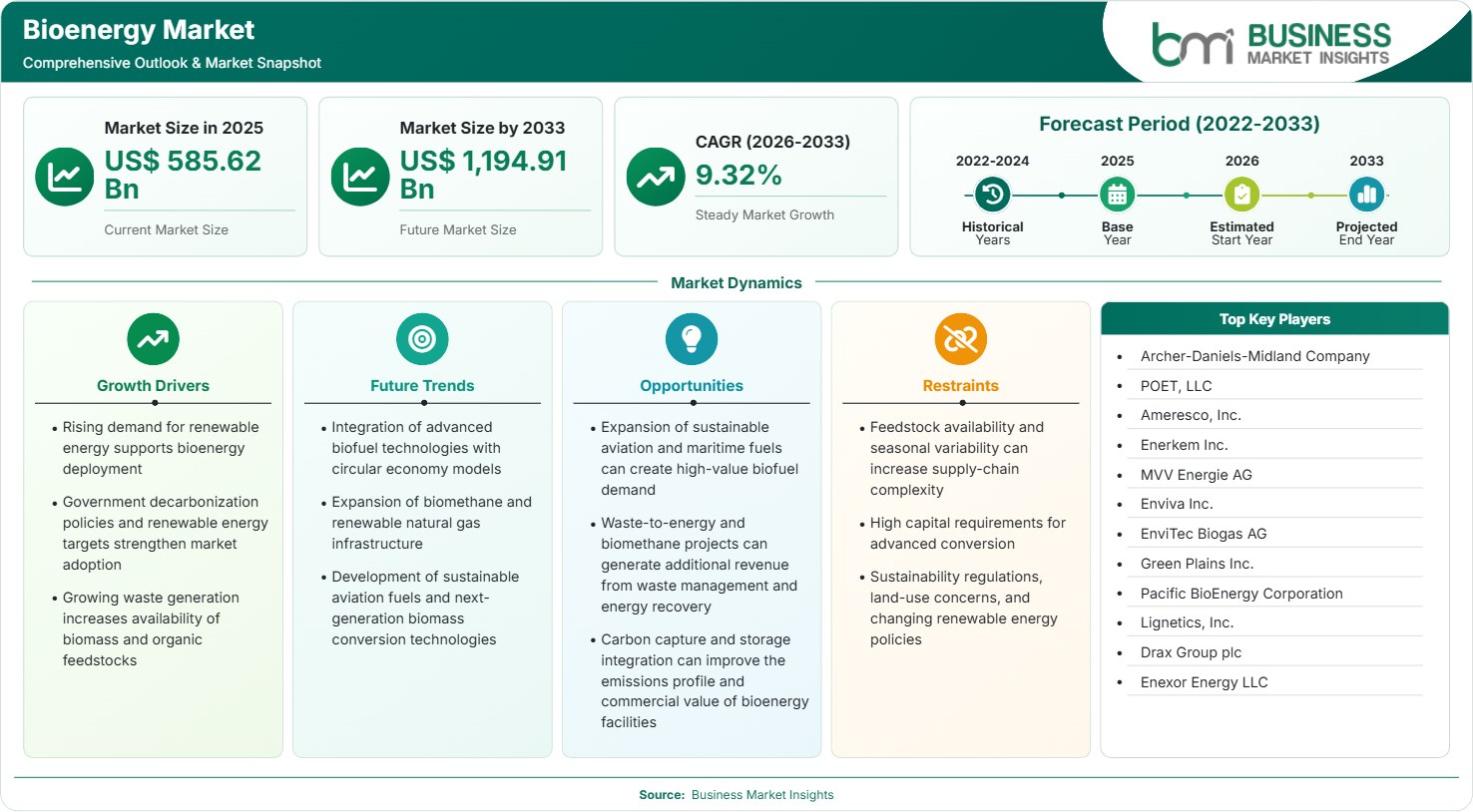
The Bioenergy Market size was valued at US$ 585.62 Billion in 2025 and is projected to reach US$ 1194.91 Billion by 2033, growing at a CAGR of 9.32% during 2026–2033, driven by renewable fuel mandates, industrial decarbonization, waste valorization, energy security priorities, and investment in advanced biomass conversion technologies.

Report Coverage
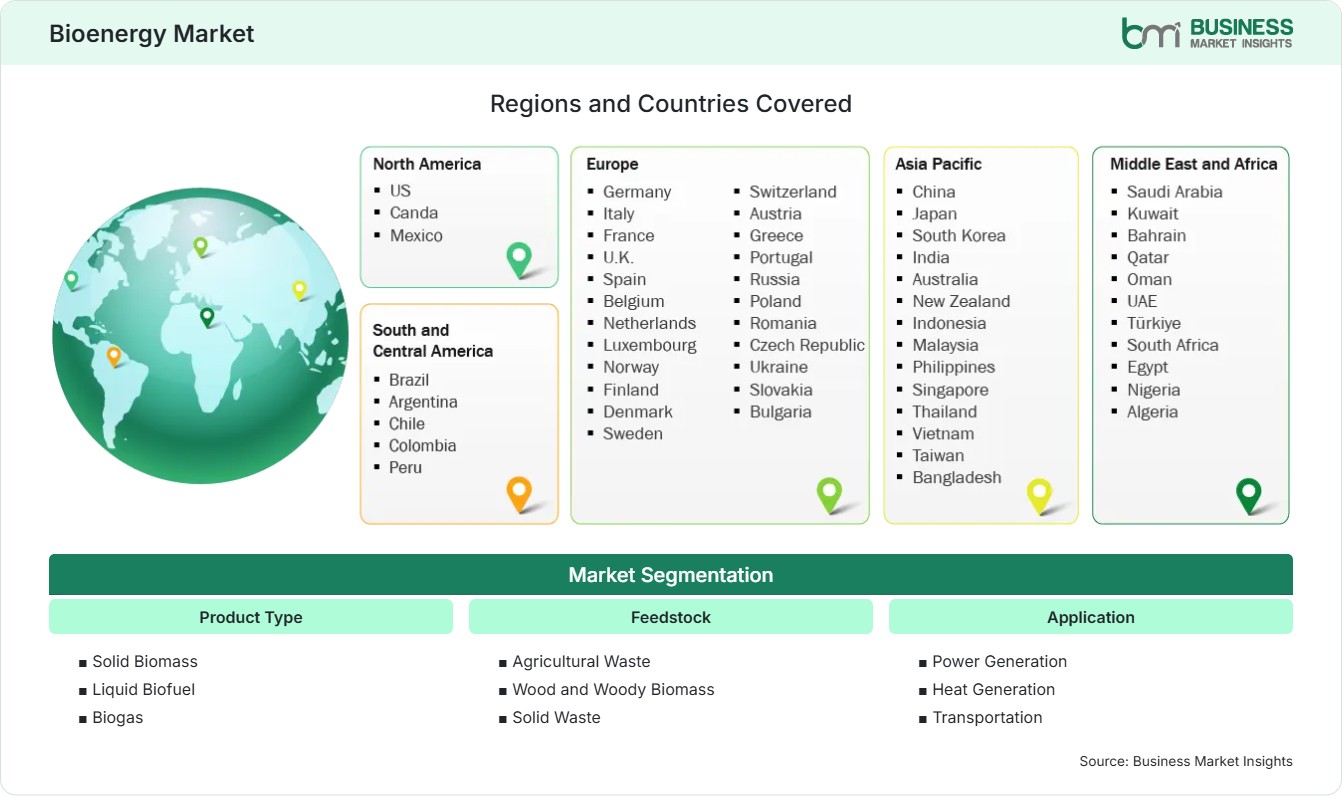
  • Product Type: Solid Biomass, Liquid Biofuel, Biogas
  • Feedstock: Agricultural Waste, Wood and Woody Biomass, Solid Waste
  • Application: Power Generation, Heat Generation, Transportation
US$ 585.62 Bn Market size in 2025
US$ 1,194.91 Bn Market Size by 2033
9.32% CAGR, 2026 - 2033
2026-2033 Forecast Period

AI Overview

Bioenergy Market Summary

  • North America Region: North America holds market share of 27%–31% in 2025, growing with a CAGR of 8.4%–9.0% affected by renewable fuel incentives, plentiful agricultural residuals, waste-to-energy projects, biogas production, decarbonizing industry, and increasing carbon management possibilities. The US remains the regional anchor, supported by ethanol production, renewable natural gas, biomass power, federal incentives, and corporate demand for lower-carbon energy, with modeled growth of 8.2%–8.8% during 2026–2033.
  • Fastest Growing Region: Asia Pacific holds market share of 29%–33% in 2025, growing with a CAGR of 10.2%–10.8%, supported by rising energy consumption, agricultural residue availability, ethanol blending, biomethane programs, industrial heat demand, waste management priorities, and government-backed renewable-energy deployment.
  • Leading Segment: Solid Biomass holds market share of 42%–46% in 2025, growing with a CAGR of 8.2%–8.8%, supported by established industrial heating, power generation, pellet demand, forestry residues, agricultural waste utilization, and comparatively mature conversion infrastructure.
  • High Growth Segment: Biogas holds market share of 18%–22% in 2025, growing with a CAGR of 10.5%–11.5%, sustained through anaerobic digestion, renewable natural gas, organic waste management, biomethane injection, transportation fuel needs, and circular economy investments.
  • Key Market Opportunity: Waste fuels, biomethane, sustainable aviation fuel, advanced ethanol, and biomass carbon capture represent investment opportunities as governments increase emissions regulation and companies require reliable renewable energy sources.
  • Major Market Players: Archer-Daniels-Midland Company, POET, LLC, Ameresco, Inc., Enerkem Inc., MVV Energie AG, Enviva Inc., EnviTec Biogas AG, Green Plains Inc., Pacific BioEnergy Corporation, Lignetics, Inc., Drax Group plc, and Enexor Energy LLC.
Strategic Insights

Bioenergy Market: Strategic Insights

Bioenergy Market Strategic Framework
FREE PDF
Request your free sample
Request free sample
Stakeholder View

Key Takeaways

  • Feedstock supply becomes an issue of strategic importance for companies whose sources of agriculture, forestry, municipal and industrial waste allow for the reduction of risks related to individual commodity cycle and better utilization of plants.
  • The most positive aspect is switching to biomethane, renewable natural gas, advanced biofuels, sustainable aviation fuel and waste-based feedstock where government intervention could create a premium market above the ordinary road fuel.
  • Innovations are taking place in technology development from simple biomass plants producing one type of product into biorefineries utilizing fuel, heat, electricity, chemicals, renewable gases and capturing biogenic carbon.
  • Asia-Pacific region represents a strong investment opportunity due to the fact that agricultural residues and growing need for energy correspond to national blending policies, industrial heating, waste management and domestic energy security.
  • Investment models become more oriented towards vertical integration of feedstock procurement, conversion assets, logistics, off-take arrangements and environmental attributes. Drax company represents a good example of this value chain approach.
Geographic Outlook

Bioenergy Market Regional Highlights

North America Bioenergy Market

North America accounts for 27%–31% share in 2025, with modeled CAGR of 8.4%–9.0% through 2033. Infrastructure for ethanol production, agricultural and forestry residuals, renewable natural gas projects, biomass energy, and decarbonization activities is available in this region. Demand comes from the US, while Canada makes contributions by supplying forestry residuals, pellets, biogas, and development of clean fuels. Bioenergy Market share is supported by established producers and long-term renewable fuel demand. Feedstock aggregation and carbon-credit economics remain important determinants of project returns across the region.

  • US ethanol, renewable diesel, renewable natural gas and biomass power continue to be key demand centers due to the existing infrastructure and the availability of agricultural feedstock.
  • The Canadian market is helped by the availability of forest residues and pellets, with fiber cost and economics for export being important considerations.
  • The renewable natural gas segment has become more prominent due to landfill gas, agricultural waste and wastewater becoming monetizable low carbon fuels.
  • The carbon-intensity programs are becoming a deciding factor for investments in differentiating the economics for low carbon fuels.

US Bioenergy Market

The US represents 72%–76% of North America share in 2025, with modeled CAGR of 8.2%–8.8% during 2026–2033. Its scale is supported by established ethanol capacity, renewable fuels infrastructure, agricultural residues, landfill gas, anaerobic digestion, biomass power, and industrial energy demand. Bioenergy Market growth is increasingly linked to carbon-intensity economics and the availability of long-term offtake arrangements. The IEA identifies the US as the largest biofuel producer and consumer through 2030.

  • Ethanol still plays an integral structural role due to blending infrastructure that links the corn economy to transportation fuel demand and conversion facilities and feedstocks.
  • Another positive option for RNG is to develop projects using landfill gas, dairy biogas, wastewater, and organic waste.
  • Biomass power generation and cogeneration from biomass are still viable if heat and feedstock economics are better than those of traditional energy sources.

Europe Bioenergy Market

Europe represents 24%–28% share in 2025, with modeled CAGR of 8.8%–9.4% through 2033. Germany, the United Kingdom, France, Italy, and the Netherlands remain leading markets, while Poland and Spain offer additional growth potential. Bioenergy Market share is supported by renewable-energy targets, waste utilization, district heating, biomethane, industrial heat, and transport decarbonization. The European Commission requires implementation of strengthened renewable-energy provisions and enhanced bioenergy sustainability frameworks, increasing regulatory emphasis on sustainable feedstock use.

  • Germany is the most developed in terms of using biogas and biomethane owing to agricultural raw materials, decentralized production, grid connections, and anaerobic digestion technologies.
  • The UK can be considered an investor in sustainable biomass production as well as carbon capture systems and flexible renewable energy resources.
  • France and Italy have potential in the form of agricultural residues, biomethane injection, industrial heat, and renewables in transport fuels.
  • Spain and Poland have potential due to targets for renewable energy, waste management, and industry decarbonation.

Asia Pacific Bioenergy Market

Asia Pacific represents 29%–33% share in 2025, with modeled CAGR of 10.2%–10.8% through 2033. China, India, Japan, South Korea, Indonesia, and Thailand form the leading markets, while India, Indonesia, and Malaysia offer particularly strong growth prospects. Bioenergy Market trends reflect agricultural residue utilization, ethanol blending, biomethane development, industrial heat demand, and energy-security objectives. The IEA expects biofuel demand growth through 2030 to be particularly strong in India and Indonesia.

  • India provides a combination of extensive agricultural residues with increased production of ethanol, compressed biogas, and other sustainable fuel projects.
  • China provides scale through industrial biomass usage, waste conversion, agricultural residue processing, and renewable energy developments in manufacturing provinces.
  • Indonesia and Malaysia enjoy large agricultural resources, especially those connected with palm oil production, while the sustainability certification affects their export potential.
  • Japan and South Korea provide support to biomass through renewable electricity purchases, import of pellets, industrial decarbonization, and technology adoption.

Rest of World Bioenergy Market

Rest of World represents 15%–19% share in 2025, with modeled CAGR of 8.0%–8.6% through 2033. South and Central America benefit from sugarcane residues, ethanol infrastructure, agricultural waste, and renewable transport fuels. Brazil remains the leading market, while Colombia and Argentina provide additional opportunities. Bioenergy Market growth across Latin America is closely connected with domestic fuel substitution, agricultural productivity, and emissions reduction policies.

  • Middle East and Africa provide development prospects through municipal waste, agricultural residues, landfill gas, biomass heat, and distributed energy projects. The case of Brazil involves the advantage of well-developed ethanol production and integration into the transport fuel sector, providing a basis for advanced biofuel and residue utilization investments.
  • The agricultural economies of Latin America can take advantage of their sugarcane, forestry and agricultural residues for monetization, reducing their reliance on fossil fuel imports.
  • Opportunities exist in South Africa for industrial biomass, agricultural residues, waste utilization and distributed energy generation due to availability of feedstocks.
  • Waste to energy and resource recycling projects exist in the Gulf region, however, less biomass than agricultural economies.
Global Market Geography
FREE PDF
Request your free sample
Request free sample
Segment Analysis

Bioenergy Market Segmentation

Product Type

Product Type represents a diversified technology base, with Solid Biomass maintaining a modeled 42%–46% share in 2025 and 8.2%–8.8% CAGR through 2033. Liquid Biofuel and Biogas gain momentum through transport mandates, renewable gas infrastructure, and advanced conversion technologies. Bioenergy Market scope increasingly spans integrated platforms combining fuels, heat, power, and carbon-management services.

  • Solid Biomass: Industrial heat, power generation, pellets, wood residues, and agricultural waste support established demand. Mature combustion infrastructure and reliable feedstock streams strengthen adoption across utilities and manufacturing.
  • Liquid Biofuel: Ethanol, biodiesel, renewable diesel, and emerging sustainable aviation fuels benefit from blending requirements, transport decarbonization, established distribution networks, and investments in lower-carbon conversion pathways.
  • Biogas: Anaerobic digestion converts agricultural, municipal, wastewater, and food residues into renewable gas. Biomethane upgrading expands applications across transportation, industry, buildings, and natural-gas networks.

Feedstock

Feedstock economics determine conversion costs, plant utilization, logistics requirements, and sustainability credentials. Agricultural Waste remains highly attractive because residues can create additional value without requiring dedicated energy crops. Wood and Woody Biomass supports pellets and industrial energy, while Solid Waste expands circular-economy applications. Bioenergy Market trends increasingly prioritize diversified feedstock portfolios.

  • Agricultural Waste: Crop residues, animal manure, and processing by-products provide geographically distributed resources. Their conversion supports rural income, waste reduction, renewable fuels, and decentralized energy production.
  • Wood and Woody Biomass: Forestry residues, sawmill by-products, and low-grade wood support pellets, heating, and electricity. Supply-chain certification and sustainable harvesting practices increasingly influence procurement strategies.
  • Solid Waste: Municipal and commercial waste provide feedstock for anaerobic digestion, thermal conversion, landfill-gas recovery, and waste-to-energy projects, supporting both energy production and waste-management objectives.

Application

Application dynamics determine revenue quality because transportation fuels can access policy-driven premiums while power and heat compete with conventional energy. Transportation offers strong long-term upside from aviation and maritime fuels. Power Generation remains important for dispatchable renewable electricity, while Heat Generation benefits from industrial decarbonization. Bioenergy Market growth therefore spans multiple energy-consuming sectors.

  • Power Generation: Biomass and biogas facilities provide dispatchable renewable electricity, supporting grid reliability where variable renewable generation creates balancing requirements and local fuel availability improves operating economics.
  • Heat Generation: Industrial boilers, combined heat and power systems, and district heating applications use biomass and biogas to replace fossil fuels while leveraging existing thermal infrastructure.
  • Transportation: Ethanol, biodiesel, renewable diesel, biomethane, and sustainable aviation fuels address emissions reduction requirements while using existing fuel-distribution infrastructure across road, aviation, and maritime applications.
Market Forces

Bioenergy Market Dynamics

Key Market Drivers

Expansion of Renewable Fuel Mandates

Renewable-fuel mandates are strengthening demand across road transportation, aviation, maritime shipping, and industrial applications. Market growth therefore increasingly reflects regulatory architecture rather than fuel-price movements alone. Advanced blending requirements, greenhouse-gas intensity standards, and sustainability certification are encouraging producers to upgrade conversion assets. Bioenergy Market trends are also moving toward fuels with measurable lifecycle-carbon advantages.

Industrial Decarbonization and Dispatchable Renewable Energy

Industrial companies are seeking renewable alternatives for thermal energy because electrification cannot economically address every high-temperature process. Solid biomass and biogas can provide continuous heat while using existing boilers, cogeneration systems, and fuel-handling infrastructure. This creates opportunities in pulp and paper, food processing, sugar, ethanol, cement, chemicals, and other energy-intensive industries. Bioenergy Market growth is strengthened where biomass residues are available near industrial clusters.

Waste Valorization and Circular Resource Management

Organic municipal waste, agricultural residue, manure, sludge from water treatment plants, and other waste generated by the processing of food is being seen not only as waste but as energy sources. Anaerobic digestion converts this waste into biogas, which is later upgraded to biomethane for injection into the grid or as transport fuel. Bioenergy Market trends increasingly favor facilities located near concentrated feedstock sources because transportation costs can materially affect project margins.

Key Market Opportunities

Biomethane and Renewable Natural Gas Expansion

The use of biomethane enables the linking of the infrastructure used for the management of wastes to the gas network and the fueling of vehicles. Waste products such as landfill gases, agricultural manure, sewage, and food wastes could be used in the generation of gas distributedly. Upgrading techniques have been used to increase methane content as well as its pipeline transmission quality. According to the IEA, the demand for biogas would grow in transport, buildings, and industry sectors, especially in the United States and the European Union.

Sustainable Aviation and Maritime Biofuels

Aviation and maritime transport provide strategic opportunities because direct electrification is more difficult for long-distance operations and energy-dense liquid fuels remain important. The IEA expects aviation and maritime fuel use to contribute materially to renewable transport growth, supported by policy mandates and emissions frameworks. Producers can pursue advanced pathways using waste oils, agricultural residues, forestry materials, and other qualifying feedstocks. The opportunity extends beyond fuel manufacturing into pretreatment, feedstock aggregation, certification, storage, blending, and distribution. Bioenergy Market Forecasts increasingly depend on the emergence of these premium applications because they can support higher-value products than conventional road fuels. Strategic partnerships between refiners, airlines, shipping companies, technology providers, and biomass suppliers can accelerate commercialization.

Bioenergy With Carbon Capture and Storage

BECCS provides a unique opportunity through the combination of renewable energy production with carbon dioxide removal possibilities. The IEA Bioenergy initiative considers biogenic carbon capture and long-term storage as an important carbon removal pathway. The Drax case represents how carbon removal opportunities can be developed along with biomass production and sustainable pellets production facilities. Investment opportunities cover carbon capture facilities, transportation networks, storage facilities, monitoring and verification and carbon credits market. Commercial viability will depend upon secure feedstock supply, life cycle assessment, permitting and long-term storage arrangements. Those BECCS projects that will benefit from existing generation facilities might have a competitive edge since existing infrastructure can help lower costs and risks of platform development.

Market Restraints and Challenges

Feedstock Cost, Availability, and Logistics Constraints

Factor: Sustainable biomass is geographically dispersed, seasonal, quality-variable, and subject to competing uses in food, materials, forestry, animal feed, and conventional energy. Impact: High transportation costs, procurement uncertainties, high moisture content, contaminants, and alternative uses are some of the factors that can lower plant efficiency and shrink project margins. According to the IEA, the mobilization of the feedstock is one of the key problems facing the wider adoption of bioenergy and highlights the importance of collection systems, biohubs, and technology which can accommodate different qualities of biomass. Therefore, producers need to develop long-term partnerships, diversify their sources of biomass, establish pre-processing facilities, and set up quality standards. In cases where projects are situated far from sustainable biomass sources, the projects will be highly vulnerable to fuel delivery costs.

Policy Uncertainty and Sustainability Compliance Complexity

Factor: Bioenergy economics frequently depend on blending mandates, carbon credits, tax incentives, renewable certificates, sustainability rules, and lifecycle-emissions thresholds that can change across jurisdictions. Impact: Policy changes can affect revenues from projects, delay investment decisions, or reduce competitiveness of established projects. According to the IEA, the profit margins for biodiesel and renewable diesel producers in the US have suffered due to high feedstock prices, low credit value, and uncertainty about the implementation of policies. In Europe, sustainability standards are getting more stringent while there is an increasing effort to promote cascading biomass use. Therefore, producers should have sophisticated capabilities in carbon accounting, traceability, certification, and monitoring of policies. The downside risks are higher for projects based on a single incentive mechanism than those based on multiple incentives.

Company Analysis

Competitive Landscape

The competitive environment combines integrated biofuel producers, biomass power operators, renewable-energy developers, waste-conversion technology companies, pellet suppliers, and biogas specialists. Bioenergy Market analysis indicates that competitive differentiation increasingly depends on feedstock security, technology efficiency, project-financing capability, sustainability certification, geographic coverage, and long-term offtake relationships.

Company Name

Overview

Products and Services relevant to this market

Archer-Daniels-Midland Company

Global agricultural processor with extensive feedstock networks and renewable-fuel capabilities across major producing regions.

Ethanol, biodiesel-related products, agricultural feedstocks, renewable fuels, processing, and integrated agricultural supply-chain services.

POET, LLC

Major US biofuel producer focused on renewable fuels and agricultural feedstock conversion at commercial scale.

Ethanol, bioethanol co-products, bioprocessing technologies, renewable fuel solutions, and agricultural residue utilization.

Ameresco, Inc.

Energy infrastructure developer delivering biomass and renewable-energy projects for public and private customers.

Biomass power, cogeneration, renewable infrastructure, engineering, project development, operations, and energy-performance solutions.

Enerkem Inc.

Canadian technology company focused on converting non-recyclable waste into renewable fuels and chemicals.

Waste-to-fuels platforms, advanced gasification, renewable methanol, ethanol, syngas, and circular-carbon technologies.

MVV Energie AG

German energy group active in renewable generation, waste utilization, and sustainable energy infrastructure.

Biomass power, waste-to-energy, renewable heat, energy services, and sustainable energy infrastructure.

Enviva Inc.

Biomass fuel producer historically focused on industrial wood pellets and international renewable-energy supply chains.

Wood pellets, biomass fuel production, sourcing, logistics, and renewable-power feedstock supply.

EnviTec Biogas AG

German specialist providing biogas and biomethane systems across the full project lifecycle.

Biogas plants, biomethane upgrading, plant engineering, operation, biological feedstock conversion, and energy services.

Green Plains Inc.

US renewable-fuels company combining ethanol production with advanced biorefining and carbon-management initiatives.

Ethanol, high-protein feed ingredients, renewable corn processing, carbon capture, and low-carbon fuel technologies.

Pacific BioEnergy Corporation

Canadian biomass company associated with wood-pellet manufacturing and renewable fuel supply.

Wood pellets, biomass feedstock processing, renewable fuel products, and forestry-residue utilization.

Lignetics, Inc.

US biomass-products company producing renewable solid fuels from wood residues and related resources.

Wood pellets, biomass heating fuels, industrial biomass products, and residue-based renewable fuel solutions.

Drax Group plc

Integrated renewable-energy company combining biomass generation, pellet production, flexible power, and carbon-removal development.

Biomass power, sustainable pellets, renewable electricity, BECCS development, flexible generation, and biomass supply-chain services.

Enexor Energy LLC

US clean-energy technology company focused on distributed conversion of organic waste into useful energy.

Waste-to-energy systems, biomass conversion, distributed power, heat, and low-carbon energy infrastructure.

Trust & Transparency

Research Methodology

The market analysis combines proprietary research with secondary data from government agencies, company disclosures, regulatory filings, industry databases and expert interviews. Market estimates are validated through data triangulation, cross-market benchmarking and analyst review.

View Full Research Methodology

Questions Answered

Frequently Asked Questions

How should investors evaluate new bioenergy projects?

Investors should assess feedstock security, conversion efficiency, offtake quality, policy exposure, lifecycle emissions, logistics distance, capital intensity, operating reliability, certification requirements, and opportunities to monetize multiple products or environmental attributes rather than evaluating fuel revenue alone.

What role can BECCS play in the industry?

BECCS can combine renewable energy generation with carbon capture and permanent storage, potentially producing carbon-removal credits alongside electricity or heat. Its commercial potential depends on sustainable biomass supply, capture efficiency, transport infrastructure, storage availability, and credible carbon accounting.

How are aviation and shipping creating new demand in bioenergy market report?

Aviation and maritime sectors face difficult electrification constraints, creating demand for energy-dense renewable fuels. Policy mandates, emissions standards, and corporate decarbonization commitments are encouraging producers to develop advanced biofuel pathways suitable for these applications.

Why is feedstock strategy becoming more important for bioenergy companies?

Feedstock determines fuel cost, plant utilization, sustainability performance, and logistics requirements. Companies with diversified sourcing, local aggregation hubs, preprocessing capability, and long-term supply agreements can better manage seasonal availability and commodity-price volatility.

What is driving investment in bioenergy beyond conventional ethanol and biomass power?

The strongest emerging investment areas include biomethane, renewable natural gas, sustainable aviation fuel, maritime biofuels, advanced waste conversion, and BECCS. These applications can create additional value through carbon-intensity credits, waste-treatment economics, premium fuel markets, and carbon-removal services.

Access the Full Bioenergy Market Report

Get segment-level forecasts, regional estimates, competitive benchmarking, company profiles and downloadable Excel datasets.

Access the full Bioenergy Market Report
350 pages PDF & Excel | 2026-09-03