
Biofilms Treatment Market Outlook: Size, Share, Trends, Growth Analysis, Competitive Landscape & Forecast, 2026-2033

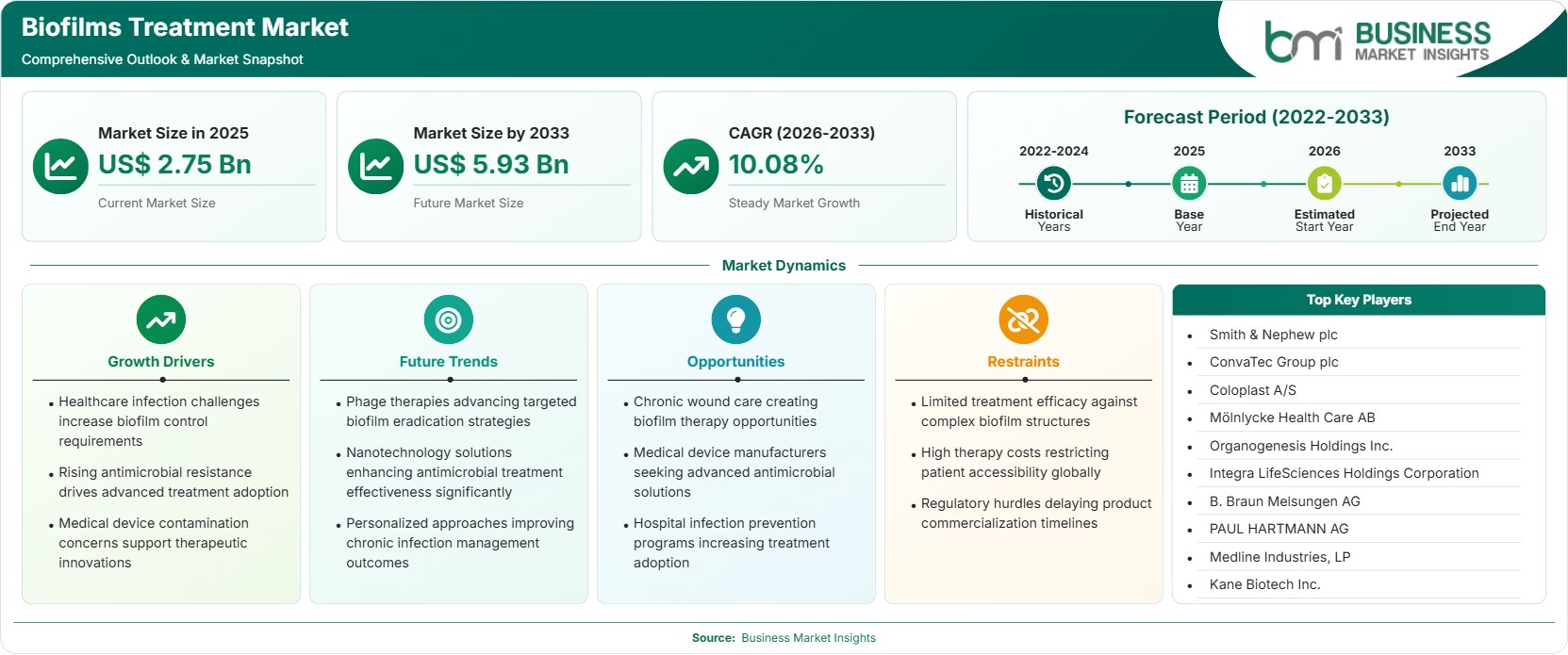
The Biofilms Treatment Market size was valued at US$ 2.75 Billion in 2025 and is projected to reach US$ 5.93 Billion by 2033, growing at a CAGR of 10.08% during 2026–2033, driven by chronic wound burden, antimicrobial innovation, biofilm-focused care, advanced dressings, and outpatient treatment expansion.

Report Coverage
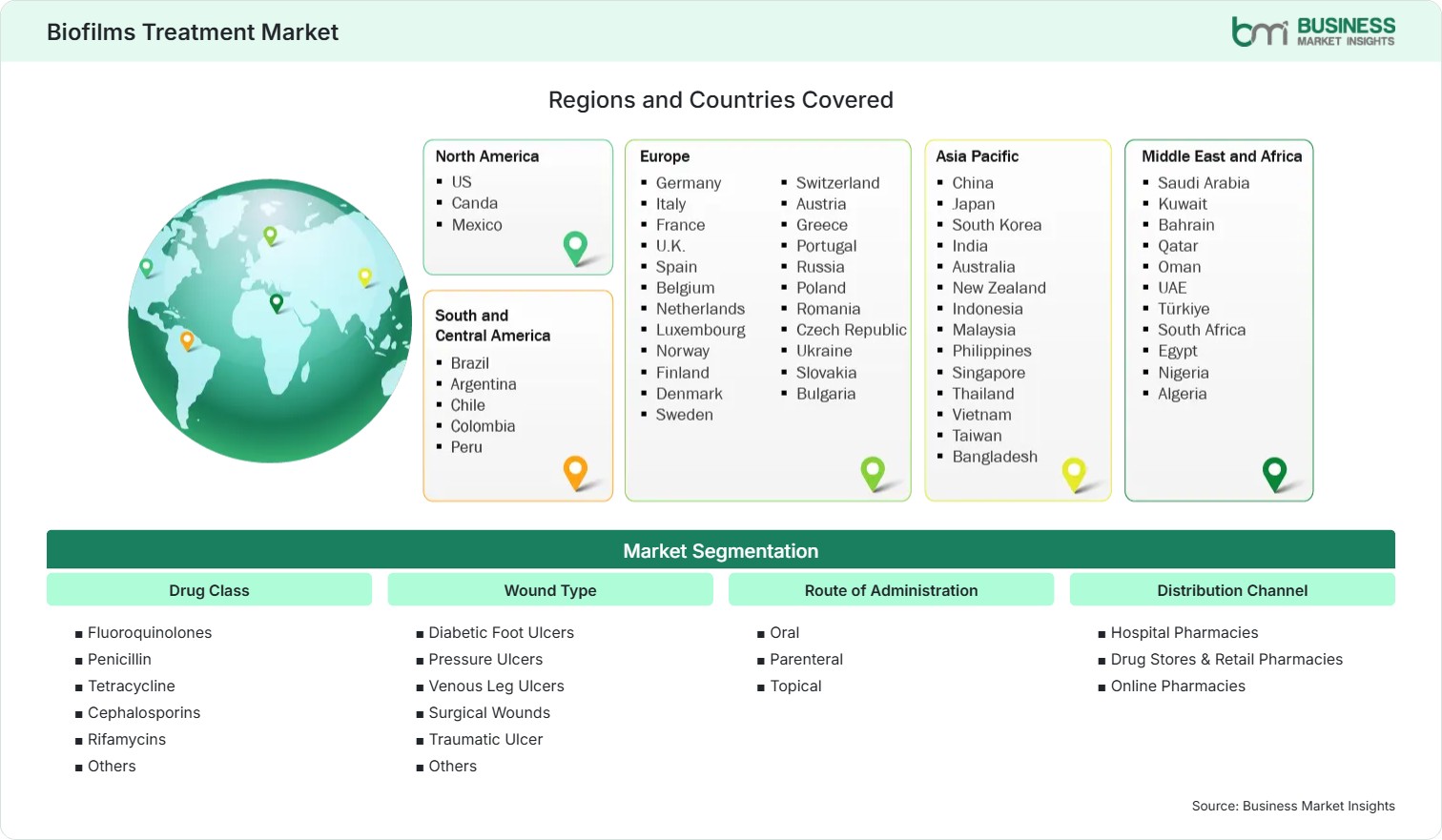
  • Drug Class: Fluoroquinolones, Penicillin, Tetracycline, Cephalosporins, Rifamycins, Others
  • Wound Type: Diabetic Foot Ulcers, Pressure Ulcers, Venous Leg Ulcers, Surgical Wounds, Traumatic Ulcer, Others
  • Route of Administration: Oral, Parenteral, Topical
  • Distribution Channel: Hospital Pharmacies, Drug Stores & Retail Pharmacies, Online Pharmacies
US$ 2.75 Bn Market size in 2025
US$ 5.93 Bn Market Size by 2033
10.08% CAGR, 2026 - 2033
2026-2033 Forecast Period

AI Overview

Biofilms Treatment Market Summary

  • North America Region: North America holds a 37%–40% share in 2025, growing at a 9.4%–9.8% CAGR during 2026–2033, supported by chronic wound prevalence, advanced wound care adoption, reimbursement infrastructure, specialist clinics, and product innovation. The US represents the regional commercial core, supported by specialist wound centers, advanced dressings, antimicrobial technologies, and established hospital procurement networks, with a 9.8%–10.4% CAGR through 2033.
  • Fastest Growing Region: Asia Pacific holds a 20%–23% Biofilms Treatment Market share in 2025 and is expanding at an 11.5%–12.2% CAGR during 2026–2033, supported by diabetes prevalence, improving surgical infrastructure, specialist wound-care adoption, urbanization, and expanding healthcare expenditure.
  • Leading Segment: Diabetic Foot Ulcers hold a 31%–34% share in 2025 and expand at a 10.4%–10.9% CAGR during 2026–2033, supported by diabetes-related wound prevalence, recurrent infection risk, prolonged healing cycles, debridement demand, antimicrobial management, and specialized outpatient care.
  • High Growth Segment: Topical administration represents a 24%–27% share in 2025 and advances at an 11.8%–12.5% CAGR during 2026–2033, supported by localized delivery, outpatient convenience, antimicrobial stewardship, dressing integration, lower systemic exposure, and easier repeat application.
  • Key Market Opportunity: Expansion of topical anti-biofilm formulations, advanced wound dressings, outpatient treatment pathways, and digitally supported wound assessment creates opportunities for differentiated products that combine microbial control with efficient wound management.
  • Major Market Players: Smith & Nephew plc, ConvaTec Group plc, Coloplast A/S, Mölnlycke Health Care AB, Organogenesis Holdings Inc., Integra LifeSciences Holdings Corporation, B. Braun Melsungen AG, PAUL HARTMANN AG, Medline Industries, LP, and Kane Biotech Inc.
Strategic Insights

Biofilms Treatment Market: Strategic Insights

Biofilms Treatment Market Strategic Framework
FREE PDF
Request your free sample
Request free sample
Stakeholder View

Key Takeaways

  • The value chain spans pharmaceutical ingredients, antimicrobial formulations, dressings, debridement technologies, wound-care distributors, hospitals, specialty clinics, and retail channels, creating opportunities for integrated product portfolios rather than single-product positioning.
  • Diabetic foot ulcers provide a substantial recurring-treatment opportunity because infection management frequently requires repeated assessment, cleansing, debridement, dressing changes, and monitoring across prolonged healing pathways.
  • Product development is moving toward multifunctional solutions that combine antimicrobial action with cleansing, moisture management, exudate absorption, barrier protection, or pressure-injury prevention, improving workflow efficiency for clinicians.
  • Asia Pacific provides an attractive expansion environment because rising diabetes prevalence and increasing healthcare capacity are occurring alongside broader adoption of advanced wound-care technologies and specialist treatment centers.
  • Capital is increasingly directed toward evidence-backed wound-care platforms, differentiated antimicrobial technologies, and specialty companies with regulatory clearances, clinical data, established distribution, or complementary advanced-care portfolios.
  • Companies can strengthen market access by demonstrating measurable clinical outcomes, simplifying application procedures, supporting antimicrobial stewardship, and developing distribution strategies tailored to hospital, specialty clinic, retail, and online purchasing behavior.
Geographic Outlook

Biofilms Treatment Market Regional Highlights

North America Biofilms Treatment Market

North America accounts for a 37%–40% Biofilms Treatment Market share in 2025 and is projected to expand at a 9.4%–9.8% CAGR through 2033. Demand is supported by advanced wound-care infrastructure, chronic wound prevalence, specialist clinicians, and established reimbursement pathways.

  • Hospital procurement remains important, but specialty wound centers increasingly influence product selection and treatment protocols through concentrated clinical expertise.
  • Antimicrobial dressings and topical technologies benefit from established clinical familiarity, particularly where products can demonstrate sustained microbial management alongside moisture and exudate control.
  • Regulatory evidence increasingly shapes competitive positioning, requiring manufacturers to substantiate indications, safety, performance, and intended wound-care applications.
  • The US market benefits from broad adoption of advanced wound management, while Canadian commercialization remains smaller but increasingly receptive to specialized antimicrobial solutions.

US Biofilms Treatment Market

The US represents approximately 84%–88% of North American Biofilms Treatment Market demand and is projected to expand at a 9.8%–10.4% CAGR through 2033. Chronic wounds, diabetic foot ulcers, pressure injuries, and postsurgical wounds support recurring demand.

  • Hospital systems remain influential purchasing centers, while ambulatory and specialist wound clinics create additional channels for products designed around repeat application and outpatient treatment.
  • Regulatory clearances for antimicrobial cleansers and wound products demonstrate continuing innovation in products addressing cleansing, debridement, microbial reduction, and wound-bed preparation.
  • Pressure-injury prevention is creating demand for multifunctional dressings that address microbial risk while also managing friction, shear, leakage, and wear time.

Europe Biofilms Treatment Market

Europe holds a 25%–28% Biofilms Treatment Market share in 2025 and is expected to expand at a 9.3%–9.7% CAGR through 2033. Germany, the UK, France, Italy, and Spain represent leading markets, while Poland offers comparatively stronger expansion at a 10.4%–11.0% CAGR.

  • Germany and the UK provide important commercialization environments because advanced wound-care procurement is supported by mature hospital systems and specialist clinical expertise.
  • France, Italy, and Spain provide established demand for advanced wound dressings and antimicrobial technologies, although reimbursement and procurement requirements can differ by market.
  • Poland offers stronger expansion potential as specialist wound-care capacity develops and advanced products become more accessible through modern healthcare channels.
  • European manufacturers benefit from proximity to established clinical research networks, enabling product validation and evidence generation for hard-to-heal wounds.

Asia Pacific Biofilms Treatment Market

Asia Pacific represents a 20%–23% Biofilms Treatment Market share in 2025 and records the fastest regional growth at an 11.5%–12.2% CAGR through 2033. China, Japan, South Korea, Australia, and India form the principal demand centers, while India and China provide comparatively high-growth opportunities.

  • China combines a large patient base with expanding hospital infrastructure, creating opportunities for antimicrobial dressings, topical products, and standardized wound-care protocols.
  • India provides high-growth potential through diabetes-related wounds, expanding private hospitals, specialist clinics, and increasing awareness of advanced wound management.
  • Japan emphasizes sophisticated clinical management and product quality, supporting demand for specialized wound-care technologies and evidence-backed treatment approaches.
  • Australia and South Korea provide mature healthcare environments where advanced dressings and specialist wound-care products can gain adoption through established clinical networks.

Rest of World Biofilms Treatment Market

South and Central America contribute approximately 6%–8% of global Biofilms Treatment Market demand in 2025 and expand at a 9.2%–9.8% CAGR through 2033. Brazil and Mexico provide the principal commercial bases, supported by diabetes, private healthcare development, and specialist distribution.

  • Brazil offers the largest South American opportunity, with private hospitals and specialist distributors supporting adoption of advanced antimicrobial wound-care products.
  • Mexico benefits from proximity to North American supply chains and expanding private healthcare capacity, supporting wider availability of specialized wound management.
  • Saudi Arabia and the United Arab Emirates provide comparatively strong Middle Eastern opportunities through tertiary hospitals, healthcare modernization, and premium medical technology procurement.
  • South Africa remains an important African hub for specialist healthcare distribution, although affordability and access constraints influence adoption of advanced products.
Global Market Geography
FREE PDF
Request your free sample
Request free sample
Segment Analysis

Biofilms Treatment Market Segmentation

Drug Class

Drug Class segmentation is shaped by clinical indication, antimicrobial stewardship, resistance considerations, route suitability, and wound severity. The segment represents an important treatment layer, with a 10%–13% Biofilms Treatment Market share in 2025 and a 9.2%–9.8% CAGR during 2026–2034. Product selection increasingly reflects targeted use rather than routine systemic exposure.

  • Fluoroquinolones: Used selectively for susceptible bacterial infections, these agents remain relevant where systemic therapy is clinically indicated, although resistance concerns and stewardship requirements constrain indiscriminate use.
  • Penicillin: Penicillin-class therapies retain relevance against susceptible organisms, with prescribing increasingly guided by microbiological assessment, resistance patterns, patient factors, and appropriate stewardship.
  • Tetracycline: Tetracyclines provide an established antimicrobial option for selected infections, while broader wound-care adoption depends on susceptibility, formulation, tolerability, and clinician preference.
  • Cephalosporins: Cephalosporins remain important systemic antibiotics for selected wound infections, with demand influenced by pathogen susceptibility, hospital protocols, infection severity, and stewardship requirements.
  • Rifamycins: Rifamycins offer specialized antimicrobial utility in selected infection-management settings, where combination strategies, resistance prevention, and careful clinical oversight influence application.

Wound Type

Wound Type is a central demand determinant because biofilm persistence varies with wound duration, tissue condition, vascular status, infection risk, and treatment intensity. Diabetic Foot Ulcers lead with a 31%–34% Biofilms Treatment Market share and 10.4%–10.9% CAGR through 2034.

  • Diabetic Foot Ulcers: Diabetes-related tissue damage, impaired healing, infection susceptibility, and recurrence create sustained requirements for cleansing, debridement, antimicrobial management, advanced dressings, and specialist monitoring.
  • Pressure Ulcers: Pressure injuries require coordinated prevention and treatment, creating demand for antimicrobial products alongside pressure redistribution, moisture management, nutritional support, and frequent wound assessment.
  • Venous Leg Ulcers: Venous disease produces prolonged healing cycles and recurrent wounds, supporting repeated dressing use, antimicrobial management, exudate control, compression-linked care, and specialist intervention.
  • Surgical Wounds: Surgical wounds create demand for infection prevention and management across acute and post-acute settings, with treatment decisions influenced by procedure type, contamination risk, and healing progress.
  • Traumatic Ulcer: Traumatic wounds vary substantially in contamination, tissue damage, and infection risk, increasing demand for adaptable cleansing, antimicrobial, dressing, and debridement approaches.

Route of Administration

Route of Administration influences clinical convenience, systemic exposure, adherence, and treatment setting. Topical administration holds a 24%–27% Biofilms Treatment Market share in 2025 and advances at an 11.8%–12.5% CAGR through 2034, supported by localized treatment and outpatient suitability.

  • Oral: Oral therapy provides convenient systemic administration when clinically indicated, supporting outpatient treatment pathways while requiring attention to susceptibility, interactions, adherence, resistance, and patient-specific factors.
  • Parenteral: Parenteral therapy supports severe or complicated infections requiring systemic exposure, particularly within hospitals where intravenous treatment can be combined with procedural wound management.
  • Topical: Topical products deliver localized treatment and can be integrated with wound cleansing, debridement, and dressings, supporting repeat use across specialist and outpatient care.

Distribution Channel

Distribution Channel dynamics reflect clinical procurement, prescription behavior, product complexity, and consumer convenience. Institutional channels remain important for advanced wound-care technologies, while retail and online channels broaden access to standardized products and repeat-use treatments.

  • Hospital Pharmacies: Hospital pharmacies remain critical for institutional procurement, formulary management, antimicrobial stewardship, and coordinated access to therapies used for complex wounds and postsurgical infections.
  • Drug Stores and Retail Pharmacies: Retail pharmacies provide convenient access to standardized wound-care products, supporting repeat purchases and treatment continuity for patients managed outside acute-care settings.
  • Online Pharmacies: Online pharmacies expand product accessibility and purchasing convenience, particularly for repeat-use topical and wound-care products that require replenishment during prolonged treatment.
Market Forces

Biofilms Treatment Market Dynamics

Key Market Drivers

Rising Chronic Wound and Diabetic Foot Burden

The expanding chronic wound population creates repeated demand for microbial management because delayed healing increases treatment duration, dressing consumption, specialist visits, and debridement requirements. Diabetes is an important disease to consider since there may be complications related to the vessels, nerves, and immune system impairment that will negatively impact the process of wound healing and cause infections. The Biofilms Treatment Market growth, therefore, indicates not only an increase in patients but also increased activity of treatment procedures for each individual wound. Wound care centers have started developing protocols for wound bed preparation based on cleansing, debridement, dressing, and other procedures.

Expansion of Advanced Antimicrobial Wound Technologies

Product innovation now seems to be going past traditional dressings into multi-functional platforms that integrate all of the elements mentioned above, such as antimicrobial properties, cleansing, moisture control, exudate management, barrier function, and interaction with the wound bed. One such example of product innovation from Convatec is the use of nitric oxide-generating technology under the trade name of ConvaNiox, which is meant for antimicrobial and antibiofilm properties. Another company doing so is Smith+Nephew with its product called ALLEVYN COMPLETE CARE. These developments reinforce Biofilms Treatment Market trends centered on multifunctionality, evidence generation, product differentiation, and clinical workflow efficiency.

Greater Emphasis on Antimicrobial Stewardship

The influence of antimicrobial stewardship on the development of treatments lies in the fact that repeated systemic exposure to antibiotics may be a factor contributing to resistance as well as excessive healthcare consumption. WHO's 2025 AWaRe classification still emphasizes proper antibiotic choice, surveillance, and stewardship, underlining the medical logic behind selective use of systemic treatment along with effective wound care. Suppliers will therefore have to start developing solutions to achieve wound-bed preparation and microbial control without relying on systemic antibiotics.

Key Market Opportunities

Topical Anti-Biofilm Product Innovation

The area of topical drug delivery provides a significant commercial opportunity since the approach allows for targeted drug delivery within existing dressing changing protocols. The innovation efforts should be concentrated on developing surfactants, nitric oxide release, antimicrobial gel delivery, wound cleansing, controlled release systems, and their combinations that would promote biofilm disruption without increasing the amount of systemic antibiotics used. This is illustrated by the upcoming 2026 FDA approval of Kane Biotech's Revyve Antimicrobial Skin and Wound Cleanser for various acute and chronic wounds.

Integration With Digital Wound Assessment

The ability to measure wounds digitally, take images of them, monitor their progress remotely, and document this information creates the opportunity to link treatment to wound progress. The need for effective documentation of information such as wound measurements, tissue type, exudate, signs of infection, and wound healing becomes increasingly necessary in hospitals and specialty care facilities. Linking the antimicrobial and antibiofilm treatments with the use of digital technologies will allow for more accurate treatment up and down escalations.

Expansion Across Emerging Wound-Care Networks

The evolving nature of healthcare systems presents the chance to integrate innovative technologies for wounds along with hospital development and the establishment of specialty clinics. Asia-Pacific markets are appealing as an opportunity, as the need for innovative technology due to wound cases from diabetes patients grows in tandem with the development of healthcare systems. These differences can be catered to through partnerships with distributors and clinician education. The Biofilms Treatment Market Forecasts are therefore influenced not only by disease prevalence but also by the pace at which advanced wound-care infrastructure reaches secondary cities and outpatient facilities.

Market Restraints and Challenges

Clinical Evidence and Regulatory Complexity

Factor: The claim that an antibiofilm product makes requires proof of significant performance capabilities under clinical conditions; regulations depend on how the product is classified (drug, device, combination product, or wound-care accessory) Impact: Commercialization may be slowed by lengthy development schedules, clinical trials, quality systems investments, and documentation. Buyers demand more than laboratory results since microbes being disrupted do not necessarily mean wounds heal any faster or infection decreases.

Antimicrobial Resistance and Treatment-Selection Constraints

Factor: The existence of antimicrobial resistance means that certain systemic therapies might not be effective, and unnecessary or excessive administration of antibiotics increases resistance pressure.

Impact: Clinicians will need to conduct microbiological testing or develop a combination of measures and use another local approach, making the therapy more complicated and delaying the introduction of new products based on their ability to act as antibiotics. The AWaRe approach developed by WHO highlights proper antibiotic usage.

Company Analysis

Competitive Landscape

Competitive Biofilms Treatment Market analysis indicates that differentiation increasingly depends on clinical evidence, antimicrobial technology, wound-care breadth, regulatory capability, and distribution reach. The competitive field includes diversified medical technology companies, advanced wound-care specialists, tissue-technology businesses, and emerging antimicrobial innovators.

Company Name

Overview

Products and Services relevant to this market

Smith & Nephew plc

Global medical technology company with an established advanced wound-management portfolio and broad hospital relationships.

Antimicrobial dressings, advanced foam dressings, enzymatic debridement, negative-pressure wound therapy, pressure-injury prevention, and wound-care systems.

ConvaTec Group plc

Global medical products company with substantial expertise in chronic wound management and antimicrobial technologies.

AQUACEL antimicrobial dressings, advanced wound dressings, infection and biofilm management, cleansing solutions, and ConvaNiox technology.

Coloplast A/S

Danish healthcare company with established wound-care capabilities and specialist clinical distribution.

Advanced wound dressings, wound-care solutions, moisture management products, and technologies supporting chronic wound treatment.

Mölnlycke Health Care AB

Specialist healthcare company focused on wound care, surgical products, and solutions supporting clinical efficiency.

Antimicrobial dressings, wound-care products, surgical wound solutions, and technologies supporting infection-risk management.

Organogenesis Holdings Inc.

Regenerative medicine company with a significant advanced wound-care portfolio and clinical focus.

Advanced wound-care products, biologic technologies, tissue-based solutions, and products supporting complex wound healing.

Integra LifeSciences Holdings Corporation

Medical technology company serving wound reconstruction, tissue repair, and surgical care markets.

Wound reconstruction products, tissue technologies, surgical wound management, and solutions for complex tissue defects.

B. Braun Melsungen AG

Diversified healthcare company with extensive hospital relationships and products spanning wound care and infection management.

Wound dressings, surgical products, antimicrobial solutions, infusion technologies, and hospital-focused infection management products.

PAUL HARTMANN AG

European healthcare supplier with long-standing expertise in wound management and infection prevention.

Advanced wound dressings, antimicrobial wound products, cleansing solutions, compression products, and professional wound-care systems.

Medline Industries, LP

Large medical-supply company with broad distribution and extensive healthcare-provider relationships.

Advanced wound-care products, antimicrobial dressings, wound cleansers, surgical supplies, and institutional wound-management solutions.

Kane Biotech Inc.

Specialist biotechnology company developing antimicrobial and antibiofilm technologies for wound-care applications.

Revyve antimicrobial wound gel, wound gel spray, antimicrobial skin and wound cleanser, and related antibiofilm technologies.

Trust & Transparency

Research Methodology

The market analysis combines proprietary research with secondary data from government agencies, company disclosures, regulatory filings, industry databases and expert interviews. Market estimates are validated through data triangulation, cross-market benchmarking and analyst review.

View Full Research Methodology

Questions Answered

Frequently Asked Questions

What should manufacturers prioritize when entering emerging markets?

The Biofilms Treatment Market Report highlights that Manufacturers should align product selection with local clinical needs, regulatory requirements, purchasing power, distributor capability, clinician education, and supply reliability. Tiered portfolios can help companies introduce advanced technologies while maintaining broader market accessibility.

Why is clinical evidence becoming more important for suppliers?

Evidence helps distinguish laboratory antimicrobial activity from clinically meaningful outcomes. Healthcare purchasers increasingly assess safety, wound progression, application requirements, treatment duration, and economic value when evaluating advanced wound-care products.

How are topical products changing wound-care workflows?

Topical products can support localized treatment while fitting existing cleansing and dressing-change procedures. Their use may reduce treatment complexity when appropriately selected and can support outpatient management where systemic therapy is not clinically required.

Which wound type creates recurring demand for advanced treatment?

Diabetic foot ulcers can generate recurring demand because impaired healing, neuropathy, vascular complications, and infection risk may require repeated assessment, cleansing, debridement, dressing changes, and specialist follow-up.

What factors determine whether a wound requires biofilm-focused treatment?

Treatment decisions depend on wound duration, tissue condition, infection indicators, exudate, recurrence, patient comorbidities, and clinical assessment. Biofilm management is generally incorporated into broader wound-bed preparation rather than treated as an isolated intervention.

Access the Full Biofilms Treatment Market Report

Get segment-level forecasts, regional estimates, competitive benchmarking, company profiles and downloadable Excel datasets.

Access the full Biofilms Treatment Market Report
350 pages PDF & Excel | 2026-10-12
Similar Research

Related Market Reports