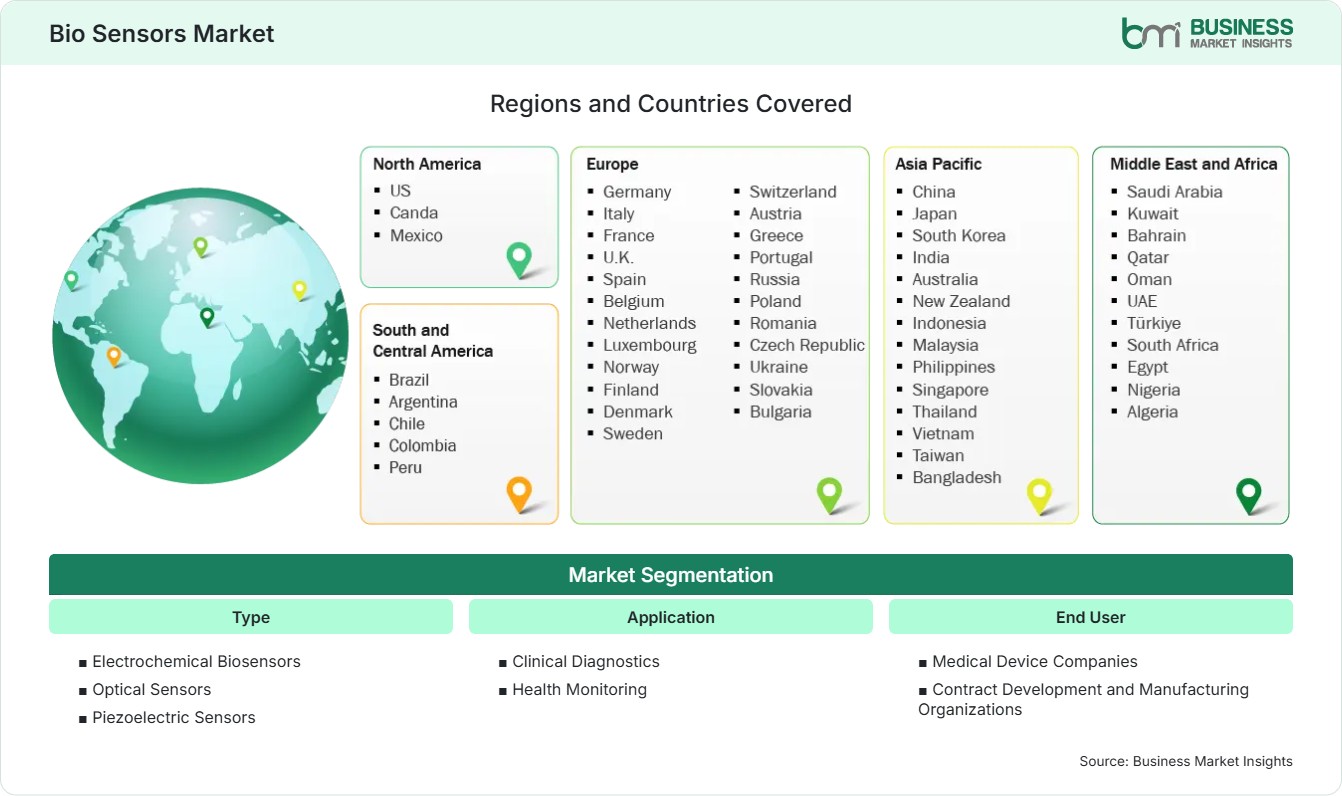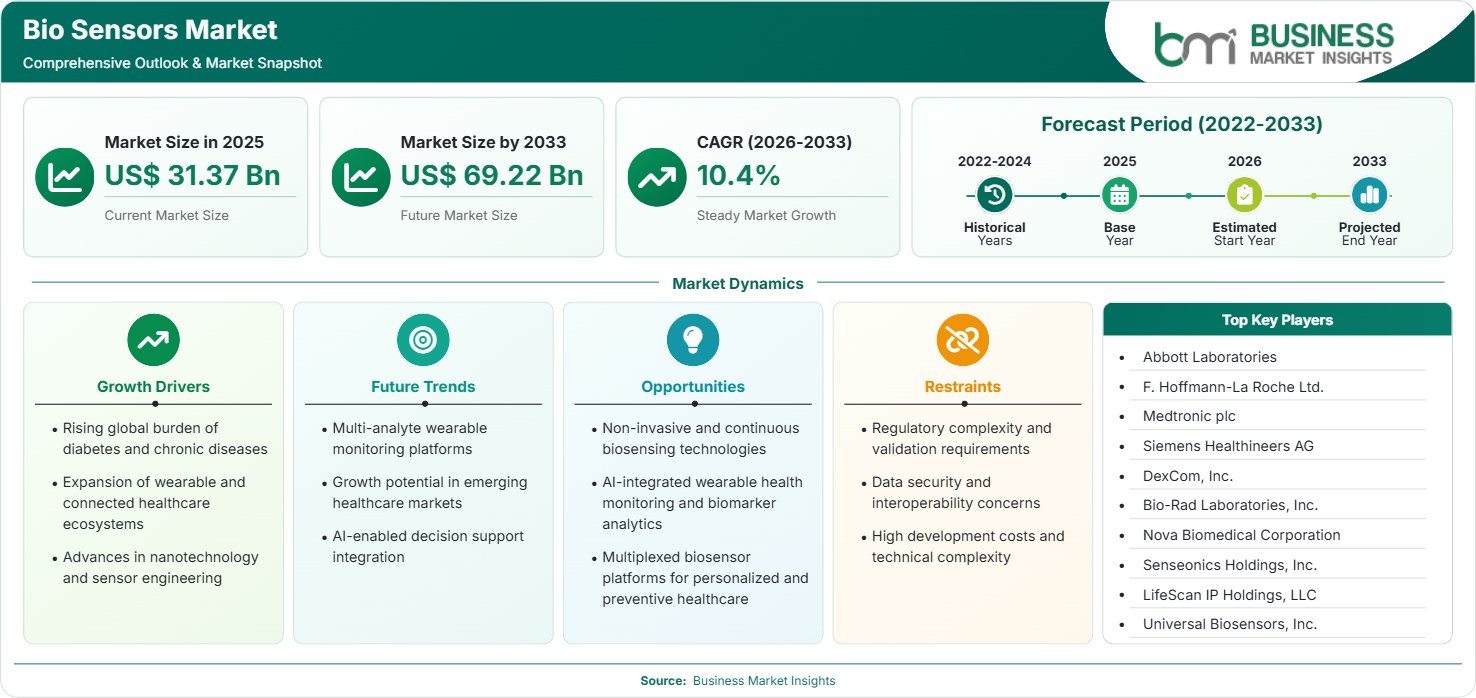
Bio Sensors Market Regional Highlights
North America Bio Sensors Market
North America accounts for approximately 36%–39% of global demand in 2025 and is expected to expand at a CAGR of 9.4%–9.8% through 2033. Strong healthcare expenditure, extensive diabetes monitoring adoption, advanced laboratory infrastructure, and supportive reimbursement systems sustain regional leadership. The Bio Sensors Market share remains concentrated in the United States due to strong innovation ecosystems and commercialization capabilities. Continuous glucose monitoring, wearable diagnostics, and digital therapeutics integration continue strengthening regional demand.
- CGM adoption remains the largest revenue contributor across diabetes management programs and remote monitoring initiatives.
- FDA-cleared wearable biosensing technologies continue expanding patient access to continuous health tracking.
- Strategic collaborations between device developers and software providers strengthen clinical decision-support capabilities.
- Hospital networks increasingly deploy real-time biomarker monitoring platforms to improve care efficiency.
- Preventive healthcare investments support broader consumer-facing biosensor adoption.
US Bio Sensors Market
The United States represents approximately 79%–83% of regional revenue and records a CAGR of 9.5%–9.9%. Strong research funding, favorable commercialization pathways, and high chronic disease prevalence support market expansion. Healthcare providers increasingly integrate remote monitoring systems into care delivery models, creating sustained demand for connected biosensing technologies and recurring software-enabled services.
- Diabetes management remains the largest application category across clinical settings.
- Digital health reimbursement frameworks encourage continuous patient monitoring adoption.
- Venture funding supports innovative biosensor startups and commercialization efforts.
- AI-enabled data interpretation is improving clinical workflow efficiency.
Europe Bio Sensors Market
Europe commands 27%–30% market share in 2025 while progressing at 9.8%–10.4% CAGR. Strong healthcare systems, aging populations, and growing demand for decentralized diagnostics support regional growth. Germany leads regional revenue generation, while Ireland and Eastern European markets demonstrate faster expansion. Regulatory emphasis on early disease detection and preventive healthcare continues supporting deployment across clinical and home-care applications.
- Germany remains the leading country with strong medical technology manufacturing capabilities.
- Ireland exhibits among the fastest growth rates, supported by medtech investment activity.
- Home diagnostics uptake continues increasing across major European healthcare systems.
- Research collaborations support commercialization of advanced biosensing platforms.
- Digital health policies encourage integration of connected monitoring technologies.
Asia Pacific Bio Sensors Market
Asia-Pacific commands a market share of 24% - 27% in 2025 with the highest CAGR of 12.1% - 12.8%. The increased investment in the health sector, the large number of diabetic patients, the growth of middle-class income groups, and improved local production facilities create strong growth prospects. China dominates in revenue generation, whereas India exhibits better growth potential. Government-backed screening programs and consumer wearable adoption contribute significantly to expansion.
- China remains the largest regional market due to scale and manufacturing capacity.
- India records accelerated growth supported by healthcare digitization and diagnostics demand.
- Japan continues advancing innovation in precision sensing technologies.
- Regional manufacturers are improving competitiveness through cost-effective production.
- Wearable health monitoring adoption continues increasing among urban consumers.
Rest of World Bio Sensors Market
Rest of World contributes 8%-11% market share in 2025 and records 10.5%-11.2% CAGR. The market in South and Central America is driven by developments in access to healthcare services and management of chronic diseases.
Adoption in the Middle East & Africa is bolstered by healthcare reforms, digital health technologies, and rising demand for diagnostic devices. Brazil dominates in terms of regional revenues, whereas Saudi Arabia records high growth rates.
- Brazil remains the largest market across Latin America.
- Saudi Arabia benefits from healthcare transformation and technology investments.
- Point-of-care testing demand continues increasing across underserved healthcare settings.
- Private healthcare expansion supports advanced diagnostic technology deployment.
- Public health initiatives encourage earlier disease detection and monitoring.