
Automotive Smart Display Market Outlook: Size, Share, Trends, Growth Analysis, Competitive Landscape & Forecast, 2026-2033

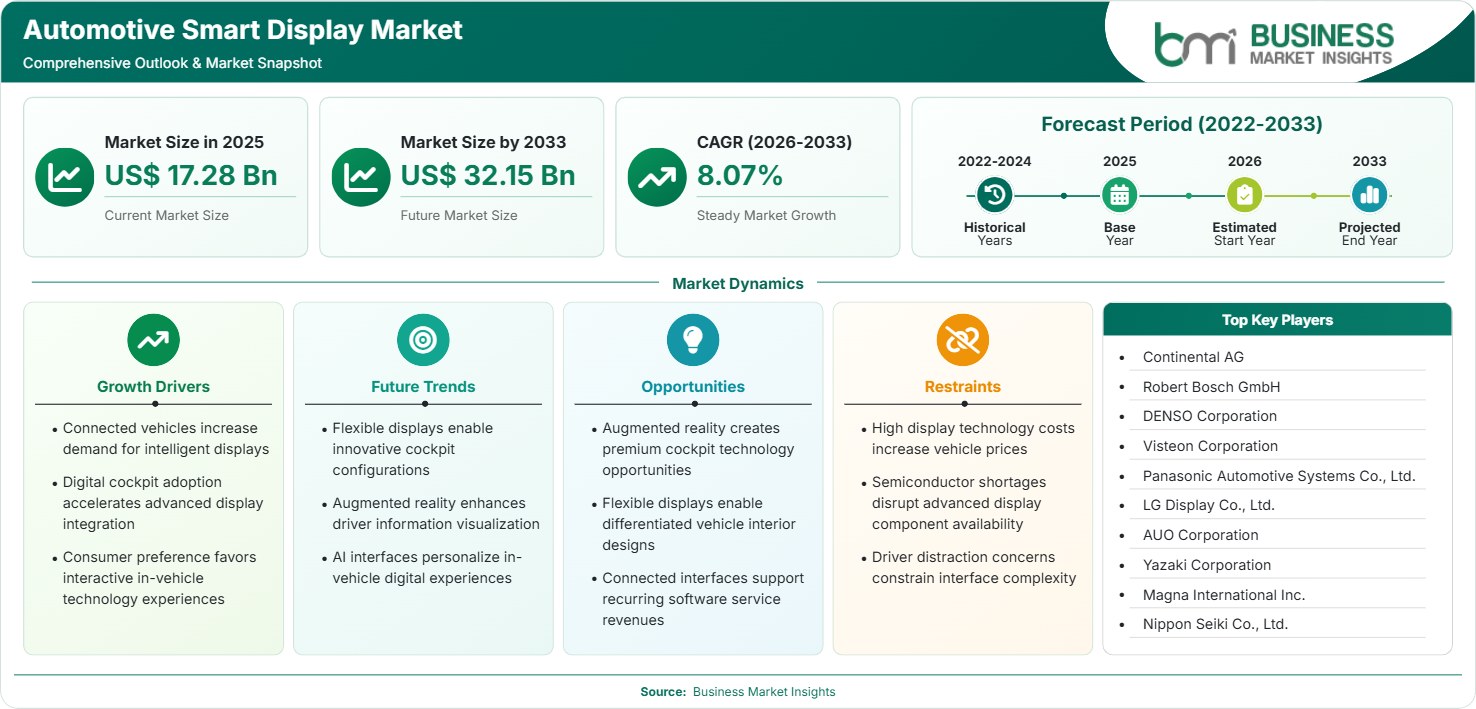
The Automotive Smart Display Market size was valued at US$ 17.28 Billion in 2025 and is projected to reach US$ 32.15 Billion by 2033, growing at a CAGR of 8.07% during 2026–2033. Growing use of digital cockpits, rising interest in connected vehicles, wider integration of advanced driver assistance systems, larger in-vehicle screens, and the move toward software-defined vehicle architectures are opening up significant revenue opportunities across the global automotive ecosystem.

Report Coverage
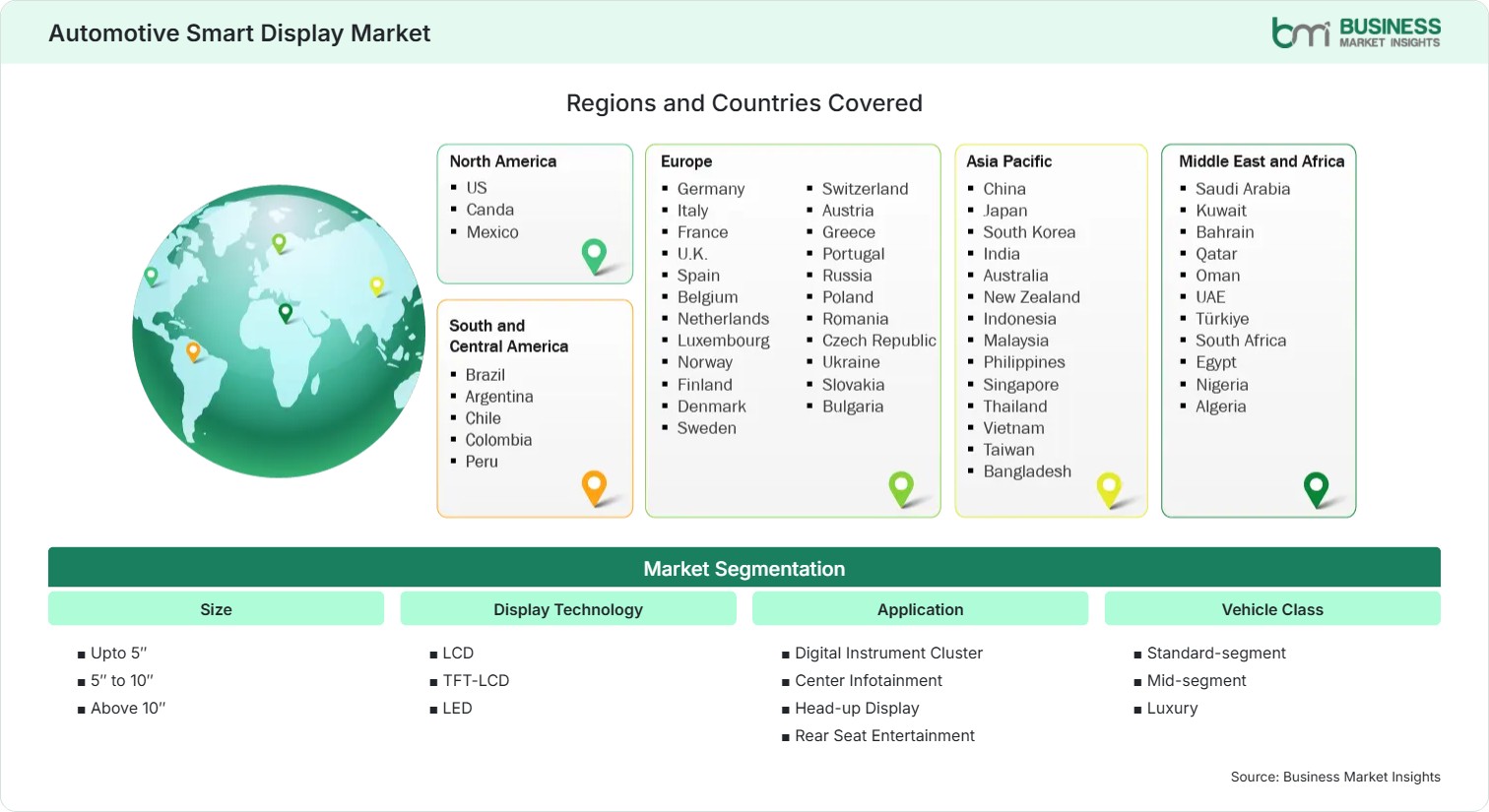
  • Size: Upto 5″, 5″ to 10″, Above 10″
  • Display Technology: LCD, TFT-LCD, LED
  • Application: Digital Instrument Cluster, Center Infotainment, Head-up Display, Rear Seat Entertainment
  • Vehicle Class: Standard-segment, Mid-segment, Luxury
US$ 17.28 Bn Market size in 2025
US$ 32.15 Bn Market Size by 2033
8.07% CAGR, 2026 - 2033
2026-2033 Forecast Period

AI Overview

Automotive Smart Display Market Summary

  • North America Region: North America holds market share of 28%–31% in 2025, growing with a CAGR of 7.2%–7.8% during 2026–2033. Vehicle digitization, strong demand for premium SUVs, cockpit software innovation, and continued investment in connected mobility are supporting adoption. Expanding EV portfolios and greater integration of advanced driver assistance systems are also creating opportunities to upgrade displays across mainstream and luxury vehicle models globally. The U.S. accounts for 72%–76% of regional demand and is advancing at a CAGR of 7.4%–8.0% through 2033, supported by digital cockpit deployments.
  • Fastest Growing Region: Asia Pacific holds market share of 34%–37% in 2025, growing with a CAGR of 9.2%–9.9% during 2026–2033. Expanding vehicle production, rising investment in smart cockpits, EV manufacturing growth, a broader semiconductor ecosystem, and consumer demand for high-resolution displays are helping the market gain momentum across China, India, South Korea, and Southeast Asia.
  • Leading Segment: Center Infotainment holds market share of 34%–38% in 2025, growing with a CAGR of 7.8%–8.5% during 2026–2033. Demand for connected services, multimedia functions, navigation systems, software updates, and more personalized user experiences is encouraging automakers to integrate these systems across passenger vehicles and emerging electric mobility platforms.
  • High Growth Segment: Head-up Display holds market share of 14%–18% in 2025, growing with a CAGR of 10.2%–11.0% during 2026–2033. Stronger safety requirements, augmented reality interfaces, better visibility of driver information, autonomous driving capabilities, and the growing availability of premium features in mid-segment vehicles are creating considerable opportunities for adoption.
  • Key Market Opportunity: Software-defined vehicle platforms are giving rise to display-centric cockpit architectures that bring entertainment, navigation, diagnostics, and safety functions together through scalable interfaces. This is opening up recurring software revenue opportunities for automotive technology providers globally.
  • Major Market Players: Continental AG, Robert Bosch GmbH, DENSO Corporation, Visteon Corporation, Panasonic Automotive Systems Co., Ltd., LG Display Co., Ltd., AUO Corporation, Yazaki Corporation, Magna International Inc., Nippon Seiki Co., Ltd.
Strategic Insights

Automotive Smart Display Market: Strategic Insights

Automotive Smart Display Market Strategic Framework
FREE PDF
Request your free sample
Request free sample
Stakeholder View

Key Takeaways

  • The value chain is gradually moving from standalone display hardware toward integrated cockpit ecosystems, where software, sensors, connectivity, and visualization platforms can create long-term revenue streams.
  • Head-up displays and multifunction cockpit solutions have strong growth potential as automakers place greater emphasis on safety, driver engagement, and distinctive user experiences in increasingly competitive vehicle markets.
  • Innovation is increasingly focused on curved displays, OLED panels, augmented reality visualization, AI-enabled personalization, and smoother integration between vehicle operating systems and digital interfaces.
  • Asia Pacific stands out as an attractive investment opportunity, supported by strong vehicle production capacity, expanding EV manufacturing, and advantages across local electronics supply chains.
  • Strategic partnerships involving automakers, semiconductor suppliers, display manufacturers, and software developers are speeding up consolidation while helping shorten development timelines for next-generation cockpit platforms.
  • As software-defined vehicles become more common, recurring revenue from upgrades, subscriptions, navigation services, and connected entertainment features is expected to play a larger role.
Geographic Outlook

Automotive Smart Display Market Regional Highlights

North America Automotive Smart Display Market

North America accounted for approximately 28%–31% of global revenue in 2025 and is projected to expand at a 7.2%–7.8% CAGR through 2033. Demand for connected vehicles, premium pickup trucks, electric vehicles, and advanced driver assistance systems continues to support display adoption. The region also benefits from a mature automotive software ecosystem and substantial investment in digital cockpit technologies. Automotive Smart Display Market share remains supported by consumers' growing expectations for seamless infotainment integration, over-the-air updates, vehicle connectivity, and more sophisticated human-machine interface architectures across vehicle categories.

  • Major OEMs are adding larger infotainment displays and digital clusters to mainstream vehicles, which is expanding the use of connected cockpit solutions and supporting demand for high-resolution display technologies across production programs.
  • Electric vehicle manufacturers continue to adopt multi-display cabin architectures that improve user experience, make navigation easier to access, and support software functionality while giving vehicle interiors a more distinctive look than conventional automotive designs.
  • The integration of AI-powered voice assistants, navigation systems, and cloud-based vehicle services is making display content more complex and increasing demand for higher-value smart display implementations across passenger vehicle portfolios.
  • Growing demand for advanced safety interfaces and driver monitoring systems is encouraging automakers to use reconfigurable digital displays that can deliver real-time vehicle intelligence and situational awareness information.
  • Suppliers are deepening partnerships with semiconductor companies and software developers to enhance display performance, strengthen cybersecurity resilience, and improve lifecycle management across connected mobility ecosystems.

US Automotive Smart Display Market

The United States represented approximately 72%–76% of North American Automotive Smart Display Market demand in 2025 and is advancing at a 7.4%–8.0% CAGR through 2033. The United States represented approximately 72%–76% of North American Automotive Smart Display Market demand in 2025 and is advancing at a 7.4%–8.0% CAGR through 2033. Preference of consumers towards tech-loaded cars, the adoption of connected mobility solutions, and a higher adoption rate of premium SUVs is fueling market growth. Top automotive makers keep on developing digital cockpit solutions, whereas the technology companies invest in a visualization ecosystem.

  • Premium vehicle manufacturers are turning to panoramic displays and multilayer visualization systems to create more distinctive customer experiences, with greater scope for personalization and digital interaction throughout the vehicle ownership cycle.
  • Rising investment in vehicle software platforms is encouraging automakers to develop display-centric architectures that support connected services, predictive maintenance, and ongoing feature enhancements through software upgrades.
  • Greater deployment of head-up displays and driver information systems reflects increased attention to road safety, user convenience, and regulatory expectations surrounding driver awareness technologies.
  • Automotive electronics suppliers are continuing to localize production and development activities to strengthen supply-chain resilience and reduce reliance on overseas component sourcing networks.

Europe Automotive Smart Display Market

Europe captured approximately 24%–27% of global Automotive Smart Display Market revenue in 2025 and is expected to register a 7.5%–8.2% CAGR through 2033. Premium car manufacturing, robust efforts to electrify cars, and stringent safety regulations are helping drive this growth in the market. Germany is the key player in the region due to its strong automotive manufacturing environment. However, Central and Eastern Europe are increasingly becoming favorable production areas.

  • Germany maintains its leadership through strong premium automotive manufacturing and investment in next-generation cockpit electronics, supporting steady demand for sophisticated visualization technologies and integrated digital interfaces.
  • The United Kingdom is seeing greater adoption of connected vehicle technologies as automakers and mobility providers place more emphasis on user-focused software experiences and advanced infotainment capabilities.
  • France is benefiting from rising EV penetration and government-backed sustainability initiatives, which are creating demand for intelligent vehicle interfaces and more efficient information delivery systems.
  • Poland and Czechia are emerging as high-growth manufacturing locations, supported by automotive investments and regional supply-chain diversification efforts that are strengthening electronics production.
  • Europe's regulatory focus on safety, driver assistance technologies, and vehicle connectivity continues to encourage display innovation across passenger and commercial vehicle segments.

Asia Pacific Automotive Smart Display Market

Asia Pacific held approximately 34%–37% of global revenue in 2025 and is anticipated to expand at a 9.2%–9.9% CAGR through 2033, making it the fastest-growing regional market. China leads regional demand because of its large automotive production base and established electric vehicle ecosystem, while India offers considerable growth potential as vehicle ownership and digitalization continue to rise. Automotive Smart Display Market growth across the region is being supported by strong electronics manufacturing capabilities, expanding semiconductor capacity, and increasing consumer preference for feature-rich connected vehicles.

  • China dominates regional demand, supported by extensive EV production, strong domestic electronics manufacturing, and the rapid rollout of smart cockpit technologies across different vehicle categories.
  • India represents one of the fastest-growing opportunities as vehicle manufacturers increasingly add digital clusters, infotainment systems, and connected services to competitive passenger vehicle offerings.
  • South Korea benefits from its technological strength in display manufacturing and automotive electronics, helping support ongoing product innovation and export-oriented growth strategies.
  • Japanese automakers continue to integrate advanced visualization solutions with an emphasis on safety, reliability, and smooth driver interaction across domestic and international vehicles.
  • Southeast Asian markets are attracting investment from automotive suppliers looking to establish localized production footprints and gain access to growing consumer demand.

Rest of World Automotive Smart Display Market

The Rest of World region accounted for approximately 9%–12% of global Automotive Smart Display Market revenue in 2025 and is projected to grow at a 7.8%–8.6% CAGR during 2026–2033. There has been more application of connected vehicles technology in South America due to increasing automotive digitalization. Brazil accounts for the highest contribution in the region owing to the already existing manufacturing base. The Middle East & Africa region benefits due to high demand for premium vehicles, modernized infrastructure, and investments in connected mobility programs.

  • Brazil leads adoption through its manufacturing scale, growing consumer preference for connected vehicles, and increasing availability of advanced infotainment technologies.
  • Mexico continues to benefit from export-oriented automotive production and supplier investments aimed at expanding advanced vehicle electronics assembly capabilities.
  • Saudi Arabia is seeing greater deployment of premium mobility technologies as automotive modernization initiatives expand across transportation ecosystems.
  • The UAE continues to show strong demand for luxury vehicles equipped with advanced display technologies, supporting higher-value product adoption throughout the region.
  • South Africa remains an important automotive manufacturing center and supports regional distribution of increasingly digitalized vehicle platforms.
Global Market Geography
FREE PDF
Request your free sample
Request free sample
Segment Analysis

Automotive Smart Display Market Segmentation

Size

The size segment reflects the growing preference for larger, multifunctional vehicle displays that can handle navigation, entertainment, connectivity, and safety information in one place. Displays ranging from 5 to 10 inches accounted for 42%–46% market share in 2025 and are expected to grow at a 7.7%–8.4% CAGR through 2033, supported by their balanced cost-performance characteristics. Automotive Smart Display Market scope continues expanding as automakers introduce larger display formats across conventional and electric vehicles.

  • Upto 5: Commonly used in entry-level vehicles, where keeping costs under control remains important. These displays provide essential driver information, multimedia functions, and basic connectivity while limiting overall vehicle electronic costs.
  • 5 to 10: Represents the mainstream category across global vehicle production. Manufacturers favor this range because it provides a practical balance between user experience, functionality, dashboard integration, and cost efficiency in high-volume vehicle platforms.
  • Above 10: Increasingly found in premium and electric vehicles that call for immersive digital experiences, multitasking interfaces, and advanced visualization capabilities within sophisticated cockpit environments.

Display Technology

Display technology continues to be an important area of differentiation in modern vehicles. TFT-LCD technology captured approximately 46%–50% market share in 2025 and is forecast to expand at a 7.8%–8.5% CAGR through 2033. Improvements in brightness, durability, energy efficiency, and cost optimization are helping sustain its adoption. At the same time, manufacturers are exploring OLED, mini-LED, and other advanced visualization technologies to improve cabin aesthetics and make in-vehicle interfaces more engaging.

  • LCD: Continues to serve cost-sensitive vehicle categories because of its mature manufacturing base, reliability, and proven performance across a wide range of environmental conditions.
  • TFT-LCD: Remains dominant in vehicle integration because it offers strong image quality, responsive touch functionality, scalable manufacturing, and compatibility with evolving cockpit software ecosystems.
  • LED: Provides greater brightness, energy efficiency, and visual clarity, making it increasingly suitable for advanced infotainment, instrument cluster, and premium display installations.

Application

Application diversity is increasing as automakers turn traditional dashboards into connected digital ecosystems. Center infotainment represented the leading category with 34%–38% Automotive Smart Display Market share in 2025 and is projected to register a 7.8%–8.5% CAGR through 2033. Demand for connected mobility services, multimedia content, navigation, and software upgrades continues to support adoption. Automakers increasingly regard infotainment systems as strategic features that can influence customer satisfaction and help differentiate their brands.

  • Digital Instrument Cluster: Replaces conventional analog gauges with configurable interfaces that make information easier to access, allow greater personalization, and integrate smoothly with modern vehicle software architectures.
  • Center Infotainment: Serves as the main user interaction hub, bringing together navigation, entertainment, climate control management, smartphone integration, and connected mobility services.
  • Head-up Display: Continues gaining momentum because it can improve safety by allowing drivers to access important information without taking their attention away from surrounding road conditions.
  • Rear Seat Entertainment: Is increasingly used in premium vehicles and family-oriented mobility solutions, giving passengers easier access to multimedia content and improving the overall in-cabin experience.

Vehicle Class

Vehicle-class demand has a direct influence on technology adoption and the pace at which new features are introduced. Mid-segment vehicles accounted for approximately 39%–43% market share in 2025 and are anticipated to grow at a 8.0%–8.7% CAGR through 2033. Competition and changing consumer expectations are pushing digital cockpit features beyond luxury vehicles. Automotive Smart Display Market trends point to a faster migration of premium display technologies into broader vehicle segments worldwide.

  • Standard-segment: Manufacturers continue to focus on affordability while adding essential digital features that meet changing customer expectations and regulatory requirements.
  • Mid-segment: Represents the largest adoption base as consumers increasingly look for connectivity, customization, and better user experiences without moving into higher price ranges.
  • Luxury: Remains at the forefront of innovation, with panoramic displays, augmented reality interfaces, premium visualization technologies, and highly personalized digital cockpit environments.
Market Forces

Automotive Smart Display Market Dynamics

Key Market Drivers

Expansion of Connected and Software-Defined Vehicles

Vehicle architecture is moving toward software-defined platforms, with displays becoming central interfaces that connect drivers and passengers with cloud services, navigation systems, and advanced safety features. Automakers are adding multiple screens within a single cockpit environment to make vehicles more engaging and support over-the-air functionality. The Automotive Smart Display Market growth trajectory is closely tied to the wider adoption of connected mobility technologies and digital user experiences. The trend is especially visible in electric vehicles, where digital interfaces have become an important part of vehicle operation.

Growing Adoption of Advanced Driver Assistance Systems

Advanced driver assistance systems depend on clear and sophisticated information displays to communicate vehicle status, navigation guidance, collision warnings, lane-departure alerts, and other safety-related information. Smart screens offer a more intelligent method of displaying such information to help drivers keep themselves updated and make decisions. The growing concern about vehicle safety and accident prevention has been adding further to the acceptance of digital instrument clusters and head-up display technology. Car manufacturers have started offering larger, higher-resolution interfaces capable of handling real-time information without causing unnecessary distractions for the driver.

Rapid Growth in Global Electric Vehicle Production

Electric vehicle manufacturers are increasingly using advanced digital cockpits to distinguish their models, with features such as large infotainment displays, configurable instrument clusters, and integrated vehicle-management systems. Smart displays give drivers convenient access to battery performance, charging information, navigation tools, and energy optimization features. The continued expansion of EV production across China, Europe, and North America is generating strong demand for next-generation display solutions. Manufacturers are also using display technology to reinforce brand identity through distinctive interfaces and more premium interior experiences. As electric mobility becomes more widespread, display content is expected to become more sophisticated and screen integration to increase steadily across vehicle categories.

Key Market Opportunities

Augmented Reality Head-Up Display Commercialization

Augmented reality head-up displays offer a promising growth opportunity as automakers look for safer and more engaging ways to present information. These systems can place navigation directions, hazard warnings, and contextual driving information directly within the driver's field of vision. Progress in projection technology, processing power, and sensor integration is helping move these solutions beyond luxury vehicles. Automotive Smart Display Market Forecasts increasingly point to augmented reality interfaces as an important long-term value creation segment. Suppliers that can deliver cost-efficient solutions for mid-segment vehicles could benefit from higher volumes, stronger OEM partnerships, and premium pricing opportunities throughout the forecast period.

Development of Multi-Display Smart Cockpit Platforms

Automotive interiors are shifting toward integrated smart cockpit ecosystems that bring digital clusters, infotainment displays, passenger screens, and rear-seat entertainment systems together. Automakers are showing greater interest in unified platforms that can handle multiple functions through a common architecture. This shift is creating opportunities for display manufacturers, software developers, semiconductor companies, and system integrators. The need for a seamless user experience is bringing entertainment, navigation, communication, and vehicle-control functions closer together within connected environments.

Localization of Automotive Electronics Manufacturing

The regionalization of automotive supply chains is encouraging investment in local electronics manufacturing, display assembly, and semiconductor ecosystems. Governments and automakers are looking for more resilient sourcing strategies that reduce dependence on concentrated production hubs. For display suppliers, localization creates an opportunity to establish production closer to vehicle assembly operations while improving responsiveness and cost efficiency. Emerging markets such as India, Southeast Asia, Mexico, and Eastern Europe are attracting capital for automotive electronics capacity expansion.

Market Restraints and Challenges

High System Integration Costs and Premium Pricing Pressure

Smart display deployment often involves integrating sensors, computing platforms, software systems, connectivity modules, and vehicle operating architectures. Increasing integration within cockpits and their resulting complexity has led to increased costs in terms of development and validation of systems. Increased costs associated with implementation could reduce usage of these systems in vehicle segments that are highly price-sensitive. The automaker will then face the challenge of meeting consumer demand for better interfaces while maintaining profits and reducing costs.

Semiconductor Supply Risks and Production Disruptions

Modern display systems rely on semiconductors, processors, controllers, memory components, and specialized electronic modules that move through complex global supply networks. Bottlenecks may result due to shortages in the supply of semiconductors, logistical issues, or political instability. Any such bottleneck can increase manufacturing costs and delay deliveries, resulting in fewer short-term business opportunities. The automobile industry has tried to address the issue by increasing its suppliers as well as improving inventory management.

Company Analysis

Competitive Landscape

The competitive environment is shaped by ongoing technology development, strategic partnerships, software integration, and advances in display engineering. Automotive Smart Display Market analysis shows that suppliers are increasingly competing on their ability to integrate cockpit systems, deliver software functionality, maintain display quality, and scale solutions across different vehicle platforms.

Company Name

Overview

Products and Services relevant to this market

Continental AG

Global automotive technology provider focused on digital cockpit solutions, vehicle electronics, connectivity technologies, and intelligent mobility systems.

Digital instrument clusters, infotainment displays, smart cockpit platforms, head-up displays, connected visualization technologies.

Robert Bosch GmbH

Leading automotive supplier with extensive expertise in mobility electronics, software platforms, vehicle connectivity, and safety systems.

Driver information systems, digital clusters, cockpit electronics, connectivity solutions, integrated display architectures.

DENSO Corporation

Major automotive technology company supporting advanced electronics, vehicle systems, and human-machine interface innovation worldwide.

Cockpit displays, vehicle electronics, driver information systems, integrated visualization and safety technologies.

Visteon Corporation

Specialized cockpit electronics provider focused on digital transformation and intelligent vehicle interior solutions.

Smart cockpit platforms, digital clusters, infotainment systems, display integration solutions and software services.

Panasonic Automotive Systems Co., Ltd.

Automotive electronics specialist offering connected mobility solutions and next-generation in-vehicle user experiences.

Infotainment systems, display technologies, cockpit integration, connectivity and multimedia platforms.

LG Display Co., Ltd.

Global display manufacturer supplying advanced visualization technologies across automotive and consumer electronics industries.

OLED displays, vehicle panels, high-resolution smart screens and cockpit visualization technologies.

AUO Corporation

Display technology developer emphasizing automotive-grade solutions with enhanced durability and performance characteristics.

Automotive displays, TFT-LCD technologies, smart cockpit screens and integrated panel solutions.

Yazaki Corporation

Automotive systems supplier with expertise across electronics, connectivity, wiring, and vehicle information systems.

Driver information displays, vehicle electronics integration and cockpit communication systems.

Magna International Inc.

Diversified automotive supplier supporting advanced electronics, mobility technologies, and complete vehicle systems.

Cockpit electronics, integrated display systems, connectivity platforms and advanced interior technologies.

Nippon Seiki Co., Ltd.

Established manufacturer specializing in instrument clusters and vehicle visualization technologies.

Head-up displays, digital instrument clusters, driver information systems and vehicle interface technologies.

Trust & Transparency

Research Methodology

The market analysis combines proprietary research with secondary data from government agencies, company disclosures, regulatory filings, industry databases and expert interviews. Market estimates are validated through data triangulation, cross-market benchmarking and analyst review.

View Full Research Methodology

Questions Answered

Frequently Asked Questions

What insights does the Automotive Smart Display Market Report provide to stakeholders?

The Automotive Smart Display Market Report provides analysis of regional demand patterns, competitive positioning, technology evolution, growth opportunities, segment trends, investment priorities, and long-term industry developments.

How are head-up displays influencing future vehicle design?

Head-up displays improve safety by placing critical information directly within the driver's field of vision while also supporting augmented reality features and advanced driver-assistance functionality.

Which region offers the strongest long-term investment opportunity?

Asia Pacific offers substantial potential because of its strong vehicle production capacity, expanding electric vehicle manufacturing, established electronics supply chains, and rising consumer demand for advanced vehicle technologies.

What application segment generates the highest revenue?

Center infotainment systems currently account for the largest revenue contribution because they bring together navigation, entertainment, vehicle controls, communication services, and connected mobility experiences.

What factors are driving adoption of smart displays in modern vehicles?

Increasing consumer demand for connected experiences, rising EV production, wider deployment of advanced driver assistance systems, software-defined vehicles, and personalized in-cabin interfaces are driving adoption globally.

Access the Full Automotive Smart Display Market Report

Get segment-level forecasts, regional estimates, competitive benchmarking, company profiles and downloadable Excel datasets.

Access the full Automotive Smart Display Market Report
350 pages PDF & Excel | 2026-09-16
Similar Research

Related Market Reports