
Automotive Graphics Display Controllers Market Outlook: Size, Share, Trends, Growth Analysis, Competitive Landscape & Forecast, 2026-2033

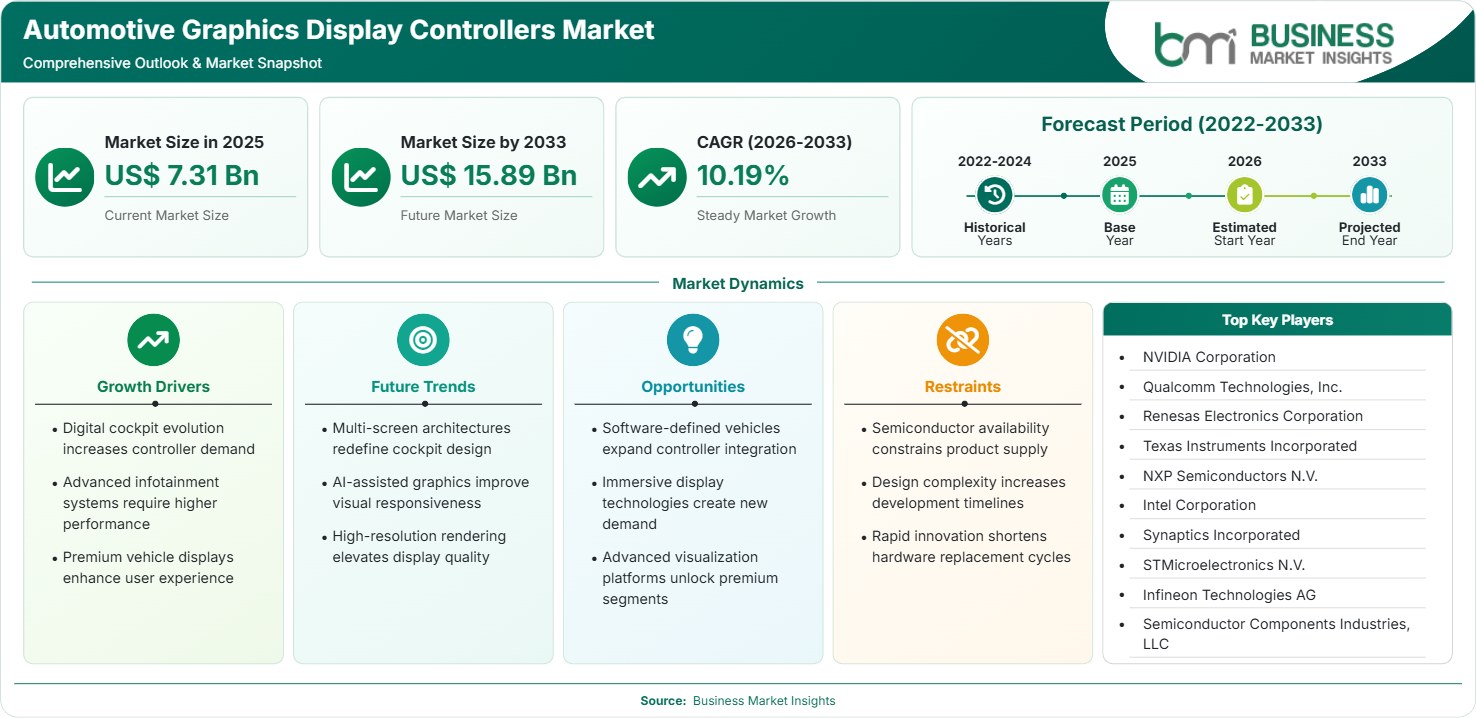
The Automotive Graphics Display Controllers Market size was valued at US$ 7.31 billion in 2025 and is projected to reach US$ 15.89 billion by 2033, growing at a CAGR of 10.19% during 2026–2033. Rising digital cockpit adoption, increasing demand for advanced infotainment systems, and expansion of software-defined vehicle platforms are driving new opportunities across automotive electronics.

Report Coverage
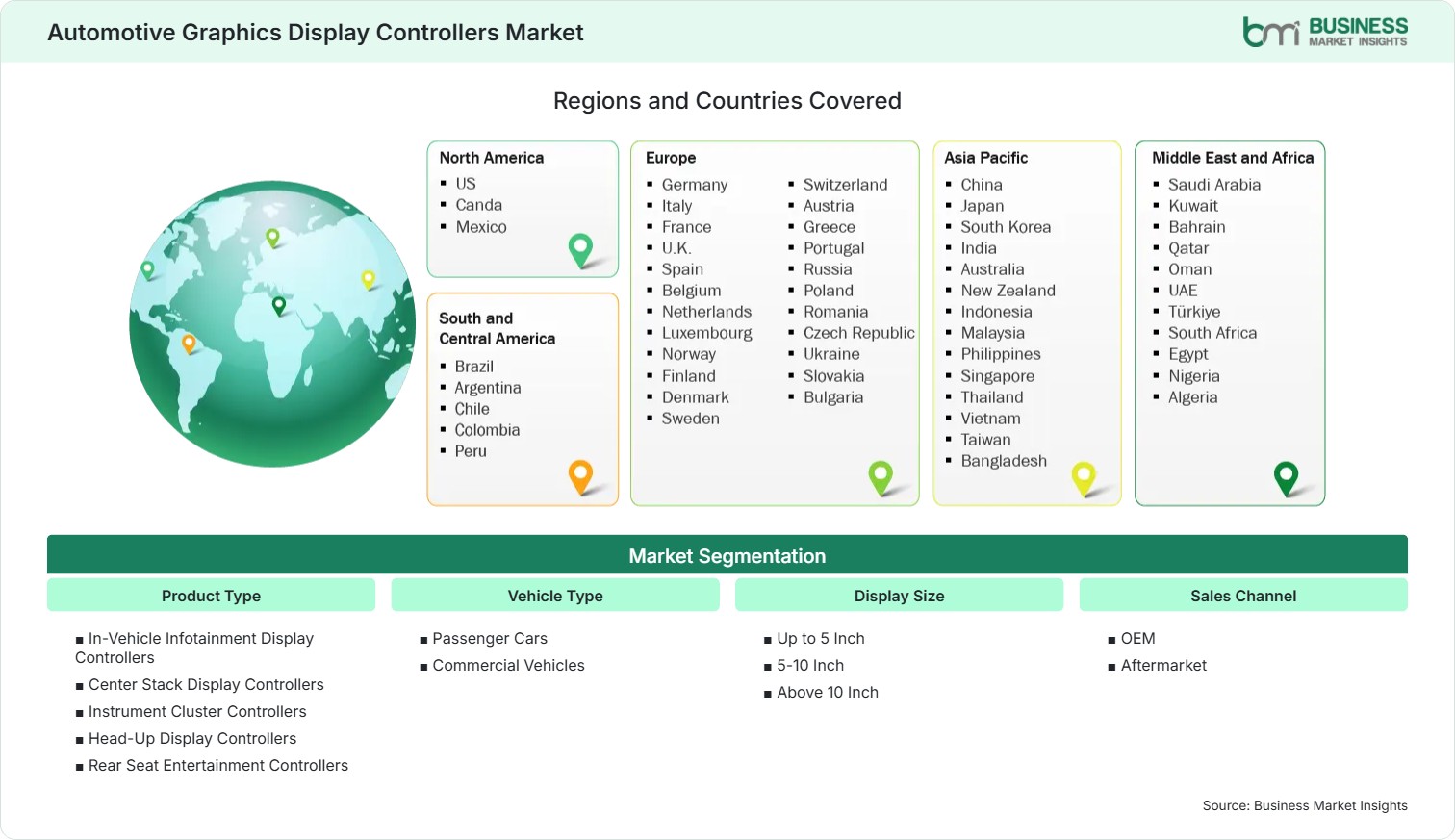
  • Product Type: In-Vehicle Infotainment Display Controllers, Center Stack Display Controllers, Instrument Cluster Controllers, Head-Up Display Controllers, and Rear Seat Entertainment Controllers
  • Vehicle Type: Passenger Cars, Commercial Vehicles
  • Display Size: Up to 5 Inch, 5-10 Inch, Above 10 Inch
  • Sales Channel: OEM, Aftermarket
US$ 7.31 Bn Market size in 2025
US$ 15.89 Bn Market Size by 2033
10.19% CAGR, 2026 - 2033
2026-2033 Forecast Period

AI Overview

Automotive Graphics Display Controllers Market Summary

  • North America Region: North America holds 30%–33% automotive graphics display controllers market share in 2025 and is projected to grow at a CAGR of 9.8%–10.3% during 2026–2033. Strong adoption of connected vehicles, premium infotainment systems, and advanced driver interfaces supports regional expansion. The U.S. remains the leading contributor with a CAGR of 9.9%–10.4%, supported by automotive semiconductor innovation and digital cockpit development.
  • Fastest Growing Region: Asia Pacific represents 39%–42% market share in 2025 and is expected to register a CAGR of 10.8%–11.4% during 2026–2033. Expanding electric vehicle production, rising automotive electronics integration, and increasing investments in intelligent vehicle platforms are accelerating regional demand.
  • Leading Segment: In-Vehicle Infotainment Display Controllers account for 31%–34% market share in 2025 and are expected to expand at a CAGR of 10.2%–10.7% due to rising demand for connected entertainment, navigation, and multimedia features.
  • High Growth Segment: Head-Up Display (HUD) Controllers capture 14%–17% market share in 2025 and are projected to grow at a CAGR of 11.2%–11.8% as automakers integrate immersive visualization and safety-focused display technologies.
  • Key Market Opportunity: Growth opportunities are emerging through software-defined vehicles, advanced visualization systems, artificial intelligence-based interfaces, and integrated cockpit platforms enabling personalized driving experiences.
  • Major Market Players: NVIDIA Corporation, Qualcomm Technologies, Inc., Renesas Electronics Corporation, Texas Instruments Incorporated, NXP Semiconductors N.V., Intel Corporation, Synaptics Incorporated, STMicroelectronics N.V., Infineon Technologies AG, and Semiconductor Components Industries, LLC.
Strategic Insights

Automotive Graphics Display Controllers Market: Strategic Insights

Automotive Graphics Display Controllers Market Strategic Framework
FREE PDF
Request your free sample
Request free sample
Stakeholder View

Key Takeaways

  • Automotive display controllers are becoming a critical component within modern vehicle architectures as manufacturers transition from traditional dashboards toward integrated digital cockpit systems.
  • Passenger vehicles, especially premium cars and electric vehicles, represent major growth opportunities due to increasing adoption of large displays, connected features, and advanced visualization systems.
  • Semiconductor suppliers are focusing on higher processing capability, lower power consumption, and integrated solutions to support next-generation automotive display requirements.
  • Asia Pacific provides significant investment potential due to expanding vehicle manufacturing, strong electric vehicle production, and increasing localization of automotive electronics supply chains.
  • Strategic partnerships between semiconductor companies, automotive OEMs, and software providers are increasing as companies compete to develop advanced cockpit platforms.
  • Growing adoption of software-defined vehicles is expected to reshape supplier relationships by increasing demand for flexible and upgradeable graphics controller architectures.
Geographic Outlook

Automotive Graphics Display Controllers Market Regional Highlights

North America Automotive Graphics Display Controllers Market

North America accounted for 30%–33% Automotive Graphics Display Controllers Market share in 2025 and is expected to expand at a CAGR of 9.8%–10.3% during 2026–2033. The region benefits from strong premium vehicle demand, advanced semiconductor capabilities, and rapid adoption of connected vehicle technologies. The United States remains the primary contributor due to investments in electric vehicles, autonomous driving technologies, and advanced cockpit platforms.

  • Automakers are increasing adoption of multi-display cockpit systems to improve driver interaction and digital experiences.
  • Semiconductor companies continue developing automotive-grade processors for enhanced graphics performance and reliability.
  • Premium vehicle manufacturers are integrating advanced displays with navigation, entertainment, and safety applications.
  • Electric vehicle production growth is increasing demand for advanced electronic architectures.

US Automotive Graphics Display Controllers Market

The United States represents 82%–85% of North American revenue and is projected to grow at a CAGR of 9.9%–10.4% during 2026–2033. Strong presence of technology providers, automotive innovators, and premium vehicle manufacturers supports continued market expansion.

  • Automotive OEMs are increasing investments in digital cockpit development and connected vehicle platforms.
  • Semiconductor innovation is supporting higher-performance display controller solutions.
  • Growing consumer preference for advanced infotainment features is increasing vehicle electronics adoption.
  • Partnerships between technology firms and automakers are accelerating product development.

Europe Automotive Graphics Display Controllers Market

Europe represents 23%–26% automotive graphics display controllers market share in 2025 and is anticipated to grow at a CAGR of 9.4%–9.9% during 2026–2033. The region benefits from strong automotive manufacturing capabilities, premium vehicle production, and increasing investments in electric mobility. Germany remains the largest market, while France and the United Kingdom continue expanding through automotive technology innovation.

  • European luxury vehicle manufacturers are adopting advanced display architectures across premium models.
  • Electric vehicle expansion is increasing demand for integrated electronic systems.
  • Automotive suppliers are developing energy-efficient controller solutions for next-generation vehicles.
  • Software-driven vehicle development is creating demand for flexible hardware platforms.

Asia Pacific Automotive Graphics Display Controllers Market

Asia Pacific holds 39%–42% automotive graphics display controllers market share in 2025 and is projected to record the fastest 10.8%–11.4% CAGR during 2026–2033. Strong automotive manufacturing capacity, rapid electric vehicle adoption, and expanding consumer demand for intelligent vehicles support regional growth. China leads regional demand, while India, Japan, and South Korea continue strengthening automotive electronics production.

  • Electric vehicle manufacturers are increasing integration of advanced cockpit display technologies.
  • Regional semiconductor investments are improving automotive electronics supply capabilities.
  • Rising disposable income supports demand for vehicles with premium digital features.
  • Automotive technology partnerships are accelerating intelligent vehicle development.

Rest of World Automotive Graphics Display Controllers Market

The Rest of World region accounts for 5%–8% automotive graphics display controllers market share in 2025 and is expected to grow at a CAGR of 9.6%–10.2% during 2026–2033. Growth is supported by increasing vehicle modernization, expanding premium vehicle sales, and improving automotive electronics adoption across Latin America, the Middle East, and Africa.

  • Brazil and Mexico are witnessing rising demand for advanced vehicle electronics.
  • Middle Eastern markets are adopting premium vehicles with enhanced digital features.
  • Automotive distributors are expanding availability of connected vehicle technologies.
  • Infrastructure development is supporting growth of modern transportation solutions.
Global Market Geography
FREE PDF
Request your free sample
Request free sample
Segment Analysis

Automotive Graphics Display Controllers Market Segmentation

Product Type

The product type segment represents the core technology foundation of modern vehicle display systems, supporting infotainment, instrument clusters, head-up displays, and rear entertainment applications. The segment accounted for 34%–37% market share in 2025 and is projected to expand at a CAGR of 10.4%–10.9% during 2026–2033. Increasing digital cockpit integration, demand for high-resolution displays, and adoption of connected vehicle technologies are accelerating product development across automotive electronics suppliers.

  • In-Vehicle Infotainment Display Controllers: This segment leads adoption due to increasing demand for navigation, multimedia, connectivity, and smartphone integration features in modern passenger vehicles.
  • Center Stack Display Controllers: These controllers support central dashboard displays with touch functionality, climate controls, and vehicle settings, improving driver interaction and enhancing cockpit usability.
  • Instrument Cluster Controllers: Rising digital transformation of traditional dashboards is increasing demand for controllers that deliver high-resolution graphics, real-time vehicle information, and customizable display interfaces.
  • Head-Up Display (HUD) Controllers: Growing focus on driver safety and immersive visualization is supporting adoption of HUD controllers that project navigation, alerts, and critical information directly into the driver’s field of view.
  • Rear Seat Entertainment Controllers: Demand from premium vehicles and luxury transportation segments is supporting rear entertainment controller adoption through advanced multimedia experiences and passenger-focused display solutions.

Vehicle Type

The vehicle type segment is influenced by rising electronic content in passenger and commercial vehicles as manufacturers integrate advanced displays to improve user experience and operational efficiency. The segment accounted for 67%–70% market share in 2025 and is expected to register a CAGR of 10.1%–10.6% during 2026–2033. Growing electric vehicle production, connected mobility solutions, and premium vehicle features are supporting broader adoption of advanced graphics controllers.

  • Passenger Cars (Hatchback/Sedan and SUVs): Passenger vehicles represent the dominant application area due to increasing consumer demand for digital dashboards, connected infotainment, and advanced visualization technologies.
  • Commercial Vehicles: Commercial vehicle manufacturers are adopting advanced display controllers for fleet management, navigation systems, driver assistance features, and operational monitoring applications.

Display Size

Display size selection is becoming increasingly important as automakers introduce larger screens, multi-display layouts, and integrated cockpit systems. The segment accounted for 41%–44% market share in 2025 and is projected to grow at a CAGR of 10.5%–11.0% during 2026–2033. Increasing consumer preference for immersive digital interfaces and advanced visualization capabilities continues encouraging adoption of larger display formats.

  • Up to 5 Inch: Smaller displays remain relevant for entry-level vehicles and basic information systems where cost efficiency and essential driver information remain priorities.
  • 5-10 Inch: Mid-sized displays maintain strong demand across mass-market vehicles due to balanced functionality, affordability, and compatibility with infotainment and instrument cluster applications.
  • Above 10 Inch: Large displays are experiencing rapid adoption in premium and electric vehicles because of enhanced multimedia capabilities, advanced graphics requirements, and integrated digital cockpit designs.

Sales Channel

The sales channel segment reflects the increasing role of automotive manufacturers and aftermarket providers in distributing graphics display controller solutions. The segment accounted for 74%–77% market share in 2025 and is anticipated to expand at a CAGR of 10.2%–10.7% during 2026–2033. Rising OEM integration of advanced electronics and growing demand for factory-installed digital systems continue supporting channel expansion.

  • OEM: OEM sales dominate due to increasing integration of display controllers during vehicle production and rising collaboration between semiconductor suppliers and automotive manufacturers.
  • Aftermarket: The aftermarket segment continues expanding through demand for upgraded infotainment systems, replacement display solutions, and enhanced vehicle customization options.
Market Forces

Automotive Graphics Display Controllers Market Dynamics

Key Market Drivers

Digital cockpit evolution increases controller demand

The shift from traditional dashboards to complete digitization of the cockpit has led to the need for graphic display controllers in passenger cars and trucks. The move towards replacing the traditional instrument panel with digital displays in the cluster and infotainment screen along with connected displays needs more computational power. The use of electric cars and software-defined architectures is making central computation a need of the hour in order to handle multiple displays. These developments are strengthening Automotive Graphics Display Controllers Market growth as manufacturers continue investing in advanced cockpit technologies that improve connectivity, personalization, and driver interaction.

Advanced infotainment systems require higher performance

Increasing consumer expectations for seamless connectivity, high-resolution visuals, and advanced entertainment features are pushing automakers to adopt higher-performance display controller solutions. Modern infotainment systems require powerful processing capabilities to support multiple displays, smartphone integration, navigation, voice assistance, and cloud-based applications. Graphics controllers that come with advanced capabilities such as increased graphic performance, reduced energy usage, and improved reliability are currently being produced by semiconductor manufacturers in order to meet these requirements. The introduction of AI and connected services is contributing towards a greater need for computation within cars. These factors are motivating technology providers towards innovation.

Premium vehicle displays enhance user experience

Premium vehicle manufacturers are increasingly using advanced display technologies to differentiate models and improve in-cabin experiences. Large-format displays, curved screens, digital instrument clusters, and augmented reality head-up displays are becoming important features in luxury and electric vehicles. Consumers are showing higher preference for intuitive interfaces and personalized digital experiences, encouraging automakers to integrate sophisticated graphics solutions. Display controllers are essential for managing complex visual information while maintaining fast response times and reliable operation. These developments continue influencing Automotive Graphics Display Controllers Market trends, with premium vehicle segments creating strong demand for advanced visualization technologies.

Key Market Opportunities

Software-defined vehicles expand controller integration

The growing adoption of software-defined vehicles is creating new opportunities for graphics controller suppliers as vehicle architectures shift toward centralized computing platforms. Modern vehicles require flexible electronic systems capable of supporting software updates, new digital services, and enhanced user interfaces throughout their lifecycle. Graphics controllers integrated with advanced processors allow manufacturers to introduce upgraded visualization features without major hardware changes. Increasing collaboration between semiconductor companies, automotive OEMs, and software developers is accelerating the development of scalable cockpit platforms. Automotive Graphics Display Controllers Market Forecasts indicate that demand for adaptable controller architectures will increase as automakers prioritize software-driven vehicle innovation.

Immersive display technologies create new demand

Emerging display technologies, including augmented reality head-up displays, three-dimensional interfaces, and panoramic cockpit screens, are generating new growth opportunities for graphics controller manufacturers. These solutions require advanced processing capabilities to deliver accurate information positioning, real-time graphics rendering, and smooth user interaction. Electric and autonomous vehicle development is further increasing demand for immersive visualization systems that improve safety and passenger engagement. Semiconductor companies are investing in controllers capable of supporting high-resolution graphics, multiple displays, and low-latency performance. These advancements are expanding the role of graphics controllers beyond traditional infotainment applications and creating opportunities in next-generation mobility solutions.

Advanced visualization platforms unlock premium segments

Advanced visualization platforms are enabling automakers to introduce differentiated digital experiences across premium vehicle categories. Integrated cockpit systems combining infotainment, instrument clusters, passenger displays, and head-up displays require controllers capable of processing multiple data streams simultaneously. Increasing demand for personalized interfaces, connected services, and intelligent vehicle features is encouraging manufacturers to develop customized graphics solutions. Automotive technology companies are collaborating to create scalable platforms that support future display requirements while improving user engagement. These developments are expected to expand opportunities for high-performance controller suppliers targeting luxury vehicles and advanced electric mobility segments.

Market Restraints and Challenges

Semiconductor availability constrains product supply

The automotive electronics industry continues facing supply challenges due to increasing semiconductor demand across automotive, consumer electronics, and industrial applications. Factor: Limited semiconductor manufacturing capacity, complex automotive chip production requirements, and extended fabrication timelines can restrict the availability of graphics controller components. Impact: Supply shortages may delay vehicle production, increase component costs, and create uncertainty for automotive manufacturers and technology suppliers. Companies are addressing these challenges through diversified sourcing strategies, long-term supplier agreements, and investments in resilient semiconductor supply chains to improve availability and production stability.

Design complexity increases development timelines

The increasing complexity of automotive display architectures is extending development cycles for graphics controller solutions. Factor: Integration of multiple displays, advanced graphics processing, connectivity features, and safety-related visualization systems requires extensive engineering validation and software compatibility testing. Impact: Longer development timelines, higher research expenses, and increased testing requirements can delay product commercialization and raise overall system costs. Semiconductor suppliers and automotive companies are adopting simulation tools, modular architectures, and collaborative engineering approaches to reduce development challenges while maintaining performance, reliability, and regulatory compliance.

Company Analysis

Competitive Landscape

The competitive environment is shaped by semiconductor innovation, automotive-grade processing capabilities, strategic partnerships, and increasing demand for integrated cockpit solutions. Automotive Graphics Display Controllers Market analysis highlights that leading companies are focusing on high-performance computing platforms, energy-efficient architectures, and scalable solutions to support infotainment, digital clusters, head-up displays, and future software-defined vehicle applications.

Company Name

Overview

Products and Services relevant to this market

NVIDIA Corporation

Global technology company specializing in accelerated computing platforms and automotive artificial intelligence solutions.

Automotive processors, graphics computing platforms, cockpit domain controllers, AI-based visualization solutions, and digital cockpit technologies.

Qualcomm Technologies, Inc.

Semiconductor leader providing advanced connectivity and computing solutions for connected and intelligent vehicles.

Snapdragon automotive platforms, digital cockpit processors, display controllers, infotainment solutions, and integrated vehicle computing systems.

Renesas Electronics Corporation

Semiconductor manufacturer offering automotive solutions for vehicle electronics and advanced display applications.

Automotive microcontrollers, system-on-chip solutions, display processing technologies, and cockpit electronic components.

Texas Instruments Incorporated

Global semiconductor company developing embedded processing and analog solutions for automotive applications.

Automotive processors, display interface solutions, graphics processing components, and vehicle electronics technologies.

NXP Semiconductors N.V.

Automotive semiconductor supplier focused on secure and connected mobility solutions.

Vehicle processors, infotainment controllers, automotive networking chips, display processing solutions, and cockpit platforms.

Intel Corporation

Technology company providing computing solutions for automotive digital transformation.

Automotive compute platforms, graphics technologies, edge computing solutions, and intelligent cockpit processing systems.

Synaptics Incorporated

Developer of human interface and semiconductor solutions for automotive display applications.

Touch controllers, display interface solutions, automotive user interaction technologies, and embedded processing solutions.

STMicroelectronics N.V.

Semiconductor manufacturer supplying automotive components for electronic systems and digital mobility applications.

Automotive microcontrollers, display processors, embedded solutions, graphics components, and vehicle electronics products.

Infineon Technologies AG

Global semiconductor company providing automotive chips for electrification, connectivity, and digital systems.

Automotive microcontrollers, processing solutions, security chips, display-related semiconductor components, and vehicle electronics.

Semiconductor Components Industries, LLC

Semiconductor supplier delivering energy-efficient and automotive-grade electronic components.

Power management solutions, automotive semiconductors, sensor technologies, and electronic components supporting vehicle display systems.

Trust & Transparency

Research Methodology

The market analysis combines proprietary research with secondary data from government agencies, company disclosures, regulatory filings, industry databases and expert interviews. Market estimates are validated through data triangulation, cross-market benchmarking and analyst review.

View Full Research Methodology

Questions Answered

Frequently Asked Questions

What does the Automotive Graphics Display Controllers Market Report cover?

The Market Report covers market size, segmentation, regional analysis, competitive developments, technology trends, growth factors, challenges, and future investment opportunities.

Why are large displays becoming important in modern vehicles?

Large displays improve navigation, entertainment, personalization, and safety communication by enabling integrated interfaces that combine multiple vehicle functions into a single digital environment.

How are software-defined vehicles affecting controller development?

Software-defined vehicles are encouraging development of flexible controller architectures that support software updates, centralized computing, and enhanced digital services throughout the vehicle lifecycle.

Which vehicle category contributes most to display controller adoption?

Passenger vehicles represent the largest adoption area because manufacturers increasingly integrate digital clusters, infotainment displays, head-up displays, and advanced cockpit technologies to improve customer experience.

What is driving demand for automotive graphics display controllers?

Demand is increasing due to the transition toward digital cockpits, connected vehicles, electric mobility, and advanced infotainment systems requiring high-performance graphics processing capabilities.

Access the Full Automotive Graphics Display Controllers Market Report

Get segment-level forecasts, regional estimates, competitive benchmarking, company profiles and downloadable Excel datasets.

Access the full Automotive Graphics Display Controllers Market Report
350 pages PDF & Excel | 2026-08-25
Similar Research

Related Market Reports