
Automotive Robotics Market Outlook: Size, Share, Trends, Growth Analysis, Competitive Landscape & Forecast, 2026-2033

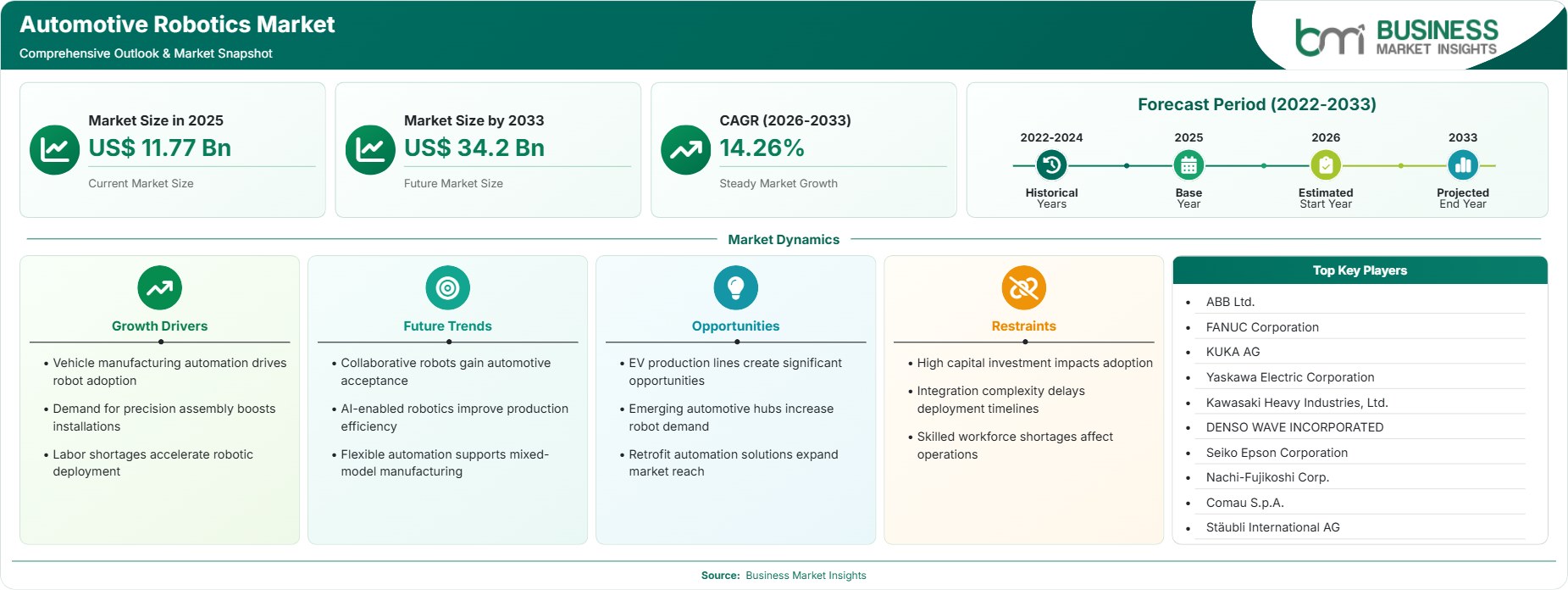
The Automotive Robotics Market size was valued at US$ 11.77 Billion in 2025 and is projected to reach US$ 34.2 Billion by 2033, growing at a CAGR of 14.26% during 2026–2033, driven by EV manufacturing automation, smart factory investments, AI-enabled robotics adoption, and opportunities across flexible production systems and collaborative robot deployment.

Report Coverage
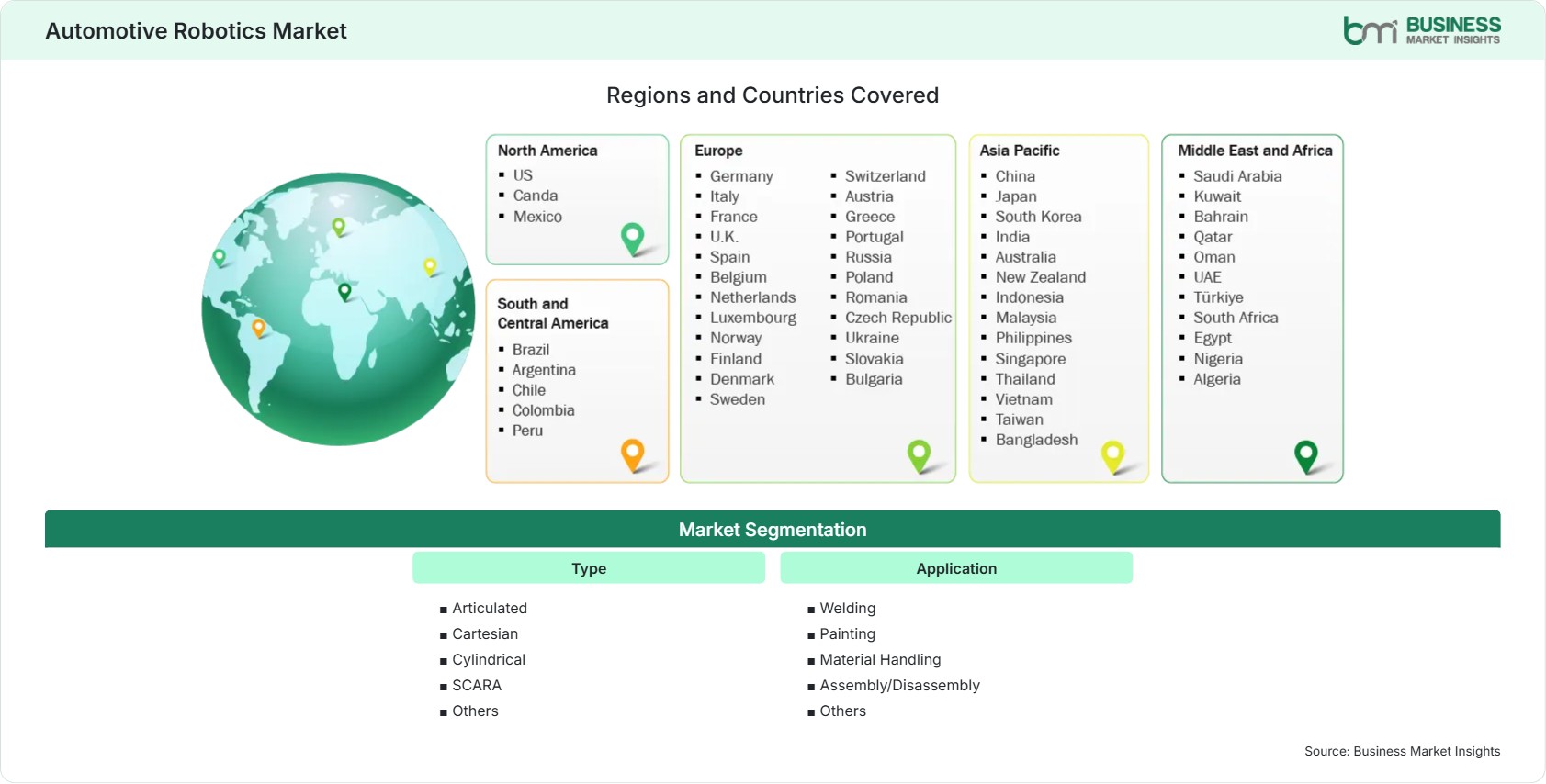
  • Type: Articulated, Cartesian, Cylindrical, SCARA, Others
  • Application: Welding, Painting, Material Handling, Assembly/Disassembly, Others
US$ 11.77 Bn Market size in 2025
US$ 34.2 Bn Market Size by 2033
14.26% CAGR, 2026 - 2033
2026-2033 Forecast Period

AI Overview

Automotive Robotics Market Summary

  • North America Region: North America holds a 23%–26% share in 2025, growing at a CAGR of 12.5%–13.8% during 2026–2033. Growth is supported by EV assembly expansion, reshoring, digital factories, AI integration, labor shortages, and investments in flexible robotic manufacturing systems across automotive production networks globally. US market benefits from vehicle electrification and factory modernization, advancing at an estimated CAGR of 12.8%–14.0%.
  • Fastest Growing Region: Asia Pacific holds a 44%–47% share in 2025 and expands at a CAGR of 15.5%–16.8% through 2026–2033. Growth stems from EV production scaling, localization strategies, smart manufacturing investments, industrial policy support, supplier ecosystem expansion, and automotive capacity additions.
  • Leading Segment: Articulated robots account for a 58%–62% share in 2025 and advance at a CAGR of 14.0%–15.2%. Demand remains supported by welding versatility, payload flexibility, precision manufacturing requirements, body-shop automation, productivity improvement goals, and integration across advanced vehicle platforms.
  • High Growth Segment: Assembly/Disassembly applications represent 16%–19% share in 2025 and grow at a CAGR of 16.5%–17.8%. Expansion is fueled by battery-pack assembly automation, customized production environments, quality requirements, operational consistency, factory digitization, and autonomous workflow coordination.
  • Key Market Opportunity: Battery manufacturing automation, AI-driven quality inspection, human-robot collaboration, and software-oriented robotics platforms are creating new value pools while enabling flexible vehicle production and faster model changeovers worldwide.
  • Major Market Players: ABB Ltd., FANUC Corporation, KUKA AG, Yaskawa Electric Corporation, Kawasaki Heavy Industries, Ltd., DENSO WAVE INCORPORATED, Seiko Epson Corporation, Nachi-Fujikoshi Corp., Comau S.p.A., and Stäubli International AG.
Strategic Insights

Automotive Robotics Market: Strategic Insights

Automotive Robotics Market Strategic Framework
FREE PDF
Request your free sample
Request free sample
Stakeholder View

Key Takeaways

  • The value chain increasingly integrates robot manufacturers, software developers, AI vision providers, controllers, sensors, and automotive OEMs, creating a highly collaborative automation ecosystem.
  • Battery-pack assembly, final vehicle assembly automation, and material handling applications offer the strongest upside due to rising EV production complexity.
  • Innovation is shifting from standalone hardware toward connected robotic cells incorporating machine learning, predictive maintenance, edge computing, and digital twin technologies.
  • India, China, Mexico, and Southeast Asian manufacturing hubs present compelling investment cases due to expanding vehicle exports and smart factory investments.
  • Strategic acquisitions increasingly focus on industrial software, autonomous systems, machine vision, and flexible automation capabilities that strengthen production efficiency.
  • Workforce shortages in industrial manufacturing are accelerating adoption of robotics capable of operating alongside human workers in mixed-production environments.
Geographic Outlook

Automotive Robotics Market Regional Highlights

North America Automotive Robotics Market

North America accounted for 23%–26% of global revenue in 2025 and is projected to advance at a CAGR of 12.5%–13.8% through 2033. Regional demand is supported by EV investment, production reshoring, and modernization initiatives across automotive facilities. Automotive Robotics Market share remains supported by major OEM investments in advanced manufacturing technologies. Automation addresses labor constraints while improving throughput and consistency. Increasing deployment of AI-enabled inspection systems and digital manufacturing platforms strengthens long-term competitiveness across vehicle production facilities.

  • EV battery manufacturing investments continue accelerating robot deployment across assembly, welding, and material-handling operations.
  • Mexico’s automotive manufacturing expansion supports regional supply-chain integration and robotics adoption.
  • Digital-twin implementation improves operational visibility, maintenance efficiency, and production optimization.
  • Collaborative robots gain traction in mixed-model production environments requiring flexibility and worker interaction.

US Automotive Robotics Market

The United States accounts for 72%-76% of the region's total income and is anticipated to witness a CAGR of 12.8%-14.0%. The construction of battery gigafactories, EV manufacturing facilities, and sophisticated manufacturing facilities will drive the demand for robotics. In addition, the implementation of robots is increasingly geared toward ensuring quality, precision in assembly, and higher throughput. The Automotive Robotics Market share in the country is driven by significant investment in factory modernization and resilient supply chain projects.

  • Vehicle electrification programs are expanding robotic requirements in battery-pack assembly and testing.
  • AI-based vision systems improve defect detection and product consistency across assembly lines.
  • Federal manufacturing incentives encourage deployment of smart factory technologies.
  • Labor availability challenges continue supporting long-term automation investment decisions.

Europe Automotive Robotics Market

Europe will capture 21% to 24% by 2025, recording a CAGR of 13.0% to 14.5%. Germany leads this market, while Eastern Europe will see growth driven by increased investment in production. Automation helps meet high standards of quality and sustainability. Automakers have started implementing smart factories and robots. Productivity and safety standards have been contributing to the implementation of automation technologies in automobile and component assembling processes.

  • Germany leads regional demand with extensive deployment in vehicle manufacturing facilities.
  • Poland and Hungary exhibit faster growth, supported by automotive investments and export-oriented production.
  • Sustainability targets encourage energy-efficient robotic technologies and smart manufacturing upgrades.
  • Advanced welding automation remains a priority across premium automotive brands.

Asia Pacific Automotive Robotics Market

The Asia Pacific region accounts for 44%-47% of worldwide revenue in 2025, with the highest CAGR at 15.5%-16.8%. In the Asia-Pacific region, China leads the market in large-scale car and EV manufacturing, and India is also growing very rapidly. Market growth is further strengthened by supportive policies, localization, and additional capacities. Growth in the use of smart factories and AI-driven robotic logistics is creating huge opportunities throughout automotive production ecosystems.

  • China remains the largest market due to extensive EV manufacturing capacity.
  • India records among the highest regional growth rates through expanding production investments.
  • Japan and South Korea emphasize precision robotics and high-value manufacturing automation.
  • Government-led industrial upgrading initiatives support accelerated technology adoption.
  • Supplier ecosystem maturity facilitates wider deployment of advanced automation platforms.

Rest of World Automotive Robotics Market

The Rest of World segment accounts for 8% to 10% of market share and maintains a CAGR of 13.8% to 15.0%. Modernization trends in automobile assembly line production drive the market in South and Central America, whereas industrial diversification drives the market in the Middle East and Africa regions. Brazil dominates in terms of market demand, while Saudi Arabia witnesses more growth owing to manufacturing initiatives. Automation adoption remains focused on productivity enhancement, operational consistency, and long-term manufacturing competitiveness.

  • Brazil remains the primary automotive manufacturing base supporting robotic demand.
  • Saudi Arabia benefits from industrial diversification and advanced manufacturing investments.
  • Logistics automation adoption supports material-handling applications across facilities.
  • Export-oriented manufacturing strategies encourage productivity-focused automation deployment.
Global Market Geography
FREE PDF
Request your free sample
Request free sample
Segment Analysis

Automotive Robotics Market Segmentation

Type

This segment accounted for 58%–62% market share in 2025 through articulated robot dominance and is projected to grow at 14.0%–15.2% CAGR. Automotive Robotics Market scope continues expanding as manufacturers pursue flexible automation, precision production, and adaptable manufacturing cells that accommodate both conventional and electric vehicle programs.

  • Articulated: Widely utilized for welding, handling, and assembly functions, offering high flexibility, multiple axes, and compatibility with advanced automotive production environments.
  • Cartesian: Preferred for linear movement applications requiring repeatability, controlled motion, and integration within structured manufacturing workflows.
  • Cylindrical: Supports material transfer and machine tending tasks where compact movement patterns and operational reliability remain important.
  • SCARA: Gains adoption in precision assembly activities requiring speed, accuracy, and efficient operation in constrained production spaces.

Application

Applications are developing in light of rising levels of automation. The welding process accounts for the largest market share, while tasks related to battery assembly help increase demand. The industry is anticipated to grow at a 14.5%-15.8% CAGR due to the deployment of robotics in smart factory operations stages and production workflows.

  • Welding: Remains essential for body-shop automation, delivering repeatable quality, throughput improvement, and process consistency.
  • Painting: Supports uniform coating quality, reduced material waste, and controlled operating conditions across automotive plants.
  • Material Handling: Improves manufacturing flow through automated transport, palletizing, loading, and component movement activities.
  • Assembly/Disassembly: Automotive Robotics Market trends increasingly favor automated assembly for batteries, electronics, and customized vehicle configurations.
Market Forces

Automotive Robotics Market Dynamics

Key Market Drivers

Expansion of Electric Vehicle Manufacturing

The accelerated production of electric vehicles is leading to greater automation in battery assembly, welding, and inspection processes. Data from the International Energy Agency show continued market expansion in the EV sector, prompting companies to increase their productivity. Robots offer the reliability, safety, and consistency necessary for large-scale manufacturing. The automakers are using robot cells to address the complexity in battery design and assembly. This shift towards electrification is one of the most important demand drivers for robotics across global automotive manufacturing networks.

Industry 4.0 and Smart Factory Adoption

The connected manufacturing environment is rapidly driving increased investment in robotics. The integration of digital twins, AI-powered analysis, machine vision, and predictive maintenance tools ensures greater efficiency and productivity. Automobile manufacturers are seeking a real-time view of their performance to increase production efficiency and reduce downtime. Robotics is increasingly becoming the execution layer in smart manufacturing factories. As the connected manufacturing paradigm gains popularity, demand for intelligent robotic systems capable of autonomous decision support and continuous operational optimization.

Need for Quality Consistency and Labor Optimization

Manufacturers are constantly under pressure to improve quality while coping with a labor shortage. Robotics helps in reducing variation in processes such as welding, painting, and assembly while making workplaces safer. Vision systems aid in detecting defects and managing the process. Consistent production, reduced reworks, and increased throughput justify an investment in automation. These operational benefits strengthen adoption across vehicle, component, and battery manufacturing facilities worldwide.

Key Market Opportunities

AI-Powered Autonomous Robotics Platforms

Artificial intelligence technology is revolutionizing automotive robotics by enabling machines to dynamically adapt to new demands during production. Intelligent vision capabilities, motion planning, and real-time process analysis contribute to greater efficiency, accuracy, and simplified programming. With increasing emphasis on flexibility and smart production practices, the need for smart robotic technologies is also rising. The Automotive Robotics Market Forecast reveals growing investment in software-based automation systems capable of managing different vehicle models.

Battery Gigafactory Automation Expansion

The quick growth of battery gigafactories is presenting many opportunities for robot manufacturers. The huge battery factories need automated equipment for logistics, battery production, assembly, quality testing, and packaging. The increase in investment in the EV battery supply chain across North America, Europe, and Asia is creating demand for specialized robotic solutions, supporting higher productivity, improved quality control, and scalable production capacity throughout the electric vehicle ecosystem

Collaborative Robot Deployment in Final Assembly

Robots that work alongside humans, or collaborative robots (cobots), are increasingly used in the final assembly of automobiles because they require flexibility and collaboration between the machine and the human operator. Cobots assemble, test, and inspect products, carrying out customized assembly procedures while maintaining very high safety standards. The relatively low cost of deployment, flexibility, and ease of adoption of cobots have made them popular with manufacturers.

Market Restraints and Challenges

High Capital Investment and Legacy System Modernization Barriers

Factor: Automotive robotics deployment requires substantial upfront spending across robotic hardware, machine vision systems, controllers, industrial software, integration services, safety infrastructure, and production-line modifications. The challenge becomes more pronounced in facilities operating legacy manufacturing systems that require extensive reconfiguration to support advanced automation technologies. Impact: High implementation costs continue to influence investment decisions, particularly among small and mid-sized automotive suppliers operating under strict capital expenditure frameworks. Extended payback periods can delay automation roadmaps, while integration with existing production environments increases project complexity and deployment risk. Manufacturers often need to phase automation investments over multiple budget cycles, which can slow the pace of modernization and limit the speed at which productivity gains are realized across manufacturing operations.

Workforce Skill Shortages and Advanced Integration Complexity

Factor: The growing sophistication of automotive robotics systems has increased demand for specialized professionals, including robotics programmers, automation engineers, machine vision specialists, and predictive maintenance technicians. Current training pipelines in many manufacturing regions are not expanding at the same pace as industrial automation adoption, creating a persistent talent gap. Impact: Limited availability of qualified personnel can extend commissioning timelines, reduce operational efficiency during deployment, and increase reliance on external system integrators. Facilities lacking in-house expertise may face challenges in optimizing robotic performance, troubleshooting complex software environments, and scaling automation initiatives across multiple production lines. As robotics become increasingly AI-enabled and software-driven, workforce development requirements continue rising, making talent acquisition and retention a critical operational challenge for manufacturers pursuing large-scale automation strategies.

Company Analysis

Competitive Landscape

Automotive Robotics Market analysis indicates competition is centered on automation breadth, software integration, precision engineering, and EV manufacturing capabilities.

Company Name

Overview

Products and Services relevant to this market

ABB Ltd.

Global automation leader with extensive automotive manufacturing presence and advanced robotics portfolio.

Industrial robots, robotic cells, digital manufacturing software, welding and assembly automation solutions.

FANUC Corporation

Major robotics specialist serving automotive OEMs and suppliers worldwide.

Industrial robots, controllers, machine vision systems, welding and handling automation.

KUKA AG

Advanced robotics provider known for automotive production expertise.

Robotic systems, smart factory integration, welding, assembly and material-handling solutions.

Yaskawa Electric Corporation

Industrial automation company with strong robotic deployment footprint.

Motoman robots, motion control systems, welding automation and assembly solutions.

Kawasaki Heavy Industries, Ltd.

Established robotics manufacturer supporting automotive automation applications.

Industrial robots for assembly, handling, spot welding and painting operations.

DENSO WAVE INCORPORATED

Technology-focused robotics supplier with automotive manufacturing roots.

Compact industrial robots, automation platforms and precision assembly systems.

Seiko Epson Corporation

Robotics innovator emphasizing precision manufacturing capabilities.

SCARA robots, automation systems and electronics-oriented assembly solutions.

Nachi-Fujikoshi Corp.

Industrial robotics and machinery provider serving automotive customers globally.

Welding robots, handling systems and integrated factory automation technologies.

Comau S.p.A.

Automotive-focused automation specialist with global operations.

Robotic assembly systems, welding cells, manufacturing software and automation engineering.

Stäubli International AG

High-performance robotics company emphasizing precision and reliability.

Industrial robots, connectors, automated handling systems and assembly applications.

Trust & Transparency

Research Methodology

The market analysis combines proprietary research with secondary data from government agencies, company disclosures, regulatory filings, industry databases and expert interviews. Market estimates are validated through data triangulation, cross-market benchmarking and analyst review.

View Full Research Methodology

Questions Answered

Frequently Asked Questions

What does the Automotive Robotics Market Report typically evaluate?

The Market Report generally examines technology trends, competitive positioning, regional outlooks, investment patterns, applications, regulatory developments, and future demand outlooks.

How are AI technologies influencing robotics adoption?

AI improves machine vision, predictive maintenance, autonomous decision-making, process optimization, and production flexibility, enhancing overall manufacturing performance.

Which region presents the strongest long-term opportunity?

Asia Pacific offers the strongest opportunity due to vehicle production leadership, EV investments, supportive industrial policies, and expanding manufacturing capacity.

What role do robots play in electric vehicle production?

Robots support battery assembly, module handling, welding, inspection, component installation, and quality control activities essential to EV manufacturing scalability.

Which automotive process generates the highest robotics demand?

Welding remains the largest application because it requires repeatability, speed, and quality consistency across high-volume vehicle production lines.

Access the Full Automotive Robotics Market Report

Get segment-level forecasts, regional estimates, competitive benchmarking, company profiles and downloadable Excel datasets.

Access the full Automotive Robotics Market Report
350 pages PDF & Excel | 2026-08-31
Similar Research

Related Market Reports