Automotive Flywheel Market Outlook: Size, Share, Trends, Growth Analysis, Competitive Landscape & Forecast, 2026-2033

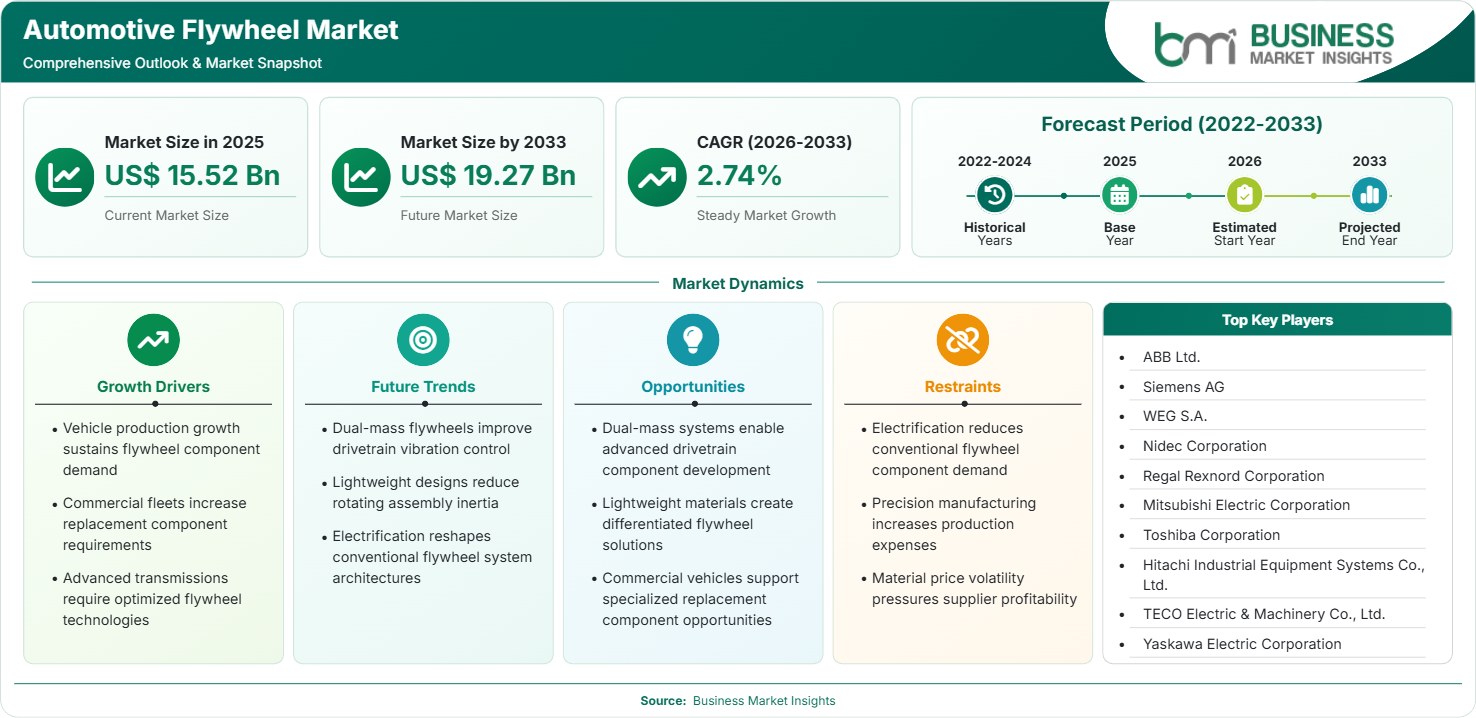
The Automotive Flywheel Market size was valued at US$ 15.52 Billion in 2025 and is projected to reach US$ 19.27 Billion by 2033, growing at a CAGR of 2.74% during 2026–2033. Growth is supported by sustained internal combustion vehicle production, expanding hybrid powertrains, rising commercial vehicle demand, drivetrain efficiency improvements, and opportunities in dual-mass flywheel technologies and aftermarket replacement sales.

Report Coverage
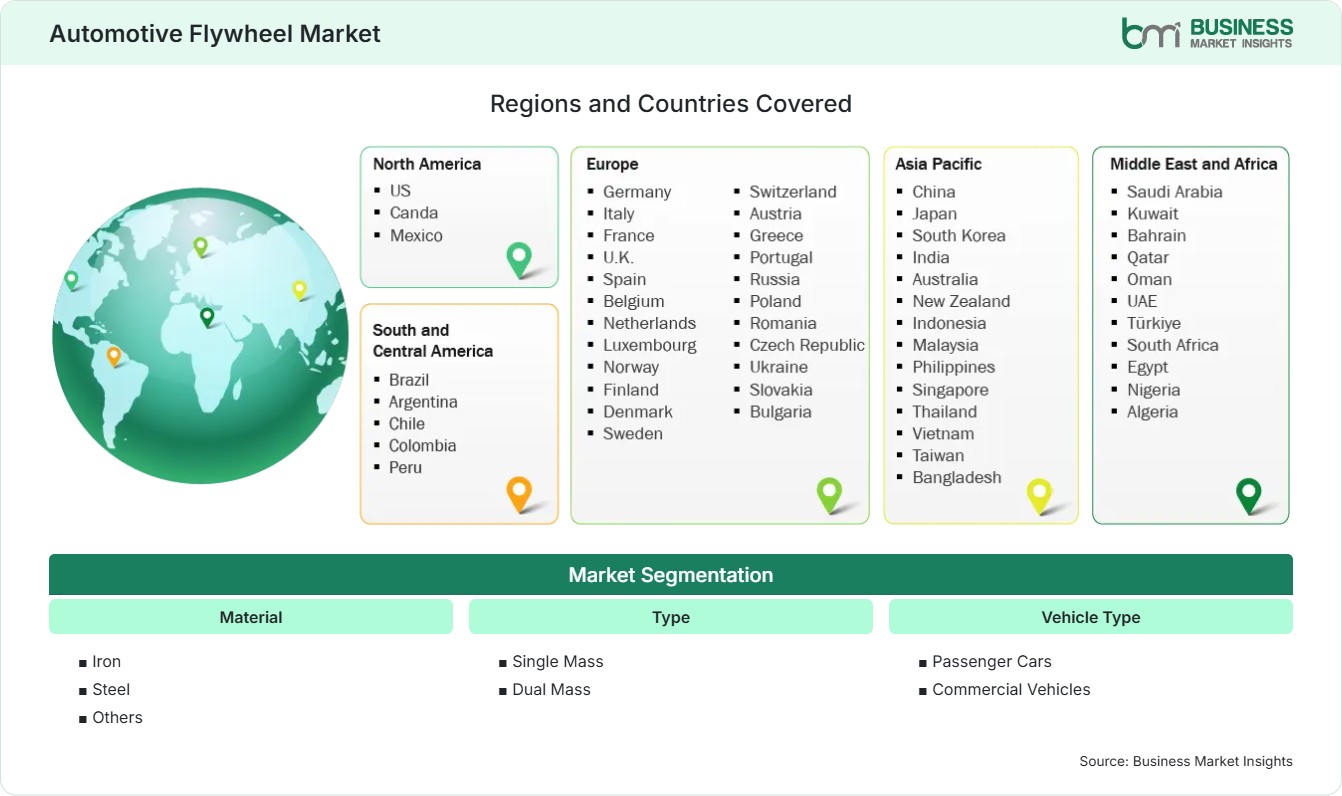
  • Material: Iron, Steel, Others
  • Type: Single Mass, Dual Mass
  • Vehicle Type: Passenger Cars, Commercial Vehicles
US$ 15.52 Bn Market size in 2025
US$ 19.27 Bn Market Size by 2033
2.74% CAGR, 2026 - 2033
2026-2033 Forecast Period

AI Overview

Automotive Flywheel Market Summary

  • North America Region: North America holds a market share of 22%–25% in 2025, growing at a CAGR of 2.1%–2.5% during 2026–2033. Demand is supported by pickup trucks, light commercial vehicles, hybrid platforms, replacement parts demand, manufacturing modernization, powertrain efficiency upgrades, and fleet durability requirements. The U.S. market benefits from sustained aftermarket demand and hybrid vehicle production, with a CAGR of 2.2%–2.6%.
  • Fastest Growing Region: Asia Pacific holds a market share of 48%–52% in 2025 and grows at a CAGR of 3.2%–3.8%. Strong vehicle manufacturing, rising hybrid adoption, supplier localization, industrial expansion, fleet modernization, growing passenger vehicle ownership, and export-oriented automotive production support regional expansion.
  • Leading Segment: Passenger Cars account for 68%–72% share in 2025 and expand at a CAGR of 2.4%–2.9%. High production volumes, increasing hybrid vehicle penetration, replacement demand, urban mobility needs, consumer vehicle ownership growth, and fuel-efficiency requirements sustain segment leadership globally.
  • High Growth Segment: Dual Mass holds 42%–46% share in 2025 and advances at 3.4%–4.0% CAGR. Adoption is driven by vibration reduction requirements, transmission protection, premium vehicle integration, hybrid compatibility, enhanced driving comfort, stricter efficiency standards, and OEM drivetrain optimization initiatives.
  • Key Market Opportunity: Expanding hybrid vehicle production creates opportunities for advanced lightweight flywheels, higher torque transmission systems, improved NVH performance, premium aftermarket solutions, regional manufacturing investments, and long-term OEM supply partnerships.
  • Major Market Players: Schaeffler AG, ZF Friedrichshafen AG, Valeo SA, AISIN Corporation, EXEDY Corporation, BorgWarner Inc., American Axle & Manufacturing Holdings, Inc., Linamar Corporation, Zhejiang Tieliu Clutch Co., Ltd., Skyway Precision, Inc.
Strategic Insights

Automotive Flywheel Market: Strategic Insights

Automotive Flywheel Market Strategic Framework
FREE PDF
Request your free sample
Request free sample
Stakeholder View

Key Takeaways

  • The value chain remains highly integrated, as original equipment manufacturers depend on first-tier suppliers for precisely engineered flywheel assemblies, clutch systems, and transmission solutions.
  • The dual-mass flywheel has the greatest potential for long-term use because of its growing use in hybrid vehicles and on platforms for premium passenger cars.
  • There is a move towards the use of lighter steel designs, better damping mechanisms, and various technologies that enhance NVH performance and drivetrain efficiency.
  • The investment case in the Asia Pacific is the most attractive because of the concentration of vehicle production, the presence of local supply chains, and the supportive manufacturing policies.
  • Strategic acquisitions and partnerships with suppliers are now placing greater emphasis on powertrain efficiency technologies and the integration of advanced transmissions.
  • The demand for aftermarket replacements is still strong since flywheels wear out during the entire operating life of a vehicle.
Geographic Outlook

Automotive Flywheel Market Regional Highlights

North America Automotive Flywheel Market

North America accounts for 22%–25% of global demand in 2025 and is expected to grow at 2.1%–2.5% CAGR through 2033. The Automotive Flywheel Market share benefits from strong pickup truck production, commercial vehicle demand, and replacement component sales. Hybrid vehicle production creates additional opportunities as manufacturers prioritize driveline refinement and durability. Regional suppliers continue investing in advanced manufacturing technologies.

  • Fleet operators increasingly prioritize durable powertrain systems that reduce maintenance frequency and improve operational reliability.
  • Hybrid pickup truck adoption supports continued integration of advanced dual-mass flywheel configurations.
  • Aftermarket replacement demand remains substantial because of large vehicle parc volumes.
  • OEMs focus on drivetrain efficiency improvements to comply with evolving emissions requirements.

US Automotive Flywheel Market

The United States represents 78%–82% of North American demand and is projected to expand at 2.2%–2.6% CAGR. Strong light truck sales, hybrid vehicle deployment, and aftermarket maintenance spending sustain demand. Domestic OEM production and established supplier networks continue supporting manufacturing activity.

  • The making of hybrid vehicles creates a little bit of demand for advanced vibration-control systems.
  • Nationwide, the availability of replacement components is improved by strong independent aftermarket distribution channels.
  • Commercial fleet renewal schemes lead to the ongoing acquisition of powertrain components.

Europe Automotive Flywheel Market

Europe holds 25%–28% share in 2025 and grows at 2.3%–2.8% CAGR. Germany remains the leading country, while Poland and selected Eastern European markets demonstrate faster growth. Automotive Flywheel Market growth is supported by premium vehicle manufacturing, advanced transmission technologies, and hybrid vehicle penetration.

  • Germany's demand in the region is led by its strong capabilities in the manufacture of motor vehicles.
  • Premium car makers now use dual-mass setups more often to improve comfort.
  • Eastern European centres for production draw in investments for making components.
  • Hybrid vehicles still need complex driveline systems.

Asia Pacific Automotive Flywheel Market

Asia Pacific dominates with 48%–52% market share in 2025 and records the highest CAGR of 3.2%–3.8%. China leads regional consumption, while India exhibits the strongest growth trajectory. Large-scale vehicle production, localization initiatives, and growing automotive exports drive expansion.

  • China is still the world's biggest centre both for manufacturing and for consumption.
  • The growing size of India's passenger vehicle market is driving strong additional demand.
  • The fact that suppliers are localised leads to greater production efficiency and increased cost competitiveness.
  • Making commercial vehicles requires buying large numbers of parts.

Rest of World Automotive Flywheel Market

Rest of World represents 7%–10% share and grows at 2.6%–3.1% CAGR. Brazil leads South and Central America, while Saudi Arabia and South Africa contribute regional demand. Vehicle fleet expansion and aftermarket development support market performance.

  • Brazil remains a major center for motor vehicle manufacturing in Latin America.
  • The Gulf countries are increasing their investments in transportation logistics infrastructure.
  • The more people have vehicles the greater the demand will be for replacement parts.
  • Expanding the distribution network improves product availability after they have been sold.
Global Market Geography
FREE PDF
Request your free sample
Request free sample
Segment Analysis

Automotive Flywheel Market Segmentation

Material

Material selection significantly influences durability, weight, and cost characteristics. The segment records widespread utilization across passenger and commercial vehicles. Steel applications are rising because manufacturers seek efficiency gains. This segment contributes a share of 48%–52%, growing at 2.7%–3.2% CAGR. The Automotive Flywheel Market scope continues expanding through lightweight material innovations.

  • Iron: Widely used in conventional flywheel manufacturing due to durability, cost advantages, and suitability for traditional vehicle powertrains.
  • Steel: Increasingly adopted because of superior strength-to-weight characteristics, improved efficiency, and compatibility with modern vehicle designs.

Type

Type segmentation reflects evolving drivetrain requirements and vehicle performance expectations. Single-mass systems retain demand in cost-sensitive applications, while dual-mass systems achieve faster expansion owing to enhanced vibration control. The segment maintains 42%–46% share and achieves 3.4%–4.0% CAGR for advanced configurations.

  • Single Mass: Preferred in economical vehicles and selected commercial applications where durability and cost-effectiveness are critical considerations.
  • Dual Mass: Gains traction through superior NVH reduction, transmission protection, and compatibility with hybrid and premium vehicle platforms.

Vehicle Type

Vehicle type remains the largest demand driver. Passenger vehicles dominate because of production scale, while commercial vehicles benefit from logistics and infrastructure growth. The segment delivers 68%–72% share with 2.4%–2.9% CAGR. Automotive Flywheel Market trends increasingly reflect hybrid passenger vehicle adoption.

  • Passenger Cars: Supported by global production volumes, rising ownership rates, and increasing use of refined drivetrain technologies.
  • Commercial Vehicles: Demand benefits from freight transportation growth, fleet replacement programs, and durability-focused component requirements.
Market Forces

Automotive Flywheel Market Dynamics

Key Market Drivers

Rising Global Vehicle Production and Fleet Expansion

Global automotive production continues to support demand for drivetrain components as manufacturers increase output across passenger and commercial vehicle categories. Expanding vehicle ownership in emerging economies strengthens replacement demand throughout the aftermarket ecosystem. The Automotive Flywheel Market benefits from continuous requirements for torque management, rotational energy storage, and engine stability functions within internal combustion platforms. Commercial transportation growth further supports component consumption because high-mileage fleet vehicles undergo more frequent drivetrain servicing. Increasing registrations across the Asia Pacific and improving logistics activity worldwide contribute to the sustained procurement of advanced flywheel solutions. These factors collectively support durable long-term demand across OEM production and aftermarket replacement channels.

Growing Adoption of Dual-Mass Flywheel Technologies

Vehicle manufacturers increasingly adopt dual-mass flywheels to improve driving comfort, reduce drivetrain vibration, and minimize transmission noise. Premium passenger vehicles and advanced transmission systems particularly benefit from vibration-damping capabilities offered by these solutions. Regulatory pressure to enhance efficiency and customer expectations regarding vehicle refinement encourage broader deployment across multiple vehicle classes. Automotive engineers continue integrating technologies that improve power delivery smoothness while maintaining reliability. Such developments strengthen Automotive Flywheel Market growth by encouraging upgrades from conventional systems to higher-performance alternatives. The transition remains especially visible within passenger cars, where comfort and fuel-efficiency objectives increasingly influence drivetrain design decisions.

Demand for Lightweight and High-Performance Materials

Automotive manufacturers continue focusing on vehicle weight reduction to improve fuel economy and operating efficiency. This trend accelerates the adoption of advanced steel compositions and engineered materials that maintain structural performance while reducing system mass. The Automotive Flywheel Market benefits from material innovation because lighter components contribute to drivetrain responsiveness and reduced rotational inertia. OEMs increasingly collaborate with component suppliers to optimize strength, durability, and thermal performance characteristics. Growing integration of precision manufacturing techniques additionally improves product quality and consistency. As efficiency targets become more stringent, material engineering advancements are expected to remain a significant factor in drivetrain component procurement strategies.

Key Market Opportunities

Hybrid Powertrain Integration and Component Innovation

Hybrid vehicles continue creating new requirements for advanced drivetrain solutions capable of supporting changing power delivery characteristics. Manufacturers are investing in engineered flywheel technologies that complement efficiency-focused propulsion architectures while maintaining durability standards. Opportunities emerge from the need for lightweight and performance-optimized systems capable of supporting evolving transmission configurations. Automotive Flywheel Market Forecasts indicate that suppliers developing specialized solutions for hybrid-compatible applications may achieve stronger competitive positioning. Research programs focused on advanced materials, rotational balancing, and vibration control technologies are likely to attract additional investment. These developments create pathways for premium product differentiation and long-term revenue expansion across global vehicle markets.

Expansion of Automotive Manufacturing in Emerging Economies

India, Vietnam, Indonesia, Mexico, and Thailand are still attracting investment in motor vehicle production. As a result of the expansion of their assembly operations, there is greater demand for locally sourced drivetrain components, which in turn offers opportunities for regional suppliers as well as for global manufacturers who are looking to diversify their production. Strategies aimed at localization reduce the complexity of logistics and, at the same time, enhance the responsiveness of the supply chain. The fact that governments are offering incentives to promote manufacturing development further increases the appeal of the market. Component producers who are able to set up local production facilities can take advantage of lower operating costs and of stronger relationships with the car makers. Rising levels of vehicle ownership, together with the growing transportation infrastructure, also provide favorable conditions for the expansion of demand for both original equipment and after-sales products over the forecast period.

Growth of Organized Automotive Aftermarket Networks

The greater professionalization of the systems involved in vehicle maintenance and repair creates more opportunities for high-end replacement parts. Due to the existence of organized service centres, digital distribution platforms, and standardised maintenance procedures, advanced flywheel technologies have better access to the market. As consumers become more aware of how well their drivetrains perform, they are more likely to choose high-quality, well-engineered products rather than cheaper ones. Commercial fleets are placing increasing emphasis on managing lifecycle costs, which in turn leads to steady demand for durable replacement solutions. Companies that strengthen their distribution partnerships and increase their service coverage can take advantage of the growing penetration in the aftermarket. Moreover, the improved availability of technical support and diagnostic facilities helps to promote the use of specialized drivetrain products in both existing and developing automotive markets.

Market Restraints and Challenges

Accelerating Vehicle Electrification and Reduced ICE Dependency

The shift to battery electric vehicles poses a fundamental problem for traditional flywheel demand. Since battery-electric powertrains eliminate many components found in conventional internal combustion systems, demand in the fully electric vehicle segment is likely to decrease in the future. Although hybrid vehicles are still using specialized flywheel technologies, the rapid move towards electrification could slowly limit long-term growth in volume. The effects are especially significant in areas that have set ambitious targets for reducing emissions and offer incentives to promote electric vehicle adoption. Manufacturers are now under increasing pressure to diversify their product lines and to make investments in other drivetrain technologies. To remain competitive as propulsion technologies change across the world's automotive markets, a strategic response is needed.

Raw Material Price Volatility and Margin Pressure

Changes in the prices of steel and other industrial materials pose cost-control challenges for manufacturers across the entire supply chain. Fluctuations in input costs affect production planning, purchasing decisions, and pricing policies in both the original equipment manufacturer and aftermarket sectors. The effect is even greater when long-term supply agreements prevent immediate price changes. If manufacturers are unable to pass on cost rises to their customers, they may see their profits fall. Further difficulties are caused by fluctuations in energy prices, rising transportation costs, and geopolitical disruptions that affect material availability. As a result, it is necessary to improve sourcing strategies, diversify suppliers, and boost operational efficiency across production networks to keep margins stable.

Company Analysis

Competitive Landscape

The competitive environment remains moderately concentrated. Automotive Flywheel Market analysis indicates leading suppliers compete through OEM relationships, dual-mass technology expertise, manufacturing scale, and aftermarket distribution capabilities.

Company Name

Overview

Products and Services relevant to this market

Schaeffler AG

Global automotive technology supplier with strong clutch and drivetrain expertise.

Dual-mass flywheels, clutch systems, transmission components, aftermarket solutions.

ZF Friedrichshafen AG

Major driveline and mobility systems manufacturer serving global OEMs.

Flywheels, transmissions, clutch technologies, powertrain solutions.

Valeo SA

Leading automotive supplier focused on efficiency and electrification.

Flywheel systems, clutch modules, drivetrain technologies.

AISIN Corporation

Japanese automotive component leader with extensive OEM presence.

Flywheels, transmission parts, powertrain assemblies.

EXEDY Corporation

Specialist in clutch and transmission-related technologies.

Flywheels, clutch systems, aftermarket performance products.

BorgWarner Inc.

Mobility technology company serving global vehicle manufacturers.

Drivetrain products, transmission technologies, related components.

American Axle & Manufacturing Holdings, Inc.

Supplier of driveline and metal-forming technologies.

Powertrain systems and associated drivetrain products.

Linamar Corporation

Diversified manufacturing company serving automotive markets.

Precision powertrain components and drivetrain assemblies.

Zhejiang Tieliu Clutch Co., Ltd.

Chinese supplier focused on clutch-related applications.

Flywheel and clutch components for OEM and aftermarket channels.

Skyway Precision, Inc.

Precision manufacturing company supporting automotive production.

Machined flywheel and drivetrain component solutions.

Trust & Transparency

Research Methodology

The market analysis combines proprietary research with secondary data from government agencies, company disclosures, regulatory filings, industry databases and expert interviews. Market estimates are validated through data triangulation, cross-market benchmarking and analyst review.

View Full Research Methodology

Questions Answered

Frequently Asked Questions

How can an Automotive Flywheel Market Report support strategic decisions?

It helps stakeholders evaluate regional opportunities, technology trends, supplier positioning, investment priorities, competitive developments, and long-term demand prospects across vehicle categories.

Which end-use segment generates the highest revenue?

Passenger cars remain the leading segment because of their dominant global production volumes and growing incorporation of advanced driveline technologies.

Why are dual-mass flywheels gaining popularity?

They reduce vibration, improve driving comfort, protect transmissions, and support modern powertrain efficiency objectives, making them attractive for hybrid and premium vehicle applications.

Which region leads global demand?

Asia Pacific leads due to substantial vehicle production capacity, large domestic automotive markets, expanding exports, and ongoing localization of automotive component manufacturing.

What factors are sustaining demand despite vehicle electrification?

Hybrid vehicles, commercial fleets, and a large global vehicle parc continue generating demand for flywheel replacement and OEM installation, particularly in regions where internal combustion and hybrid vehicles remain dominant.

Access the Full Automotive Flywheel Market Report

Get segment-level forecasts, regional estimates, competitive benchmarking, company profiles and downloadable Excel datasets.

Access the full Automotive Flywheel Market Report
350 pages PDF & Excel | 2026-09-23
Similar Research

Related Market Reports