
Automotive Exhaust System Market Outlook: Size, Share, Trends, Growth Analysis, Competitive Landscape & Forecast, 2026-2033

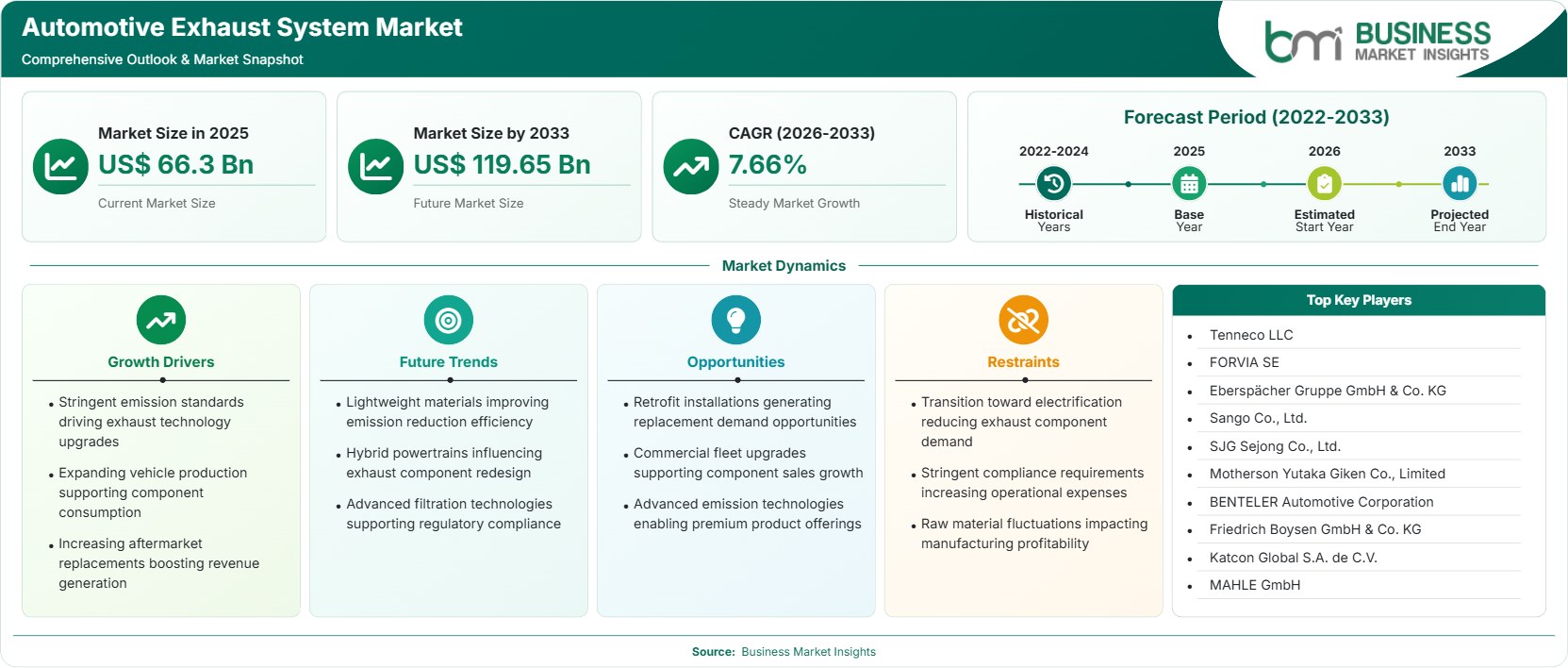
The Automotive Exhaust System Market size was valued at US$ 66.3 Billion in 2025 and is projected to reach US$ 119.65 Billion by 2033, growing at a CAGR of 7.66% during 2026–2033, driven by stricter emissions standards, commercial vehicle production, hybrid powertrains, lightweight components, advanced aftertreatment, and replacement demand.

Report Coverage
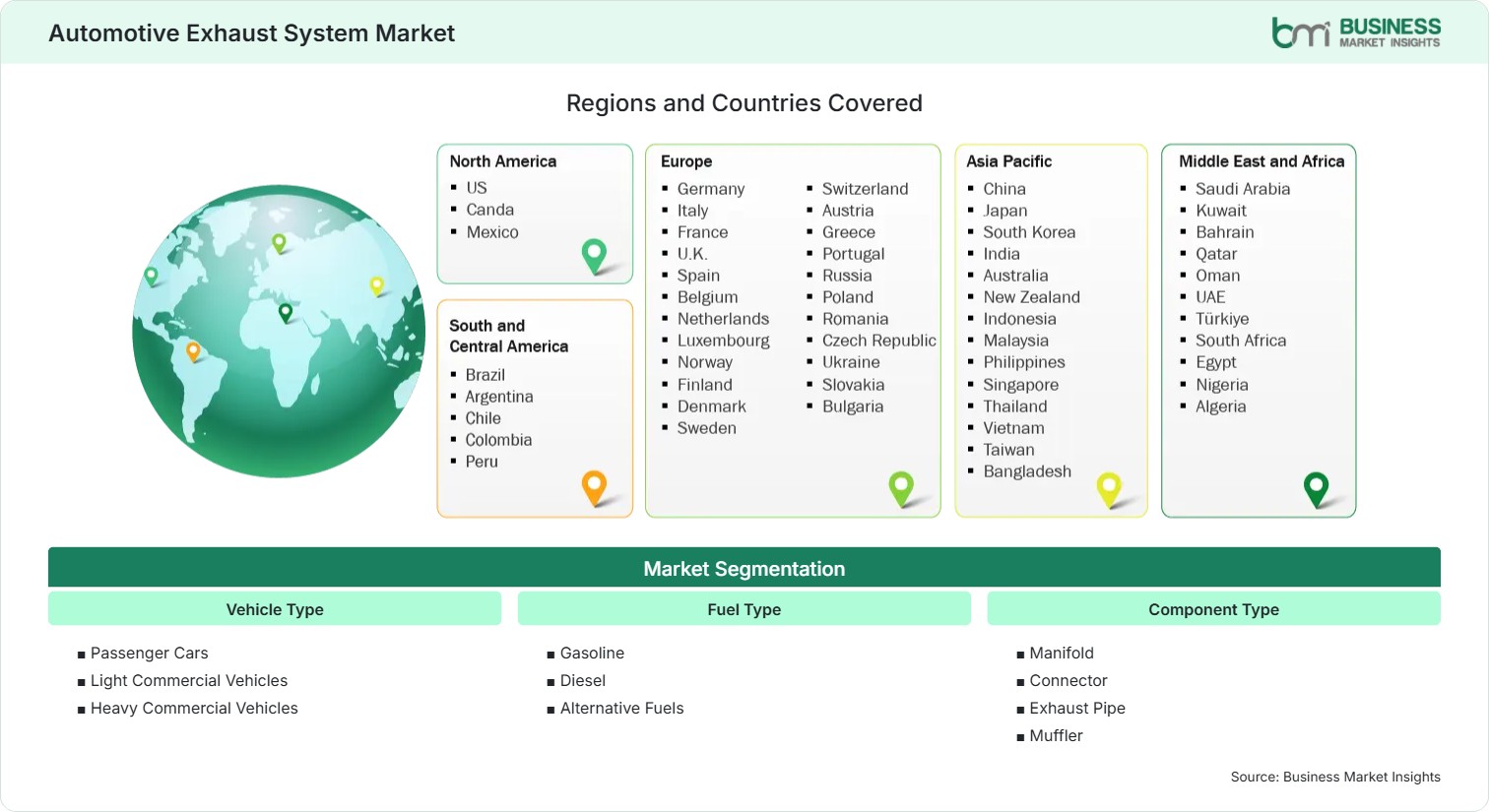
  • Vehicle Type: Passenger Cars, Light Commercial Vehicles, Heavy Commercial Vehicles
  • Fuel Type: Gasoline, Diesel, Alternative Fuels
  • Component Type: Manifold, Connector, Exhaust Pipe, Muffler
US$ 66.3 Bn Market size in 2025
US$ 119.65 Bn Market Size by 2033
7.66% CAGR, 2026 - 2033
2026-2033 Forecast Period

AI Overview

Automotive Exhaust System Market Summary

  • North America Region: holds a modeled Automotive Exhaust System Market share of 22%–25% in 2025, growing at a CAGR of 6.8%–7.4%, influenced by heavy-duty emissions compliance, fleet replacement, advanced aftertreatment, hybridization, and aftermarket demand. The US represents the region's principal market, with a modeled 6.6%–7.2% CAGR as federal and state emissions requirements stimulate advanced exhaust architectures.
  • Fastest Growing Region: Asia Pacific holds a modeled share of 39%–43% in 2025, expanding at a CAGR of 8.3%–9.0%, supported by vehicle manufacturing, urbanization, commercial fleets, tighter emission standards, localized component production, and increasing adoption of sophisticated aftertreatment technologies.
  • Leading Segment: Passenger Cars account for a modeled 62%–66% share in 2025, advancing at a CAGR of 7.2%–7.8%, supported by high global production volumes, hybridization, particulate control, lightweighting, and increasingly integrated exhaust architectures across gasoline and alternative-fuel platforms.
  • High Growth Segment: Alternative Fuels hold a modeled 10%–14% Automotive Exhaust System Market share in 2025, with a CAGR of 9.0%–10.0%, driven by CNG and LPG adoption, commercial fleet decarbonization, lower particulate emissions, fuel diversification, and expanding infrastructure in emerging automotive markets.
  • Key Market Opportunity: Demand is shifting toward compact, lightweight, thermally optimized systems that integrate catalysts, sensors, pipes, acoustic modules, and controls, creating opportunities for suppliers with advanced materials, software-enabled diagnostics, and flexible manufacturing capabilities.
  • Major Market Players: Tenneco LLC; FORVIA SE; Eberspächer Gruppe GmbH & Co. KG; Sango Co., Ltd.; SJG Sejong Co., Ltd.; Motherson Yutaka Giken Co., Limited; BENTELER Automotive Corporation; Friedrich Boysen GmbH & Co. KG; Katcon Global S.A. de C.V.; MAHLE GmbH.
Strategic Insights

Automotive Exhaust System Market: Strategic Insights

Automotive Exhaust System Market Strategic Framework
FREE PDF
Request your free sample
Request free sample
Stakeholder View

Key Takeaways

  • The value chain is increasingly integrated around OEM engineering partnerships, catalyst and stainless-steel sourcing, precision forming, welding, thermal management, sensor integration, and validation. Suppliers with hot-end and cold-end capabilities can capture more program value and reduce integration complexity for vehicle manufacturers.
  • Passenger cars provide the largest revenue pool because of their global production base, while commercial vehicles offer attractive technical value per vehicle. Alternative-fuel platforms provide an additional growth avenue because CNG and LPG systems continue to require dedicated exhaust optimization.
  • Product development is moving toward thermally efficient architectures, close-coupled treatment, lightweight materials, electronically controlled valves, exhaust heat recovery, improved acoustic engineering, and condition monitoring. SJG Sejong, for example, combines catalytic converters, SCR, GPF, exhaust heat recovery, and electronic exhaust valves within its portfolio.
  • Asia Pacific offers the strongest combination of production scale and regulatory-driven technology demand. China, India, Japan, and South Korea provide complementary opportunities across passenger cars, commercial vehicles, components, and export-oriented manufacturing.
  • Capital is increasingly directed toward suppliers capable of serving both combustion and electrified mobility. Tenneco announced a strategic investment involving Apollo Fund X and American Industrial Partners in 2025, while traditional exhaust specialists are diversifying into battery, hydrogen, electronics, and thermal technologies.
  • The transition toward electric vehicles does not eliminate near-term exhaust demand because combustion, hybrid, commercial, off-highway, and alternative-fuel platforms remain substantial portions of global vehicle production. Suppliers are therefore balancing emissions technologies with adjacent mobility businesses.
Geographic Outlook

Automotive Exhaust System Market Regional Highlights

North America Automotive Exhaust System Market

North America is expected to hold an estimated 22%–25% market share in the 2025 Automotive Exhaust System Market and is projected to grow at a 6.8%–7.4% CAGR between 2026 and 2033. The growth driver for North America will be demand from the US heavy-duty vehicle market, pickup and SUV production, replacements, and stringent emissions regulations. Other countries, such as Canada and Mexico, reinforce the manufacturing environment in North America through vehicle assembly and production.

  • Heavy-duty truck fleets provide recurring demand because high annual mileage accelerates wear across pipes, mufflers, catalysts, sensors, and associated thermal components.
  • Mexico strengthens regional sourcing through established automotive manufacturing clusters, creating opportunities for exhaust suppliers capable of meeting North American OEM localization requirements.
  • Hybridization preserves demand for sophisticated exhaust technologies because combustion engines continue operating under variable load and temperature conditions requiring rapid emissions control.
  • California and federal emissions requirements encourage suppliers to improve catalyst durability, diagnostics, thermal management, and real-world performance rather than optimizing systems only for laboratory certification.

US Automotive Exhaust System Market

In the US, the market was modeled at 72%-76% for North America in 2025, with a CAGR of 6.6%-7.2% for 2026-2033. The demand is driven by a high number of passenger cars, pickups, sport utility vehicles, and heavy-duty trucks. Aftermarket replacements are driven by fleet use, whereas the growing need to comply with increasingly stringent emissions regulations leads to higher technical demands on new vehicles. Heavy-duty vehicles are especially significant because diesel engine exhaust requires combined treatment of particulate matter and NOx.

  • Federal and state regulations encourage advanced emissions architectures, particularly for heavy-duty platforms where NOx, particulate matter, durability, and monitoring requirements increase system complexity.
  • The aftermarket remains attractive because aging vehicles require replacement mufflers, pipes, catalytic components, sensors, and related assemblies after prolonged operation.
  • Hybrid pickup and SUV adoption creates demand for lightweight systems engineered around frequent engine start-stop cycles, rapid catalyst activation, and variable exhaust temperatures.

Europe Automotive Exhaust System Market

Europe held a modeled share of 23%–26% in 2025, growing with a CAGR of 7.0%–7.6% between 2026 and 2033. Germany holds the top spot, while countries such as France, Italy, Spain, and the United Kingdom play a major role due to their considerable manufacturing and vehicle parc requirements. Germany holds a modeled CAGR of 7.1%–7.7% in the Automotive Exhaust System Market, whereas Poland is one of the rapidly growing manufacturers at a CAGR of 7.7%–8.4%.

  • Germany remains strategically important because premium OEM production requires advanced exhaust engineering, acoustic optimization, lightweight materials, and high-volume precision manufacturing.
  • Poland and Central Europe benefit from expanding automotive supplier networks, creating opportunities for localized exhaust assembly, pipe forming, welding, and component manufacturing.
  • Euro 7 increases engineering intensity because suppliers must demonstrate durable emissions performance over longer vehicle operating periods and across broader driving conditions.
  • Hybrid powertrains sustain exhaust demand while requiring rapid catalyst activation, compact packaging, and thermal strategies suited to intermittent engine operation.

Asia Pacific Automotive Exhaust System Market

The Asia Pacific region is modeled to account for 39%-43% of market share in 2025 and is estimated to exhibit the highest regional growth rate, at an 8.3%-9.0% CAGR, during the forecast period of 2026-2033. China continues to dominate the market, and India, Japan, and South Korea offer complementary strengths in manufacturing. India is estimated to grow at a CAGR of 9.0%-9.7%, driven by vehicle manufacturing of vehicles and compliance requirements for emissions.

  • China provides the largest regional manufacturing base, supporting high-volume demand for catalytic converters, pipes, mufflers, sensors, and integrated aftertreatment systems.
  • India is gaining importance as both a vehicle market and export manufacturing location, supported by BS6 Phase 2 compliance and increasing supplier localization.
  • Japan retains technological strength in compact exhaust packaging, thermal management, acoustic engineering, and lightweight components for passenger vehicles and hybrids.
  • South Korea combines OEM integration with specialist exhaust expertise, with SJG Sejong maintaining broad capabilities spanning catalytic systems, SCR, GPF, resonators, and exhaust heat recovery.

Rest of World Automotive Exhaust System Market

Rest of World is forecasted to have a modeled share of 10%-14% by 2025 and is expected to exhibit a CAGR of 6.9%-7.5% during the period 2026-2033. South & Central America can benefit from growth in their vehicle park and vehicle replacements, whereas the growth opportunities for Middle East & Africa lie in commercial transport, construction machinery, and imported vehicles. Brazil is a prominent name in the Latin American Automotive Exhaust Systems market, while Saudi Arabia & UAE are strongholds for premium and commercial vehicles, respectively.

Demand in South and Central America is driven by passenger cars, agricultural transport, logistics services, and replacement. Commercial vehicles create demand for components that are durable enough to work at high usage rate and in varying conditions.

Demand in Middle East and Africa comes from the need to supply heavy trucks, buses, construction machinery, and imported passenger cars. Replacement cycles can be extended; corrosion resistance and durability become more important.

  • Brazil provides scale through passenger vehicles, commercial fleets, and established component manufacturing capabilities, supporting both original equipment and replacement demand.
  • Saudi Arabia and the United Arab Emirates provide opportunities for premium vehicle and commercial fleet applications where heat management and component durability are critical.
  • South Africa supports regional demand through vehicle manufacturing, logistics fleets, mining-related transportation, and replacement requirements for high-mileage vehicles.
  • Latin American fleet modernization encourages suppliers to provide cost-effective exhaust assemblies without compromising emissions compliance or operating durability.
Global Market Geography
FREE PDF
Request your free sample
Request free sample
Segment Analysis

Automotive Exhaust System Market Segmentation

Vehicle Type

Vehicle Type is the most important segmentation parameter, owing to differences in exhaust system configurations, emissions tuning, packaging considerations, thermal loading, and acoustics across vehicle types. Passenger cars have 62%–66% of the modeled Automotive Exhaust System Market share in 2025, with a CAGR growth of 7.2%–7.8%. Additional value creation comes from commercial vehicles on account of aftertreatment complexity and durability. Hybridization trend is changing exhaust specifications.

  • Passenger Cars: High production volumes and stringent emissions requirements sustain demand for compact catalytic systems, manifolds, pipes, mufflers, sensors, and lightweight acoustic components across gasoline and hybrid vehicles.
  • Light Commercial Vehicles: Fleet utilization creates demand for durable exhaust assemblies, while urban delivery cycles increase the importance of thermal management, rapid catalyst activation, and compact packaging.
  • Heavy Commercial Vehicles: Advanced diesel and alternative-fuel applications require robust exhaust routing, NOx control, particulate management, thermal durability, and serviceable components capable of operating under intensive fleet conditions.

Fuel Type

Fuel Type affects catalyst properties, thermal properties, particulate formation, emissions, and component life cycle. The usage of gasoline will remain the largest base, while diesel fuel continues to be an important fuel for commercial vehicles. Alternative fuels are assumed to be the most rapidly growing group, with 10%-14% market share in 2025 and 9.0%-10.0% CAGR.

  • Gasoline: Gasoline vehicles require catalytic conversion, acoustic control, and increasingly particulate management, particularly for direct-injection engines where combustion characteristics increase particulate-control requirements.
  • Diesel: Diesel applications demand sophisticated NOx and particulate treatment, including SCR-compatible architecture, durable piping, thermal management, and monitoring systems for commercial and passenger vehicle platforms.
  • Alternative Fuels (LPG, CNG, Others): CNG and LPG systems offer opportunities for suppliers developing corrosion-resistant, thermally optimized, low-backpressure exhaust assemblies suited to fleet, urban transportation, and fuel-diversification programs.

Component Type

Component Type dictates the system's design, manufacturability, acoustics, heat-transfer capabilities, and emissions-management integration. Manifolds and connectors operate under extreme thermal and mechanical loads, whereas pipes and mufflers govern routing, strength, backpressure, and acoustics. Trends in the Automotive Exhaust System Market lean towards lightweight components, advanced joining techniques, thermal functionality, and automation.

  • Manifold: Manifolds require high-temperature durability, optimized gas flow, rapid catalyst light-off characteristics, and precise geometry, making material selection and thermal engineering central to performance.
  • Connector: Connectors support reliable assembly between exhaust modules while accommodating thermal expansion, vibration, and manufacturing tolerances across complex vehicle packaging environments.
  • Exhaust Pipe: Exhaust pipes require corrosion resistance, dimensional precision, efficient gas flow, and lightweight construction while connecting hot-end treatment components with downstream acoustic assemblies.
  • Muffler: Mufflers balance noise attenuation, pressure loss, durability, packaging, and increasingly active acoustic requirements, supporting differentiated designs across passenger, commercial, and performance-oriented vehicles.
Market Forces

Automotive Exhaust System Market Dynamics

Key Market Drivers

Stricter Real-World Emissions Compliance

Emission standards are moving the suppliers' emphasis from mere catalytic conversion to longevity and real world performance of the system. While the Euro 7 standard widens the compliance requirements beyond just vehicle life cycle, particulate emission controls, diagnostics and varied operating conditions, the heavy duty standards in North America are becoming more stringent with each new release. China and India, too, have introduced strict standards through China VI and BS6 Phase 2. All this translates to increased engineering needs for proper placement, thermal management, sensing, dosing, and diagnostics of the exhaust system. Consequently, the Automotive Exhaust System market growth is becoming increasingly dependent on content per vehicle rather than vehicle volumes alone.

Growth of Commercial and High-Utilization Vehicle Fleets

Commercial vehicle exhaust systems have stringent requirements due to high utilization, resulting in more thermal cycles, vibrations, corrosion, and replacements. Freight transport, construction, logistics, public transport, and other fleet operations still require internal combustion and alternative fuel engines even as cars are being made increasingly electric. The design of the exhaust system on heavy vehicles also requires greater technical expertise because the removal of NOx and particulates should be efficient across different engine loads. Automotive Exhaust System Market trends are thus positive for those manufacturers who produce reliable hot-end and cold-end systems, high-technology components, and effective systems. Fleet operators appreciate reliability and compliance of the exhaust system throughout its lifetime. Providers who can integrate reliable engineering solutions with low backpressure and effective diagnostics will gain a competitive advantage.

Expansion of Hybrid and Multi-Powertrain Architectures

The impact of hybridization is to alter the behavior of the exhaust rather than eliminate it. Engine stop-starts pose thermal challenges, as catalysts may cool down while running on electricity and must quickly warm up to become effective again when the engine starts. This favors close-coupled catalysts, better insulation, thermal management systems, optimized manifolds, and smart systems. Thus, the Automotive Exhaust System Market growth provides the opportunity for technological innovations due to the nature of hybrid behavior. In addition, manufacturers are developing architectural designs that meet the needs of gasoline, diesel, CNG, LPG, and hybrid vehicles through modular production.

Key Market Opportunities

Lightweight Materials and Sustainable Manufacturing

Vehicle weight reduction is becoming strategically essential as reduced weight translates into fuel efficiency and sustainability. Sourcing is becoming a growing concern for the OEM’s procurement strategy. Stainless steel remains important because it offers corrosion resistance, high-temperature performance, and formability. Suppliers have started considering the use of low-carbon steel, efficient material gauges, forming technologies, and joining techniques. In 2025, the company Eberspächer reported an increase in the use of Outokumpu Circle Green stainless steel in exhaust after-treatment systems, which have lower carbon footprints than traditional stainless steel.

Advanced Thermal Management and Exhaust Heat Recovery

The combination of increased thermal efficiency and catalysis provides opportunity due to the strong dependence of catalyst conversion on temperature and hybridization causing temperature variation. Thermal recovery from exhaust can help to speed up engine warm up, improve heating of the passenger compartment, and enhance energy efficiency, in particular, during cold starts and short cycles. SJG Sejong already provides exhaust heat recovery solutions along with catalytic converters, SCR, GPF, resonators, and electronically controlled exhaust valves. Therefore, suppliers have an opportunity to develop more sophisticated technologies than simple pipes and mufflers by creating more valuable products per car. This technology can be especially useful for hybrid and commercial vehicles, where thermal efficiency affects fuel economy and emissions performance.

Localized Production in Emerging Automotive Hubs

The need for regionally based supply chains to mitigate logistics risk, accelerate time to market, and ensure compliance with local content rules makes India, Mexico, Central Europe, Southeast Asia, and select Middle Eastern manufacturing hubs potential markets for the exhaust supplier to enter. This is especially true for the Automotive Exhaust System Market Forecasts, since the regional programs manufacturers are pursuing make the localization of both engineering and manufacturing essential rather than relying on imported assemblies. For example, Tenneco's 2025 list of its Indian subsidiary shows just how critical India is to the worldwide manufacture of automobiles and the manufacturer's commitment to the nation as an engineering and manufacturing center.

Market Restraints and Challenges

Powertrain Electrification Reduces Long-Term Exhaust Content

Factor: Battery-electric vehicles do not need traditional exhaust systems since the engine does not produce exhaust. Long-Term Demand Impact would be caused by a lack of market demand due to the rise in electric cars. Impact: Manufacturers that have used gasoline and diesel engines in the past would see lower business volume due to overcapacity and higher fixed costs. It wouldn’t affect all the products equally because some categories, like hybrids, commercial, and fleet in developing countries, would still use internal combustion engines. However, the change means there is a different mix of products to address and consider adjacencies across fields such as thermal management, battery housing, hydrogen systems, and electronics, among others.

High Engineering and Material Costs

Factor: The development of advanced catalysts, stainless steel, sensors, thermal insulation, precise forming, and emissions testing results in higher system cost and complexity. Impact: Suppliers are under margin pressure as OEMs are trying to reduce the cost of components, but at the same time, there are more regulatory requirements, which means that more technology is included. Price fluctuations in materials may lead to additional problems during contract negotiations, especially for stainless steel and catalysts, which include precious metals. Small suppliers might have difficulties financing testing, simulations, tooling, certification, and automation necessary for future projects. Competitive advantage will be based on production efficiency and early cooperation with OEMs.

Company Analysis

Competitive Landscape

The Automotive Exhaust System Market analysis indicates a competitive structure combining large global Tier 1 suppliers with specialist exhaust manufacturers. Competitive differentiation is increasingly based on emissions engineering, global manufacturing reach, lightweight materials, thermal management, acoustic performance, and the ability to support multiple powertrain architectures.

Company Name

Overview

Products and Services relevant to this market

Tenneco LLC

Global automotive supplier with substantial clean-air capabilities and broad OEM relationships across passenger and commercial vehicle programs.

Catalytic converters, diesel aftertreatment, emissions-control systems, exhaust components, thermal technologies, sensors, and integrated clean-air solutions.

FORVIA SE

Global automotive technology group with established clean-mobility and emissions-control capabilities serving major vehicle manufacturers.

Exhaust aftertreatment, emissions control, thermal systems, acoustic solutions, electronics, and integrated vehicle technologies.

Eberspächer Gruppe GmbH & Co. KG

German technology supplier with longstanding expertise in exhaust, acoustics, thermal management, and clean mobility applications.

Exhaust gas aftertreatment, acoustic systems, commercial-vehicle exhaust solutions, thermal management, and related mobility technologies.

Sango Co., Ltd.

Japanese automotive component specialist with strong exhaust-system engineering and OEM supply capabilities.

Exhaust manifolds, catalytic converters, pipes, mufflers, exhaust assemblies, and related emissions-control components.

SJG Sejong Co., Ltd.

South Korean exhaust specialist serving passenger and commercial vehicle applications while expanding into hydrogen and electrification.

Catalytic converters, SCR, GPF, resonators, exhaust heat recovery systems, electronic exhaust valves, and complete exhaust systems.

Motherson Yutaka Giken Co., Limited

Automotive component specialist combining exhaust engineering with manufacturing, joining, forming, and thermal capabilities.

Exhaust manifolds, silencers, catalytic converters, heat collectors, exhaust systems, thermal components, and precision manufacturing services.

BENTELER Automotive Corporation

Global automotive supplier providing structural, chassis, module, and powertrain-related solutions to vehicle manufacturers.

Exhaust-related assemblies, formed metal components, vehicle modules, lightweight structures, and precision metal manufacturing.

Friedrich Boysen GmbH & Co. KG

German exhaust specialist serving passenger cars, commercial vehicles, and off-highway applications while diversifying into electrification.

Complete exhaust systems, hot-end components, acoustic systems, battery housings, hydrogen-related technologies, and advanced metal assemblies.

Katcon Global S.A. de C.V.

Global automotive supplier focused strongly on emissions-control systems and manufacturing for vehicle platforms worldwide.

Catalytic converters, exhaust manifolds, pipes, mufflers, aftertreatment systems, and emissions-control assemblies.

MAHLE GmbH

Global mobility supplier with extensive powertrain, thermal-management, filtration, and combustion technology expertise.

Exhaust-related thermal technologies, engine components, emissions-control solutions, filtration, thermal management, and powertrain systems.

Trust & Transparency

Research Methodology

The market analysis combines proprietary research with secondary data from government agencies, company disclosures, regulatory filings, industry databases and expert interviews. Market estimates are validated through data triangulation, cross-market benchmarking and analyst review.

View Full Research Methodology

Questions Answered

Frequently Asked Questions

Which technologies are creating new exhaust-system opportunities?

Advanced catalytic systems, particulate filters, exhaust heat recovery, electronically controlled valves, lightweight stainless steel, improved acoustic systems, thermal insulation, and integrated sensors are creating opportunities. Alternative-fuel vehicles also require specialized exhaust architectures that support lower emissions and efficient operation.

What does the Automotive Exhaust System Market Report indicate about emerging suppliers?

The competitive environment favors suppliers that combine exhaust engineering with lightweight materials, thermal management, electronics, software-enabled diagnostics, and flexible manufacturing. Emerging automotive hubs such as India, Mexico, Central Europe, and Southeast Asia provide opportunities for localized production and OEM partnerships.

Why are hybrid vehicles relevant to exhaust-system suppliers?

Hybrid vehicles continue using combustion engines, but frequent engine shutdowns and restarts create new thermal challenges. Suppliers therefore need systems that achieve rapid catalyst activation, manage temperature fluctuations, reduce backpressure, and maintain emissions performance during variable engine operation.

Which vehicle category provides the strongest revenue opportunity?

Passenger cars provide the largest revenue opportunity because of their global production volumes and broad gasoline and hybrid installed base. Heavy commercial vehicles provide higher technical content per vehicle because of demanding NOx, particulate, durability, and thermal-management requirements.

How will Euro 7 influence the Automotive Exhaust System Market?

Euro 7 places increasing emphasis on real-world emissions, durability, particulate control, diagnostics, and broader operating conditions. This encourages suppliers to improve catalyst positioning, thermal management, sensing, monitoring, and system durability rather than optimizing only for laboratory certification.

Access the Full Automotive Exhaust System Market Report

Get segment-level forecasts, regional estimates, competitive benchmarking, company profiles and downloadable Excel datasets.

Access the full Automotive Exhaust System Market Report
350 pages PDF & Excel | 2026-09-18
Similar Research

Related Market Reports