
Automotive Regenerative Braking System Market Outlook: Size, Share, Trends, Growth Analysis, Competitive Landscape & Forecast, 2026-2033

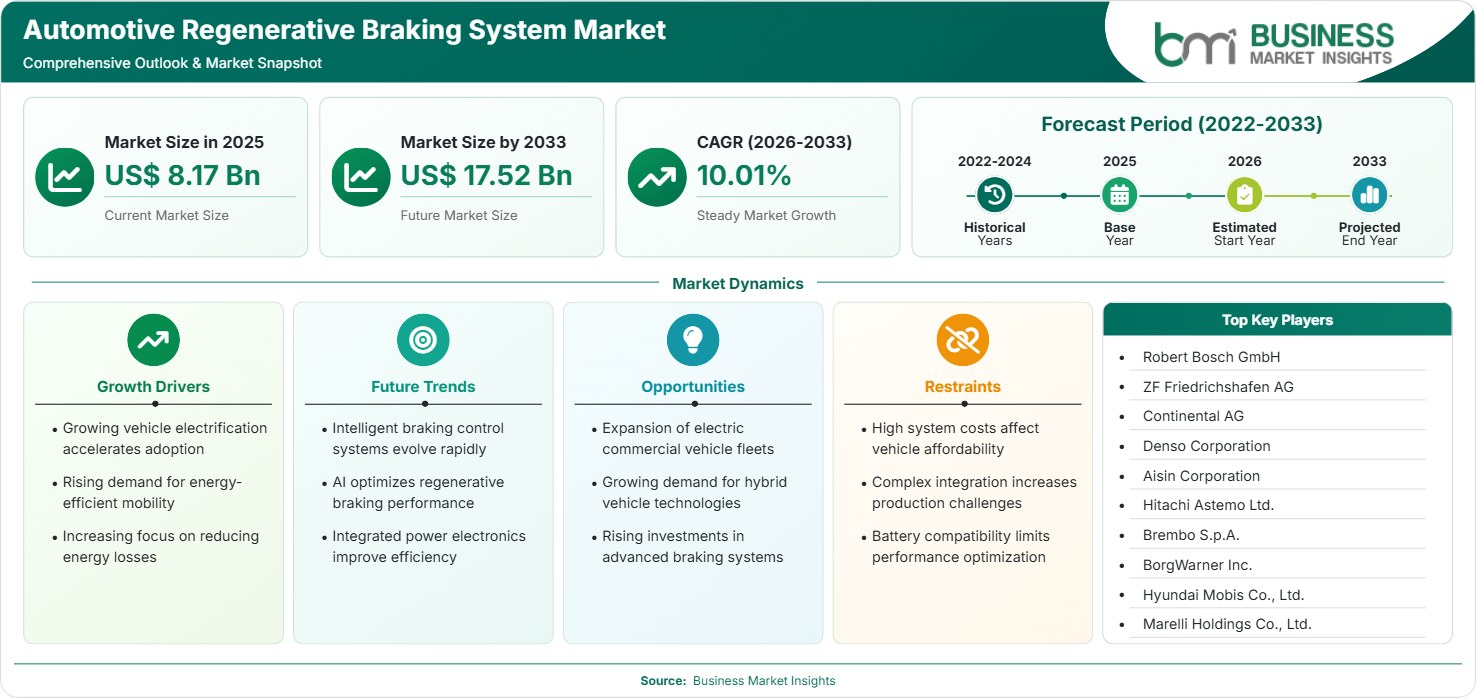
The Automotive Regenerative Braking System Market size was valued at US$ 8.17 billion in 2025 and is projected to reach US$ 17.52 billion by 2033, growing at a CAGR of 10.01% during 2026–2033. Increasing vehicle electrification, rising demand for energy-efficient mobility, and continuous advancements in regenerative braking technologies are supporting market expansion, while growing electric vehicle adoption and investments in intelligent braking systems create long-term opportunities.

Report Coverage
  • Component: Battery, Motor, ECU, Flywheel
  • Propulsion Type: BEV, PHEV, FCEV
  • Vehicle Type: Passenger Car, Light Commercial Vehicle, Heavy Commercial Vehicle
US$ 8.17 Bn Market size in 2025
US$ 17.52 Bn Market Size by 2033
10.01% CAGR, 2026 - 2033
2026-2033 Forecast Period

AI Overview

Automotive Regenerative Braking System Market Summary

  • North America Region: North America holds 28%–31% market share in 2025 and is projected to expand at a CAGR of 9.3%–9.8% during 2026–2033. Rising electric vehicle production, stringent emission regulations, and increasing investments in advanced automotive technologies continue supporting regional demand. The U.S. leads the regional market through strong battery electric vehicle production, expanding EV charging infrastructure, and advanced automotive manufacturing, registering a CAGR of 9.5%–10.0% during the forecast period.
  • Fastest Growing Region: Asia Pacific accounts for 36%–39% automotive regenerative braking system market share in 2025 and is anticipated to register a CAGR of 10.8%–11.4% during 2026–2033, supported by rapid electric vehicle production, favorable government incentives, and expansion of automotive manufacturing across China, Japan, South Korea, and India.
  • Leading Segment: Battery represents 38%–41% market share in 2025 and is expected to grow at a CAGR of 10.2%–10.7% through 2033 due to its essential role in storing recovered braking energy and extending electric vehicle driving range.
  • High Growth Segment: Battery Electric Vehicle (BEV) accounts for 44%–47% market share in 2025 and is projected to expand at a CAGR of 11.2%–11.8% during the forecast period owing to increasing EV production, battery technology advancements, and supportive emission policies.
  • Key Market Opportunity: Expansion of electric commercial vehicle fleets, growing adoption of hybrid vehicle technologies, and increasing investments in advanced brake-by-wire systems are creating strong opportunities for next-generation regenerative braking solutions.
  • Major Market Players: Robert Bosch GmbH, ZF Friedrichshafen AG, Continental AG, Denso Corporation, Aisin Corporation, Hitachi Astemo Ltd., Brembo S.p.A., BorgWarner Inc., Hyundai Mobis Co., Ltd., and Marelli Holdings Co., Ltd.
Strategic Insights

Automotive Regenerative Braking System Market: Strategic Insights

Automotive Regenerative Braking System Market Strategic Framework
FREE PDF
Request your free sample
Request free sample
Stakeholder View

Key Takeaways

  • Automotive manufacturers are increasingly integrating regenerative braking technologies with advanced electronic braking systems to improve vehicle efficiency, driving range, and overall energy recovery performance.
  • Battery electric vehicles represent the strongest growth opportunity as increasing global EV production continues driving demand for highly efficient regenerative braking systems.
  • Innovation is focused on intelligent brake-by-wire technologies, advanced electronic control units, lightweight braking components, and software-driven energy management systems.
  • Asia Pacific remains the most attractive investment destination owing to expanding electric vehicle manufacturing, supportive government policies, and a well-established automotive supply chain.
  • Strategic collaborations between automotive OEMs and Tier-1 suppliers continue accelerating product innovation, technology integration, and commercialization of next-generation regenerative braking solutions.
Geographic Outlook

Automotive Regenerative Braking System Market Regional Highlights

North America Automotive Regenerative Braking System Market

North America accounted for 28%–31% of the Automotive Regenerative Braking System Market Share in 2025 and is projected to grow at a CAGR of 9.3%–9.8% through 2033. Strong electric vehicle adoption, investments in advanced braking technologies, and stringent fuel efficiency regulations continue supporting regional demand. Automotive manufacturers are increasingly integrating regenerative braking systems into battery electric and hybrid vehicles to improve energy recovery and vehicle performance.

  • The U.S. and Canada continue investing in electric vehicle production, strengthening demand for regenerative braking technologies.
  • Growing deployment of battery electric and plug-in hybrid vehicles supports higher adoption of intelligent braking systems.
  • Increasing R&D investments by automotive suppliers accelerate innovation in brake-by-wire and energy recovery technologies.
  • Government incentives encouraging zero-emission mobility continue supporting long-term market expansion.

US Automotive Regenerative Braking System Market

The U.S. represented 74%–78% of the North American market in 2025 and is expected to register a CAGR of 9.5%–10.0% during the forecast period. Expanding EV manufacturing, growing investments in battery production, and increasing consumer preference for energy-efficient vehicles continue strengthening product demand.

  • Leading automotive manufacturers continue expanding electric vehicle production facilities across the country.
  • Advanced vehicle safety technologies encourage adoption of integrated regenerative braking systems.
  • Federal incentives continue supporting electric mobility and automotive technology investments.
  • Increasing charging infrastructure supports higher EV sales and component demand.

Europe Automotive Regenerative Braking System Market

Europe held 27%–30% market share in 2025 and is anticipated to expand at a CAGR of 9.6%–10.1% through 2033. Germany remains the leading regional market, while France demonstrates the fastest growth due to increasing electric vehicle adoption and government support for sustainable mobility.

  • Strict CO₂ emission regulations continue accelerating electrified vehicle production.
  • Premium automotive manufacturers increasingly integrate advanced regenerative braking technologies.
  • Investments in hybrid and electric vehicle platforms strengthen component demand.
  • Expansion of battery manufacturing supports the regional automotive value chain.

Asia Pacific Automotive Regenerative Braking System Market

Asia Pacific accounted for 36%–39% of global revenue in 2025 and is projected to record the highest CAGR of 10.8%–11.4% through 2033. China leads regional demand, while India is expected to witness the fastest growth due to expanding EV manufacturing and supportive government initiatives.

  • China continues dominating global electric vehicle production and battery manufacturing.
  • India is increasing investments in EV production and charging infrastructure.
  • Japan and South Korea remain major innovation hubs for advanced automotive technologies.
  • Government incentives continue encouraging domestic electric vehicle manufacturing.
  • Rising consumer preference for energy-efficient mobility strengthens market demand.

Rest of World Automotive Regenerative Braking System Market

The Rest of World region represented 8%–11% of the market in 2025 and is forecast to grow at a CAGR of 9.1%–9.6% during the forecast period. Brazil leads demand across South America, while the UAE demonstrates strong growth across the Middle East due to increasing investments in sustainable transportation.

  • Fleet electrification initiatives support adoption of regenerative braking technologies.
  • Growing public transportation modernization creates additional market opportunities.
  • Automotive imports with electrified powertrains continue increasing regional penetration.
  • Government sustainability initiatives encourage deployment of electric mobility solutions.
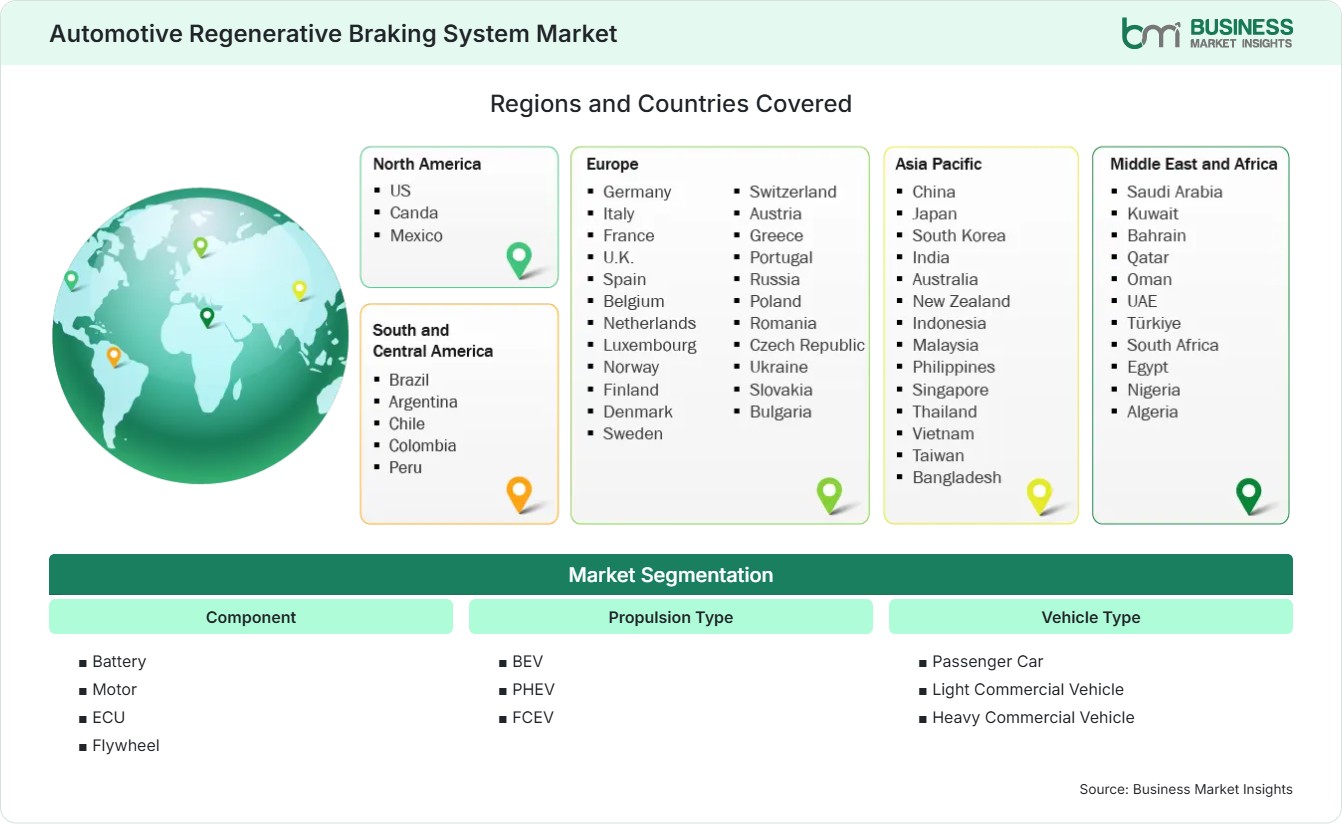
Global Market Geography
FREE PDF
Request your free sample
Request free sample
Segment Analysis

Automotive Regenerative Braking System Market Segmentation

Component

The Component segment accounted for the largest share of the market, with Battery representing 38%–41% market share in 2025 and expected to grow at a CAGR of 10.2%–10.7% through 2033. The Automotive Regenerative Braking System Market Trends indicate increasing integration of high-performance energy storage systems to maximize recovered braking energy, improve vehicle efficiency, and enhance overall driving range across electrified vehicle platforms.

  • Battery: Stores recovered braking energy efficiently, improving vehicle range and overall energy utilization in electric and hybrid vehicles.
  • Motor: Converts kinetic energy into electrical energy during braking while supporting efficient propulsion during vehicle operation.
  • ECU: Controls regenerative braking functions, optimizes braking distribution, and ensures seamless coordination between mechanical and electrical braking systems.
  • Flywheel: Provides temporary energy storage for specific regenerative braking applications requiring rapid energy transfer and improved efficiency.

By Propulsion Type

The propulsion type segment is expanding rapidly as electrified vehicles gain higher global adoption. BEV remains the leading category with 44%–47% market share in 2025 and is projected to register the fastest CAGR of 11.2%–11.8% through 2033 due to increasing battery electric vehicle production and supportive government policies.

  • BEV: High regenerative braking efficiency supports longer driving range and improved battery utilization.
  • PHEV: Growing consumer demand for flexible electrified mobility continues supporting technology adoption.
  • FCEV: Emerging hydrogen mobility initiatives create long-term opportunities for regenerative braking integration.

By Vehicle Type

Passenger vehicles continue dominating adoption owing to rapid electrification of personal mobility. The segment accounted for 58%–61% market share in 2025 and is expected to grow at a CAGR of 10.0%–10.5% during the forecast period. Rising EV production and stricter emission regulations continue supporting technology deployment across multiple vehicle categories.

  • Passenger Car: Increasing production of electric and hybrid passenger vehicles continues driving widespread regenerative braking adoption.
  • Light Commercial Vehicle (LCV): Fleet electrification and urban logistics expansion encourage deployment of advanced braking technologies.
  • Heavy Commercial Vehicle (HCV): Electrification of buses and heavy-duty trucks creates growing demand for high-capacity regenerative braking systems.
Market Forces

Automotive Regenerative Braking System Market Dynamics

Key Market Drivers

Growing Vehicle Electrification Accelerates Adoption

Growing electrification of the global automotive industry is a major factor supporting the Market Growth. Governments across major economies are promoting battery electric, plug-in hybrid, and fuel cell vehicles through incentives and stringent emission regulations. Regenerative braking systems have emerged as a vital component in electrified powertrain systems as they enable the capture of kinetic energy through the process of braking and increase the vehicle range. There has been a trend among automotive companies to incorporate improved brake systems in the design of their cars to help reduce energy consumption from batteries. Growth in the production capacity of electric vehicles will continue.

Rising Demand for Energy-Efficient Mobility

Consumers and fleet operators are increasingly seeking vehicles that offer greater energy efficiency and lower operating costs. Regenerative braking systems improve vehicle performance by converting braking energy into reusable electrical energy, reducing overall power losses. The increased standards of fuel economy and sustainability have compelled car manufacturers to adopt sophisticated braking systems in both passenger and commercial cars. Increased spending on electrical vehicle infrastructure coupled with rising consumer awareness about environment-friendly transport options has facilitated the adoption of regenerative braking systems all over the world.

Increasing Focus on Reducing Energy Losses

Automotive manufacturers are focusing on technologies that improve vehicle efficiency without compromising safety or driving performance. Regenerative braking systems significantly reduce energy Losses that are incurred through conventional braking systems are prevented by harnessing the energy generated in the process and storing it in the battery. There are continued developments in areas such as intelligent braking systems, light weight cars, and electric brakes that improve the efficiency of the regenerative braking system.

Key Market Opportunities

Expansion of Electric Commercial Vehicle Fleets

The rapid expansion of electric buses, delivery vans, and commercial truck fleets presents significant opportunities for regenerative braking system manufacturers. Fleet operators increasingly prioritize technologies that improve driving range, reduce maintenance costs, and enhance energy efficiency. Commercial vehicles operate under frequent stop-and-go conditions, enabling regenerative braking systems to recover greater amounts of energy compared to conventional vehicles. Increasing government support for zero-emission public transportation and commercial fleet electrification is expected to create substantial opportunities for advanced braking system suppliers throughout the forecast period. The Automotive Regenerative Braking System Market Forecasts indicate sustained investment in this application area.

Growing Demand for Hybrid Vehicle Technologies

Hybrid vehicles continue gaining popularity in regions where charging infrastructure remains under development. Regenerative braking systems play a critical role in maximizing fuel efficiency and battery utilization within hybrid powertrains. Automotive manufacturers are introducing new hybrid vehicle platforms featuring enhanced braking control systems capable of improving overall vehicle performance. Rising consumer preference for fuel-efficient mobility solutions and supportive emission reduction policies continue creating favorable growth opportunities for regenerative braking technology providers.

Rising Investments in Advanced Braking Systems

Automotive suppliers are investing heavily in brake-by-wire technologies, intelligent electronic control units, integrated safety systems, and software-defined vehicle platforms. These investments are improving braking precision, energy recovery efficiency, and vehicle safety. Strategic partnerships between OEMs and component manufacturers continue accelerating development of next-generation regenerative braking systems. Increasing research and development activities are expected to generate new commercialization opportunities across passenger and commercial vehicle applications.

Market Restraints and Challenges

High System Costs Affect Vehicle Affordability

Factor: Advanced regenerative braking systems require sophisticated electronic components, sensors, control units, and software integration, increasing overall vehicle manufacturing costs.

Impact: Higher production costs directly influence vehicle pricing, particularly within entry-level electric and hybrid vehicle segments. Cost-sensitive consumers may delay purchasing decisions, while manufacturers must balance performance improvements with affordability. Although economies of scale are gradually reducing component costs, pricing remains a significant challenge for wider adoption across emerging automotive markets.

Complex Integration Increases Production Challenges

Factor: Integrating regenerative braking systems with electric powertrains, battery management systems, electronic stability control, and conventional braking technologies requires advanced engineering expertise and extensive testing.

Impact: Integration complexity increases product development timelines, manufacturing costs, and validation requirements for automotive manufacturers. Achieving seamless coordination between regenerative and friction braking systems remains technically challenging, particularly across multiple vehicle platforms. These engineering complexities may delay product launches and increase development expenditures despite growing demand for electrified vehicles.

Company Analysis

Competitive Landscape

The Automotive Regenerative Braking System Market Analysis indicates that leading companies are emphasizing intelligent braking technologies, brake-by-wire systems, integrated electronic control units, and strategic partnerships with automotive OEMs. Product innovation, regional manufacturing expansion, and investments in electrification technologies remain the primary competitive strategies.

Company Name

Overview

Products and Services Relevant to this Market

Robert Bosch GmbH

Global automotive technology leader specializing in mobility and vehicle electrification solutions.

Regenerative braking systems, brake control units, brake-by-wire technologies, sensors, and electronic braking solutions.

ZF Friedrichshafen AG

Leading supplier of driveline, chassis, and advanced mobility technologies.

Integrated braking systems, electric drive technologies, regenerative braking modules, and vehicle control systems.

Continental AG

Global automotive supplier focused on intelligent mobility and safety technologies.

Electronic braking systems, brake actuators, regenerative braking solutions, sensors, and software platforms.

Denso Corporation

Major automotive component manufacturer serving global OEMs.

Electronic control units, braking electronics, electric drive components, and power management systems.

Aisin Corporation

Leading developer of automotive drivetrain and braking technologies.

Brake systems, regenerative braking components, powertrain systems, and integrated vehicle technologies.

Hitachi Astemo Ltd.

Provider of advanced mobility technologies for electrified vehicles.

Brake-by-wire systems, regenerative braking technologies, electric powertrain solutions, and control systems.

Brembo S.p.A.

Premium braking technology manufacturer with global automotive presence.

High-performance braking systems, electronic braking technologies, brake calipers, and integrated braking solutions.

BorgWarner Inc.

Global supplier of electrification and propulsion technologies.

Electric propulsion components, regenerative braking technologies, power electronics, and drive modules.

Hyundai Mobis Co., Ltd.

Automotive parts manufacturer supporting global vehicle production.

Integrated braking systems, electronic control modules, regenerative braking technologies, and chassis systems.

Marelli Holdings Co., Ltd.

Automotive technology company specializing in advanced electronic systems.

Brake control systems, electronic modules, vehicle electronics, and electrification technologies.

Trust & Transparency

Research Methodology

The market analysis combines proprietary research with secondary data from government agencies, company disclosures, regulatory filings, industry databases and expert interviews. Market estimates are validated through data triangulation, cross-market benchmarking and analyst review.

View Full Research Methodology

Questions Answered

Frequently Asked Questions

What does the Automotive Regenerative Braking System Market Report cover?

The Market Report provides comprehensive insights into market size, regional performance, segmentation, competitive landscape, technological developments, growth opportunities, recent developments, and future industry outlook through 2033.

Who are the leading companies operating in this market?

Major participants include Robert Bosch GmbH, ZF Friedrichshafen AG, Continental AG, Denso Corporation, Aisin Corporation, Hitachi Astemo Ltd., Brembo S.p.A., BorgWarner Inc., Hyundai Mobis Co., Ltd., and Marelli Holdings Co., Ltd.

Which region is expected to grow the fastest?

Asia Pacific is projected to witness the highest growth owing to expanding EV manufacturing, government incentives, rapid automotive production, and increasing investments in battery and charging infrastructure.

Which propulsion type dominates the market?

Battery Electric Vehicles (BEVs) lead the market due to their greater dependence on regenerative braking systems for maximizing driving range, improving battery efficiency, and reducing overall energy consumption.

What is driving the Automotive Regenerative Braking System Market?

The market is driven by rising electric vehicle production, increasing demand for energy-efficient mobility, stringent emission regulations, and growing investments in advanced braking technologies that improve energy recovery and vehicle efficiency.

Access the Full Automotive Regenerative Braking System Market Report

Get segment-level forecasts, regional estimates, competitive benchmarking, company profiles and downloadable Excel datasets.

Access the full Automotive Regenerative Braking System Market Report
350 pages PDF & Excel | 2026-08-06