
Automotive Navigation Systems Market Outlook: Size, Share, Trends, Growth Analysis, Competitive Landscape & Forecast, 2026-2033

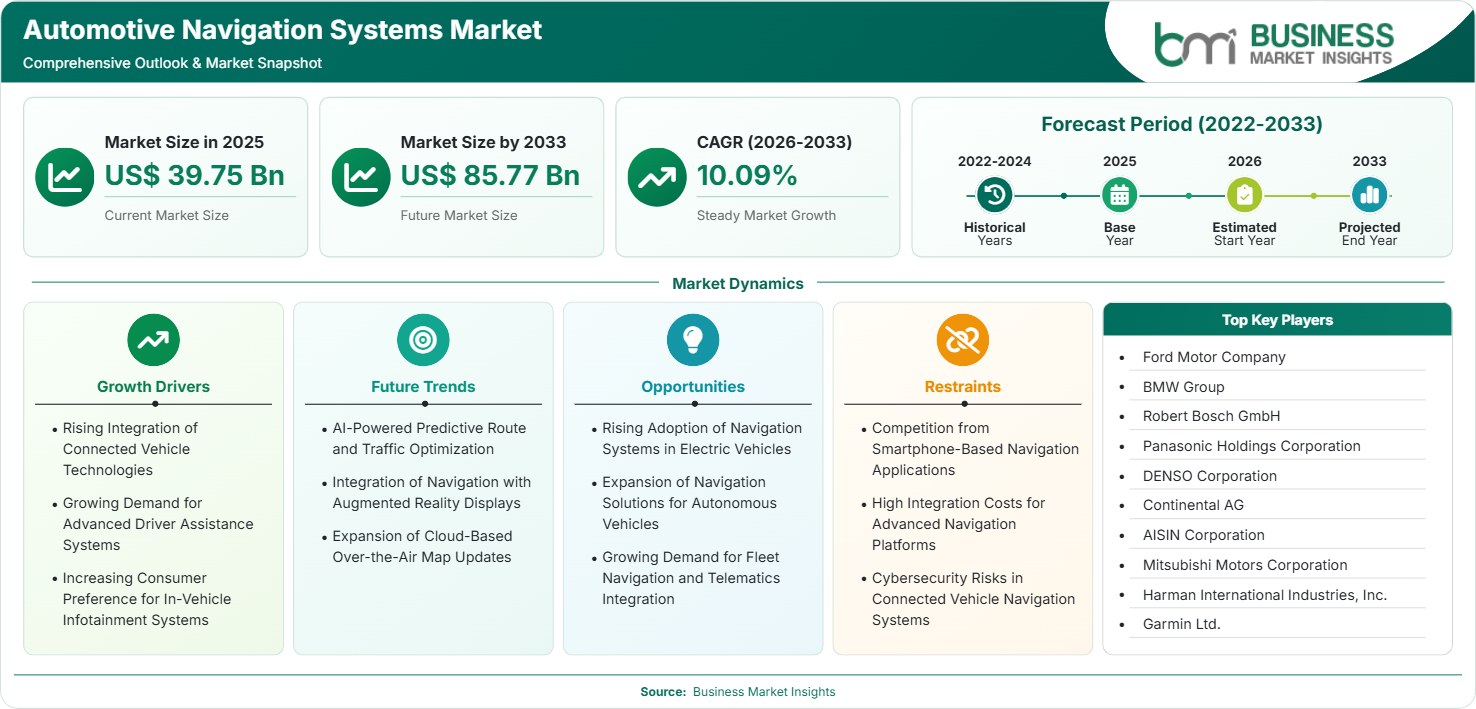
The Automotive Navigation Systems Market size was valued at US$ 39.75 Billion in 2025 and is projected to reach US$ 85.77 Billion by 2033, growing at a CAGR of 10.09% during 2026–2033. Rising adoption of connected vehicles, increasing demand for real-time traffic intelligence, growing integration of advanced driver assistance technologies, and expanding deployment of infotainment platforms are creating significant growth opportunities across the automotive navigation ecosystem.

Report Coverage
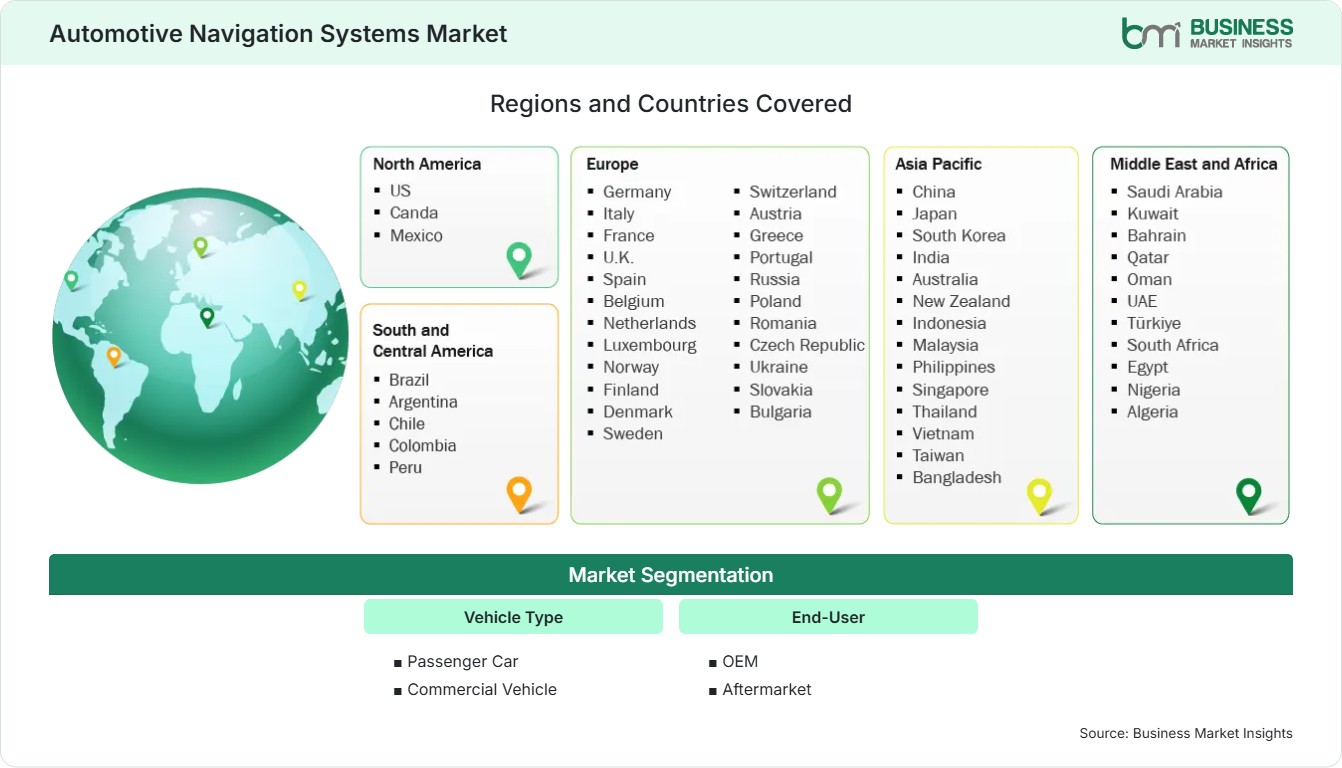
  • Vehicle Type: Passenger Car, Commercial Vehicle
  • End-User: OEM, Aftermarket
US$ 39.75 Bn Market size in 2025
US$ 85.77 Bn Market Size by 2033
10.09% CAGR, 2026 - 2033
2026-2033 Forecast Period

AI Overview

Automotive Navigation Systems Market Summary

  • North America Region: North America holds 32%–35% automotive navigation systems market share in 2025 and is projected to expand at a 9.4%–9.9% CAGR during 2026–2033. Growth is supported by high connected vehicle penetration, increasing adoption of embedded navigation platforms, demand for advanced mobility services, and rising investments in intelligent transportation systems. The United States dominates the regional market through strong automotive technology adoption, expanding connected car ecosystems, and growing demand for premium in-vehicle experiences, advancing at approximately 9.7%–10.2% CAGR through 2033.
  • Fastest Growing Region: Asia Pacific accounts for 35%–38% market share in 2025 and is expected to register the fastest 10.8%–11.4% CAGR during the forecast period. Rising vehicle production, increasing smartphone integration, expanding digital mapping infrastructure, and growing consumer demand for connected mobility solutions continue accelerating regional growth.
  • Leading Segment: Passenger Car accounts for 74%–78% market share in 2025 and is anticipated to grow at a 10.1%–10.6% CAGR through 2033. Increasing consumer preference for connected vehicles, integrated infotainment systems, and advanced navigation capabilities continues supporting segment dominance.
  • High Growth Segment: OEM holds 61%–65% market share in 2025 while expanding at a 10.6%–11.2% CAGR during 2026–2033. Growing integration of factory-installed navigation platforms, connected vehicle technologies, and software-defined vehicle architectures continues driving adoption.
  • Key Market Opportunity: Growing integration of artificial intelligence, cloud-connected navigation services, predictive routing technologies, and vehicle-to-everything communication platforms is creating long-term opportunities for navigation solution providers.
  • Major Market Players: Ford Motor Company, BMW Group, Robert Bosch GmbH, Panasonic Holdings Corporation, DENSO Corporation, Continental AG, AISIN Corporation, Mitsubishi Motors Corporation, Harman International Industries, Inc., and Garmin Ltd.
Strategic Insights

Automotive Navigation Systems Market: Strategic Insights

Automotive Navigation Systems Market Strategic Framework
FREE PDF
Request your free sample
Request free sample
Stakeholder View

Key Takeaways

  • Automotive manufacturers are increasingly integrating navigation systems with connected vehicle platforms, advanced driver assistance systems, digital cockpits, and cloud-based mobility services to enhance user experience and vehicle functionality.
  • OEM installations represent the strongest growth opportunity as automakers prioritize factory-fitted navigation solutions capable of supporting connected services, over-the-air updates, and intelligent route optimization.
  • Innovation is increasingly centered on artificial intelligence, predictive navigation, augmented reality displays, cloud-based mapping platforms, and real-time traffic intelligence solutions.
  • Asia Pacific offers the most attractive investment opportunity owing to strong vehicle production volumes, rapid digitalization of mobility services, increasing passenger vehicle demand, and expanding connected car ecosystems.
  • Strategic collaborations among automakers, mapping providers, software developers, and connectivity service vendors are becoming increasingly important as navigation systems evolve into integrated mobility platforms.
  • The transition toward software-defined vehicles, electric mobility, and autonomous driving technologies is creating new opportunities for advanced navigation and location-based service providers.
Geographic Outlook

Automotive Navigation Systems Market Regional Highlights

North America Automotive Navigation Systems Market

North America accounts for 32%–35% of the Automotive Navigation Systems Market share in 2025 and is projected to grow at a 9.4%–9.9% CAGR through 2033. Strong adoption of connected vehicles, increasing demand for premium infotainment systems, and investments in intelligent transportation infrastructure continue supporting regional growth. Vehicle manufacturers are increasingly integrating cloud-connected navigation technologies to improve route planning, driving efficiency, and customer experience.

  • Connected vehicle adoption continues accelerating demand for embedded navigation systems and location-based mobility services.
  • Real-time traffic analytics and cloud-enabled route optimization remain major priorities for automotive manufacturers.
  • Premium vehicle segments continue driving demand for advanced navigation and infotainment solutions.
  • Investments in intelligent transportation systems support broader adoption of connected mobility technologies.
  • Over-the-air software update capabilities continue enhancing navigation system functionality and user engagement.

US Automotive Navigation Systems Market

The United States contributes 83%–86% of North American revenue and is anticipated to register a 9.7%–10.2% CAGR through 2033. Demand is supported by high connected vehicle penetration, advanced automotive technology adoption, and increasing consumer expectations for intelligent in-vehicle experiences. Automakers continue investing in digital cockpit platforms and integrated mobility ecosystems to enhance competitive differentiation.

  • Automotive manufacturers continue introducing advanced navigation capabilities across new passenger vehicle launches.
  • Cloud-based navigation services are gaining adoption because of real-time updates and predictive routing functions.
  • Growth in electric vehicles is creating demand for intelligent charging-station navigation capabilities.
  • Smartphone integration and voice-enabled functionality continue enhancing user experience and system usability.

Europe Automotive Navigation Systems Market

Europe represents 24%–27% market share in 2025 and is expected to expand at a 9.5%–10.0% CAGR through 2033. Growing adoption of connected vehicles, increasing deployment of advanced driver assistance technologies, and strict vehicle safety standards continue supporting market demand. Germany leads the regional automotive navigation systems market, while Spain records the fastest growth with a 10.1%–10.6% CAGR due to increasing digital mobility adoption and connected vehicle investments.

  • Vehicle connectivity initiatives continue encouraging adoption of integrated navigation and infotainment solutions.
  • Premium automotive manufacturers remain major adopters of advanced route guidance technologies.
  • Growth in electric vehicle sales supports demand for charging-aware navigation platforms.
  • Digital mobility initiatives continue driving investments in intelligent transportation ecosystems.
  • Increasing focus on user experience is accelerating adoption of AI-enabled navigation technologies.

Asia Pacific Automotive Navigation Systems Market

Asia Pacific accounts for 35%–38% market share in 2025 and is forecast to register the fastest 10.8%–11.4% CAGR during 2026–2033. Expanding vehicle production, rising consumer demand for connected technologies, increasing smartphone integration, and growing digital infrastructure investments continue driving regional leadership. China remains the largest regional market, while India is projected to witness the fastest growth with a 11.3%–11.9% CAGR through 2033.

  • Growing passenger vehicle ownership continues supporting adoption of integrated navigation platforms.
  • Automotive manufacturers increasingly offer connected infotainment systems across mid-range vehicle segments.
  • Expanding digital mapping infrastructure improves navigation accuracy and service quality.
  • Electric vehicle growth is creating opportunities for advanced route management and charging network integration.
  • Rising demand for smart mobility services continues encouraging innovation in navigation technology.

Rest of World Automotive Navigation Systems Market

The Rest of World region represents 7%–9% Automotive Navigation Systems Market share in 2025 and is projected to expand at a 8.8%–9.4% CAGR through 2033. South & Central America continue benefiting from vehicle technology upgrades, while the Middle East & Africa are witnessing increasing demand for connected vehicle solutions and premium automotive technologies. Brazil leads regional demand, whereas the United Arab Emirates demonstrates the fastest growth with a 9.6%–10.1% CAGR.

  • Increasing demand for connected mobility solutions continues supporting navigation system adoption.
  • Vehicle technology modernization programs are encouraging integration of intelligent infotainment platforms.
  • Premium vehicle sales remain an important contributor to advanced navigation system demand.
  • Smart city development projects continue supporting connected transport infrastructure investments.
  • Growing consumer demand for real-time navigation services is driving technology penetration across emerging markets.
Global Market Geography
FREE PDF
Request your free sample
Request free sample
Segment Analysis

Automotive Navigation Systems Market Segmentation

Vehicle Type

Vehicle type remains the primary demand determinant as navigation technologies become increasingly integrated into connected and intelligent vehicle ecosystems. Passenger Car accounts for approximately 74%–78% share in 2025 and is projected to grow at a 10.1%–10.6% CAGR through 2033. The Automotive Navigation Systems Market scope continues expanding with growing consumer demand for connected mobility, intelligent route guidance, enhanced infotainment experiences, and seamless integration of navigation functionality into digital cockpit platforms.

  • Passenger Car: Represents the dominant segment due to high adoption of connected infotainment systems, real-time navigation services, voice-controlled interfaces, and advanced mobility applications.
  • Commercial Vehicle: Adoption continues increasing as fleet operators prioritize route optimization, fuel efficiency, driver productivity, asset monitoring, and transportation management capabilities.

End-User

End-user demand continues to evolve as automakers enhance factory-installed navigation capabilities while consumers increasingly seek advanced digital experiences. OEM accounts for approximately 61%–65% share in 2025 and is projected to expand at a 10.6%–11.2% CAGR through 2033. Vehicle manufacturers are increasingly integrating navigation platforms with telematics systems, ADAS technologies, cloud connectivity services, and software-defined vehicle architectures.

  • OEM: Remains the leading segment due to rising integration of embedded navigation platforms, connected services, real-time traffic intelligence, and over-the-air update capabilities.
  • Aftermarket: Maintains demand among consumers seeking navigation upgrades, fleet management functionality, enhanced route guidance, and specialized telematics solutions.
Market Forces

Automotive Navigation Systems Market Dynamics

Key Market Drivers

Rising Integration of Connected Vehicle Technologies

Connected vehicle technologies are transforming modern transportation by enabling real-time communication between vehicles, cloud platforms, digital infrastructure, and mobility services. Navigation systems are increasingly serving as central components within connected vehicle ecosystems, providing live traffic updates, predictive routing, location-based services, and enhanced safety information. Automakers are integrating advanced connectivity features into new vehicle platforms to improve customer experiences and create recurring digital service revenues. Growth in vehicle-to-cloud communication, telematics adoption, and intelligent mobility solutions continues accelerating demand for sophisticated navigation capabilities. These developments remain a key growth driver across the automotive navigation systems market.

Growing Demand for Advanced Driver Assistance Systems

With the development of Advanced Driver Assistance Systems, there is an increasing need for highly precise positioning, mapping, and navigation systems. Information gathered from navigation systems is essential for implementing such aspects as lane guidance, route planning, speed control, and situational awareness. In line with the continuous integration of Advanced Driver Assistance Systems by automobile manufacturers for luxury as well as ordinary automobiles, there will be a continuous need for the implementation of integrated navigation systems. At the same time, there is an increasing consumer interest in vehicles featuring advanced safety-related technologies.

Increasing Consumer Preference for In-Vehicle Infotainment Systems

The demands of consumers for connectivity and personalization of their driving experiences keep rising, which is motivating automobile companies to improve the functionality of infotainment systems. The integration of navigation with the voice assistants, media, smartphones, connectivity services, and applications hosted on cloud infrastructure helps to create a seamless user experience. Real-time route guidance, location-based suggestions, traffic analysis, and a user-friendly interface are the key factors that matter to users when they travel. As such, car manufacturers have started equipping their cars with better displays and graphics and are offering connected navigation features too.

Key Market Opportunities

Rising Adoption of Navigation Systems in Electric Vehicles

The fast rise in the popularity of electric vehicles presents a great chance for providers of navigation solutions. Electric cars have some special requirements for routing in relation to the distance between charging stations, battery capacity, the time of charging, and fuel efficiency. Today's navigation solutions allow drivers to locate the nearest charging stations and choose efficient routes. With the growth of electric cars' popularity throughout the world, car makers install navigation solutions capable of supporting emerging needs of their customers. Such navigation solutions should gain much from the development of the market niche.

Expansion of Navigation Solutions for Autonomous Vehicles

Autonomous vehicle development is increasing demand for high-precision navigation technologies capable of supporting advanced decision-making and vehicle positioning functions. Self-driving systems require detailed digital maps, real-time localization capabilities, environmental awareness, and continuous route optimization. Automakers and technology companies are investing heavily in autonomous mobility platforms, creating opportunities for navigation providers delivering sophisticated mapping, positioning, and routing solutions. Long-term Automotive Navigation Systems Market Forecasts remain favorable as automated driving technologies continue advancing from pilot deployments toward broader commercial adoption across passenger and commercial transportation applications.

Growing Demand for Fleet Navigation and Telematics Integration

Fleet operators increasingly rely on connected navigation systems integrated with telematics platforms to improve operational efficiency, reduce fuel consumption, optimize routing, and enhance asset visibility. Commercial transportation companies require intelligent navigation solutions capable of supporting real-time tracking, predictive maintenance scheduling, driver behavior monitoring, and logistics optimization. Growth in e-commerce, last-mile delivery services, and connected fleet management initiatives continues supporting adoption. Navigation providers capable of integrating advanced telematics functionality with cloud-based analytics and route management services are positioned to benefit from expanding demand across commercial vehicle fleets.

Market Restraints and Challenges

Competition from Smartphone-Based Navigation Applications

Factor: Smartphone navigation applications provide consumers with convenient access to mapping, route guidance, traffic updates, and location-based services, often at little or no direct cost. Frequent updates and widespread familiarity further strengthen their appeal among vehicle owners.

Impact: The availability of smartphone-based navigation alternatives can reduce demand for standalone navigation solutions and place competitive pressure on embedded navigation providers. Manufacturers must therefore differentiate through enhanced vehicle integration, superior user experiences, safety-related functionality, and advanced connected services that extend beyond conventional route guidance capabilities.

High Integration Costs for Advanced Navigation Platforms

Factor: Advanced navigation systems require significant investments in software development, digital mapping technologies, connectivity infrastructure, cloud services, sensor integration, and cybersecurity capabilities. Integrating these solutions into modern vehicle architectures can increase overall development complexity.

Impact: Higher implementation costs may affect adoption within price-sensitive vehicle segments and create challenges for manufacturers seeking to balance functionality with affordability. Automakers and suppliers must continuously optimize development processes and leverage scalable software platforms to maintain competitiveness while delivering advanced navigation capabilities.

Company Analysis

Competitive Landscape

The Automotive Navigation Systems Market analysis indicates strong competition among automotive OEMs, vehicle electronics suppliers, navigation technology providers, and connected mobility solution developers. Market participants are focusing on cloud-connected navigation platforms, AI-enabled route optimization, advanced digital cockpit integration, real-time traffic intelligence, and seamless connectivity capabilities. Strategic partnerships between automakers, mapping service providers, and software companies continue accelerating innovation and strengthening competitive positioning across the global automotive ecosystem.

Company Name

Overview

Products and Services Relevant to this Market

Ford Motor Company

Global automotive manufacturer integrating connected vehicle technologies and intelligent mobility solutions across its vehicle portfolio.

Embedded navigation systems, connected vehicle platforms, digital cockpit technologies, telematics solutions, and mobility services.

BMW Group

Premium automotive manufacturer recognized for advanced in-vehicle technology and connected driving experiences.

Navigation systems, digital cockpit platforms, connected services, real-time traffic intelligence, and intelligent mobility solutions.

Robert Bosch GmbH

Global supplier of automotive technology focused on connected mobility, electronics, and software-defined vehicle solutions.

Navigation systems, ADAS integration, vehicle connectivity solutions, digital instrument clusters, and telematics platforms.

Panasonic Holdings Corporation

Technology provider delivering automotive infotainment and connectivity solutions to global vehicle manufacturers.

Navigation platforms, infotainment systems, connected cockpit solutions, multimedia integration, and mobility technologies.

DENSO Corporation

Automotive technology company specializing in vehicle electronics, connectivity solutions, and intelligent transportation technologies.

Navigation systems, connected vehicle technologies, telematics solutions, positioning systems, and vehicle communication platforms.

Continental AG

Automotive supplier focused on digital mobility, intelligent transportation, and connected vehicle innovation.

Navigation software, digital cockpit solutions, connected mobility platforms, telematics systems, and smart transportation technologies.

AISIN Corporation

Automotive component and technology provider offering advanced mobility and vehicle information systems.

Navigation technologies, vehicle connectivity platforms, infotainment systems, driver information systems, and mobility services.

Mitsubishi Motors Corporation

Automotive manufacturer integrating navigation and connected technologies across passenger vehicle platforms.

Embedded navigation systems, infotainment technologies, connected vehicle services, and driver assistance integration solutions.

Harman International Industries, Inc.

Connected vehicle technology provider specializing in automotive software, infotainment, and digital cockpit solutions.

Navigation platforms, connected vehicle software, premium infotainment systems, telematics services, and cloud-enabled mobility solutions.

Garmin Ltd.

Navigation technology company recognized for GPS-based navigation, mapping solutions, and connected mobility applications.

Automotive navigation devices, mapping platforms, route optimization software, GPS technologies, and connected navigation services.

Trust & Transparency

Research Methodology

The market analysis combines proprietary research with secondary data from government agencies, company disclosures, regulatory filings, industry databases and expert interviews. Market estimates are validated through data triangulation, cross-market benchmarking and analyst review.

View Full Research Methodology

Questions Answered

Frequently Asked Questions

What does the Automotive Navigation Systems Market Report cover?

The report provides comprehensive insights into market size, share, segmentation, regional analysis, competitive landscape, growth drivers, opportunities, restraints, and future market outlook through 2033.

Which region is expected to grow the fastest?

Asia Pacific is projected to experience the fastest growth due to rising vehicle production, increasing connected car adoption, expanding digital infrastructure, and growing demand for intelligent mobility technologies.

Why are navigation systems important for electric vehicles?

Navigation systems help electric vehicle users optimize routes, identify charging stations, estimate battery range, monitor energy consumption, and improve overall travel efficiency through intelligent route planning.

Which vehicle type dominates the market?

Passenger Car remains the leading vehicle type segment due to strong adoption of connected infotainment technologies, embedded navigation systems, and premium in-vehicle digital experiences.

What is driving growth in the Market?

Growth is primarily driven by increasing connected vehicle adoption, rising demand for intelligent infotainment systems, expansion of ADAS technologies, real-time traffic analytics, and growing consumer preference for integrated navigation experiences.

Access the Full Automotive Navigation Systems Market Report

Get segment-level forecasts, regional estimates, competitive benchmarking, company profiles and downloadable Excel datasets.

Access the full Automotive Navigation Systems Market Report
350 pages PDF & Excel | 2026-08-06