
Automotive Steering System Market Outlook: Size, Share, Trends, Growth Analysis, Competitive Landscape & Forecast, 2026-2033

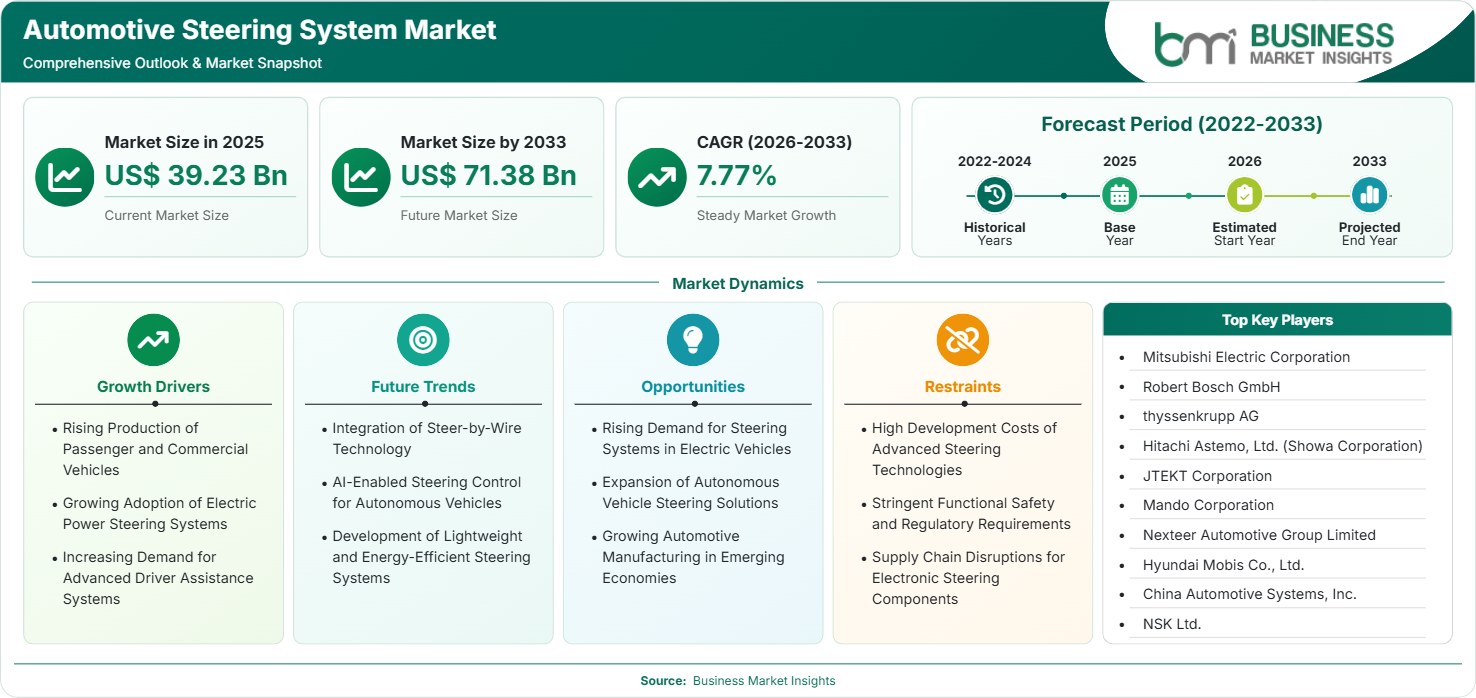
The Automotive Steering System Market size was valued at US$ 39.23 Billion in 2025 and is projected to reach US$ 71.38 Billion by 2033, growing at a CAGR of 7.77% during 2026–2033. Increasing vehicle production, rising adoption of electric power steering systems, growing vehicle electrification, and advancements in autonomous driving technologies continue creating significant opportunities across the global automotive industry.

Report Coverage
  • Type: Electric Power Steering, Hydraulic Power Steering, Manual, ElectroHydraulic Power Steering
  • Vehicle Type: Passenger Cars, Light Commercial Vehicles, Heavy Commercial Vehicles
US$ 39.23 Bn Market size in 2025
US$ 71.38 Bn Market Size by 2033
7.77% CAGR, 2026 - 2033
2026-2033 Forecast Period

AI Overview

Automotive Steering System Market Summary

  • North America Region: North America holds 26%–29% automotive steering system market share in 2025 and is projected to grow at a CAGR of 7.2%–7.6% during 2026–2033. Strong vehicle production, rising ADAS adoption, and increasing electric vehicle manufacturing continue supporting demand. The U.S. dominates regional revenue through advanced automotive manufacturing, strong OEM investments, and expanding electric vehicle production, registering a CAGR of 7.3%–7.7% during the forecast period.
  • Fastest Growing Region: Asia Pacific accounts for 44%–47% market share in 2025 and is expected to expand at a CAGR of 8.3%–8.7%. Expanding automotive production, growing EV adoption, and increasing investments in intelligent mobility continue accelerating market growth.
  • Leading Segment: Electric Power Steering (EPS) accounts for 56%–59% market share in 2025 while growing at a CAGR of 8.1%–8.5%. Improved fuel efficiency, lower maintenance requirements, and compatibility with ADAS support widespread adoption.
  • High Growth Segment: Passenger Cars represent 67%–70% market share in 2025 and are projected to register a CAGR of 8.0%–8.4% due to increasing global passenger vehicle production and rising consumer demand for advanced steering technologies.
  • Key Market Opportunity: Expanding deployment of steer-by-wire technology, autonomous vehicles, and software-defined vehicle platforms is creating long-term growth opportunities for advanced steering system manufacturers.
  • Major Market Players: Mitsubishi Electric Corporation, Robert Bosch GmbH, thyssenkrupp AG, Showa Corporation, JTEKT Corporation, Mando Corporation, Nexteer Automotive Group Limited, Hyundai Mobis Co., Ltd., China Automotive Systems, Inc., and NSK Ltd.
Strategic Insights

Automotive Steering System Market: Strategic Insights

Automotive Steering System Market Strategic Framework
FREE PDF
Request your free sample
Request free sample
Stakeholder View

Key Takeaways

  • The automotive steering system market value chain is increasingly integrating electronics suppliers, software developers, steering component manufacturers, semiconductor companies, and global automotive OEMs to accelerate the development of intelligent, connected, and software-enabled steering solutions that meet evolving mobility requirements.
  • The electric power steering (EPS) system offers the best prospect for growth in the coming years, given its energy efficiency, maintenance ease, fewer emissions, and excellent adaptability to electric and hybrid cars.
  • There is rapid evolution towards steer-by-wire, the use of ECUs (electronic control units) and AI-steering systems, sensors integration that results in better precision, safer drive and autonomy.
  • The Asia Pacific region offers the best chances for investment because of the growing number of automobile plants, electric car production, government policies, and investments in advanced automobile technology production.
  • Collaborations between steering manufacturers, electric vehicle producers, technology companies and semiconductors firms facilitate the design, tests, and launch of the new generation of steering systems used in connected and autonomous cars.
  • Greater integration of software makes the steering system not only mechanical but intelligent one capable of providing predictive diagnostics, over-the-air updates, ADAS (advanced driver assistance systems), data processing, and future autonomous mobility features.
Geographic Outlook

Automotive Steering System Market Regional Highlights

North America Automotive Steering System Market

North America accounts for 35%–38% Automotive Steering System Market share in 2025 and is projected to grow at a CAGR of 7.2%–7.9% through 2033. The region benefits from advanced automotive manufacturing capabilities, high adoption of driver assistance technologies, increasing electric vehicle sales, and strong regulatory emphasis on vehicle safety. Growing investments in intelligent mobility and autonomous driving technologies continue supporting regional market leadership.

  • Automotive manufacturers are increasingly integrating electric power steering systems to improve vehicle efficiency and support advanced safety functions.
  • Growing adoption of ADAS technologies such as lane-keeping assistance, automated parking, and collision avoidance systems continues driving demand for advanced steering solutions.
  • Electric vehicle manufacturers are increasingly utilizing electronically controlled steering systems to optimize performance and energy efficiency.
  • Investments in autonomous vehicle research and connected mobility platforms continue supporting innovation across steering technologies.
  • Consumers are increasingly favoring vehicles equipped with enhanced safety and driver convenience features.
  • Strong supplier networks and technology development capabilities continue supporting market expansion.

US Automotive Steering System Market

The United States contributes approximately 87%–91% of North American revenue and is expected to register a CAGR of 7.4%–8.1% through 2033. The country remains the largest market due to significant vehicle production volumes, advanced automotive engineering capabilities, and growing investment in autonomous and electric vehicle technologies.

  • Vehicle manufacturers continue implementing advanced steering technologies to improve safety, efficiency, and vehicle dynamics.
  • Electric vehicle growth remains a major driver for EPS adoption across the automotive sector.
  • Automotive software innovation is improving steering system responsiveness and integration capabilities.
  • Ongoing development of automated driving platforms is creating demand for next-generation steer-by-wire technologies.
  • Technology-focused mobility investments continue strengthening market prospects.

Europe Automotive Steering System Market

Europe represents 23%–26% of global revenue in 2025 and is anticipated to expand at a CAGR of 7.6%–8.3% through 2033. Strong automotive manufacturing expertise, increasing electrification strategies, and stringent emissions regulations continue supporting regional growth. Germany remains the leading market while Poland demonstrates stronger growth momentum.

  • Germany continues leading regional demand through strong OEM presence, advanced engineering capabilities, and vehicle technology innovation.
  • Poland is among the fastest-growing markets and is estimated to register a CAGR of 8.5%–9.2% during the forecast period, supported by automotive manufacturing expansion and supplier investments.
  • Vehicle electrification initiatives continue accelerating the transition toward electric steering architectures.
  • Automotive suppliers are investing heavily in next-generation steering technologies and control systems.
  • Demand for advanced safety and automation features continues supporting market growth.
  • Autonomous mobility development programs are generating new opportunities across the value chain.

Asia Pacific Automotive Steering System Market

Asia Pacific accounts for 30%–33% of global revenue in 2025 and is expected to achieve the fastest CAGR of 8.2%–8.9% through 2033. Rapid vehicle production growth, increasing automotive technology adoption, expanding EV manufacturing, and rising consumer demand for advanced mobility solutions continue supporting strong regional growth.

  • China remains the largest regional market due to extensive automotive production and aggressive vehicle electrification initiatives.
  • India is projected to achieve approximately 9.1%–9.8% CAGR, supported by increasing passenger vehicle sales, infrastructure development, and automotive manufacturing investments.
  • Vehicle manufacturers are increasingly integrating advanced steering systems across mass-market and premium vehicle segments.
  • Government incentives supporting electric mobility are strengthening demand for electric power steering technologies.
  • Growing adoption of connected vehicle technologies continues supporting market expansion.
  • Rising investments in automotive component manufacturing are creating substantial opportunities for steering system suppliers.

Rest of World Automotive Steering System Market

Rest of World accounts for 8%–11% of global revenue in 2025 and is projected to expand at a CAGR of 6.8%–7.5% through 2033. Increasing automotive production, growing adoption of vehicle safety technologies, and rising investment in transportation modernization are supporting market growth across Latin America, the Middle East, and Africa.

  • Brazil continues generating demand through expanding vehicle manufacturing activities and increasing consumer vehicle ownership.
  • The UAE is witnessing rising adoption of premium and technology-enabled vehicles equipped with advanced steering systems.
  • Saudi Arabia is expected to achieve approximately 7.7%–8.4% CAGR through 2033, supported by transportation development initiatives and growing automotive investments.
  • Vehicle safety awareness continues encouraging adoption of advanced steering technologies.
  • Automotive modernization efforts are supporting broader deployment of electronically controlled systems.
  • Investments in mobility innovation continue creating growth opportunities across emerging markets.
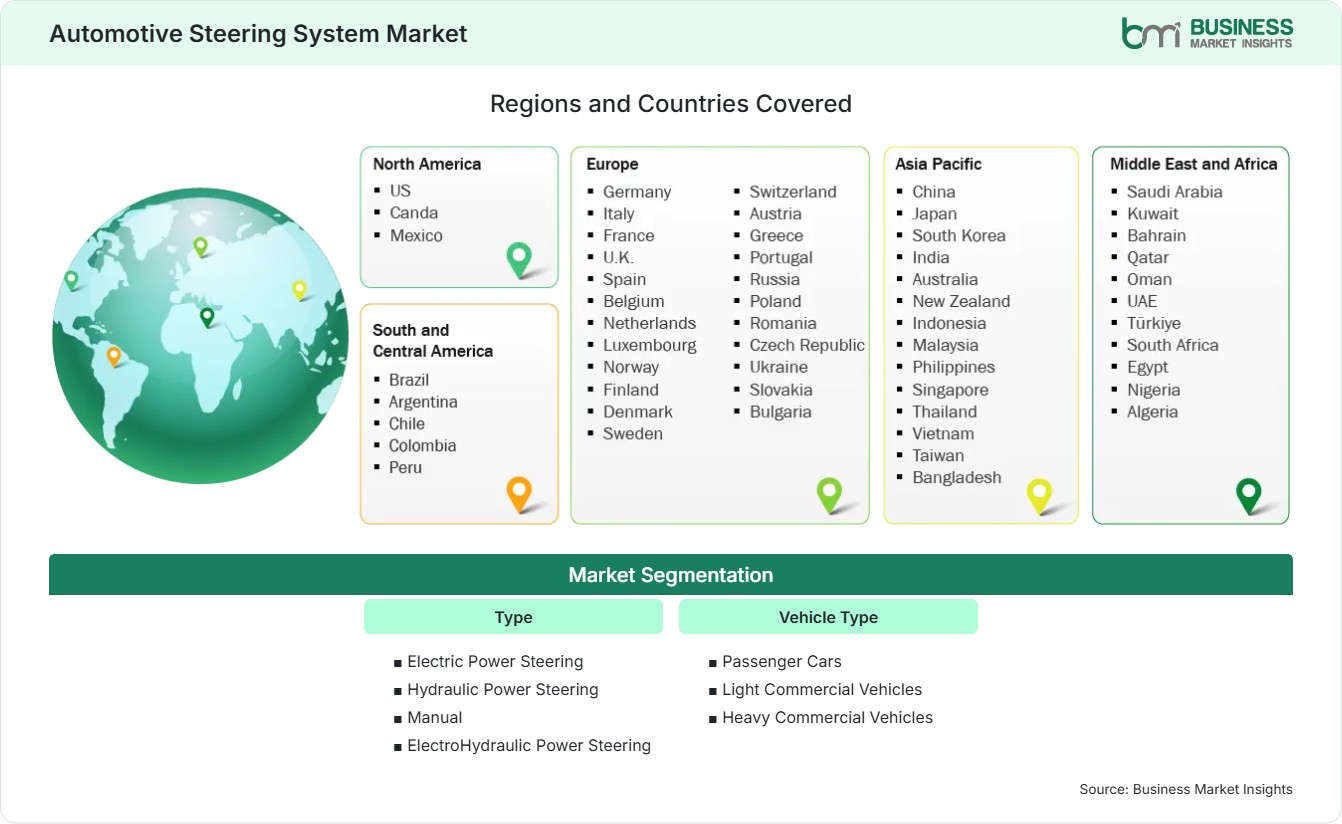
Global Market Geography
FREE PDF
Request your free sample
Request free sample
Segment Analysis

Automotive Steering System Market Segmentation

Type

The Type segment accounted for approximately 56%–59% of the market in 2025 and is projected to expand at a CAGR of 8.1%–8.5% during 2026–2033. Continuous advancements in vehicle electrification, fuel efficiency standards, and intelligent steering technologies are accelerating the transition toward electronically controlled steering systems. The Automotive Steering System Market scope continues expanding as manufacturers integrate advanced steering solutions into next-generation vehicles.

  • Electric Power Steering (EPS): Electric power steering dominates the market owing to improved fuel efficiency, lightweight construction, lower maintenance requirements, and seamless integration with advanced driver assistance systems and electric vehicles.
  • Hydraulic Power Steering (HPS): Hydraulic power steering remains widely used in commercial vehicles and legacy passenger vehicles requiring higher steering assistance under demanding operating conditions.
  • Manual: Manual steering systems continue serving entry-level vehicles, utility applications, and cost-sensitive markets where simplicity, durability, and lower manufacturing costs remain priorities.
  • Electro-Hydraulic Power Steering (EHPS): Electro-hydraulic steering combines hydraulic steering performance with electronically controlled assistance, offering improved efficiency and better compatibility with modern vehicle electronics.

Vehicle Type

Vehicle production volumes and increasing demand for enhanced driving comfort continue supporting steering system adoption across all vehicle categories. This segment represented approximately 67%–70% of market revenue in 2025 and is projected to register a CAGR of 8.0%–8.4% during the forecast period. The Automotive Steering System Market trends indicate increasing penetration of electronically assisted steering across passenger and commercial vehicles.

  • Passenger Cars: Passenger cars account for the largest demand owing to high production volumes, increasing consumer preference for driving comfort, and widespread adoption of electric power steering technologies.
  • Light Commercial Vehicles: Light commercial vehicles increasingly incorporate advanced steering systems to improve maneuverability, fuel efficiency, and operational reliability across logistics and urban transportation applications.
  • Heavy Commercial Vehicles: Heavy commercial vehicles require robust steering technologies capable of supporting high payload capacities, long-distance transportation, and enhanced driver safety under demanding operating conditions.
Market Forces

Automotive Steering System Market Dynamics

Key Market Drivers

Rising Production of Passenger and Commercial Vehicles

The global automotive industry is continuing its growth trend as automotive companies invest more in their manufacturing capacity to fulfill the growing transport needs in developed and developing nations. Passenger vehicles, commercial vehicles, fleet vehicles, and even electric vehicles need efficient steering systems, which provide enhanced safety, handling, reliability, and efficiency. The Automotive Steering System Market growth drivers include increased investments in automotive manufacturing plants, network expansions, and replacement and upgradation of vehicles. Growing income levels, rapid urbanization, development in the infrastructure, and connectivity have resulted in an increase in vehicle ownerships, especially in developing countries.

Growing Adoption of Electric Power Steering Systems

Electric power steering (EPS) systems are rapidly replacing conventional hydraulic steering technologies due to their superior energy efficiency, reduced maintenance requirements, lower emissions, and compatibility with modern vehicle architectures. The automotive steering system market is witnessing increased adoption of EPS technology as automakers focus on improving vehicle efficiency, electrification, and advanced mobility solutions. Unlike hydraulic systems that continuously consume engine power, EPS operates using electrical assistance only when steering support is required, improving overall vehicle efficiency and fuel economy. The technology is becoming increasingly important in electric and hybrid vehicles, where energy optimization directly impacts driving range and performance. EPS systems also provide a foundation for advanced features such as lane-keeping assistance, automated parking, adaptive steering control, and autonomous driving functions.

Increasing Demand for Advanced Driver Assistance Systems

Rapidly emerging advanced driver assistance systems (ADAS) technologies have increased the need for steering systems that can support automated vehicles. Features like lane centering, collision avoidance, adaptive cruise control, traffic jam assistance, and automated parking are some of the modern features that need fast and responsive steering systems that use advanced technology sensors, cameras, and electronic controllers. Car manufacturers have become increasingly keen on adopting intelligent steering systems in their vehicles, not only to ensure safety but also for convenience and to meet safety standards set globally. In addition, advances in artificial intelligence, connectivity, and vehicle data analytics have made steering systems a critical component of self-driving platforms. This shift is expected to create significant growth opportunities for the automotive steering system market.

Key Market Opportunities

Rising Demand for Steering Systems in Electric Vehicles

The rapid growth of electric vehicle (EV) production is creating significant opportunities for advanced steering system manufacturers as automakers transition toward electrified mobility solutions. Electric vehicles increasingly rely on electric power steering (EPS) systems due to their ability to improve energy efficiency, reduce mechanical complexity, and integrate seamlessly with electronic vehicle architectures. Unlike traditional hydraulic steering systems, EPS technology supports the energy optimization requirements of battery-powered vehicles by minimizing power consumption and improving overall vehicle performance. The Automotive Steering System Market Forecasts remain positive as governments worldwide introduce EV incentives, stricter emission regulations, and investments in charging infrastructure to accelerate electrification.

Expansion of Autonomous Vehicle Steering Solutions

The rise in autonomous driving technologies is resulting in the evolution of highly advanced steering systems that can accurately control vehicles with minimal or no need for driver input. Autonomous vehicles will need highly advanced steering systems that will process information from various sensors, cameras, radar systems, and artificial intelligence systems to make sure of safe and accurate maneuvers. The steer-by-wire technology will gain prominence as it does away with the need for mechanical connections and allows for flexibility in vehicle designs as well as faster response. Car manufacturers, technology firms, and mobility services are heavily investing in autonomous vehicles, and hence present immense potential for growth in steering systems. The use of redundant electronics, highly advanced control algorithms, and functional safety technologies will be vital to meeting the stringent requirements of such systems.

Growing Automotive Manufacturing in Emerging Economies

Emerging economies are becoming key automotive manufacturing hubs due to lower production costs, expanding consumer demand, skilled labor availability, and supportive government initiatives. Countries across Asia, Latin America, and Eastern Europe are attracting investments from global automotive manufacturers seeking to establish localized production facilities and strengthen regional supply chains. Rising vehicle ownership, infrastructure development, and increasing demand for passenger vehicles, commercial fleets, and electric vehicles are contributing to automotive steering system market expansion in these regions. Steering system manufacturers are increasingly focusing on localized manufacturing, strategic supplier partnerships, and regional engineering capabilities to improve cost efficiency and enhance market competitiveness. Additionally, the growth of electric vehicle production in emerging markets is creating new opportunities for suppliers offering advanced electric steering technologies. As automotive ecosystems continue developing in these economies, investments in component manufacturing, research and development, and technology partnerships are expected to support sustained growth in the global steering system market.

Market Restraints and Challenges

High Development Costs of Advanced Steering Technologies

Factor: There is heavy investment in electronic hardware, software design, sensors, functional safety testing, cyber security measures, and vehicle integration engineering that is needed for developing advanced intelligent steering systems. The adoption of steer-by-wire, autonomous steering assistance, and AI-driven steering systems is making additional investments necessary for research and development.

Impact: The cost of research and development is creating financial strain on steering systems producers and delaying their development cycles and entry into the market. Small producers might find it difficult to compete with already existing global companies that have more engineering expertise and financial strength. To solve this problem, manufacturers have started to use strategic partnerships and standard solutions.

Stringent Functional Safety and Regulatory Requirements

Factor: State-of-the-art steering systems are supposed to be in line with stringent safety norms of the automotive industry, cyber security laws, and functional safety specifications because of their significance in terms of control of the automobile as well as self-driving systems.

Impact: The need to adhere to compliance rules, certification policies, and safety validation tests results in higher cost of manufacturing and increased complexities in product development and release to market. Steering system manufacturers have to invest constantly in the areas of quality assurance, cyber security, software testing, and compliance management in order to stay competitive.

Company Analysis

Competitive Landscape

Automotive steering system market analysis is characterized by intense competition among global steering system manufacturers focusing on electric power steering, steer-by-wire technologies, lightweight components, and software-integrated vehicle control systems. Companies are continuously investing in electrification, autonomous driving technologies, strategic collaborations, and manufacturing expansion to strengthen their global market positions. The competitive landscape is influenced by advancements in intelligent steering solutions, increasing integration of electronics, and growing demand for connected vehicle technologies.

Company Name

Overview

Products and Services Relevant to this Market

Mitsubishi Electric Corporation

Mitsubishi Electric develops advanced automotive electronics and vehicle control technologies supporting electrification, intelligent mobility, and next-generation steering solutions.

Electric power steering components, automotive electronics, motor control systems, inverters, vehicle control units, and mobility technologies.

Robert Bosch GmbH

Bosch is a leading global automotive technology supplier offering advanced steering systems, electronic controls, and integrated vehicle safety solutions.

Electric power steering systems, steering control units, automotive sensors, ADAS technologies, vehicle electronics, and mobility solutions.

thyssenkrupp AG

thyssenkrupp supplies innovative steering technologies and automotive components for passenger vehicles and commercial transportation worldwide.

Electric steering systems, steering columns, steering gears, chassis components, and integrated steering technologies.

Showa Corporation

Showa Corporation specializes in automotive steering, suspension, and chassis technologies that improve vehicle handling, comfort, and driving performance.

Electric power steering systems, steering columns, suspension systems, shock absorbers, and automotive chassis components.

JTEKT Corporation

JTEKT is a global manufacturer of steering systems, bearings, and drivetrain technologies serving leading automotive manufacturers worldwide.

Electric power steering systems, hydraulic steering systems, steering gears, driveline components, and automotive bearings.

Mando Corporation

Mando develops advanced automotive systems supporting vehicle safety, electrification, and autonomous driving applications.

Electric steering systems, braking systems, suspension technologies, electronic chassis systems, and autonomous driving components.

Nexteer Automotive Group Limited

Nexteer Automotive is a leading supplier of motion control technologies focused on intelligent steering and vehicle control solutions.

Electric power steering, steer-by-wire systems, steering columns, driveline systems, and advanced steering software solutions.

Hyundai Mobis Co., Ltd.

Hyundai Mobis develops advanced automotive modules and electronic systems supporting connected, autonomous, and electric vehicles.

Electric steering systems, chassis modules, ADAS components, vehicle electronics, integrated mobility systems, and automotive modules.

China Automotive Systems, Inc.

China Automotive Systems manufactures steering technologies for passenger cars and commercial vehicles across domestic and international automotive markets.

Power steering systems, steering gears, steering pumps, electronic steering technologies, and commercial vehicle steering solutions.

NSK Ltd.

NSK develops precision steering systems and automotive components that enhance vehicle performance, safety, and driving efficiency.

Electric power steering systems, steering columns, bearings, precision automotive components, and motion control technologies.

Trust & Transparency

Research Methodology

The market analysis combines proprietary research with secondary data from government agencies, company disclosures, regulatory filings, industry databases and expert interviews. Market estimates are validated through data triangulation, cross-market benchmarking and analyst review.

View Full Research Methodology

Questions Answered

Frequently Asked Questions

What does an Automotive Steering System Market Report include?

The market report provides comprehensive insights into market size, segmentation, regional trends, competitive landscape, technological developments, growth opportunities, regulatory environment, and future industry forecasts.

Which region is expected to witness the fastest market growth?

Asia Pacific is projected to record the fastest growth because of expanding automotive manufacturing, increasing electric vehicle production, rising consumer demand, and significant investments in intelligent mobility technologies.

Why is electric power steering replacing hydraulic systems?

EPS improves fuel efficiency, reduces energy consumption, lowers maintenance costs, eliminates hydraulic fluids, and integrates seamlessly with autonomous driving features and advanced electronic vehicle control systems.

Which steering technology dominates the market?

Electric Power Steering (EPS) holds the largest market share due to its superior energy efficiency, lower maintenance requirements, lightweight design, and compatibility with electric vehicles and ADAS technologies.

What is an automotive steering system?

An automotive steering system enables drivers to control vehicle direction while improving handling, stability, and safety. Modern systems increasingly utilize electronic assistance to enhance driving comfort and support advanced driver assistance functions.

Access the Full Automotive Steering System Market Report

Get segment-level forecasts, regional estimates, competitive benchmarking, company profiles and downloadable Excel datasets.

Access the full Automotive Steering System Market Report
350 pages PDF & Excel | 2026-08-07
Similar Research

Related Market Reports