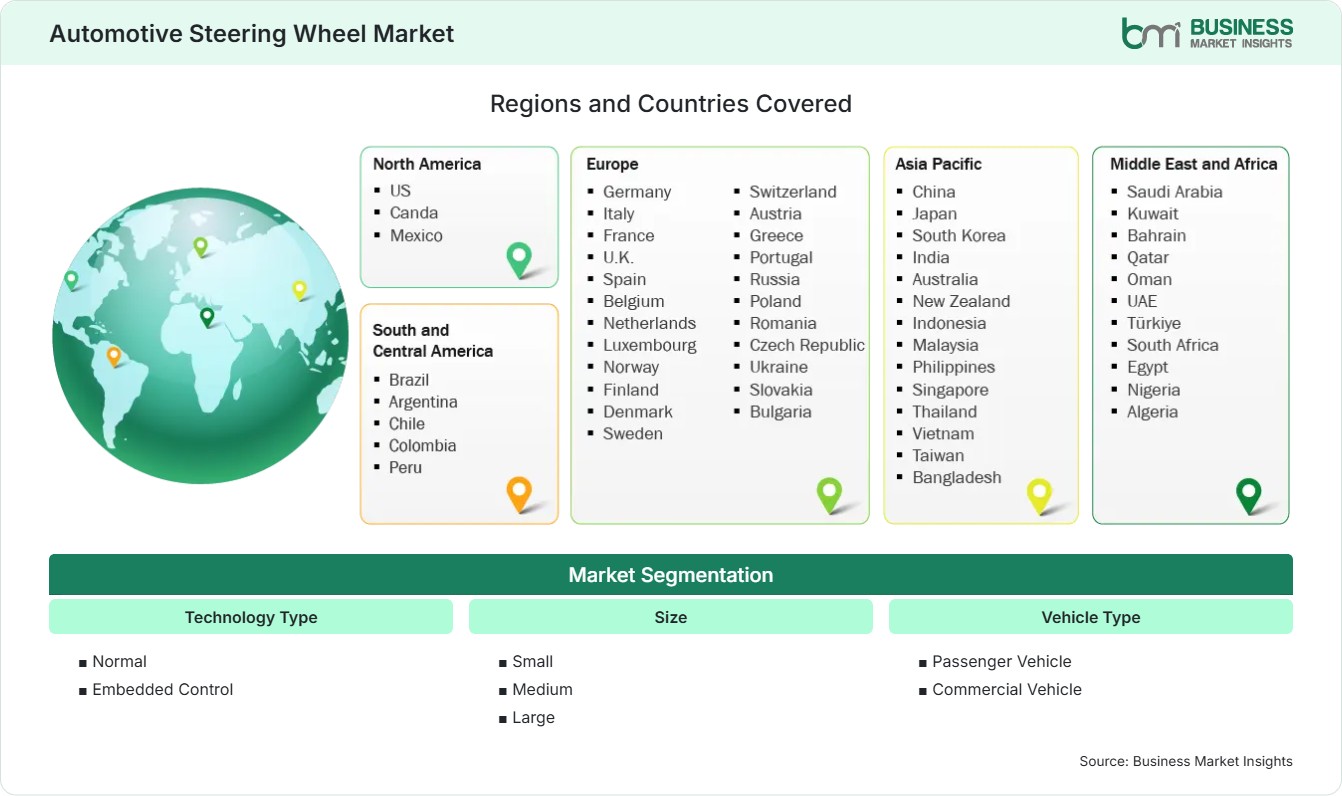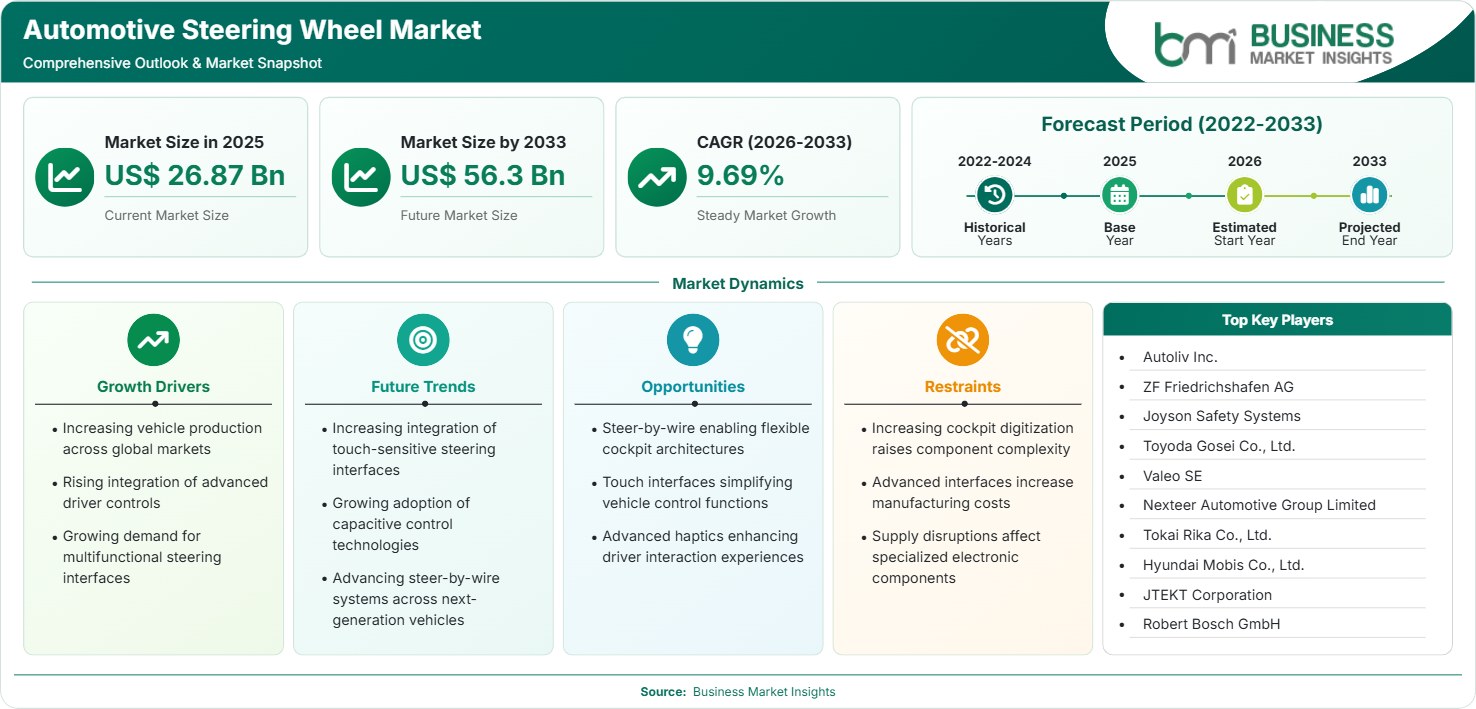
Automotive Steering Wheel Market Regional Highlights
North America Automotive Steering Wheel Market
North America accounts for 28%–31% of global demand in 2025 and is projected to grow at a CAGR of 8.6%–9.1% through 2033. The Automotive Steering Wheel Market share in the region is supported by high penetration of advanced driver assistance technologies, robust pickup and SUV production, and growing electrification investments. OEMs emphasize premium steering interfaces incorporating safety controls, connectivity functions, and heated features. The United States represents the dominant country market, while Mexico benefits from expanding automotive manufacturing investments and supplier localization strategies.
- Premium vehicle manufacturers increasingly integrate multifunction steering systems featuring capacitive controls, customizable displays, and enhanced ergonomics to differentiate cabin experiences.
- EV platform expansion encourages adoption of lightweight steering components and software-connected control interfaces aligned with advanced vehicle architectures.
- Regulatory focus on vehicle safety promotes continued incorporation of integrated airbag systems, driver monitoring capabilities, and advanced steering-related technologies.
- Regional suppliers benefit from proximity to OEM assembly operations, reducing logistics complexity while supporting customized product development initiatives.
US Automotive Steering Wheel Market
The United States accounts for 74%–78% of North American demand and is expanding at a CAGR of 8.8%–9.3% through 2033. Strong consumer demand for technologically advanced vehicles supports adoption of premium steering solutions. Automotive Steering Wheel Market growth is reinforced by EV production programs, autonomous driving research, and rising integration of digital cockpit technologies. Domestic and international automakers continue investing in intelligent interfaces that enhance safety, connectivity, and driver convenience while supporting evolving mobility expectations.
- Luxury and electric vehicle segments demonstrate strong adoption of embedded controls, heated designs, and haptic feedback technologies.
- Technology-focused OEM programs create opportunities for software-enabled steering architectures supporting future autonomous features.
- Vehicle personalization trends encourage manufacturers to offer customizable steering configurations and premium materials.
- Advanced safety regulations continue supporting demand for high-performance occupant protection and integrated steering solutions.
Europe Automotive Steering Wheel Market
Europe commands a 24% to 27% market share in 2025 and is projected to grow at a CAGR of 8.9% to 9.5% through 2033. Excellent automotive engineering, luxury car manufacturing, and green practices drive demand for composites in Europe. Germany is the market leader, and central and eastern European industrial clusters provide additional manufacturing capacity. The region concentrates on lightweighting solutions, electrification, and advanced human-machine interfaces. Up-and-coming markets like Poland and Hungary are capitalizing on investments in electric vehicles and localization efforts.
- European automakers prioritize premium cabin experiences, driving demand for multifunction steering platforms integrated with connected vehicle ecosystems.
- Carbon reduction goals encourage sustainable materials and manufacturing methods across automotive interior components.
- Luxury vehicle manufacturers support innovation in touch-sensitive controls and next-generation ergonomic steering architectures.
- Electrification investments across Germany, France, and Nordic countries stimulate advanced component requirements.
- Poland and Hungary show faster expansion due to manufacturing investments linked to EV and battery ecosystem development.
Asia Pacific Automotive Steering Wheel Market
Asia Pacific captures 39%–42% of global revenue in 2025 and achieves a CAGR of 10.6%–11.2% through 2033, making it the fastest-growing region. China leads regional demand through extensive vehicle production and EV adoption, while India represents a high-growth market supported by rising passenger vehicle ownership. Strong manufacturing ecosystems, local supplier capabilities, and expanding exports support Automotive Steering Wheel Market expansion. Automakers increasingly incorporate advanced cockpit technologies, creating demand for embedded controls and intelligent steering interfaces.
- China remains the largest contributor owing to large-scale automotive manufacturing and growing software-defined vehicle deployment.
- India experiences rapid adoption of feature-rich vehicles, supporting increased integration of multifunction steering systems.
- Japanese and South Korean manufacturers continue advancing premium steering technologies linked to safety and connectivity.
- Regional localization initiatives reduce production costs and strengthen supply-chain resilience.
- Accelerating EV penetration creates substantial demand for steer-by-wire compatible steering wheel platforms.
Rest of World Automotive Steering Wheel Market
Rest of World represents 8%–10% market share in 2025 and records a CAGR of 8.2%–8.8% through 2033. South and Central America benefit from automotive manufacturing activity in Brazil and Mexico-linked regional supply networks.
Middle East and Africa demand is supported by fleet replacement cycles, infrastructure development, and increasing vehicle imports. Brazil serves as the leading market, while the United Arab Emirates demonstrates notable growth due to premium vehicle demand and mobility modernization investments.
- Brazil continues strengthening regional vehicle manufacturing capabilities and supplier development programs.
- Growing urbanization encourages demand for feature-enhanced passenger vehicles incorporating advanced steering technologies.
- Gulf countries support premium and luxury vehicle segments requiring sophisticated steering systems.
- Infrastructure and mobility investments improve long-term automotive demand prospects across several African markets.
- Local assembly initiatives gradually create opportunities for component localization and supplier partnerships.