
Automotive Actuators Market Outlook: Size, Share, Trends, Growth Analysis, Competitive Landscape & Forecast, 2026-2033

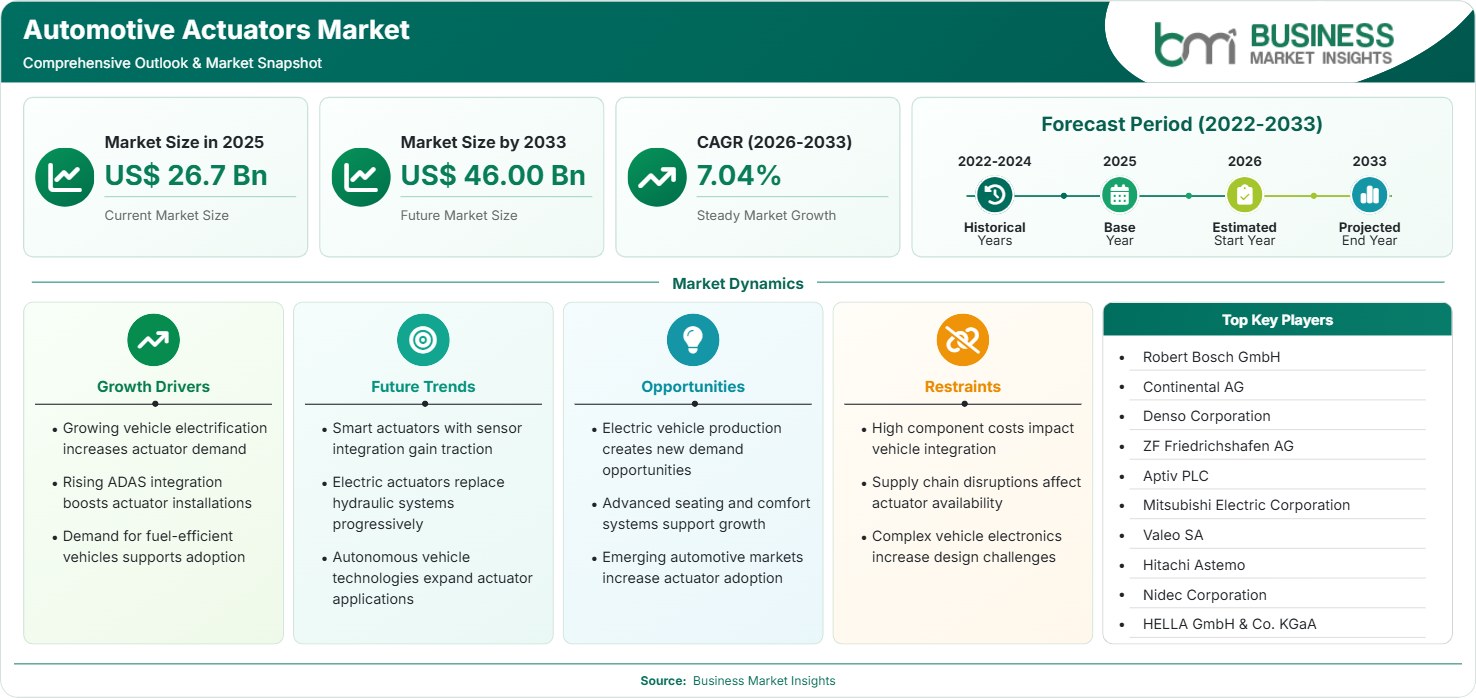
The Automotive Actuators Market size was valued at US$ 26.70 Billion in 2025 and is projected to reach US$ 46.00 Billion by 2033, growing at a CAGR of 7.04% during 2026–2033. Rising vehicle electrification, increasing adoption of advanced driver assistance systems, growing demand for vehicle automation, expansion of electric vehicle production, and continuous integration of comfort and safety features are driving market growth globally.

Report Coverage
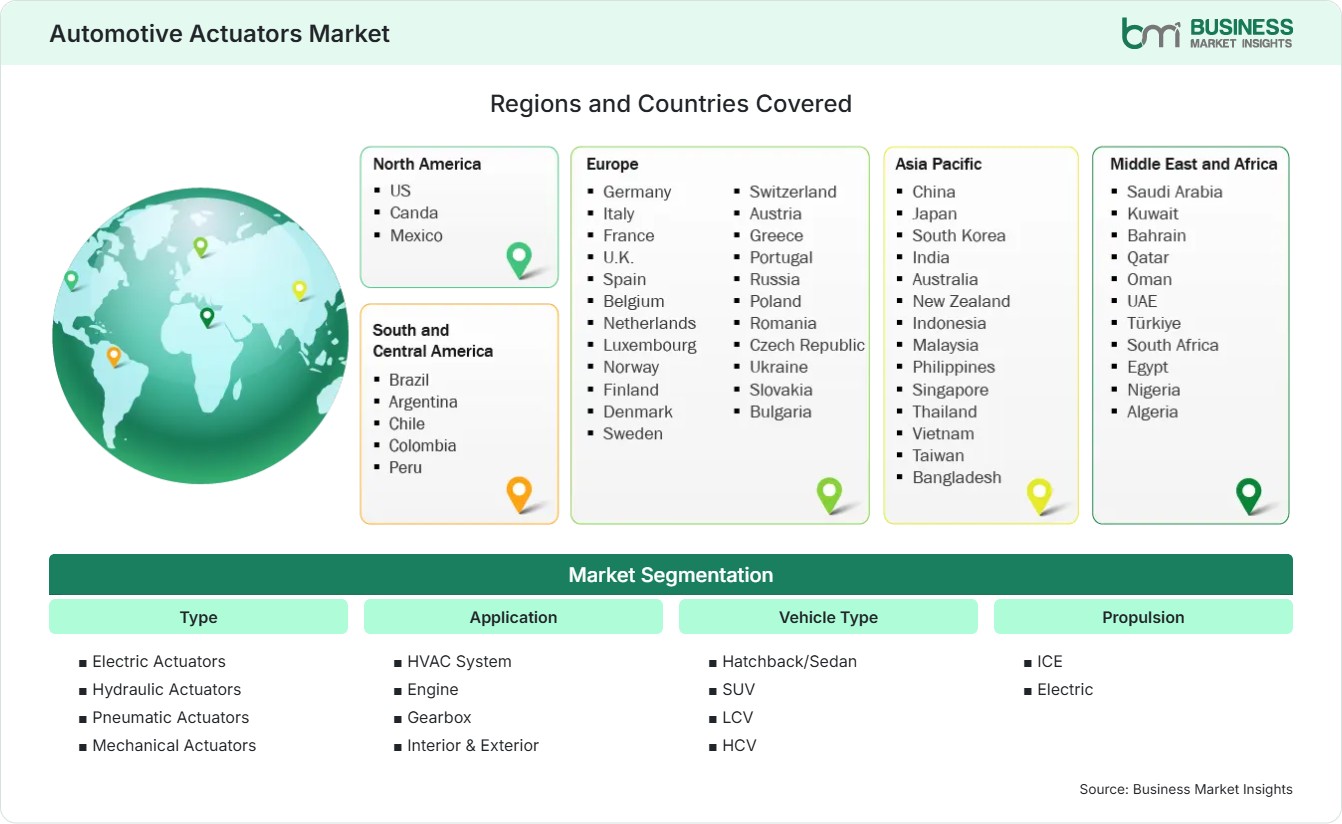
  • Type: Electric Actuators, Hydraulic Actuators, Pneumatic Actuators, Mechanical Actuators
  • Application: HVAC System, Engine, Gearbox, Interior & Exterior
  • Vehicle Type: Hatchback/Sedan, SUV, LCV, HCV
  • Propulsion: ICE, Electric
US$ 26.7 Bn Market size in 2025
US$ 46.00 Bn Market Size by 2033
7.04% CAGR, 2026 - 2033
2026-2033 Forecast Period

AI Overview

Automotive Actuators Market Summary

  • North America Region: North America holds a automotive actuators market share of 24%–28% in 2025 and is projected to grow at a CAGR of 6.5%–7.1% during 2026–2033. Growth is supported by increasing vehicle electrification, strong automotive technology adoption, advanced manufacturing capabilities, growing demand for premium vehicles, and rising integration of electronic vehicle systems. The U.S. remains the dominant market, advancing at a CAGR of 6.6%–7.2%.
  • Fastest Growing Region: Asia Pacific accounts for 39%–43% share in 2025 and is expected to register a CAGR of 7.8%–8.5% through 2033. Growth is fueled by expanding vehicle production, increasing electric vehicle adoption, rising disposable incomes, growing automotive manufacturing investments, and strengthening automotive supply chains.
  • Leading Segment: Electric Actuators represent 42%–46% share in 2025 and are anticipated to grow at a CAGR of 7.6%–8.2% through 2033. Demand is supported by rising vehicle electrification, growing implementation of electronic control systems, enhanced energy efficiency, and increasing adoption across safety and comfort applications.
  • High Growth Segment: Electric Vehicle Propulsion captures 22%–26% share in 2025 and is forecast to expand at a CAGR of 9.2%–10.0% during 2026–2033. Expansion is driven by growing EV production, increasing government incentives, expanding charging infrastructure, and rising demand for advanced vehicle electronics.
  • Key Market Opportunity: Increasing deployment of intelligent vehicle systems, autonomous driving technologies, and software-controlled vehicle architectures is creating significant opportunities for actuator manufacturers.
  • Major Market Players: Robert Bosch GmbH, Continental AG, Denso Corporation, ZF Friedrichshafen AG, Aptiv PLC, Mitsubishi Electric Corporation, Valeo SA, Hitachi Astemo, Nidec Corporation, and HELLA GmbH & Co. KGaA.
Strategic Insights

Automotive Actuators Market: Strategic Insights

Automotive Actuators Market Strategic Framework
FREE PDF
Request your free sample
Request free sample
Stakeholder View

Key Takeaways

  • The automotive actuators market is benefiting from increasing vehicle electrification, expansion of advanced electronic systems, and rising demand for intelligent vehicle functionalities.
  • Electric actuators are rapidly replacing conventional hydraulic and pneumatic systems due to improved efficiency, reduced weight, lower maintenance requirements, and better electronic integration capabilities.
  • Electric vehicles represent the fastest-growing propulsion segment as OEMs increasingly deploy electronically controlled systems for powertrain, thermal management, and safety applications.
  • Asia Pacific remains the largest and fastest-growing market due to strong automotive manufacturing activity, rising vehicle production, and increasing EV adoption.
  • The growing implementation of ADAS, autonomous driving technologies, and connected vehicle architectures is creating significant opportunities for advanced actuator systems.
  • Automotive manufacturers continue investing in lightweight, compact, and energy-efficient actuators to improve performance, safety, comfort, and vehicle sustainability.
Geographic Outlook

Automotive Actuators Market Regional Highlights

North America Automotive Actuators Market

North America accounted for 24%–28% of global revenue in 2025 and is projected to grow at a CAGR of 6.5%–7.1% through 2033. The region benefits from strong adoption of advanced vehicle technologies, increasing EV production, and growing integration of electronically controlled vehicle systems. The Automotive Actuators Market share remains significant due to strong demand for premium vehicles and technologically advanced automotive platforms.

  • Vehicle manufacturers continue integrating sophisticated actuator technologies across powertrain, safety, HVAC, and comfort systems to improve vehicle performance and regulatory compliance.
  • The growing adoption of electric vehicles is increasing demand for electric actuators used in battery management systems, thermal control systems, and advanced vehicle electronics.
  • Consumers increasingly prefer vehicles equipped with advanced convenience and safety features, driving demand for additional actuator deployment throughout vehicle architectures.
  • Automotive OEMs continue investing in smart mobility technologies and connected vehicle platforms requiring highly responsive and energy-efficient actuator systems.
  • Strong research and development activities support innovation in lightweight and compact actuator technologies.

US Automotive Actuators Market

The United States represents 82%–86% of North American demand and is expected to grow at a CAGR of 6.6%–7.2% through 2033. Growth is supported by increasing EV manufacturing, advanced automotive technology adoption, and strong consumer demand for feature-rich vehicles.

  • Automotive manufacturers continue enhancing vehicle automation and digitalization capabilities, creating greater demand for electronically controlled actuators.
  • EV production expansion is driving significant opportunities for actuator suppliers focused on thermal management and battery system applications.
  • Demand for luxury and premium vehicles continues encouraging adoption of advanced comfort and safety systems utilizing multiple actuator technologies.
  • Ongoing investments in automotive innovation support long-term market development and product advancement.

Europe Automotive Actuators Market

Europe held 25%–29% of global revenue in 2025 and is expected to register a CAGR of 6.8%–7.5% through 2033. The region benefits from strict vehicle emission regulations, strong EV adoption, and advanced automotive manufacturing capabilities. Germany remains the leading market, while France represents a strong growth market with a CAGR of 7.4%–8.0%.

  • Vehicle electrification initiatives are increasing demand for advanced electronic and electric actuator solutions across passenger and commercial vehicles.
  • Stringent emission standards encourage manufacturers to improve vehicle efficiency through lightweight and electronically controlled systems.
  • Premium automotive brands continue driving innovation in comfort, safety, and automated vehicle technologies.
  • Growing deployment of ADAS features is supporting demand for highly precise actuator systems.
  • Investments in next-generation mobility solutions continue strengthening industry growth prospects.

Asia Pacific Automotive Actuators Market

Asia Pacific accounted for 39%–43% of global revenue in 2025 and is expected to record the fastest CAGR of 7.8%–8.5% through 2033. Expanding vehicle production, increasing EV adoption, growing disposable incomes, and strong manufacturing ecosystems are driving regional growth. China, Japan, South Korea, and India remain the key markets.

  • Strong automotive production volumes continue generating substantial demand for actuator technologies across multiple vehicle categories.
  • Government incentives supporting electric mobility are accelerating adoption of advanced electronic vehicle systems.
  • Automotive suppliers are expanding manufacturing capacities to support regional vehicle production growth and export demand.
  • Rising consumer demand for advanced vehicle features is encouraging broader deployment of actuators in comfort and safety applications.
  • Increasing investments in autonomous and connected vehicle technologies continue supporting long-term market expansion.

Rest of World Automotive Actuators Market

Rest of World accounted for 6%–10% of global revenue in 2025 and is forecast to grow at a CAGR of 6.7%–7.4% through 2033. Market growth is supported by expanding automotive production capabilities, infrastructure development, and increasing adoption of modern vehicle technologies.

  • Growing vehicle ownership levels are supporting demand for advanced automotive systems and components.
  • Automotive manufacturers are increasingly introducing electronically controlled systems within mainstream vehicle models.
  • Fleet modernization initiatives are encouraging adoption of efficient vehicle technologies.
  • International manufacturers continue strengthening regional operations through investments and strategic partnerships.
  • Increased awareness regarding safety, efficiency, and vehicle performance supports broader actuator integration across vehicle platforms.
Global Market Geography
FREE PDF
Request your free sample
Request free sample
Segment Analysis

Automotive Actuators Market Segmentation

Type

Electric Actuators account for 42%–46% share in 2025 and are expected to grow at a CAGR of 7.6%–8.2% through 2033. The segment dominates due to increasing vehicle electrification, superior energy efficiency, compact design, improved reliability, and seamless integration with modern vehicle electronics. The Automotive Actuators Market scope continues to expand as automakers increasingly replace traditional actuation technologies with electronically controlled systems that enhance vehicle efficiency, comfort, and safety performance.

  • Electric Actuators: Widely adopted across powertrain, braking, seating, HVAC, and advanced driver assistance applications.
  • Hydraulic Actuators: Continue to be utilized in heavy-duty and high-force applications requiring substantial power output and durability.
  • Pneumatic Actuators: Maintain demand in specific automotive systems where lightweight operation and simplified control are required.
  • Mechanical Actuators: Remain relevant in cost-sensitive applications and conventional vehicle architectures.

Application

HVAC Systems account for 28%–32% share in 2025 and are projected to grow at a CAGR of 7.2%–7.9% through 2033. Strong demand is driven by increasing consumer expectations for cabin comfort, climate control automation, and energy-efficient thermal management systems.

  • HVAC System: Benefits from increasing deployment of automated climate control systems in passenger and commercial vehicles.
  • Engine: Supports fuel management, emissions control, and performance optimization functions.
  • Gearbox: Utilized in transmission control applications to improve shifting efficiency and vehicle performance.
  • Interior & Exterior: Includes seating adjustment systems, sunroofs, power windows, mirrors, lighting systems, and tailgate automation.

Vehicle Type

SUVs account for 34%–38% share in 2025 and are anticipated to grow at a CAGR of 7.5%–8.1% through 2033. Growth is supported by rising global SUV demand, increasing integration of comfort and safety technologies, and greater deployment of electronic vehicle systems.

  • Hatchback/Sedan: Continue generating substantial actuator demand due to high global production volumes.
  • SUV: Lead the market owing to strong consumer preference and increasing adoption of advanced technologies.
  • LCV: Utilize actuators across powertrain, braking, HVAC, and convenience applications.
  • HCV: Require robust actuation systems for heavy-duty performance and operational reliability.

Propulsion

ICE vehicles account for 74%–78% share in 2025, while Electric Vehicles represent the fastest-growing category with a CAGR of 9.2%–10.0% through 2033. Current Automotive Actuators Market trends indicate accelerating adoption of actuators in electric vehicles as manufacturers increase deployment of electronically controlled thermal management, battery cooling, regenerative braking, and intelligent vehicle control systems.

  • ICE: Continue dominating vehicle production volumes globally despite increasing electrification efforts.
  • Electric: Benefit from higher actuator intensity per vehicle and increasing investments in EV manufacturing worldwide.
Market Forces

Automotive Actuators Market Dynamics

Key Market Drivers

Rising Vehicle Electrification Across Global Automotive Markets

The rapid transition toward vehicle electrification is significantly increasing demand for advanced actuator technologies. Electric vehicles require numerous electronically controlled systems for battery thermal management, energy optimization, regenerative braking, and intelligent vehicle operation. In addition, hybrid vehicles and electrified powertrains depend heavily on actuators to enhance performance and operational efficiency. Automakers continue investing in electric mobility platforms to meet regulatory requirements and consumer demand for sustainable transportation solutions. As global EV production expands, actuator manufacturers are expected to benefit from increasing component content per vehicle and growing technological requirements.

Growing Integration of Advanced Driver Assistance Systems (ADAS)

Advanced driver assistance systems are becoming standard features in modern vehicles, driving demand for high-precision actuator technologies. Functions such as automated braking, adaptive cruise control, lane keeping assistance, and automated parking require reliable actuation mechanisms capable of responding quickly and accurately. Regulatory focus on vehicle safety and rising consumer expectations regarding driving convenience continue supporting broader ADAS adoption. Automotive OEMs are integrating increasingly sophisticated electronic systems throughout vehicle architectures, creating sustained demand for intelligent actuators capable of supporting advanced safety and semi-autonomous driving functions.

Increasing Consumer Demand for Comfort and Convenience Features

Consumers increasingly prefer vehicles equipped with premium comfort and convenience functions such as power seats, automated climate control, power tailgates, sunroofs, adjustable mirrors, and smart cabin technologies. These features rely extensively on actuator systems to provide smooth and efficient operation. Growing competition among automotive manufacturers is encouraging greater deployment of electronically controlled comfort features even within mid-range vehicle models. Rising disposable incomes, improving living standards, and increasing consumer expectations are supporting wider adoption of advanced vehicle functions that depend on reliable actuator technologies.

Key Market Opportunities

Expansion of Autonomous and Software-Defined Vehicles

The emergence of autonomous driving technologies and software-defined vehicle architectures is creating substantial opportunities for actuator manufacturers. Future vehicles will require advanced electromechanical systems capable of executing software-controlled actions with high levels of precision and reliability. Steering, braking, thermal management, seating, and safety functions are increasingly becoming electronically controlled. Manufacturers investing in intelligent actuator technologies compatible with autonomous mobility platforms are expected to benefit significantly as next-generation vehicle architectures continue evolving across passenger and commercial transportation sectors.

Growing Demand for Electric Vehicle Platforms

Electric vehicles incorporate a greater number of electronically controlled systems than many conventional vehicle platforms. This creates substantial opportunities for actuator suppliers developing energy-efficient, lightweight, and intelligent solutions. Automotive Actuators Market Forecast analysis indicates that expanding EV manufacturing capacity, increasing government incentives, and rising consumer adoption of electric mobility will generate strong long-term demand for advanced actuator technologies throughout the forecast period. Companies capable of supporting evolving EV requirements are positioned to capitalize on significant future market growth opportunities.

Increasing Adoption of Smart Vehicle Interior Technologies

Automotive manufacturers are increasingly focusing on smart interior experiences that improve comfort, personalization, and convenience. Advanced seating adjustments, automated ventilation systems, customizable cabin environments, and intelligent storage solutions all require sophisticated actuator technologies. Vehicle interiors are becoming important differentiators in both premium and mainstream segments. As connected mobility continues developing, actuators supporting intelligent interior systems are expected to experience growing demand and provide attractive growth opportunities for component manufacturers.

Market Restraints and Challenges

Volatility in Raw Material and Electronic Component Costs

Factor: Automotive actuators rely on various raw materials and electronic components including motors, semiconductor devices, sensors, magnets, and specialty metals. Price fluctuations and supply chain disruptions can affect production economics.

Impact: Rising input costs may increase manufacturing expenses, reduce profit margins, and create pricing pressures across the automotive supply chain. Manufacturers must carefully manage procurement strategies while ensuring consistent product quality and delivery performance. Ongoing volatility may affect investment decisions and operational planning throughout the industry.

Complexity of Vehicle Integration and Reliability Requirements

Factor: Modern actuators must function reliably under demanding automotive conditions involving vibration, temperature variations, moisture exposure, and extended operational lifecycles. Integration within increasingly complex vehicle architectures also presents engineering challenges.

Impact: Manufacturers must invest substantially in testing, validation, quality assurance, and compliance processes to meet automotive standards. Development complexity can increase costs and extend product development timelines. Failure to achieve required reliability levels may affect vehicle performance, safety, and customer satisfaction, creating significant risks for suppliers and OEMs alike.

Company Analysis

Competitive Landscape

The Automotive Actuators Market analysis highlights intense competition among global automotive component manufacturers, vehicle electronics suppliers, and motion control technology providers. Companies are focusing on lightweight actuator designs, intelligent control systems, electrification solutions, and software-integrated actuation technologies to support the growing demand for connected, autonomous, and electric vehicles.

Company Name

Overview

Products and Services Relevant to this Market

Robert Bosch GmbH

Global automotive technology and component supplier.

Electric actuators, throttle actuators, brake actuators, HVAC actuators, and vehicle automation systems.

Continental AG

Automotive systems and mobility technology company.

Electronic actuators, powertrain systems, chassis controls, and intelligent mobility components.

Denso Corporation

Major automotive component manufacturer.

Engine actuators, HVAC actuators, electric vehicle systems, and electronic control components.

ZF Friedrichshafen AG

Global supplier of automotive driveline and chassis technologies.

Transmission actuators, steering actuators, braking systems, and mobility solutions.

Aptiv PLC

Advanced automotive electronics and software provider.

Smart actuators, vehicle architecture systems, and connected mobility technologies.

Mitsubishi Electric Corporation

Industrial and automotive electronics manufacturer.

Electric actuators, motor control technologies, and vehicle electronic systems.

Valeo SA

Automotive technology and electrification solutions provider.

Thermal management actuators, comfort systems, ADAS-related actuators, and electric mobility solutions.

Hitachi Astemo

Automotive systems company specializing in advanced mobility technologies.

Powertrain actuators, suspension systems, engine management solutions, and EV components.

Nidec Corporation

Electric motor and motion control specialist.

Automotive motors, electric actuators, thermal management systems, and vehicle motion technologies.

HELLA GmbH & Co. KGaA

Automotive electronics and lighting solutions provider.

Electronic actuators, sensor systems, vehicle access solutions, and comfort electronics.

Trust & Transparency

Research Methodology

The market analysis combines proprietary research with secondary data from government agencies, company disclosures, regulatory filings, industry databases and expert interviews. Market estimates are validated through data triangulation, cross-market benchmarking and analyst review.

View Full Research Methodology

Questions Answered

Frequently Asked Questions

What does this Automotive Actuators Market Report evaluate?

The market report evaluates product innovations, vehicle technology trends, application analysis, regional opportunities, competitive developments, growth drivers, market opportunities, and industry challenges through 2033.

Which propulsion segment offers the highest growth potential?

Electric vehicles represent the fastest-growing propulsion segment because they require a higher number of electronically controlled actuator systems compared to conventional vehicles.

Why is Asia Pacific the fastest-growing region?

Asia Pacific benefits from large-scale vehicle production, strong automotive manufacturing ecosystems, rising EV adoption, and increasing investments in advanced mobility technologies.

Which actuator type dominates the market?

Electric Actuators dominate the market due to their energy efficiency, lightweight design, reliability, and compatibility with modern electronic vehicle systems.

What is driving growth in the automotive actuators market?

Growth is driven by increasing vehicle electrification, rising adoption of ADAS technologies, growing consumer demand for comfort features, and expansion of software-controlled vehicle architectures.

Access the Full Automotive Actuators Market Report

Get segment-level forecasts, regional estimates, competitive benchmarking, company profiles and downloadable Excel datasets.

Access the full Automotive Actuators Market Report
350 pages PDF & Excel | 2026-09-16
Similar Research

Related Market Reports