
Audiology Devices Market Outlook: Size, Share, Trends, Growth Analysis, Competitive Landscape & Forecast, 2026-2033

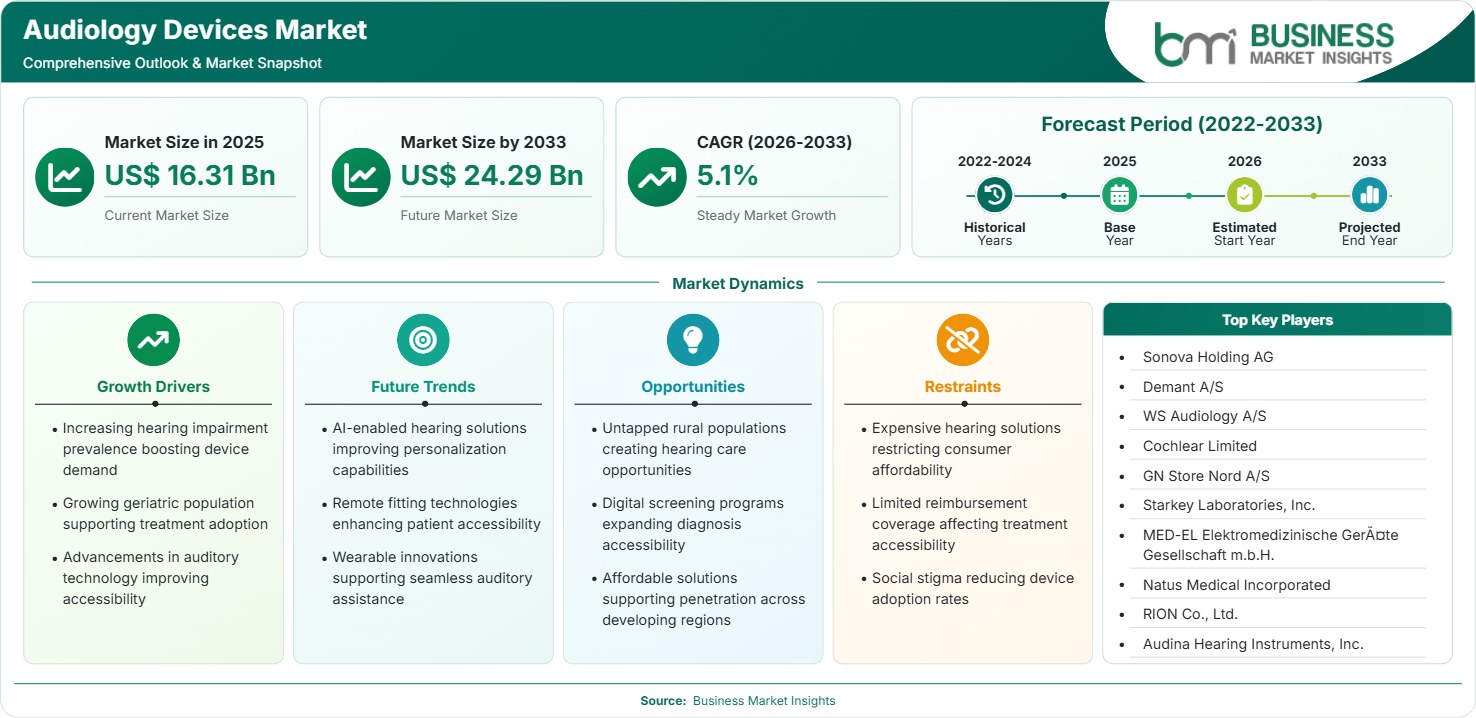
The Audiology Devices Market size was valued at US$ 16.31 Billion in 2025 and is projected to reach US$ 24.29 Billion by 2033, growing at a CAGR of 5.10% during 2026–2033, driven by rising hearing-loss awareness, device miniaturization, digital connectivity, and expanding access to diagnostic and implantable technologies.

Report Coverage
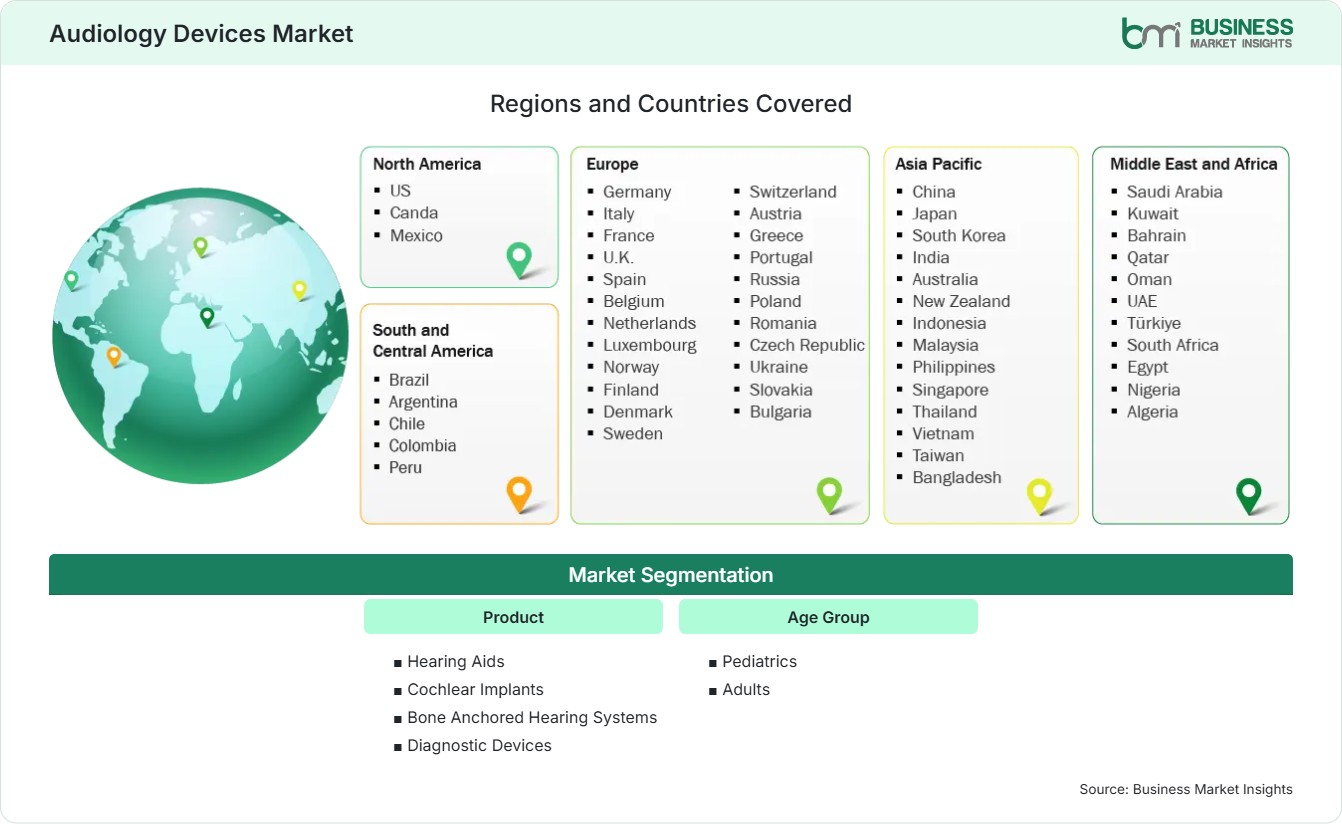
  • Product: Hearing Aids , Cochlear Implants, Bone Anchored Hearing Systems, Diagnostic Devices
  • Age Group: Pediatrics, Adults
US$ 16.31 Bn Market size in 2025
US$ 24.29 Bn Market Size by 2033
5.1% CAGR, 2026 - 2033
2026-2033 Forecast Period

AI Overview

Audiology Devices Market Summary

  • North America Region: North America holds a 34%–38% Audiology Devices Market share in 2025, growing at a 4.8%–5.6% CAGR through 2033, influenced by established audiology networks, reimbursement infrastructure, premium hearing devices, specialist availability, and strong adoption of connected technologies.
  • Fastest Growing Region: Asia Pacific holds a 23%–27% share in 2025, advancing at a 6.2%–7.0% CAGR through 2033, supported by expanding ENT infrastructure, rising disposable incomes, improving diagnosis rates, pediatric screening, and broader device availability.
  • Leading Segment: Hearing Aids hold a 63%–67% share in 2025, expanding at a 4.9%–5.5% CAGR through 2033, supported by rechargeable platforms, wireless connectivity, artificial intelligence, discreet form factors, and replacement demand.
  • High Growth Segment: Cochlear Implants hold a 10%–14% Audiology Devices Market share in 2025, advancing at a 6.3%–7.1% CAGR through 2033, supported by pediatric implantation, improved speech-processing algorithms, clinical evidence, bilateral implantation, and expanding specialist capacity.
  • Key Market Opportunity: Greater integration of artificial intelligence, smartphone connectivity, remote programming, self-fitting capabilities, and lower-cost distribution models can broaden access while creating recurring software, service, and replacement revenue opportunities.
  • Major Market Players: Sonova Holding AG, Demant A/S, WS Audiology A/S, Cochlear Limited, GN Store Nord A/S, Starkey Laboratories, Inc., MED-EL Elektromedizinische Geräte Gesellschaft m.b.H., Natus Medical Incorporated, RION Co., Ltd., and Audina Hearing Instruments, Inc.
Strategic Insights

Audiology Devices Market: Strategic Insights

Audiology Devices Market Strategic Framework
FREE PDF
Request your free sample
Request free sample
Stakeholder View

Key Takeaways

  • The value chain increasingly links acoustic component suppliers, semiconductor manufacturers, software developers, device manufacturers, audiologists, ENT specialists, clinics, distributors, and after-sales service providers. Competitive advantage therefore depends on ecosystem coordination rather than hardware performance alone.
  • Hearing aids remain the largest commercial opportunity, but cochlear implants and bone-anchored systems offer stronger value expansion where severe hearing loss, pediatric intervention, and specialist capacity support higher clinical adoption.
  • Artificial intelligence is moving from marketing differentiation toward practical functions such as environmental classification, speech enhancement, feedback management, personalized sound processing, and automatic adaptation to changing acoustic conditions.
  • Asia Pacific offers the strongest incremental opportunity because large populations remain underserved while private healthcare investment, screening programs, urban specialist networks, and consumer awareness improve access to hearing care.
  • Consolidation continues around hearing-care networks, technology platforms, distribution channels, and specialized diagnostics. Sonova's strategic portfolio actions illustrate how major companies are reassessing business mix while concentrating resources on core hearing-health activities.
  • Recurring revenue opportunities are expanding through remote care, device upgrades, accessories, software-enabled personalization, service contracts, and replacement cycles, making lifetime customer value increasingly important to manufacturers and providers.
Geographic Outlook

Audiology Devices Market Regional Highlights

North America Audiology Devices Market

North America accounted for 34%–38% share in 2025, with a forecast CAGR of 4.8%–5.6% until 2033. North America has a strong demand for Audiology Devices due to its developed audiology network, reimbursement processes, increased awareness of devices, and the use of premium connected hearing aids. Canada sees additional demand due to the involvement of public healthcare and an aging population. The Audiology Devices Market share in North America is characterized by high penetration rate of diagnosis and treatment in comparison with developing countries.

  • United States: Premium hearing aids, over-the-counter availability, tele-audiology, and expanding consumer awareness are widening access while increasing competitive pressure on traditional clinic-based distribution models.
  • Canada: Aging demographics and improving access to audiological services support steady device replacement, while provincial healthcare structures influence purchasing patterns and reimbursement availability.
  • Technology adoption: Bluetooth connectivity, rechargeable batteries, artificial intelligence, and smartphone applications remain important differentiators for premium products targeting active adult users.
  • Clinical ecosystem: Established ENT and audiology networks support complex diagnostic pathways and implantation procedures, sustaining demand for sophisticated diagnostic and implantable equipment.

US Audiology Devices Market

The United States constituted around 29%-33% share of the global market in 2025, growing at 4.7%-5.5% CAGR up to 2033. Favorable demand is driven by the presence of extensive specialized infrastructure, manufacturers, consumer knowledge, and availability of sophisticated devices. The regulatory environment has expanded consumers' access to particular types of hearing aids. Sonova had US revenue of CHF 1,093.7 million in 2025/26 through its continuing operations.

  • Consumer access: OTC hearing aids have expanded consumer choice and increased price transparency, encouraging manufacturers and retailers to refine product positioning and service models.
  • Premiumization: Advanced speech processing, artificial intelligence, connectivity, and rechargeable designs support higher-value product demand among users seeking discreet and multifunctional devices.
  • Clinical demand: Pediatric audiology, cochlear implantation, diagnostic testing, and rehabilitation services maintain demand beyond conventional adult hearing-aid replacement cycles.

Europe Audiology Devices Market

Europe accounted for 27%–31% of the Audiology Devices Market in 2025 and is projected to grow at a CAGR of 4.5%–5.3% through 2033. Germany, the United Kingdom, France, Italy, and the Nordic countries are important regions of demand due to the presence of infrastructure and high levels of clinical expertise in hearing care. Germany continues to be an important market, while Poland and certain Eastern European Countries present greater growth opportunities due to rising diagnostics and specialist availability. Sonova posted CHF 1,904.2 million in EMEA revenue in 2025/26, but this included several hearing health activities.

  • Germany: Broad hearing-care infrastructure and established reimbursement arrangements support consistent hearing-aid adoption and replacement demand.
  • United Kingdom: Public-sector hearing services create substantial installed demand, while private channels support premium technology and specialized products.
  • Nordics: Strong digital healthcare adoption supports remote consultations, connected devices, and technology-enabled audiology workflows.
  • Eastern Europe: Improving specialist availability and household purchasing power provide a larger runway for hearing aids and diagnostic equipment.

Asia Pacific Audiology Devices Market

The Asia Pacific market accounted for 23%–27% in 2025 with a 6.2%–7.0% CAGR during the forecast period. China, Japan, Australia, South Korea, and India have the most business potential, and countries such as India, Indonesia, Vietnam, and other Southeast Asia markets have higher incremental growth potential. Aging population, health spending in cities, pediatric screenings, higher awareness, and the development of private audiology clinics will improve diagnostics.

  • China: Large patient populations and expanding specialist capacity support demand for hearing aids, implants, and diagnostic equipment despite variable regional healthcare access.
  • Japan: Advanced healthcare infrastructure and a rapidly aging population support sophisticated hearing devices, diagnostics, rehabilitation, and replacement demand.
  • India: Expanding ENT infrastructure, rising awareness, pediatric intervention, and private-sector audiology networks create significant long-term adoption opportunities.
  • Australia: High diagnosis rates and mature hearing-care services sustain demand for premium hearing aids, implants, and technologically advanced diagnostics.
  • Southeast Asia: Improving healthcare infrastructure and private investment create opportunities for affordable devices, portable diagnostics, and distributor-led market penetration.

Rest of World Audiology Devices Market

The Rest of the World will account for 10% - 14% market share in 2025, with a CAGR of 5.4% - 6.4% in the Audiology Devices Market between 2023 and 2033. South and Central America will take advantage of the growing private health care network, with Brazil representing the biggest market opportunity. On the other hand, Gulf healthcare investments and scarcity of specialists in many African countries will define the Middle East and Africa region.

  • Brazil: A large patient base, public healthcare programs, and private clinics create opportunities across hearing aids, diagnostics, and implantable systems.
  • Mexico: Private audiology networks and urban healthcare expansion support steady demand for diagnostic equipment and hearing aids.
  • Gulf markets: Healthcare modernization and investment in specialist hospitals support premium diagnostics, implants, and technologically advanced hearing devices.
  • Africa: Low diagnosis rates create substantial latent demand, although affordability, specialist shortages, procurement limitations, and after-sales service remain important barriers.
Global Market Geography
FREE PDF
Request your free sample
Request free sample
Segment Analysis

Audiology Devices Market Segmentation

Product

Product proved to be the dominant segment, accounting for nearly 92%-95% of the market in terms of revenue in 2025, and is anticipated to witness a growth rate of 5.0%-5.4% CAGR during 2025-2033. The factors contributing to the segment include repeated hearing aid replacements, increasing implantations, developments in diagnostic processes, and technological advancements. The number of devices available in the market is increasing as companies focus on creating products for people with mild to moderate hearing impairment, severe hearing loss, pediatric patients, and advanced clinical procedures. Audiology Devices Market trends within various product segments increasingly focus on connectivity, miniaturization, customization, automation, and enhanced patient experience.

  • Hearing Aids: Hearing aids remain the principal revenue category, supported by replacement cycles, aging populations, connectivity, rechargeable platforms, artificial intelligence, and increasingly discreet designs.
    • BTE: Behind-the-ear devices support moderate to profound hearing loss and remain valuable for pediatric and complex cases because of durability, fitting flexibility, and power availability.
    • ITE: In-the-ear devices provide discreet placement and customized fitting, appealing to users seeking cosmetic advantages and stable everyday amplification.
    • RIC / RITE: Receiver-in-canal designs combine discreet form factors with strong connectivity and flexible receiver configurations, supporting broad adult adoption and premium product positioning.
    • CIC / IIC: Completely-in-canal and invisible-in-canal products address cosmetic priorities through deep placement, although battery limitations and fitting requirements influence their use cases.
  • Cochlear Implants: Cochlear implants serve severe-to-profound sensorineural hearing loss and have gained from pediatric implantation, improved processors, better speech algorithms, bilateral procedures, and rehabilitation advances.
  • Bone Anchored Hearing Systems: Bone anchored systems provide alternatives for conductive, mixed, and selected single-sided hearing losses, with adoption supported by minimally invasive approaches and improved processor connectivity.
  • Diagnostic Devices: Diagnostic equipment supports screening, diagnosis, fitting, monitoring, and treatment planning across hospitals, clinics, audiology centers, and specialized ENT practices.
    • Audiometers: Audiometers remain foundational diagnostic systems for measuring hearing thresholds and supporting clinical classification, fitting decisions, occupational screening, and longitudinal monitoring.
    • Tympanometers: Tympanometers assess middle-ear function and support diagnosis of conductive disorders, otitis-related conditions, and eustachian tube dysfunction.
    • Otoscopes: Digital and conventional otoscopes enable ear-canal and tympanic-membrane examination, with connected systems increasingly supporting documentation and remote consultation.
    • OAE Analyzers: OAE analyzers are important for objective screening, especially in newborn and pediatric programs where behavioral testing may be impractical.
    • ABR Systems: Auditory brainstem response systems support objective assessment in infants, difficult-to-test patients, neurological evaluation, and cochlear implantation pathways.

Age Group

The adults’ segment accounted for about 78%-82% of demand in 2025, with growth forecast at a 4.8%-5.3% CAGR through 2033, while the pediatric market grows at a faster pace due to improved screening. The audiology devices market scope is being extended beyond the acquisition of a hearing aid to lifelong hearing management. In adults, age-related hearing loss and workplace exposures have influenced the market size; while in pediatrics, early diagnosis and implantation have helped boost the demand.

  • Pediatrics: Pediatric demand is supported by newborn hearing screening, early intervention, school-based rehabilitation, congenital hearing loss diagnosis, cochlear implantation, and family-centered care.
  • Adults: Adults remain the largest user group because age-related hearing loss creates recurring demand for hearing aids, diagnostics, upgrades, rehabilitation, and replacement devices.
Market Forces

Audiology Devices Market Dynamics

Key Market Drivers

Artificial Intelligence and Adaptive Signal Processing

AI is transforming the functionality of hearing devices by incorporating greater speech enhancement, environmental classification, feedback suppression, and personalization capabilities. Modern premium platforms are becoming more adept at using algorithms to classify speech in the presence of competing noise sources and make real-time adjustments accordingly. Such capabilities contribute to the Audiology Devices Market growth by providing differentiation between generations and stimulating the replacement of previous models among their current owners. These market dynamics allow moving the competition away from pure amplification toward the software's performance, giving audiologists more tools for customization. In addition to stimulating hardware sales, this commercial dynamic will enable the relationship to be sustained after the initial purchase.

Rising Hearing-Loss Awareness and Earlier Diagnosis

Awareness about the impact of untreated hearing impairment is leading to more need for screening, diagnostic testing, rehabilitation, and intervention. WHO regards hearing and communication devices as important assistive devices, and the organization’s market-shaping strategy for 2025 is centered on making these products affordable, accessible, and financed. Early diagnosis helps reach more people, as they can be reached through hearing care routes without significant functional impairment. Screening of infants is especially vital due to the effect that such diagnosis can have on their language development. Adult screenings, occupational testing, and regular ear, nose, and throat (ENT) exams are avenues for sales of audiometers, tympanometers, OAE analyzers, and ABR machines.

Miniaturization, Rechargeability, and Connectivity

Miniaturization improves comfort, acceptability, and convenience, and the use of rechargeable batteries decreases dependency on disposable batteries. The Bluetooth feature allows the hearing devices to be linked with cell phones, TVs, computers, and other consumer products. It makes them function as multifunctional communication devices. Such advances make people more likely to replace current devices when the need is not due to reduced hearing performance. In terms of engineering, miniaturization demands investments by device manufacturers in lower power consumption semiconductors, microphones, antennae, batteries, and thermal control systems. Engineering improvements translate into more valuable product lines and differentiation in competitive mature markets.

Key Market Opportunities

Expansion of Affordable and Self-Fitting Hearing Solutions

There is a significant market opportunity for affordable hearing options due to the limited availability of assistive technology worldwide. According to WHO statistics from 2025, only one in ten individuals who require assistive devices has access to such technology. The use of affordable hearing devices, streamlined hearing aid fitting procedures, direct-to-consumer selling options, and self-fitting hearing devices can be made possible with clinical safety considerations. Hearing device companies can come up with tiered portfolios of hearing devices with high margin devices and affordable options for budget-conscious individuals. Affordable hearing solutions can be provided through pharmacies, online shopping, primary care, and community-based hearing programs. The Audiology Devices Market Forecasts will largely depend on manufacturers' ability to meet affordability and service requirements.

Connected Remote Audiology Ecosystems

Remote audiology enables patients to be seen by specialist clinicians without having to visit clinics multiple times, especially in cases where audiologists tend to work only in big cities. The connected hearing aid would be able to send operational data, enable remote adjustments, and provide follow-up. Similarly, diagnostic equipment can be made portable and integrated into the digital world, allowing testing to be done away from large hospitals. This concept is important for people living in rural areas, for elderly with limited mobility, and for people who need constant adjustment of their devices. The technology companies can generate continuous revenue streams through software subscriptions, clinician portals, service bundles, and management tools.

Advanced Implantable and Pediatric Hearing Solutions

In cases where hearing aids do not provide sufficient functional benefits, cochlear implants and bone anchored devices can provide possibilities where there were none before. Implanting patients at a young age is very significant, as timely intervention can help develop speech, language, education, and social skills. Advances in the technology of electrodes, sound processors, wireless devices, and rehabilitation software are enhancing the value proposition. The market can grow through the expansion of implant centers within a particular region, which involves training surgeons and educating audiologists and patients. Growth in the Audiology Devices Market is not limited to implants, as such activities will create opportunities for diagnostics, surgery, device processing, and rehabilitation.

Market Restraints and Challenges

High Device Costs and Uneven Reimbursement

Factor: Modern hearing aids, cochlear implants, bone anchored solutions, and diagnostic tools may be expensive to purchase and to maintain, and the reimbursement varies greatly from country to country. Impact: Cost limitations may hinder the timely diagnosis and intervention, particularly for low-income families and disadvantaged groups. Additional functionality such as artificial intelligence, recharging systems, advanced connectivity, and remote services can drive the average price even higher. Surgical costs and rehabilitation costs are not limited to equipment. Hence, companies have to strike a delicate balance between technology investment and accessibility. However, despite all possible ways to overcome cost barriers in distribution and financing, a fragmented reimbursement system remains an obstacle for penetration in certain markets.

Shortage of Audiology Specialists and Service Infrastructure

Factor: Audiology devices require proper diagnosis, fitting, programming, interpretation, maintenance, and rehabilitation, but the availability of audiology specialists varies by country and is especially scarce in rural areas and resource-constrained environments. Impact: The absence of proper clinic capacity may result in reduced device usage even if the hardware is available commercially. The use of complex implants is especially sensitive to the involvement of a multidisciplinary team consisting of an audiologist, an ENT specialist, a surgeon, a speech therapist, and a rehabilitation professional. The diagnostic tools also require a qualified person to properly interpret the results. The manufacturers can solve this issue using remote services, process automation, training, portable diagnostic tools, and a user-friendly interface.

Company Analysis

Competitive Landscape

The Audiology Devices Market analysis indicates a concentrated competitive structure dominated by multinational hearing-technology groups alongside specialist implant, diagnostic, and independent hearing-device manufacturers. Product differentiation increasingly centers on artificial intelligence, connectivity, miniaturization, battery performance, clinical evidence, and integrated care ecosystems.

Company Name

Overview

Products and Services relevant to this market

Sonova Holding AG

Global hearing-care group with major positions in hearing instruments, audiological care, and cochlear implants.

Phonak hearing aids, Advanced Bionics cochlear implants, audiological care services, accessories, connectivity, and related hearing solutions.

Demant A/S

Major hearing-health company serving consumers and clinicians across hearing aids, diagnostics, and hearing care.

Oticon hearing aids, Bernafon products, Interacoustics diagnostic equipment, hearing-care services, and audiology technologies.

WS Audiology A/S

Global hearing-aid company combining technology development with broad professional and consumer distribution.

Signia and Widex hearing aids, accessories, connectivity solutions, fitting technologies, and hearing-care services.

Cochlear Limited

Specialist leader focused on implantable hearing solutions and long-term hearing rehabilitation.

Cochlear implants, sound processors, accessories, wireless technologies, clinical support, and rehabilitation solutions.

GN Store Nord A/S

Diversified hearing and audio technology group with strong digital and connectivity capabilities.

ReSound hearing aids, Beltone solutions, diagnostic technologies, wireless accessories, and hearing-care platforms.

Starkey Laboratories, Inc.

Independent hearing-technology manufacturer emphasizing personalized devices and artificial-intelligence capabilities.

Starkey hearing aids, Edge AI and Genesis AI platforms, fitting tools, accessories, and connectivity solutions.

MED-EL Elektromedizinische Geräte Gesellschaft m.b.H.

Specialist implantable hearing technology company with strong cochlear and bone-conduction portfolios.

Cochlear implants, audio processors, bone conduction systems, accessories, surgical technologies, and rehabilitation support.

Natus Medical Incorporated

Medical technology company with substantial expertise in neurological and audiological diagnostics.

Auditory evoked-potential systems, OAE technologies, diagnostic equipment, neurodiagnostic platforms, and clinical workflow solutions.

RION Co., Ltd.

Japanese medical technology company with long-standing expertise in audiological measurement and hearing solutions.

Audiometers, tympanometers, hearing-related diagnostic instruments, and clinical measurement technologies.

Audina Hearing Instruments, Inc.

Specialist hearing-device manufacturer serving professional audiology and hearing-care channels.

Custom hearing aids, in-the-ear products, behind-the-ear solutions, accessories, fitting support, and professional hearing technologies.

Trust & Transparency

Research Methodology

The market analysis combines proprietary research with secondary data from government agencies, company disclosures, regulatory filings, industry databases and expert interviews. Market estimates are validated through data triangulation, cross-market benchmarking and analyst review.

View Full Research Methodology

Questions Answered

Frequently Asked Questions

How should investors interpret regional differences in demand?

In mature markets, replacement revenues, premiumization, and sophisticated clinical infrastructure abound, whereas emerging markets have larger untapped markets and infrastructure-driven growth. Strategy is thus needed for different pricing, distribution, training, and service models by geography.

What makes cochlear implants an attractive growth opportunity?

Cochlear implants address severe-to-profound hearing loss where conventional amplification may provide limited benefit. Pediatric intervention, improved processors, bilateral implantation, rehabilitation advances, and expanding implant-center capabilities support long-term adoption.

How can manufacturers expand access in emerging markets?

Manufacturers can combine lower-cost product tiers with portable diagnostics, distributor partnerships, tele-audiology, professional training, financing programs, and community screening. These approaches address affordability and specialist shortages simultaneously.

Why are hearing aids expected to remain the largest product category?

Hearing aids address a broad spectrum of hearing loss and benefit from recurring replacement cycles, aging populations, product upgrades, connectivity, rechargeable platforms, and growing consumer awareness. Their use also requires less invasive intervention than implantable alternatives.

What technologies are shaping the Audiology Devices Market Report?

Artificial intelligence, Bluetooth connectivity, rechargeable power, remote programming, digital diagnostics, miniaturization, and improved implant processors are among the most influential technologies. Their commercial importance comes from improving usability while creating differentiation and upgrade opportunities.

Access the Full Audiology Devices Market Report

Get segment-level forecasts, regional estimates, competitive benchmarking, company profiles and downloadable Excel datasets.

Access the full Audiology Devices Market Report
350 pages PDF & Excel | 2026-09-18
Similar Research

Related Market Reports