Market Summary
Executive Summary and Global Market Analysis
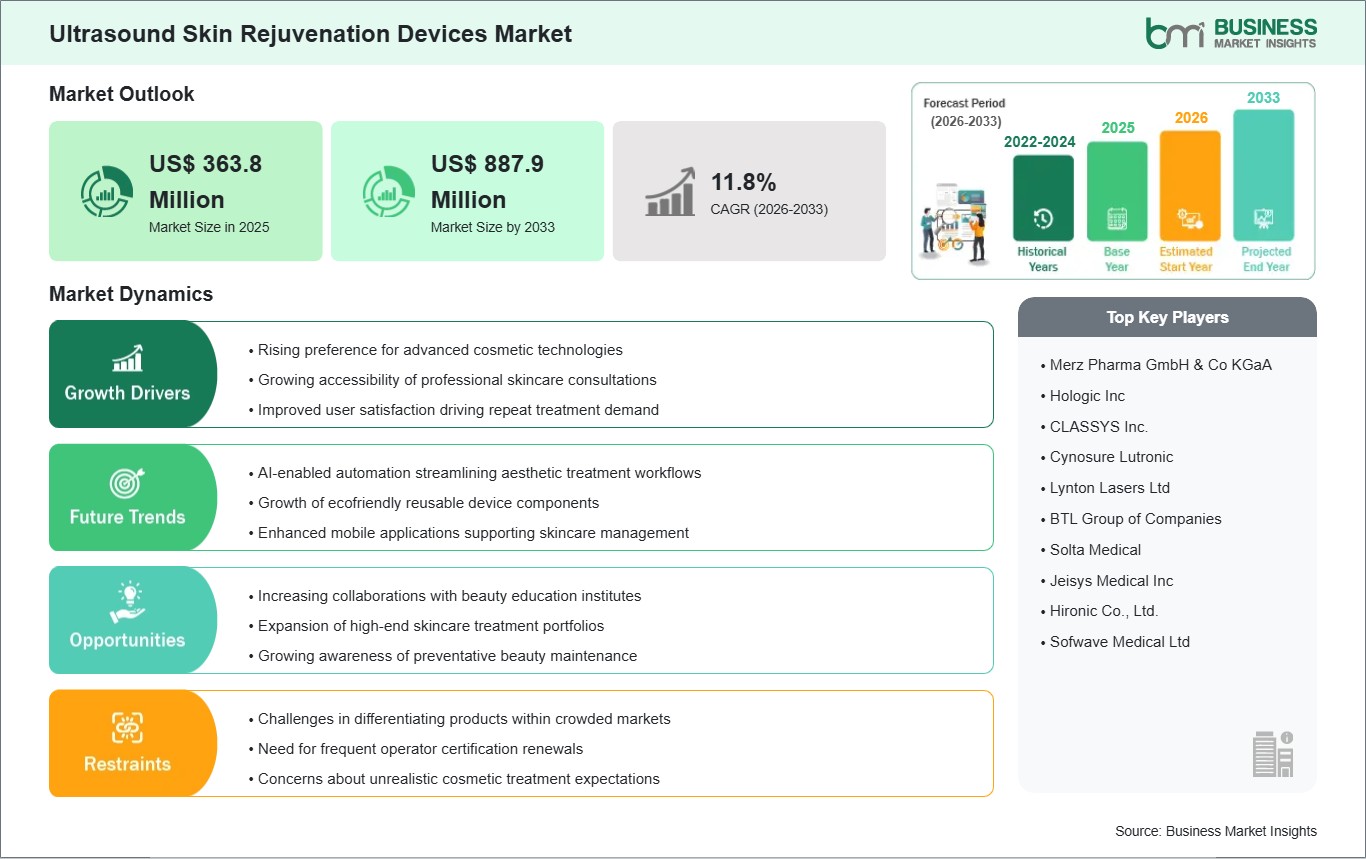
The ultrasound skin rejuvenation devices market is advancing rapidly, supported by rising consumer preference for non-invasive cosmetic treatments and the shift toward wellness-driven healthcare. Across regions, dermatology clinics, private practices, and medical spas are adopting ultrasound technologies to meet demand for safe, effective, and minimally invasive anti-aging solutions. Manufacturers are focusing on portable, multifunctional devices that deliver precision energy and customizable treatment options. Strategic partnerships between device makers and distributors are expanding reach, particularly in emerging economies where awareness of aesthetic procedures is growing. Regulatory frameworks in developed regions provide strong oversight, reinforcing consumer trust and accelerating adoption. In developing markets, evolving compliance standards are opening new opportunities for entry. Competitive differentiation is defined by advancements in AI-enabled diagnostics, ergonomic designs, and integration with digital health platforms, which enhance patient engagement and broaden accessibility. The cultural emphasis on appearance, combined with rising disposable incomes and medical tourism, strengthens demand across diverse geographies. As preventive care and lifestyle-driven wellness continue to gain prominence, ultrasound skin rejuvenation devices are positioned as a cornerstone of modern aesthetic medicine, offering sustainable opportunities for established players and new entrants.
Segment Analysis
Ultrasound Skin Rejuvenation Devices Market Segmentation
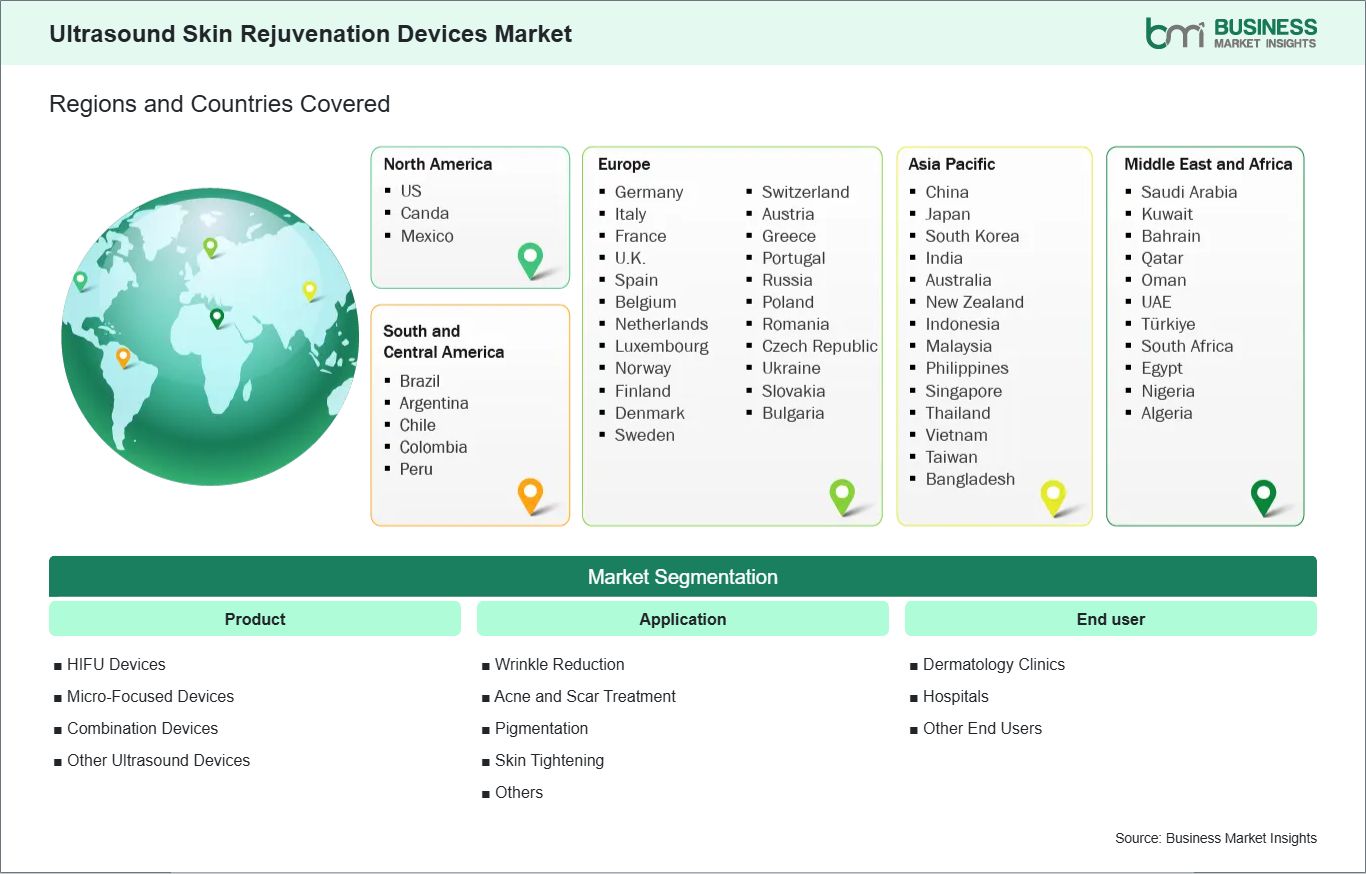
Key segments that contributed to the derivation of the ultrasound skin rejuvenation devices market analysis are product, application, and end user.
- By product, the ultrasound skin rejuvenation devices market is segmented into HIFU devices, micro-focused devices, combination devices, and other ultrasound devices. The HIFU devices segment dominated the market in 2025.
- Based on application, the ultrasound skin rejuvenation devices market is categorized into wrinkle reduction, acne and scar treatment, pigmentation, skin tightening, others application. The wrinkle reduction segment dominated the market in 2025.
- In terms of end user, the ultrasound skin rejuvenation devices market is categorized into dermatology clinics, hospitals, and other end users. The dermatology clinics segment dominated the market in 2025.
Market Forces
Ultrasound Skin Rejuvenation Devices Market Drivers and Opportunities
Rising Popularity of Outpatient Cosmetic Procedures
The desire among patients is to look for procedures that provide visible benefits regarding aging without being required to be hospitalized or recover for long periods afterward. Ultrasound, a process that encourages the formation of collagen and elasticity in the skin, is ideal for this demand. "Lunchtime treatments" have been made popular by clinics due to their ability to complete the procedure within the span of an hour.
The advantage of opting for non-surgical methods is their capability of delivering natural results without posing any risk related to surgery. Ultrasound gadgets are safe, efficient, and flexible according to varying skin tones, and hence they attract people from various groups. Young individuals find them appealing since they are a way of keeping ahead of aging. The elderly prefer them as they can avoid going through surgeries such as facelifts.
Cultural values of keeping oneself young without disturbing one's social life can be easily achieved through outpatient ultrasonic treatment, which helps achieve the desired results quickly and discreetly. It is being offered alongside other noninvasive treatments by clinics as part of the package. Increased awareness about the benefits of ultrasonography will ensure that outpatient treatments continue dominating as a major growth driver for devices.
Expanding Online Sales Channels for Aesthetic Devices
Portable devices intended for home use have been developed in e-commerce portals and DTC brands in order to cater to the needs of consumers who would rather have self-treatment. Consumers can buy certified devices and skincare items online, and subscriptions are available to facilitate their continued use. Digital health care technologies have made it possible for consumers to gain access to modern technology without having to visit clinics.
There is a changing trend in consumer behavior toward online buying of these services, as well as online education, which is facilitated by social media influencers and digital marketing to educate consumers on ultrasound skin rejuvenation. These trends are being supported by the use of livestreams as well as beauty-tech groups to demonstrate the product. Portable devices are presented as supplementary products to be used alongside professional ones, thus giving a mixed treatment plan for users.
Regulatory systems and certification standards are boosting consumer confidence in online transactions. E-commerce platforms stress safety and compliance issues to ensure customers get only high-quality products. Convenience and strong promotional strategies will make e-commerce an important channel of distribution in the future. With the increasing use of digital technologies, it is expected that online sales will become an integral part of the market penetration strategy for ultrasound skin rejuvenation equipment.
Size and Share Analysis
Ultrasound Skin Rejuvenation Devices Market Size and Share Analysis
The ultrasound skin rejuvenation devices market demonstrates steady growth, with size and share analysis highlighting evolving trends and competitive dynamics among key players. The report examines subsegments categorized within product, application, and end user, offering insights into their contribution to overall market performance.
By product, the HIFU devices segment dominated the market in 2025, driven by their effectiveness in deep tissue tightening and long-lasting noninvasive results.
Based on application, the wrinkle reduction segment dominated the market in 2025, driven by rising global demand for anti-aging treatments among expanding middle-aged and elderly populations.
In terms of end user, the dermatology clinics segment dominated the market in 2025, driven by patient trust in specialized expertise and access to advanced aesthetic technologies.
Report Coverage
Ultrasound Skin Rejuvenation Devices Market Report Coverage and Deliverables
The "Ultrasound Skin Rejuvenation Devices Market Size and Forecast (2022-2033)" report provides a detailed analysis of the market covering below areas:
- Market size and forecast at global, regional, and country levels for all the key market segments covered under the scope
- Market trends, as well as drivers, restraints, and opportunities
- Market analysis covering key trends, global and regional framework, major players, regulations, and recent developments
- Market concentration, heat map analysis, prominent players, and recent developments for the Market
- Detailed company profiles, including SWOT analysis
Geographic Insights
Ultrasound Skin Rejuvenation Devices Market Geographic Insights
The geographical scope of the ultrasound skin rejuvenation devices market report is divided into North America, Asia Pacific, Europe, the Middle East & Africa, and South & Central America. North America held the largest share in 2025.
In North America, the US leads with widespread clinical integration and consumer willingness to invest in premium noninvasive treatments. Canada emphasizes safety and regulatory compliance, reinforcing trust. Europe presents a fragmented landscape. Germany and France prioritize clinical excellence. The UK shows rapid uptake in private practices targeting younger demographics. Italy leverages its fashion-driven culture to sustain demand. Asia Pacific demonstrates strong momentum. South Korea and Japan are leading the innovation in device sophistication. China is expanding through middle-class demand and government-backed medical device initiatives. India is emerging as a growth market in urban centers. The Middle East highlights premium adoption, particularly in the UAE and Saudi Arabia, where luxury clinics dominate. Africa remains nascent but shows potential in metropolitan hubs with rising private healthcare investment. South and Central America highlight Brazil's leadership in aesthetic medicine, Mexico's cross-border appeal for cost-effective treatments, and Argentina's urban adoption through private clinics. Smaller nations such as Costa Rica and Panama integrate ultrasound rejuvenation into medical tourism packages. These insights underscore North America's dominance, not only in terms of adoption but also in setting global standards for innovation, compliance, and consumer engagement. Other regions present significant opportunities, but localized strategies, cultural alignment, and tailored device positioning remain critical for sustained success across diverse markets.
Industry Activity
Recent Developments
The ultrasound skin rejuvenation devices market is evaluated by gathering qualitative and quantitative data post primary and secondary research, which includes important corporate publications, association data, and databases. A few of the key developments in the ultrasound skin rejuvenation devices market are:
- In May 2025, Ulthera, Inc. received FDA 510(k) clearance for an updated Ulthera System (UC-1 Control Unit PRIME Model 2.1), supporting continued advancement of its focused ultrasound technology used for non-invasive skin lifting and rejuvenation procedures.
- In January 2025, GE HealthCare announced FDA clearance for its enhanced Voluson Expert Series ultrasound systems, incorporating advanced imaging technologies and AI-based tools to improve workflow and imaging performance, reflecting continued innovation in ultrasound-based medical technologies.
Trust & Transparency
Research Methodology
The market analysis combines proprietary research with secondary data from government agencies, company disclosures, regulatory filings, industry databases and expert interviews. Market estimates are validated through data triangulation, cross-market benchmarking and analyst
review.
View Full Research Methodology
Key Sources Referred:
American Society for Laser Medicine and Surgery (ASLMS) European Academy of Dermatology and Venereology (EADV) Bharat Society of Laser Medicine & Surgery (BSLMS) S. Food and Drug Administration (FDA) European Medicines Agency (EMA) International Electrotechnical Commission (IEC) International Organization for Standardization (ISO) Beauty Device Association (BDA) Indian Laser Association (ILA) Association of Industrial Laser Users (AILU)