
Artificial Intelligence (AI) Camera Market Outlook: Size, Share, Trends, Growth Analysis, Competitive Landscape & Forecast, 2026-2033

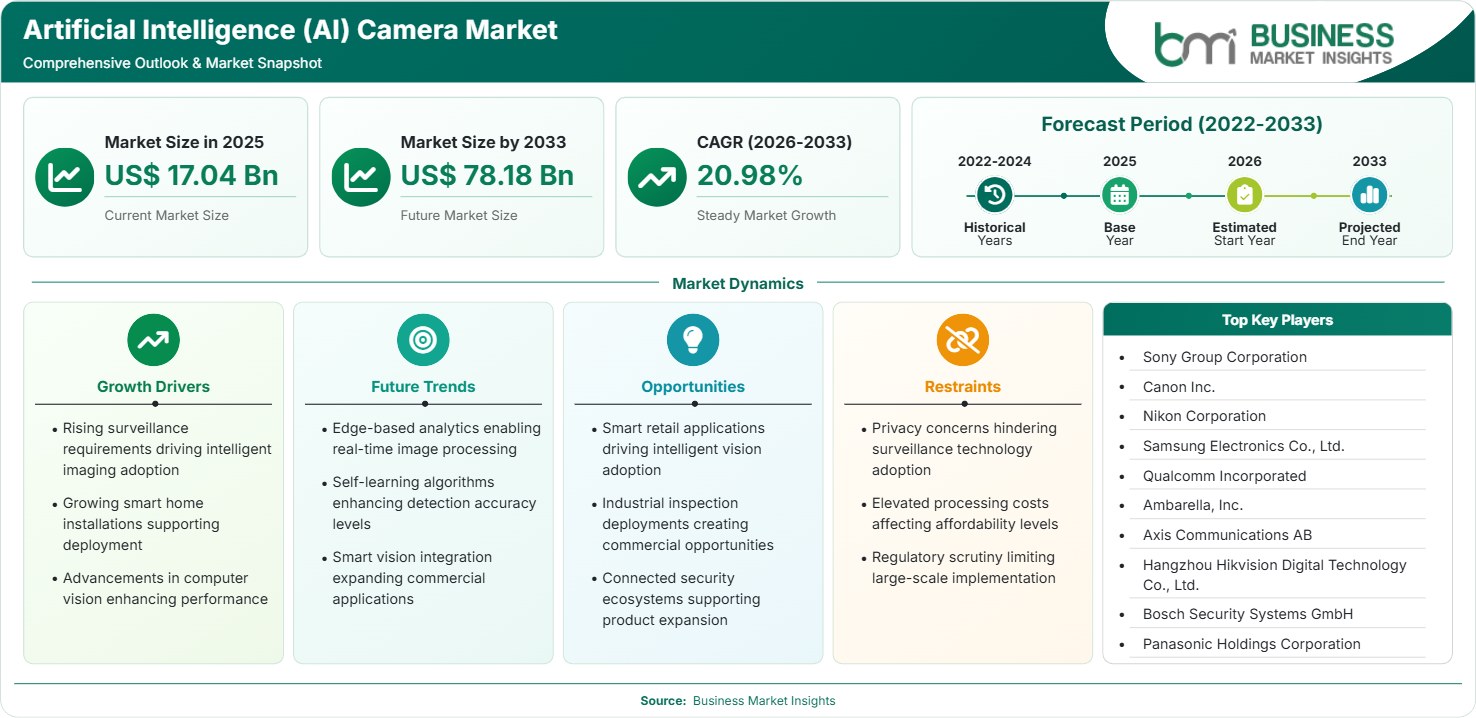
The Artificial Intelligence (AI) Camera Market size was valued at US$ 17.04 Billion in 2025 and is projected to reach US$ 78.18 Billion by 2033, growing at a CAGR of 20.98% during 2026–2033. Increasing deployment of vision analytics, smart surveillance, edge AI processing, industrial automation, autonomous mobility, and intelligent retail systems continues creating substantial commercialization opportunities across global markets.

Report Coverage
  • Technology: Biometric Recognition, Computer Vision, Deep Learning, Context-Aware Computing, Others
  • End-user: BFSI, Healthcare, Automotive, Consumer Electronics, Retail, Government, Others
  • Product Type: Smartphone Camera, Surveillance Camera, DSLR Camera, Others
US$ 17.04 Bn Market size in 2025
US$ 78.18 Bn Market Size by 2033
20.98% CAGR, 2026 - 2033
2026-2033 Forecast Period

AI Overview

Artificial Intelligence (AI) Camera Market Summary

  • North America Region: North America holds a market share of 34%–37% in 2025, growing with a CAGR of 19%–21% during 2026–2033, driven by advanced surveillance modernization, edge computing investments, enterprise analytics adoption, public safety programs, expanding smart city deployments, and strong semiconductor innovation ecosystems supporting intelligent vision applications globally. The U.S. represents the largest regional contributor, supported by smart surveillance upgrades and enterprise AI adoption, recording a CAGR of 19.5%–21.5%.
  • Fastest Growing Region: Asia Pacific holds a market share of 27%–30% in 2025, growing with a CAGR of 22%–24% during 2026–2033, supported by manufacturing automation, smart city expansion, rising electronics production, increasing public security investments, expanding automotive intelligence integration, and rapid deployment of connected infrastructure solutions.
  • Leading Segment: Surveillance Camera accounts for 38%–41% share in 2025, registering a CAGR of 20%–22% during 2026–2033, supported by real-time monitoring requirements, security modernization initiatives, facial analysis capabilities, traffic management deployment, enterprise risk mitigation strategies, and expanding critical infrastructure protection programs.
  • High Growth Segment: Computer Vision accounts for 28%–31% share in 2025, expanding at a CAGR of 23%–25% during 2026–2033, driven by advanced image recognition capabilities, edge inference improvements, autonomous decision systems, industrial inspection demand, intelligent retail analytics implementation, and accelerated investment in visual intelligence platforms.
  • Key Market Opportunity: Large-scale integration of edge AI chips with intelligent imaging platforms enables low-latency analytics, reduced bandwidth consumption, improved privacy compliance, and broader adoption across industrial, transportation, healthcare, and retail environments.
  • Major Market Players: Sony Group Corporation, Canon Inc., Nikon Corporation, Samsung Electronics Co., Ltd., Qualcomm Incorporated, Ambarella, Inc., Axis Communications AB, Hangzhou Hikvision Digital Technology Co., Ltd., Bosch Security Systems GmbH, Panasonic Holdings Corporation.
Strategic Insights

Artificial Intelligence (AI) Camera Market: Strategic Insights

Artificial Intelligence (AI) Camera Market Strategic Framework
FREE PDF
Request your free sample
Request free sample
Stakeholder View

Key Takeaways

  • The value chain is now bringing together image sensor suppliers, chipset manufacturers, software developers, cloud providers, and system integrators, thus establishing a highly collaborative ecosystem focused on intelligent visual analytics.
  • There is considerable potential in healthcare, retail analytics, and smart transportation applications, as companies seek automated monitoring, improved operational efficiency, and enhanced customer experience.
  • Innovation is now moving in the direction of edge-native architectures that incorporate advanced sensors, onboard inference engines, and efficient deep-learning models which are able to provide real-time insights without the need for constant connectivity.
  • The Asia Pacific region provides a highly attractive environment for investment, due to its large-scale smart city initiatives, the rapid digitalization of manufacturing, and the growing rollout of intelligent surveillance infrastructure.
  • The number of strategic partnerships being entered into between semiconductor vendors, camera makers, and software companies is growing as all the relevant parties look for complete vision-based solutions and wish to speed up the process of bringing them to market.
  • The growing demand for visual intelligence systems that prioritize privacy is leading to the development of anonymization features, federated learning frameworks, and secure edge processing technologies.
Geographic Outlook

Artificial Intelligence (AI) Camera Market Regional Highlights

North America Artificial Intelligence Camera Market

North America accounts for 34%–37% of the global Artificial Intelligence Camera Market share in 2025 and is projected to expand at a CAGR of 19%–21% from 2026 to 2033. The existence of mature technology ecosystems, strong security infrastructure, and high levels of digitalization within the enterprise contributes to the acceptance. AI Camera Market share is the largest within this region because of the widespread use in transportation, government buildings, hospitals, and enterprises.

  • Large companies are still adopting intelligent surveillance systems that combine behavioural analytics, threat detection, and operational monitoring to improve security effectiveness and resource usage in a number of facilities.
  • Visual intelligence systems are increasingly being used in public sector modernization programs to monitor traffic, improve emergency responses, and enhance infrastructure security.
  • Healthcare providers use imaging platforms with AI capabilities to enhance patient monitoring, facility management, and workflow efficiency while still meeting compliance requirements.
  • The leadership in the region is speeding up innovation in image sensors, computer vision processors, and the embedded AI hardware needed for advanced deployment scenarios.

US Artificial Intelligence Camera Market

The United States represents approximately 76%–80% of North American Artificial Intelligence Camera Market demand and is forecast to grow at a CAGR of 19.5%–21.5% through 2033. Investments in technologies, sophisticated budgets for public safety, and cloud usage can help expand the market. More companies utilize predictive visual analytics to enhance their visibility and risk management practices.

  • The major technology vendors are still expanding their edge AI capabilities, which allows for faster real-time analysis and less dependence on the network in commercial applications.
  • Operators in the transportation sector are now using intelligent vision technologies to enhance traffic flow, to detect incidents, and to improve the performance of the infrastructure.
  • Retail businesses use advanced image recognition systems to carry out customer behaviour analytics and loss-prevention measures.
  • Visual inspection solutions are incorporated by industrial facilities to enhance quality assurance and manufacturing productivity.

Europe Artificial Intelligence Camera Market

Europe represents 24%–27% of global Artificial Intelligence Camera Market revenue in 2025 and is expected to register a CAGR of 18%–20% through 2033. There are many advantages of automation in industries, smart mobility schemes, and modern manufacturing systems in this area. There has been a growing demand in applications such as transport, retail, and government services. In terms of regional application, Germany dominates with a CAGR of 18.5% - 20.5%. Eastern Europe is also becoming a major deployment center.

  • Germany is leading regional demand as a result of its extensive use in manufacturing automation, logistics monitoring, and industrial inspection, backed by its Industry 4.0 investments and digital transformation initiatives.
  • France and the United Kingdom are widening their intelligent transportation infrastructure and are promoting the use of advanced imaging solutions for use in mobility management and public safety.
  • Privacy regulations promote the use of edge-processing architectures that analyze data locally, thereby reducing the need for data transmission and improving adherence to evolving governance frameworks.
  • Retailers increasingly implement visual analytics platforms for customer flow optimization, inventory insights, and operational efficiency enhancement across physical store networks.
  • In central and eastern European countries, there is a growing uptake as a result of infrastructure modernization programs and greater investment in smart security systems.

Asia Pacific Artificial Intelligence Camera Market

Asia Pacific accounts for 27%–30% of global Artificial Intelligence Camera Market revenue in 2025 and is forecast to achieve a CAGR of 22%–24% during 2026–2033, making it the fastest-growing regional market. E-CAT Manufacturing capabilities, urbanization patterns, and development in smart cities help expand into the region. China is still the biggest market in the region, with CAGR of 22.5%-24.5%, whereas India becomes the most attractive market, with CAGR of 24%-26%.

  • China benefits from large-scale implementation across transportation, smart city infrastructure, industrial automation, and public security applications supported by domestic technology ecosystems.
  • India is seeing a rapid uptake as a result of digital transformation, the expansion of its surveillance infrastructure, and greater enterprise investment in intelligent operational technologies.
  • Japan and South Korea have maintained their strong positions due to their advanced semiconductor capabilities, innovations in robotics, and sophisticated consumer electronics manufacturing.
  • Manufacturing companies increasingly deploy machine vision systems for quality assurance, predictive maintenance, and process optimization across industrial facilities.
  • Investments in smart infrastructure projects are being made at a faster rate, offering vendors of AI-powered visual intelligence solutions long-term opportunities.

Rest of World Artificial Intelligence Camera Market

The Rest of World region holds 10%–13% of global Artificial Intelligence Camera Market revenue in 2025 and is anticipated to expand at a CAGR of 20%–22% through 2033. South and Central American nations are experiencing positive impacts from the modernization of urban security systems and transport systems, whereas Middle Eastern and African countries are increasingly working on their smart cities.

  • Brazil promotes regional expansion through the modernization of public safety projects, transportation monitoring systems, and growing demand from businesses for intelligent analytics platforms.
  • In Mexico, the use of vision-enabled technologies to enhance operational efficiency and compliance monitoring is increasing among manufacturing facilities.
  • The Gulf states are still investing in smart city systems, incorporating intelligent imaging technologies into their transportation, utilities, and public administration infrastructure.
  • In South Africa, greater implementation is taking place in commercial facilities, in logistics operations, and in urban surveillance projects, which are backed by digitalization initiatives.
  • In emerging economies large-scale infrastructure development programs generate a demand for scalable visual intelligence platforms and for advanced monitoring capabilities.
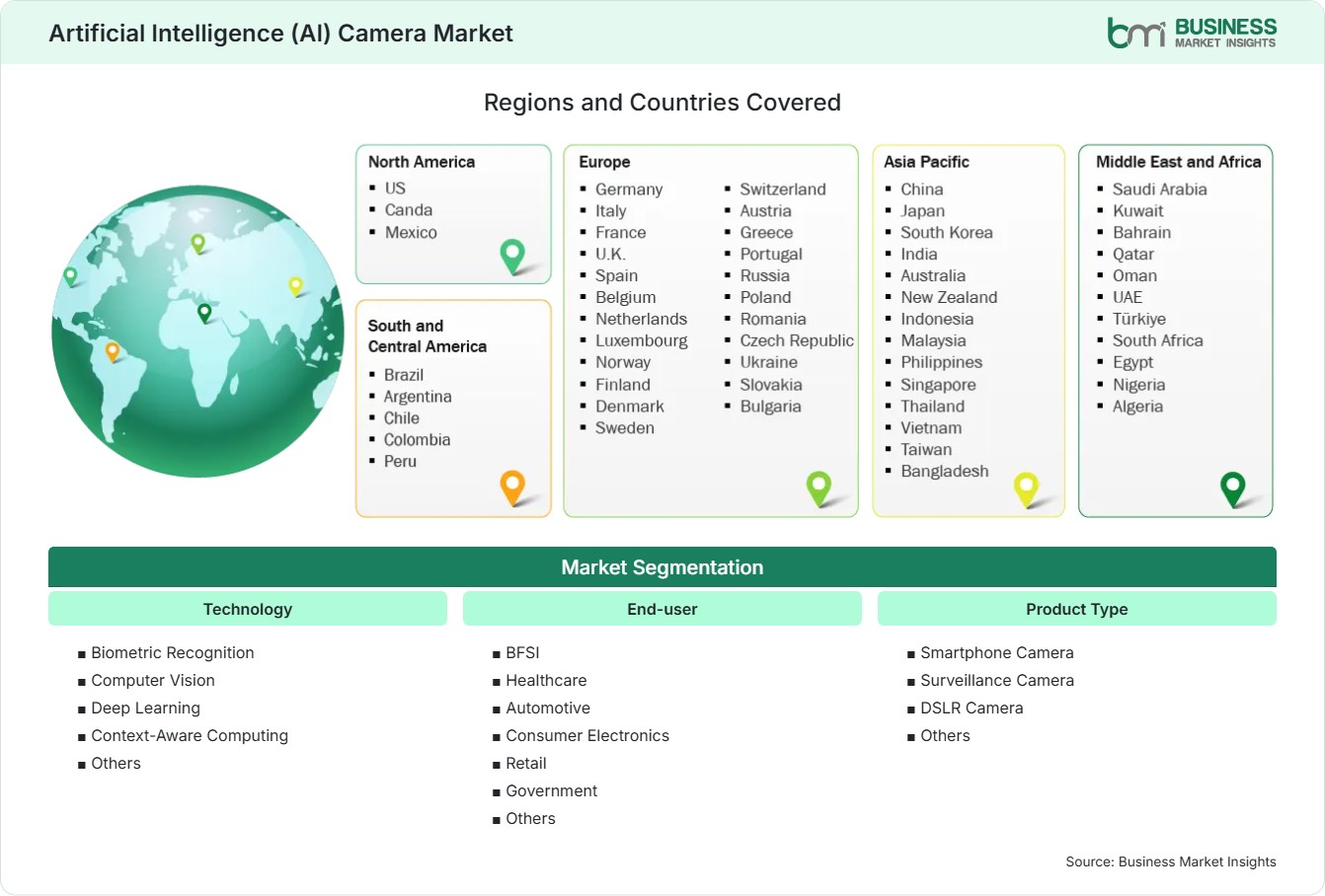
Global Market Geography
FREE PDF
Request your free sample
Request free sample
Segment Analysis

Artificial Intelligence (AI) Camera Market Segmentation

Technology

Technology represented approximately 39%–42% market share in 2025 and is forecast to expand at a CAGR of 21%–23% during 2026–2033. The Artificial Intelligence Camera Market scope continues expanding as organizations adopt sophisticated vision algorithms that improve detection accuracy, automation efficiency, and decision-making quality.

  • Biometric Recognition: Widely adopted for identity verification, access control, and security applications. Growing regulatory requirements and demand for frictionless authentication continue to support implementation across enterprises and public institutions.
  • Computer Vision: The largest technology category benefiting from advances in object detection, pattern recognition, and visual analytics. Strong adoption across manufacturing, mobility, healthcare, and retail environments supports sustained expansion.
  • Deep Learning: Enables continuous improvement in image interpretation accuracy through advanced neural networks. The increasing availability of AI accelerators is enabling deployment across complex visual analysis applications.
  • Context-Aware Computing: Supports intelligent decision-making by combining image inputs with environmental and behavioral data. Adoption is increasing in smart buildings, transportation systems, and connected infrastructure.

End-user

End-user demand remains diversified, with enterprise and institutional buyers driving substantial adoption. This segment captured 32%–35% Artificial Intelligence Camera Market share in 2025 and is projected to grow at a CAGR of 20%–22% through 2033.

  • BFSI: Financial institutions deploy intelligent cameras for fraud prevention, branch monitoring, perimeter security, and enhancing the customer experience in physical banking environments.
  • Healthcare: Hospitals and healthcare facilities increasingly use AI-powered imaging systems for patient monitoring, facility management, workflow optimization, and compliance-driven surveillance requirements.
  • Automotive: Growing integration into advanced driver assistance systems, autonomous vehicle development, occupancy monitoring, and intelligent transportation ecosystems strengthens adoption prospects.
  • Consumer Electronics: Smartphone manufacturers and device vendors utilize AI-enhanced imaging capabilities to improve photography, personalization, and user experience differentiation.
  • Retail: Retailers apply visual intelligence technologies for customer analytics, inventory management, shelf monitoring, checkout optimization, and loss-prevention initiatives.
  • Government: Public agencies deploy advanced camera systems for traffic management, law enforcement operations, emergency response coordination, and critical infrastructure protection.

Product Type

Product type segmentation is led by surveillance solutions, accounting for 38%–41% market share in 2025 and growing at 20%–22% CAGR through 2033. The Artificial Intelligence Camera Market trends indicate increasing convergence of advanced sensors, real-time processing, and embedded analytics within imaging products.

  • Smartphone Camera: AI-powered computational photography, scene recognition, image enhancement, and personalization features continue driving adoption among global consumers and device manufacturers.
  • Surveillance Camera: Maintains leadership due to widespread demand across public safety, transportation, industrial facilities, commercial buildings, and critical infrastructure applications worldwide.
  • DSLR Camera: Professional imaging users increasingly benefit from intelligent subject tracking, autofocus enhancement, scene optimization, and automated image processing functionalities.
Market Forces

Artificial Intelligence (AI) Camera Market Dynamics

Key Market Drivers

Expansion of Smart Surveillance and Public Safety Programs

Government agencies and businesses are boosting spending on smart surveillance systems to boost security performance and enhance visibility and effectiveness in handling emergencies. Urbanization is generating more need for enhanced surveillance technology in transport terminals, municipal systems, business establishments, and public places. Artificial intelligence camera systems offer functionalities of object identification, facial recognition, abnormality detection, and behavior analysis, which boost the effectiveness of surveillance systems over traditional surveillance systems. Artificial Intelligence Camera Market growth is being supported by continuous public sector funding, modernization programs, and expanding smart city projects across developed and emerging economies.

Accelerating Adoption of Edge AI Processing Technologies

From cloud-based analytics to edge computing has revolutionized the adoption of intelligent imaging systems. The improvement in neural processing units, AI accelerators, and chipsets has enabled cameras to perform analytics on images without any need for cloud connectivity. Edge computing ensures reduced latency, lower bandwidth consumption, more security, and improved reliability of the system. The companies that adopt industrial automation, logistics monitoring, and retail analytics systems have adopted edge computing due to its capability of delivering real-time insights. Artificial Intelligence Camera Market trends are strongly influenced by ongoing improvements in energy-efficient processors and high-performance image sensors.

Integration of Visual Intelligence into Industrial Automation

Manufacturers are now using AI-driven machine vision systems to improve quality control, predictive maintenance, worker safety, and process optimization. Intelligent cameras are capable of detecting product defects, monitoring performance of machines, and aiding in making automated decisions far better than traditional inspection systems. Industries implementing digital transformation initiatives are investing in visual analytics solutions to enhance their efficiency and improve resilience. In particular, there is a huge interest in this field in relation to manufacturing electronic products, automotive vehicles, medicines, logistics operations, and food processing. Implementation of Industry 4.0 solutions is allowing development of intelligent imaging solutions that can be deployed in combination with robotics systems, IIOT solutions, and advanced analytics solutions.

Key Market Opportunities

AI-Enabled Healthcare Imaging and Monitoring Expansion

Healthcare organizations are increasingly adopting intelligent camera technologies to improve patient monitoring, facility security, workflow management, and clinical efficiency. Hospitals and medical institutions seek automated systems capable of supporting patient observation, fall detection, access management, and operational analytics while reducing administrative burden. Growing healthcare infrastructure investment across emerging economies presents substantial opportunities for vendors. The Artificial Intelligence Camera Market Forecasts indicate continued demand for healthcare-focused visual intelligence solutions as providers address workforce constraints and rising patient volumes.

Growth of Autonomous Mobility and Intelligent Transportation Systems

Because autonomous mobility ecosystems need sophisticated visual sensing capabilities to perform navigation, driver assistance, occupancy monitoring, and traffic management, intelligent transportation infrastructure projects are increasingly turning to AI-powered imaging solutions to boost operational efficiency, improve congestion management, and enhance road safety. Vehicle makers are still making investments in camera-based perception systems to supplement radar and lidar systems. As connected transportation networks expand, this presents opportunities for suppliers of advanced vision processing hardware and analytics software. Urban authorities that are putting into practice smart mobility strategies also constitute a highly attractive group of customers.

Emergence of AI-Powered Retail Analytics Platforms

Retail companies are increasingly using smart imaging technologies to study customer behavior, refine store layouts, improve inventory visibility, and enhance their ability to prevent losses. Using real-time analysis through visual analytics, retailers can increase their operational effectiveness as well as the entire customer experience. With the evolution of omnichannel retailing techniques, there arises an increasing need for an analytics solution that connects the physical sales channel to the virtual one. Advanced imaging technology may help gain valuable information on foot traffic, conversions, shelf space availability, and staffing.

Market Restraints and Challenges

Privacy Regulations and Data Governance Complexity

Factor: The growing level of regulatory oversight concerning the collection of biometric data, the use of facial recognition, and consumer privacy requirements presents compliance difficulties for both solution providers and enterprise users.

Impact: The deployment project may be delayed or the number of deployments reduced if regulatory requirements remain unclear in different jurisdictions. Since compliance entails costs incurred in developing a data governance model, deploying cybersecurity measures, implementing de-identification techniques, and ensuring legal oversight, the cost of the project becomes higher. The case is even more complex for multinational organizations since regulations vary from country to country.

High Deployment Costs and Technical Integration Barriers

Factor: The development of advanced camera systems equipped with AI capabilities demands spending on specialized hardware, software platforms, storage infrastructure, networking resources, and qualified technical staff.

Impact:  The cost factors may prevent small and medium-sized organizations from adopting the solution, especially in emerging AI camera markets. Furthermore, integrating the system with existing security systems, enterprise applications and operational technology environments will add to the difficulty of implementing it. Over time, ongoing operational costs will include performance optimization, model training, maintenance and regular software updates.

Company Analysis

Competitive Landscape

The competitive environment remains characterized by technological innovation, semiconductor advancement, and strategic partnerships. Artificial Intelligence Camera Market analysis indicates that leading participants are focusing on edge AI processing, advanced image sensors, intelligent analytics, and integrated hardware-software ecosystems.

Company Name

Overview

Products and Services relevant to this market

Sony Group Corporation

Global electronics and imaging leader with strong expertise in image sensor technology and AI-powered visual solutions.

CMOS image sensors, AI vision platforms, intelligent imaging components, edge processing technologies.

Canon Inc.

Major imaging technology provider serving consumer, enterprise, healthcare, and industrial markets worldwide.

AI-enabled cameras, machine vision systems, surveillance solutions, imaging software platforms.

Nikon Corporation

Established imaging company expanding intelligent camera capabilities through advanced optical and processing technologies.

Professional cameras, machine vision systems, intelligent inspection and imaging solutions.

Samsung Electronics Co., Ltd.

Leading electronics manufacturer integrating AI capabilities across consumer and enterprise imaging ecosystems.

Smartphone cameras, AI imaging software, semiconductor technologies, intelligent vision applications.

Qualcomm Incorporated

Semiconductor innovator supporting edge AI and computer vision deployments across industries.

AI chipsets, vision processors, edge computing platforms, embedded analytics solutions.

Ambarella, Inc.

Specialist in AI vision semiconductors and edge analytics technologies.

Computer vision processors, intelligent camera chipsets, edge AI platforms.

Axis Communications AB

Global provider of network video and intelligent surveillance solutions.

Network cameras, video analytics, access control, security solutions.

Hangzhou Hikvision Digital Technology Co., Ltd.

Major supplier of surveillance and visual intelligence technologies worldwide.

AI surveillance cameras, video management systems, smart security platforms.

Bosch Security Systems GmbH

Security technology provider delivering advanced monitoring and analytics solutions.

Intelligent cameras, video analytics software, integrated security platforms.

Panasonic Holdings Corporation

Diversified technology company with strong capabilities in imaging and monitoring solutions.

Surveillance cameras, machine vision products, imaging hardware and related services.

Trust & Transparency

Research Methodology

The market analysis combines proprietary research with secondary data from government agencies, company disclosures, regulatory filings, industry databases and expert interviews. Market estimates are validated through data triangulation, cross-market benchmarking and analyst review.

View Full Research Methodology

Questions Answered

Frequently Asked Questions

Why is an Artificial Intelligence Camera Market Report valuable for stakeholders?

It helps technology providers, investors, policymakers, and enterprise users evaluate competitive positioning, growth opportunities, demand trends, regional prospects, and technology adoption patterns supporting long-term strategic planning.

What industries are adopting these solutions most rapidly?

Healthcare, automotive, retail, manufacturing, government, logistics, and financial services organizations are increasingly deploying intelligent imaging technologies to improve efficiency, visibility, and decision-making.

How is edge AI changing camera system architecture?

Edge AI enables image processing directly within camera hardware, reducing latency, lowering bandwidth usage, strengthening privacy compliance, and improving operational reliability for real-time applications.

Which region offers the strongest future growth potential?

Asia Pacific presents the most attractive growth outlook due to rapid urbanization, extensive manufacturing activity, smart infrastructure investments, and expanding deployment of intelligent transportation and surveillance systems.

What factors are driving adoption of intelligent camera technologies?

Rising security requirements, edge analytics adoption, industrial automation initiatives, smart city investments, and demand for real-time visual intelligence are encouraging organizations to deploy AI-enabled camera systems across multiple sectors.

Access the Full Artificial Intelligence (AI) Camera Market Report

Get segment-level forecasts, regional estimates, competitive benchmarking, company profiles and downloadable Excel datasets.

Access the full Artificial Intelligence (AI) Camera Market Report
350 pages PDF & Excel | 2026-09-18
Similar Research

Related Market Reports