AI Camera Market Outlook (2022-2033)

Historic Data: 2022-2024   |   Base Year: 2025   |   Forecast Period: 2026-2033
Report Content: Market Scope, Market Segmentation, Market Dynamics, and Competitive Analysis

Report Coverage:
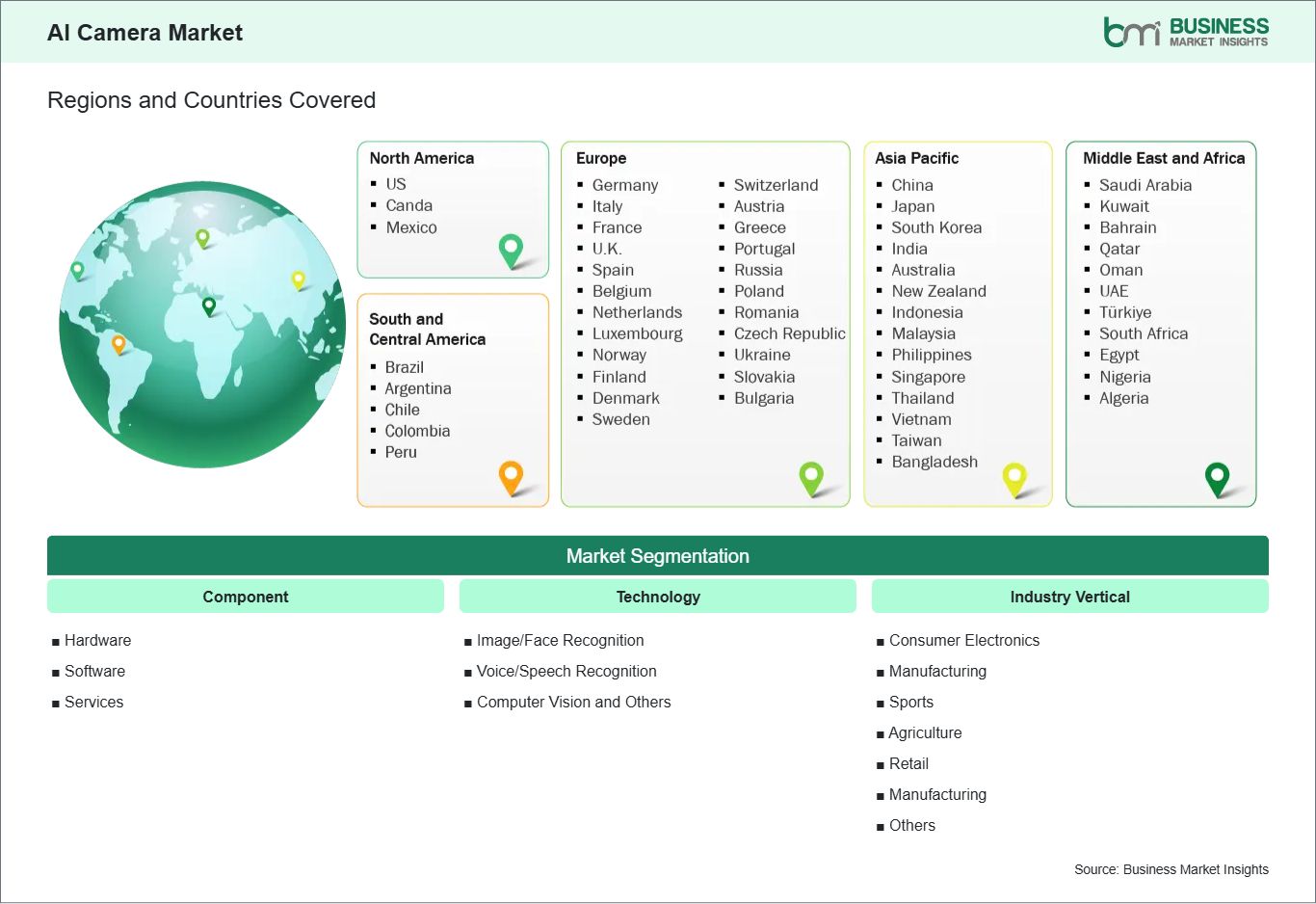
  • Component (Hardware, Software, Services)
  • Technology (Image/Face Recognition, Voice/Speech Recognition, Computer Vision and Others)
  • Industry Vertical (Consumer Electronics, Manufacturing, Sports, Agriculture, Retail, Manufacturing, and Others)

No. of Pages: 400
Report Code: BMIPUB00033244
Category: Technology, Media and Telecommunications
AI Camera Market
Buy Now

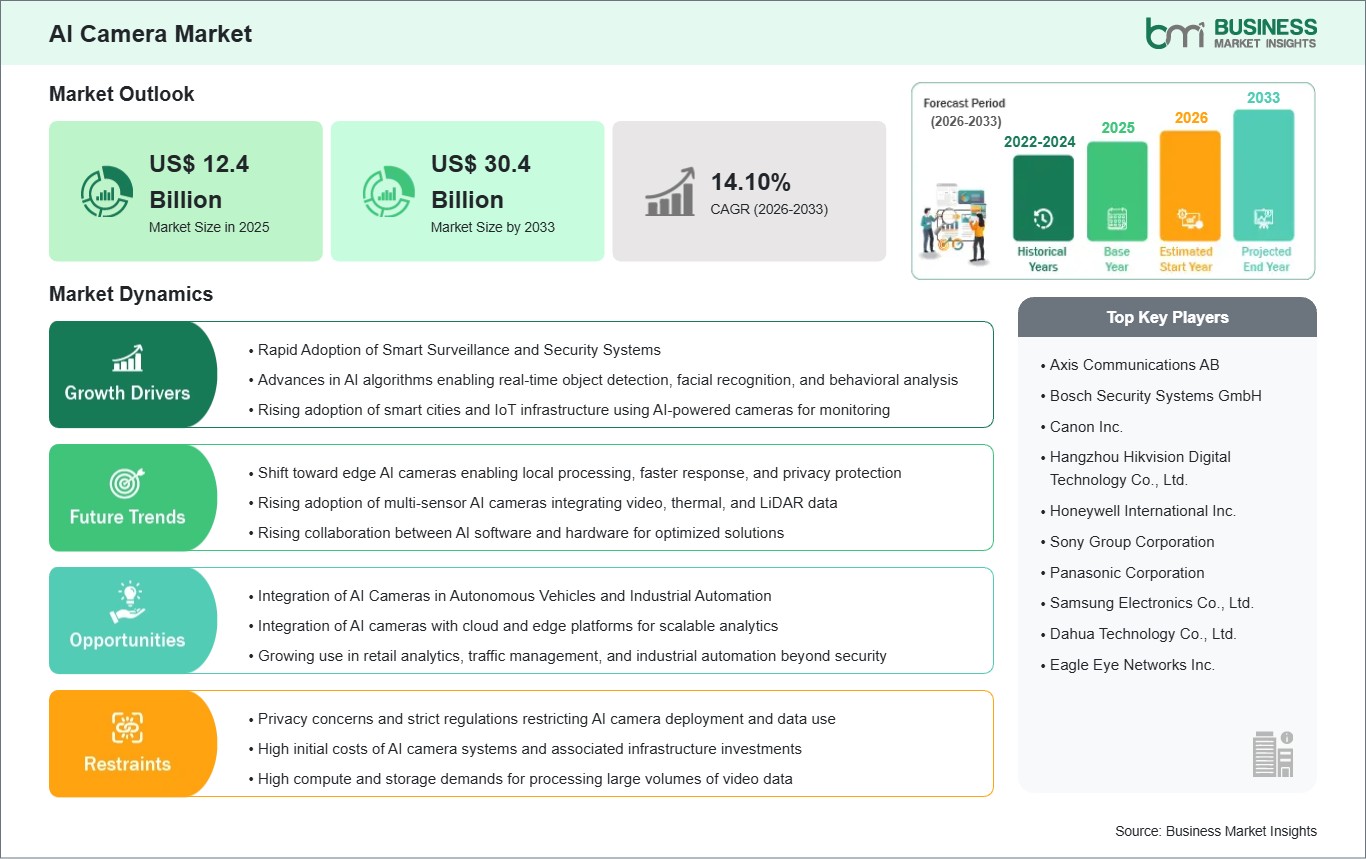
The AI Camera market size is expected to reach US$ 30.4 billion by 2033 from US$ 12.4 billion in 2025. The market is estimated to record a CAGR of 14.1% from 2026 to 2033.

Executive Summary and Global Market Analysis:

The AI Camera market is a critical enabler of next-generation imaging and intelligent vision applications across industries such as security & surveillance, automotive, consumer electronics, industrial automation, and smart cities. AI cameras combine advanced image sensors with on-device artificial intelligence and computer vision algorithms, enabling real-time object detection, facial recognition, scene analysis, and automated decision-making. These solutions are central to improving operational efficiency, enhancing safety, and supporting data-driven insights in a wide range of applications. Continuous innovation in AI processing, deep learning algorithms, and high-resolution imaging is driving the development of more capable, compact, and energy-efficient AI camera solutions. AI Cameras are at the core of managing the growing complexity of modern visual intelligence applications, including autonomous vehicles, smart surveillance networks, robotics, and industrial inspection systems. These solutions enable critical capabilities such as advanced motion detection, real-time analytics, multi-object tracking, low-light performance, and seamless integration with IoT and cloud platforms. As adoption expands across diverse sectors, robust AI-powered imaging frameworks are essential for ensuring accuracy, reliability, and scalable deployment. Several factors are driving the growth of the AI Camera market, including rising adoption of smart surveillance systems, growth in autonomous and connected vehicles, expanding use of AI in consumer electronics, and increasing demand for industrial automation and smart city solutions. Additionally, advancements in edge AI computing, high-resolution imaging, 5G connectivity, and cloud-based analytics are accelerating innovation and reducing time-to-market for AI camera solutions. Despite strong growth potential, the market faces challenges such as high initial development and deployment costs, integration complexities with existing infrastructure, data privacy concerns, and a shortage of skilled AI and computer vision professionals. Regulatory compliance across regions and cybersecurity risks associated with connected camera networks also pose additional hurdles. Nevertheless, ongoing R&D investments, strategic partnerships, and advancements in AI algorithms, sensor technology, and edge computing are expected to drive scalable growth and long-term competitiveness in the global AI Camera market.

AI Camera Market - Strategic Insights:

global-market-strategic-framework
Get more information on this report

AI Camera Market Segmentation Analysis:

Key segments that contributed to the derivation of the AI Camera market analysis are component, technology, and industry vertical.

  • By component, the AI Camera market is divided into Hardware, Software, and Services. The Hardware segment held the larger share in 2024.
  • By technology, the market is divided into Image/Face Recognition, Voice/Speech Recognition, Computer Vision and Others. The Image/Face Recognition segment held the larger share in 2024.
  • By industry vertical, the market is divided into Consumer Electronics, Manufacturing, Sports, Agriculture, Retail, Manufacturing, and Others. The consumer electronics segment held the larger share in 2024.

AI Camera Market Drivers and Opportunities:

Rapid Adoption of Smart Surveillance and Security Systems

The growing demand for enhanced safety, security, and operational monitoring is a primary driver of the AI Camera market. Governments, enterprises, and public institutions are increasingly deploying AI-powered surveillance systems to manage security risks, prevent criminal activities, and ensure real-time situational awareness. Traditional CCTV systems are rapidly being replaced with intelligent AI cameras capable of advanced features such as facial recognition, motion detection, license plate recognition, crowd analysis, and anomaly detection.

Urbanization and the rise of smart cities have further amplified the need for AI-enabled monitoring across public spaces, transportation hubs, and critical infrastructure. Businesses and industries are leveraging AI cameras to reduce manual monitoring, improve response times, and enhance overall operational efficiency. The integration of AI with edge computing and cloud-based analytics ensures faster decision-making, while reducing data transfer and storage costs. Additionally, rising regulatory compliance and safety standards in sectors such as banking, retail, and transportation are accelerating the adoption of AI camera solutions.

Integration of AI Cameras in Autonomous Vehicles and Industrial Automation

The integration of AI cameras into autonomous vehicles, industrial automation, and robotics represents a significant growth opportunity for the AI Camera market. Autonomous vehicles rely on AI-powered vision systems for real-time object detection, pedestrian recognition, lane tracking, traffic sign recognition, and adaptive decision-making, making AI cameras a critical component in ensuring safety and performance. As the automotive industry accelerates the development of advanced driver-assistance systems (ADAS) and fully autonomous vehicles, the demand for high-resolution, low-latency, and intelligent camera systems is expected to surge.

Similarly, in industrial automation, AI cameras are transforming manufacturing, logistics, and quality control by enabling automated inspection, defect detection, process optimization, and predictive maintenance. These systems reduce human error, enhance operational efficiency, and support the broader adoption of Industry 4.0 practices. Edge AI deployment in manufacturing plants allows real-time analytics without reliance on cloud connectivity, improving scalability and cost-effectiveness.

AI Camera Market Size and Share Analysis:

By component, the AI Camera market is divided into Hardware, Software, and Services. The Hardware segment held the larger share in 2024. Hardware includes image sensors, lenses, processors, and embedded AI chips that are essential for capturing and processing high-quality images and video in real time.

By technology, the market is divided into Image/Face Recognition, Voice/Speech Recognition, Computer Vision and Others. The Image/Face Recognition segment held the larger share in 2024. Image and facial recognition technologies are widely used in security surveillance, access control, and identity verification, driving demand in both consumer and enterprise applications.

By industry vertical, the market is divided into Consumer Electronics, Manufacturing, Sports, Agriculture, Retail, Manufacturing, and Others. The consumer electronics segment held the larger share in 2024. Smartphones, smart home devices, and wearable cameras are the primary contributors to this segment, driven by increasing adoption of AI-enabled imaging features, including facial recognition, gesture control, and automated photography.

AI Camera Market Report Highlights:

Report Attribute Details
Market size in 2025 US$ 12.4 Billion
Market Size by 2033 US$ 30.4 Billion
Global CAGR (2026 - 2033)14.10%
Historical Data 2022-2024
Forecast period 2026-2033
Segments Covered By Component
  • Hardware
  • Software
  • Services
By Technology
  • Image/Face Recognition
  • Voice/Speech Recognition
  • Computer Vision and Others
By Industry Vertical
  • Consumer Electronics
  • Manufacturing
  • Sports
  • Agriculture
  • Retail
  • Manufacturing
  • Others
Regions and Countries Covered North America
  • US
  • Canada
  • Mexico
Europe
  • Belgium
  • Austria
  • Finland
  • Denmark
  • Greece
  • Poland
  • Romania
  • Russia
  • Ukraine
  • Czech Republic
  • Slovakia
  • Bulgaria
  • Italy
  • Luxembourg
  • Germany
  • Switzerland
  • France
  • Netherlands
  • Norway
  • Portugal
  • Spain
  • Sweden
  • United Kingdom
Asia-Pacific
  • Australia
  • China
  • India
  • Japan
  • South Korea
  • Indonesia
  • Malaysia
  • Philippines
  • Singapore
  • Thailand
  • Vietnam
  • Bangladesh
  • New Zealand
  • Taiwan
South and Central America
  • Brazil
  • Argentina
  • Peru
  • Chile
  • Colombia
Middle East and Africa
  • Bahrain
  • Kuwait
  • Oman
  • Qatar
  • Saudi Arabia
  • United Arab Emirates
  • Turkiye
  • South Africa
  • Egypt
  • Algeria
  • Nigeria
Market leaders and key company profiles
  • Axis Communications AB
  • Bosch Security Systems GmbH
  • Canon Inc.
  • Hangzhou Hikvision Digital Technology Co., Ltd.
  • Honeywell International Inc.
  • Sony Group Corporation
  • Panasonic Corporation
  • Samsung Electronics Co., Ltd.
  • Dahua Technology Co., Ltd.
Get more information on this report

AI Camera Market Report Coverage and Deliverables:

The "AI Camera Market Size and Forecast (2022–2033)" report provides a detailed analysis of the market covering below areas:

  • AI Camera market size and forecast at global, regional, and country levels for all the key market segments covered under the scope
  • AI Camera market trends, as well as market dynamics such as drivers, restraints, and key opportunities
  • AI Camera market analysis covering key market trends, global and regional framework, major players, regulations, and recent market developments
  • Industry landscape and competition analysis covering market concentration, heat map analysis, prominent players, and recent developments for the AI Camera market
  • Detailed company profiles, including SWOT analysis

AI Camera Market Geographic Insights:

The AI Camera market is geographically segmented into North America, Asia Pacific, Europe, the Middle East & Africa, and South & Central America. Among these regions, Asia Pacific is expected to witness the strongest growth and remain a leading market throughout the forecast period, driven by rapid industrialization, expanding smart city initiatives, and increasing adoption of AI-enabled technologies across consumer electronics, automotive, manufacturing, and surveillance applications. The region benefits from large-scale electronics manufacturing capabilities, rising smartphone penetration, and government-backed digitalization programs, positioning it as a strategic hub for AI Camera development and deployment.

Within Asia Pacific, the market spans China, Japan, South Korea, India, Australia, New Zealand, Indonesia, Malaysia, the Philippines, Singapore, Thailand, Vietnam, Taiwan, Bangladesh, and the Rest of Asia. Growth in the region is supported by strong demand for AI-enabled consumer devices, industrial automation solutions, and intelligent surveillance systems. Leading economies such as China, Japan, South Korea, and India are at the forefront of integrating AI cameras in smartphones, smart homes, automotive systems, and enterprise security, leveraging advanced AI algorithms, edge computing, and cloud analytics to enhance accuracy, reliability, and real-time decision-making.

Demand for AI Cameras in Asia Pacific is further fueled by industrial automation, smart city projects, automotive and mobility applications, retail analytics, and security infrastructure. Significant investments in R&D centers, testing laboratories, AI startups, and deployment infrastructure are accelerating market growth. Additionally, public–private collaborations, government incentives for AI adoption, and workforce development programs focused on computer vision and AI technologies are strengthening the regional ecosystem.

Despite challenges such as high initial investment costs, complex integration with legacy systems, data privacy regulations, and cybersecurity risks, Asia Pacific remains strategically positioned as a global hub for AI Camera adoption, supported by efficient manufacturing supply chains, cost-competitive production, and a strong base of technology innovators and early adopters.

global-market-geography
Get more information on this report

AI Camera Market Research Report Guidance:

  • The report includes qualitative and quantitative data in the AI Camera market across component, technology, industry vertical, and geography.
  • The report starts with the key takeaways (chapter 2), highlighting the key trends and outlook of the AI Camera market.
  • Chapter 3 includes the research methodology of the study.
  • Chapter 4 further includes ecosystem analysis.
  • Chapter 5 highlights the major industry dynamics in the AI Camera market, including factors that are driving the market, prevailing deterrents, potential opportunities, as well as future trends. Impact analysis of these drivers and restraints is also covered in this section.
  • Chapter 6 discusses the AI Camera market scenario, in terms of historical market revenues, and forecast till the year 2031.
  • Chapters 7 to 10 cover AI Camera market segments by type, destination, and end user, and geography across North America, Europe, Asia Pacific, Middle East and Africa, and South and Central America. They cover the market volume revenue forecast and factors driving the market.
  • Chapter 11 describes the competitive analysis along with the heat map analysis for the key players operating in the market.
  • Chapter 12 describes the industry landscape analysis. It provides detailed descriptions of business activities such as market initiatives, new developments, mergers, and joint ventures globally, along with a competitive landscape.
  • Chapter 13 provides detailed profiles of the major companies operating in the AI Camera market. Companies have been profiled on the basis of their key facts, business descriptions, products and services, financial overview, SWOT analysis, and key developments.
  • Chapter 14, i.e., the appendix is inclusive of a brief overview of the company, list of abbreviations, and disclaimer

AI Camera Market News and Key Development:

The AI Camera market is evaluated by gathering qualitative and quantitative data post primary and secondary research, which includes important corporate publications, association data, and databases. A few of the key developments in the AI Camera market are:

  • In January 2026, VIVOTEK (3454-TW), the leading global security solution provider, announced the official launch of its Chroma24 low-light full-color AI camera series (hereafter referred to as "Chroma24"), delivering a new security experience defined by "24/7 operation, true color, and clear details." In extremely low-light nighttime environments, Chroma24 features advanced imaging, combining comprehensive upgrades to lenses and image sensors with AI-enhanced imaging technology, to deliver clear, stable, full-color images without the need for infrared or white-light illumination.
  • In July 2025, Hikvision, a global leader in the AI-powered Internet of Things (AIoT), has released a suite of next generation checkpoint cameras, traffic incident detection cameras, and servers, powered by advanced large-scale Traffic AI models. These innovative products are designed to significantly enhance detection accuracy, reduce false alarms, and improve overall traffic safety.

Key Sources Referred:

  • International Data Corporation (IDC)
  • International Telecommunication Union (ITU)
  • Institute of Electrical and Electronics Engineers (IEEE)
  • Consumer Technology Association (CTA)
  • National Institute of Standards and Technology (NIST)
  • Company website
  • Company annual reports
  • Company investor presentations

The List of Companies - AI Camera Market

  • Axis Communications AB
  • Bosch Security Systems GmbH
  • Canon Inc.
  • Hangzhou Hikvision Digital Technology Co., Ltd.
  • Honeywell International Inc.
  • Sony Group Corporation
  • Panasonic Corporation
  • Samsung Electronics Co., Ltd.
  • Dahua Technology Co., Ltd.
  • Eagle Eye Networks Inc.
Frequently Asked Questions
How big is the AI Camera Market?

The AI Camera Market is valued at US$ 12.4 Billion in 2025, it is projected to reach US$ 30.4 Billion by 2033.

What is the CAGR for AI Camera Market by (2026 - 2033)?

As per our report AI Camera Market, the market size is valued at US$ 12.4 Billion in 2025, projecting it to reach US$ 30.4 Billion by 2033. This translates to a CAGR of approximately 14.10% during the forecast period.

What segments are covered in this report?

The AI Camera Market report typically cover these key segments-

  • Component (Hardware, Software, Services)
  • Technology (Image/Face Recognition, Voice/Speech Recognition, Computer Vision and Others)
  • Industry Vertical (Consumer Electronics, Manufacturing, Sports, Agriculture, Retail, Manufacturing, and Others)

What is the historic period, base year, and forecast period taken for AI Camera Market?

The historic period, base year, and forecast period can vary slightly depending on the specific market research report. However, for the AI Camera Market report:

  • Historic Period : 2022-2024
  • Base Year : 2025
  • Forecast Period : 2026-2033
  • Who are the major players in AI Camera Market?

    The AI Camera Market is populated by several key players, each contributing to its growth and innovation. Some of the major players include:

  • Axis Communications AB
  • Bosch Security Systems GmbH
  • Canon Inc.
  • Hangzhou Hikvision Digital Technology Co., Ltd.
  • Honeywell International Inc.
  • Sony Group Corporation
  • Panasonic Corporation
  • Samsung Electronics Co., Ltd.
  • Dahua Technology Co., Ltd.
  • Eagle Eye Networks Inc.
  • Who should buy this report?

    The AI Camera Market report is valuable for diverse stakeholders, including:

    • Investors: Provides insights for investment decisions pertaining to market growth, companies, or industry insights. Helps assess market attractiveness and potential returns.
    • Industry Players: Offers competitive intelligence, market sizing, and trend analysis to inform strategic planning, product development, and sales strategies.
    • Suppliers and Manufacturers: Helps understand market demand for components, materials, and services related to concerned industry.
    • Researchers and Consultants: Provides data and analysis for academic research, consulting projects, and market studies.
    • Financial Institutions: Helps assess risks and opportunities associated with financing or investing in the concerned market.

    Essentially, anyone involved in or considering involvement in the AI Camera Market value chain can benefit from the information contained in a comprehensive market report.

    Available Report Formats

    pdf-format excel-format pptx-format
    Buy Now

    Customization Form

    Please tell us your area of interest
    (Market Segments/ Regions and Countries/ Companies)