Market Summary
Executive Summary and Global Market Analysis
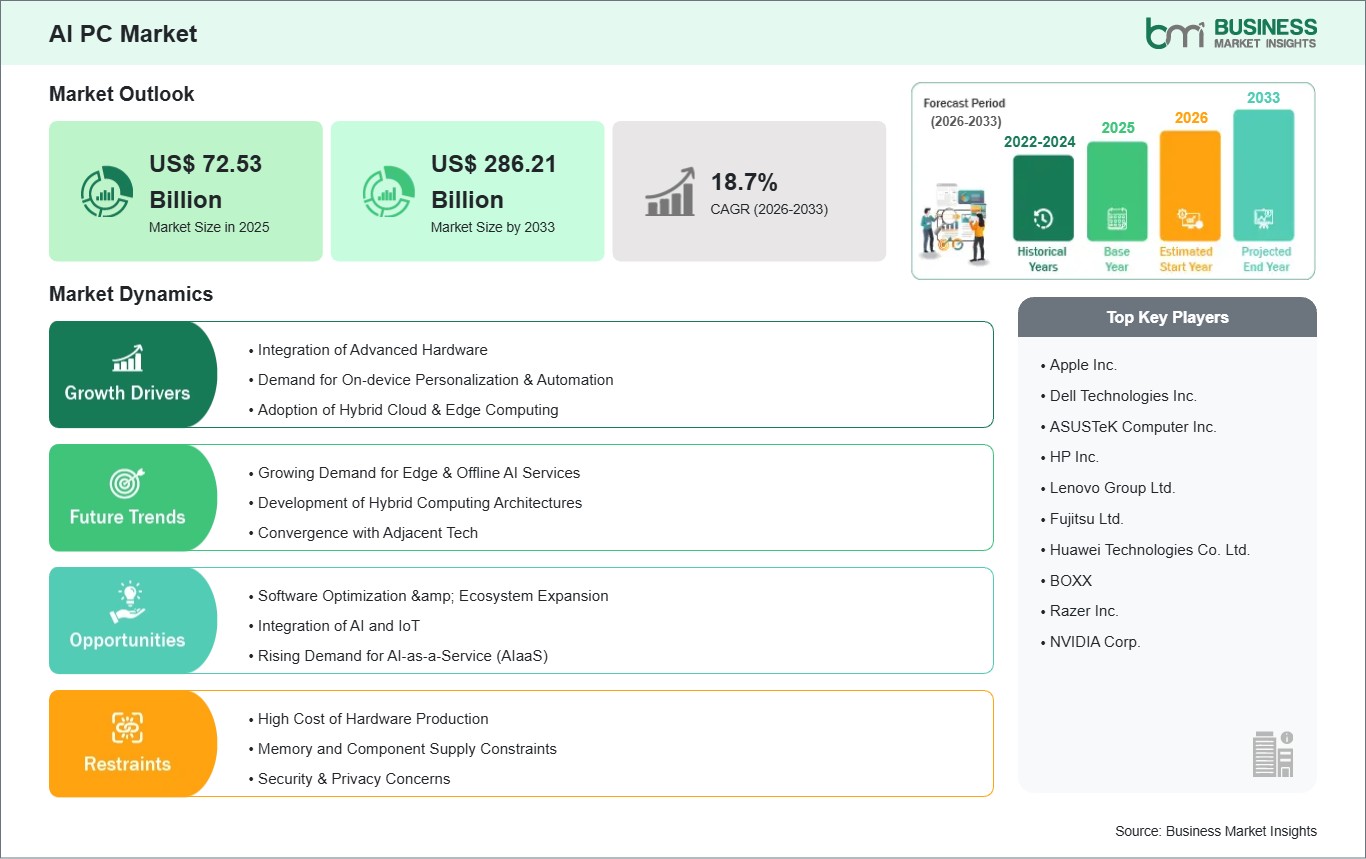
An AI PC, or Artificial Intelligence Personal Computer, refers to a computing device integrated with advanced AI capabilities that enhance performance, automation, and user experience. Unlike traditional PCs, AI PCs leverage machine learning algorithms, neural networks, and intelligent processors to perform tasks such as predictive computing, real-time data analysis, natural language processing, and automated system optimization. The usage of AI PCs spans diverse sectors, including professional creative work, gaming, scientific research, and enterprise operations. For instance, content creators benefit from AI-assisted video editing and graphics rendering, while businesses utilize AI PCs for intelligent data management and decision-making. Several demand factors are driving the growth of the AI PC market. The increasing need for high-performance computing, rising adoption of AI-powered software, and growing reliance on automation in both personal and professional workflows contribute significantly. Additionally, the proliferation of remote work and digital transformation initiatives across industries has amplified the demand for smarter, more adaptive computing solutions. Consumers and organizations increasingly seek devices that can streamline tasks, enhance productivity, and provide predictive insights, further accelerating AI PC adoption. As AI technology continues to advance, the market is expected to witness robust growth, with innovations in hardware and software driving broader accessibility and functionality.
Segment Analysis
AI PC Market Segmentation
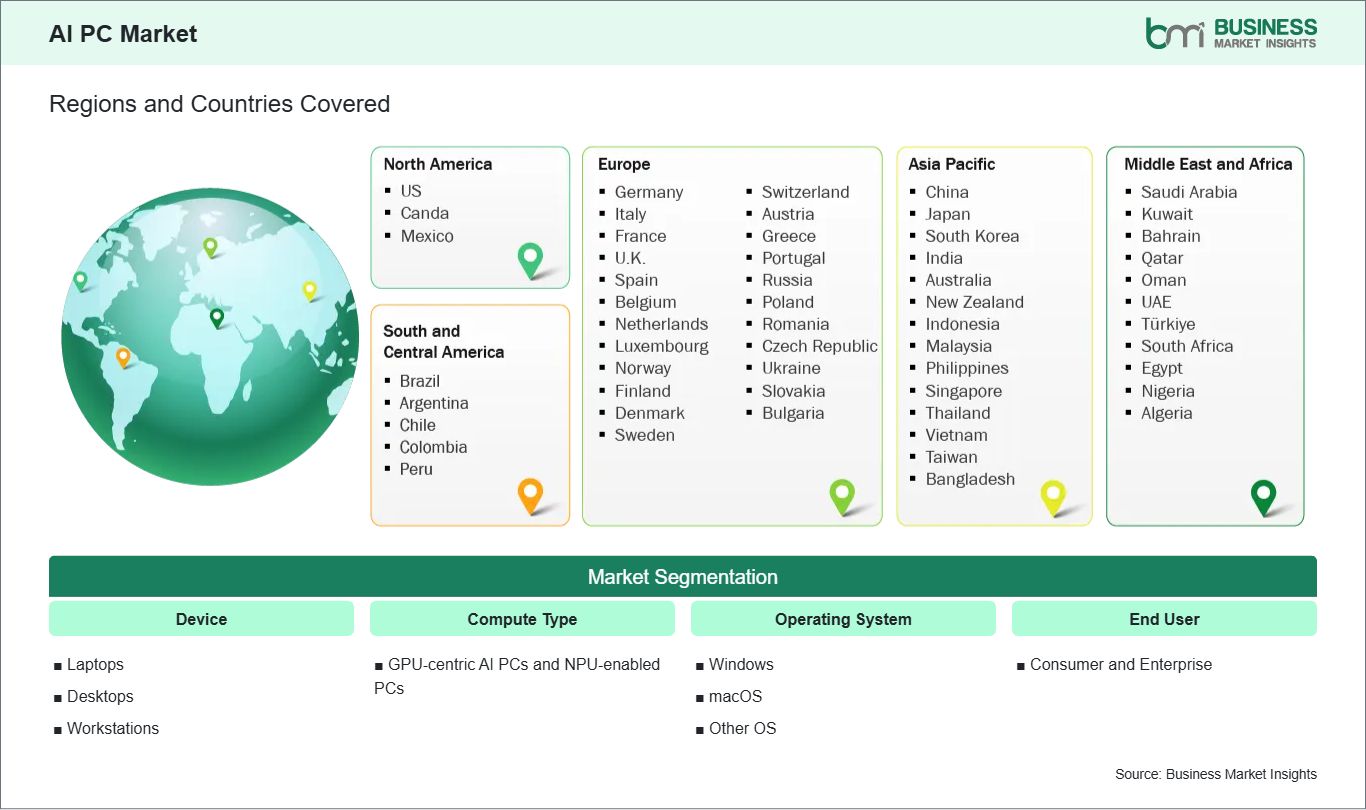
Key segments that contributed to the derivation of the AI PC market analysis are device, compute type, operating system, and end user.
- By device, the market is segmented into laptops, desktops, and workstations. The desktops segment held the largest share of the market in 2025.
- By compute type, the market is divided into GPU‑centric AI PCs and NPU‑enabled PCs. The GPU‑centric AI PCs segment held the largest share of the market in 2025.
- By operating system, the market is segmented into Windows, macOS, and others. The Windows segment held the largest share of the market in 2025.
- By end user, the market is segmented into consumer and enterprise. The enterprise segment held the largest share of the market in 2025.
Market Forces
AI PC Market Drivers and Opportunities
Integration of Advanced Hardware
Advanced hardware integration is a key driver in the AI PC market, as AI‑optimized CPUs, GPUs, and NPUs significantly enhance on‑device intelligence and performance. By embedding specialized processing units directly into personal computers, manufacturers enable faster and more efficient execution of AI tasks such as real-time inference, natural language processing, and image or voice recognition. This reduces reliance on cloud computing, lowering latency, improving privacy, and enabling seamless offline functionality. AI PCs equipped with such hardware can run complex models locally, delivering smoother experiences in applications like AI-assisted content creation, gaming, and productivity tools. The synergy between CPUs, GPUs, and NPUs ensures optimal parallel processing, accelerating both data-intensive computations and machine learning workloads. As software ecosystems increasingly leverage AI capabilities, consumer and enterprise demand for PCs with advanced AI hardware grows, positioning hardware integration as a central factor in the expanding AI PC market.
Software Optimization & Ecosystem Expansion
The growing focus on software optimization and ecosystem expansion is creating significant opportunities in the AI PC market. As AI applications become more optimized, they can leverage local processing power more efficiently, reducing reliance on cloud computing and enhancing performance for tasks like real-time data analysis, content creation, and gaming. This drives demand for PCs with more capable CPUs, GPUs, and specialized AI accelerators, prompting hardware upgrades among consumers and enterprises alike. Simultaneously, a richer AI software ecosystem encourages developers to create innovative applications that fully exploit advanced hardware, further fueling adoption. The cycle of optimized software and upgraded hardware not only boosts sales of high-performance PCs but also stimulates complementary markets, such as memory, storage, and cooling solutions. Ultimately, the synergy between AI‑ready software and upgraded hardware creates a fertile environment for growth, positioning the AI PC market as a key driver of next-generation computing experiences.
Size and Share Analysis
AI PC Market Size and Share Analysis
By device, the market is segmented into laptops, desktops, and workstations. The desktops segment held the largest share of the market in 2025. Desktop adoption fuels the AI PC market by providing powerful hardware capable of handling intensive AI workloads, encouraging innovation, enabling faster model training, and supporting AI applications for professionals and consumers alike.
By compute type, the market is divided into GPU‑centric AI PCs and NPU‑enabled PCs. The GPU‑centric AI PCs segment held the largest share of the market in 2025. The adoption of GPU‑centric AI PCs is accelerating, driven by demand for faster AI processing, real-time machine learning, and advanced graphics, positioning these systems as essential tools in the expanding AI PC market.
By operating system, the market is segmented into Windows, macOS, and others. The Windows segment held the largest share of the market in 2025. The rising adoption of GPU‑centric AI PCs is driven by growing demand for accelerated AI workloads, enhanced deep learning performance, real-time data processing, creative content generation, and advanced machine learning model training.
By end user, the market is segmented into consumer and enterprise. The enterprise segment held the largest share of the market in 2025. Enterprises are increasing AI-powered PCs to enhance productivity, enable faster data analysis, support advanced machine learning applications, improve decision-making, automate repetitive tasks, and maintain competitive advantage in a technology-driven market.
Report Coverage
AI PC Market Report Coverage and Deliverables
The "AI PC Market Size and Forecast (2022–2033)" report provides a detailed analysis of the market covering below areas:
- AI PC market size and forecast at global, regional, and country levels for all the key market segments covered under the scope
- AI PC market trends, as well as market dynamics such as drivers, restraints, and key opportunities
- AI PC market analysis covering key market trends, global and regional framework, major players, regulations, and recent market developments
- Industry landscape and competition analysis covering market concentration, heat map analysis, prominent players, and recent developments for the AI PC market
- Detailed company profiles, including SWOT analysis
Geographic Insights
AI PC Market Geographic Insights
The geographical scope of the AI PC market report is divided into five regions: North America, Asia Pacific, Europe, Middle East & Africa, and South & Central America. The AI PC market in Asia Pacific is expected to grow significantly during the forecast period.
The Asia Pacific AI PC market is segmented into China, Japan, South Korea, India, Australia, New Zealand, Indonesia, Malaysia, the Philippines, Singapore, Thailand, Vietnam, Taiwan, Bangladesh, and the Rest of Asia. The increasing demand for and adoption of AI-powered personal computers (AI PCs) in the Asia Pacific region can be attributed to several key factors. Rapid digital transformation across industries is driving the need for advanced computing solutions capable of handling AI-driven tasks such as data analysis, machine learning, and automation. Consumers are increasingly seeking devices that enhance productivity, gaming experiences, and creative workflows through AI-assisted features like intelligent voice recognition, automated photo editing, and predictive system optimization. The region’s growing tech-savvy population, rising disposable incomes, and expanding e-commerce ecosystem are further fueling adoption. Additionally, governments in Asia Pacific are investing heavily in AI research, smart city initiatives, and digital infrastructure, creating an environment conducive to AI PC integration. The combination of technological innovation, consumer demand for smarter devices, and supportive policy frameworks is positioning AI PCs as an essential tool for both personal and professional use across the region.
Industry Activity
Recent Developments
The AI PC market is evaluated by gathering qualitative and quantitative data post primary and secondary research, which includes important corporate publications, association data, and databases. A few of the key developments in the AI PC market are:
- In January 2026, HP Inc. unveiled the HP EliteBoard G1a Next Gen AI PC, a CES 2026 Innovation Award Honoree and the world’s first full AI PC built into a keyboard4 —powering the future of work with a design that moves, connects, and adapts to any workspace. To complement this evolution of the desk, HP also introduced the newest HP Series 7 Pro 4K Monitor, pushing the boundaries for visual fidelity and flawless performance for the most demanding professional users.
- In January 2026, At CES 2026, Intel launched the Intel Core Ultra Series 3 processors, the first compute platform built on Intel 18A - the most advanced semiconductor process ever developed and manufactured in the United States.
Trust & Transparency
Research Methodology
The market analysis combines proprietary research with secondary data from government agencies, company disclosures, regulatory filings, industry databases and expert interviews. Market estimates are validated through data triangulation, cross-market benchmarking and analyst
review.
View Full Research Methodology
Key Sources Referred:
World Bank – Global Trade IndicatorsWorld Trade Organization (WTO)International Monetary Fund (IMF)International Trade Administration (ITA)Company websiteCompany annual reportsCompany investor presentations